United States Fatty Alcohol Market Year-wise Growth Rate (2021-2031F)
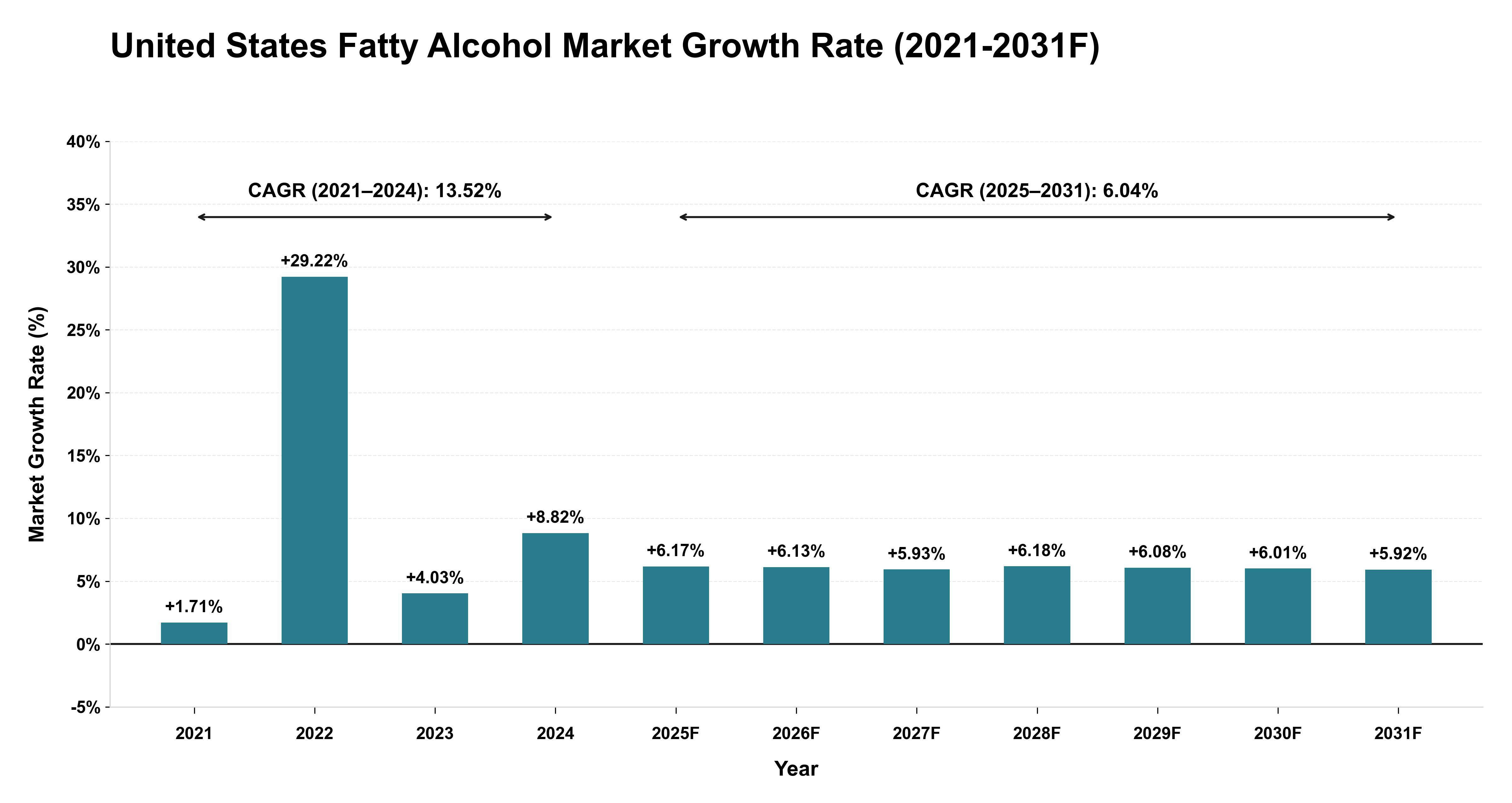
The United States Fatty Alcohol Market experienced a notable upsurge from 2021 to 2024, with a robust historical CAGR of 13.52%. This growth trajectory was characterized by moderate initial growth in 2021 (1.71%), followed by a substantial spike in 2022 (29.22%), indicating shifting consumer preferences or technological advancements driving demand. The market maintained positive momentum through 2024, with steady growth rates of 4.03% and 8.82% in 2023 and 2024, respectively, suggesting increased industrial applications or regulatory changes favoring the sector. Looking ahead to the forecast period of 2025-2031, the market is expected to stabilize with a lower CAGR of 6.04%, indicating a more mature phase with sustainable growth driven by established end-use industries and stable supply chain dynamics, ensuring continued demand for fatty alcohols in various sectors like personal care, pharmaceuticals, and chemicals.
United States (US) Fatty Alcohol Market Synopsis
The United States fatty alcohol market is a dynamic and growing sector driven by a wide range of applications including personal care products, pharmaceuticals, and industrial processes. Fatty alcohols are widely used in the production of surfactants, emollients, and lubricants due to their excellent properties such as emulsifying, thickening, and moisturizing capabilities. The increasing demand for natural and organic ingredients in personal care products is fueling the growth of the fatty alcohol market in the US, with consumers seeking products that are sustainable and environmentally friendly. Key players in the US fatty alcohol market include Sasol, BASF SE, and Ecogreen Oleochemicals, among others. Factors such as technological advancements, shifting consumer preferences, and regulatory support for sustainable ingredients are expected to drive further growth in the US fatty alcohol market.
United States (US) Fatty Alcohol Market Trends
In the United States, the fatty alcohol market is experiencing several notable trends. One key trend is the growing demand for natural and sustainable ingredients in personal care and cosmetic products, leading to an increased interest in plant-derived fatty alcohols such as cetyl alcohol and stearyl alcohol. Additionally, there is a rising preference for fatty alcohols in the production of eco-friendly surfactants and emollients due to their mildness and conditioning properties. The market is also witnessing a shift towards the development of innovative formulations incorporating multifunctional fatty alcohols that offer benefits such as moisturization, emulsification, and thickening. Overall, the US fatty alcohol market is adapting to consumer preferences for clean label products and sustainable solutions, driving manufacturers to explore new applications and sources for fatty alcohols.
United States (US) Fatty Alcohol Market Challenges
In the US Fatty Alcohol Market, challenges such as fluctuating raw material prices, increasing competition from alternative products like synthetic alcohols, and stringent regulatory requirements pose significant hurdles for industry players. Additionally, the market is heavily influenced by global economic conditions and trade policies, which can impact both supply chain dynamics and pricing strategies. Companies in this sector must also navigate evolving consumer preferences towards sustainable and eco-friendly products, driving the need for innovation and investment in green technologies. Overall, maintaining profitability while adapting to changing market dynamics and ensuring compliance with regulatory standards remain key challenges for participants in the US Fatty Alcohol Market.
United States (US) Fatty Alcohol Market Investment Opportunities
The United States Fatty Alcohol Market offers diverse investment opportunities due to the growing demand for fatty alcohols in various industries such as personal care, pharmaceuticals, and chemicals. With the increasing trend towards natural and sustainable products, there is a rising demand for fatty alcohols derived from renewable sources like palm oil and coconut oil. Investing in companies involved in the production, processing, or distribution of fatty alcohols can be lucrative. Additionally, innovations in the production processes, such as the development of bio-based fatty alcohols, present a promising growth area. Investors can also explore opportunities in research and development of new applications for fatty alcohols, as well as strategic partnerships with key players in the market to capitalize on the expanding opportunities in the US Fatty Alcohol Market.
Jordan Agar Market Government Policies
The US government regulates the fatty alcohol market through various policies focused on ensuring product safety, environmental sustainability, and fair competition. The Food and Drug Administration (FDA) oversees the safety and labeling requirements for fatty alcohols used in personal care products. The Environmental Protection Agency (EPA) sets limits on emissions and waste disposal related to fatty alcohol production to protect the environment. Additionally, the Federal Trade Commission (FTC) enforces antitrust laws to prevent monopolies and promote fair market competition among fatty alcohol producers. Overall, government policies play a crucial role in shaping the regulatory landscape of the US fatty alcohol market to safeguard consumer health, environmental well-being, and market competitiveness.
United States (US) Fatty Alcohol Market Future Outlook
The United States fatty alcohol market is poised for steady growth in the coming years, driven by increasing demand from personal care and pharmaceutical industries. The market is expected to benefit from the rising awareness regarding the benefits of natural and organic ingredients in personal care products, as well as the growing popularity of specialty fatty alcohols for pharmaceutical applications. Additionally, the expanding use of fatty alcohols in the production of surfactants, lubricants, and other industrial applications is anticipated to further propel market growth. With a focus on sustainability and eco-friendly products gaining momentum, manufacturers are likely to invest in research and development to innovate and offer more environmentally friendly fatty alcohol products, which will contribute to the overall growth of the market.
Key Highlights of the Report:
- United States (US) Fatty Alcohol Market Outlook
- Market Size of United States (US) Fatty Alcohol Market, 2021
- Forecast of United States (US) Fatty Alcohol Market, 2031
- Historical Data and Forecast of United States (US) Fatty Alcohol Revenues & Volume for the Period 2018 - 2031
- United States (US) Fatty Alcohol Market Trend Evolution
- United States (US) Fatty Alcohol Market Drivers and Challenges
- United States (US) Fatty Alcohol Price Trends
- United States (US) Fatty Alcohol Porter's Five Forces
- United States (US) Fatty Alcohol Industry Life Cycle
- Historical Data and Forecast of United States (US) Fatty Alcohol Market Revenues & Volume By Product for the Period 2018 - 2031
- Historical Data and Forecast of United States (US) Fatty Alcohol Market Revenues & Volume By C6-C10 for the Period 2018 - 2031
- Historical Data and Forecast of United States (US) Fatty Alcohol Market Revenues & Volume By C11-C14 for the Period 2018 - 2031
- Historical Data and Forecast of United States (US) Fatty Alcohol Market Revenues & Volume By C15-C22 for the Period 2018 - 2031
- Historical Data and Forecast of United States (US) Fatty Alcohol Market Revenues & Volume By Application for the Period 2018 - 2031
- Historical Data and Forecast of United States (US) Fatty Alcohol Market Revenues & Volume By Soaps & Detergents for the Period 2018 - 2031
- Historical Data and Forecast of United States (US) Fatty Alcohol Market Revenues & Volume By Personal Care for the Period 2018 - 2031
- Historical Data and Forecast of United States (US) Fatty Alcohol Market Revenues & Volume By Lubricants for the Period 2018 - 2031
- Historical Data and Forecast of United States (US) Fatty Alcohol Market Revenues & Volume By Amines for the Period 2018 - 2031
- Historical Data and Forecast of United States (US) Fatty Alcohol Market Revenues & Volume By Others for the Period 2018 - 2031
- United States (US) Fatty Alcohol Import Export Trade Statistics
- Market Opportunity Assessment By Product
- Market Opportunity Assessment By Application
- United States (US) Fatty Alcohol Top Companies Market Share
- United States (US) Fatty Alcohol Competitive Benchmarking By Technical and Operational Parameters
- United States (US) Fatty Alcohol Company Profiles
- United States (US) Fatty Alcohol Key Strategic Recommendations






































