United States (US) Gift Packaging Market Summary
The united states (us) gift packaging market was estimated at USD 210 Million in 2025 and is projected to reach USD 246 Million by 2032, growing at a CAGR of 2.7% from 2026 to 2032.
United States (US) Gift Packaging Market Year-wise Growth Rate and Key Drivers
This graph highlights how the United States (US) Gift Packaging Market has steadily grown over the past five years, supported by major growth factors.
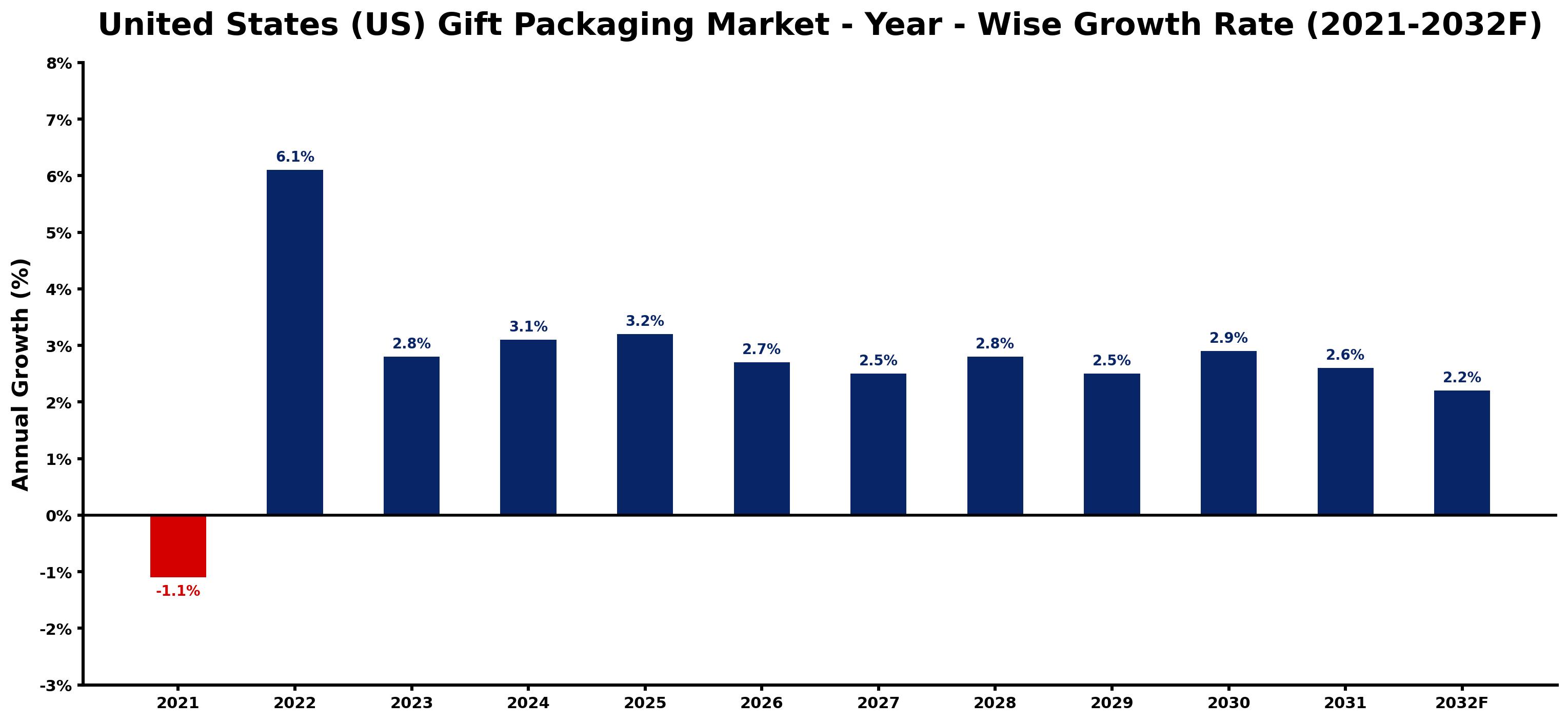
The table below presents the year wise growth rates along with the key drivers influencing the market
| Year | Growth Rate | Major Drivers |
| 2021 | -1.1% | Increased emphasis on sustainability led to a shift away from traditional gift packaging options. |
| 2022 | 6.1% | E-commerce boom significantly increased demand for attractive and functional packaging solutions. |
| 2023 | 2.8% | Sustainability trends encouraged brands to adopt recyclable and biodegradable packaging materials. |
| 2024 | 3.1% | Innovations in printing technology enhanced customization capabilities for gift packaging designs. |
| 2025 | 3.2% | Digital marketing strategies highlighted the importance of visual presentation in e-gifting. |
| 2026 | 2.7% | Increased disposable income motivated consumers to invest in premium packaging experiences. |
| 2027 | 2.5% | Brand collaborations with artists and designers redefined the aesthetic of gift packaging. |
| 2028 | 2.8% | Cultural shifts placed greater emphasis on experiences, boosting demand for gift-related products. |
| 2029 | 2.5% | Retailers integrated packaging solutions that enhance the unboxing experience for customers. |
| 2030 | 2.9% | Technological advancements in supply chain logistics improved delivery times for packaging supplies. |
| 2031 | 2.6% | Consumer educational campaigns promoted awareness of eco-friendly packaging benefits and options. |
| 2032 | 2.2% | Global events and trends continued to influence seasonal demand fluctuations in packaging styles. |
Note - Market size estimations and growth projections presented in this report are based on 6Wresearch's advanced forecasting approach, validated with industry datasets as of June 2026.
United States (US) Gift Packaging Market Synopsis
The United States (US) Gift Packaging Market is projected to reach 2.7% and witness significant growth during the forecast period (2026-2032). This dynamic sector is characterized by a broad range of products, including gift bags, wrapping paper, boxes, ribbons, and bows, designed to cater to various occasions such as birthdays, holidays, weddings, and corporate events. Consumers increasingly favor aesthetically pleasing and personalized packaging solutions, which drive market growth.
United States (US) Gift Packaging Market Growth Drivers
Several factors are propelling the growth of the United States (US) Gift Packaging Market. Firstly, the rise in e-commerce has significantly influenced consumer expectations for attractive and convenient packaging options. Secondly, an increasing preference for eco-friendly and sustainable packaging solutions is reshaping product offerings, as consumers become more aware of environmental issues. Thirdly, the ongoing trend towards personalization allows consumers to create unique gifting experiences, fostering brand loyalty. Fourthly, the expansion of retail channels, including online platforms, has increased accessibility to gift packaging products, accommodating diverse consumer needs. Finally, seasonal and event-driven gifting occasions continue to spur demand for innovative packaging solutions, providing additional momentum for market growth.
United States (US) Gift Packaging Market Trends and Opportunities
The United States (US) Gift Packaging Market is witnessing transformational trends, particularly in sustainability, personalization, and luxury offerings. Eco-conscious consumers are driving demand for biodegradable and recyclable materials, leading companies to innovate in their product lines. Customization options are also evolving, with businesses offering tailored designs and messages that enhance the unboxing experience. In addition, premium packaging options are gaining traction, appealing to consumers looking for elegance and sophistication in their gifts. Moreover, with the proliferation of subscription box services, there are extensive opportunities for specialized packaging designs that cater to recurring gifting needs. Overall, companies that effectively leverage these trends are likely to achieve a competitive advantage in this dynamic market.
United States (US) Gift Packaging Market Challenges and Restraints
While the United States (US) Gift Packaging Market is poised for growth, it faces significant challenges. Firstly, the increasing competition from online retailers and e-commerce platforms has raised the bar for traditional retailers, leading them to enhance their packaging offerings. Secondly, evolving consumer preferences for sustainable packaging materials may strain companies that rely on conventional raw materials. Thirdly, the volatility of raw material prices, such as paper and plastics, presents ongoing challenges for manufacturers, impacting profitability. Fourthly, regulatory pressures regarding environmental sustainability and packaging safety requirements necessitate that companies invest in compliance measures. Lastly, the shift towards minimalism in packaging can challenge producers to balance aesthetic appeal with functionality without incurring excessive costs.
United States (US) Gift Packaging Market Investment Opportunities
The United States (US) Gift Packaging Market offers extensive investment opportunities driven by changing consumer dynamics. Investors can focus on developing and supplying eco-friendly packaging materials, which are increasingly in demand as consumers become more environmentally aware. Furthermore, custom packaging solutions can cater to the growing preference for personalized gifting experiences, allowing companies to command premium pricing. Technology-driven innovations, such as augmented reality features in packaging, offer novel experiences that can capture consumer interest. The emergence of luxury gift packaging provides avenues for investment in high-end materials and designs that appeal to affluent consumers. Additionally, partnerships with emerging artists and designers to create unique packaging can attract consumers looking for distinctive and memorable gift options.
United States (US) Gift Packaging Market Government Investment and Initiatives
Government policies play a significant role in shaping the landscape of the United States (US) Gift Packaging Market. Regulatory bodies enforce standards to ensure the safety and compliance of packaging materials, particularly those related to food and beverages under the jurisdiction of the Food and Drug Administration (FDA). The Federal Trade Commission (FTC) regulates advertising practices to prevent misleading claims regarding packaging. Additionally, the Environmental Protection Agency (EPA) is crucial in promoting sustainability by regulating packaging materials to reduce environmental impact. Public spending is increasingly directed toward initiatives that support sustainable practices, encouraging manufacturers to adopt innovative solutions that align with environmental objectives. Collectively, these regulations and initiatives help safeguard consumer interests while enabling sustainable growth in the gift packaging sector.
United States (US) Gift Packaging Market Latest Developments (May 2025 - June 2026)
Recent developments in the United States (US) Gift Packaging Market indicate a shift towards increased sustainability and innovation. During this period, there has been a notable increase in consumer demand for recyclable and biodegradable materials, spurring manufacturers to invest in eco-friendly packaging solutions. Customization trends have also gained momentum, with companies emphasizing personalized designs and unique unboxing experiences. Additionally, as e-commerce continues to expand, businesses are adapting their packaging strategies to offer convenience and aesthetic appeal for online shoppers. The market has witnessed a rise in collaborations between packaging manufacturers and technology firms to create interactive and engaging packaging experiences. Overall, the industry is navigating these developments by focusing on sustainability, customization, and technological integration.
United States (US) Gift Packaging Market - Key Attractiveness of the Report
- 10 Years of Market Numbers
- Historical Data Starting from 2022 to 2025
- Base Year: 2025
- Forecast Data until 2032
- Key Performance Indicators Impacting the Market
- Major Upcoming Developments and Projects
Key Highlights of the Report:
- United States (US) Gift Packaging Market Outlook
- Market Size of United States (US) Gift Packaging Market, 2025
- Forecast of United States (US) Gift Packaging Market, 2032F
- Historical Data and Forecast of United States (US) Gift Packaging Revenues & Volume for the Period 2022-2032F
- United States (US) Gift Packaging Market Trend Evolution
- United States (US) Gift Packaging Market Drivers and Challenges
- United States (US) Gift Packaging Price Trends
- United States (US) Gift Packaging Porter's Five Forces
- United States (US) Gift Packaging Industry Life Cycle
- Historical Data and Forecast of United States (US) Gift Packaging Market Revenues & Volume By Types for the Period 2022-2032F
- Historical Data and Forecast of United States (US) Gift Packaging Market Revenues & Volume By Primary Gift Packaging for the Period 2022-2032F
- Historical Data and Forecast of United States (US) Gift Packaging Market Revenues & Volume By Secondary Gift Packaging for the Period 2022-2032F
- Historical Data and Forecast of United States (US) Gift Packaging Market Revenues & Volume By Applications for the Period 2022-2032F
- Historical Data and Forecast of United States (US) Gift Packaging Market Revenues & Volume By Personal for the Period 2022-2032F
- Historical Data and Forecast of United States (US) Gift Packaging Market Revenues & Volume By Commercial for the Period 2022-2032F
- United States (US) Gift Packaging Import Export Trade Statistics
- Market Opportunity Assessment By Types
- Market Opportunity Assessment By Applications
- United States (US) Gift Packaging Top Companies Market Share
- United States (US) Gift Packaging Competitive Benchmarking By Technical and Operational Parameters
- United States (US) Gift Packaging Company Profiles
- United States (US) Gift Packaging Key Strategic Recommendations






































