United States (US) Glufosinate Market Top 5 Importing Countries and Market Competition (HHI) Analysis
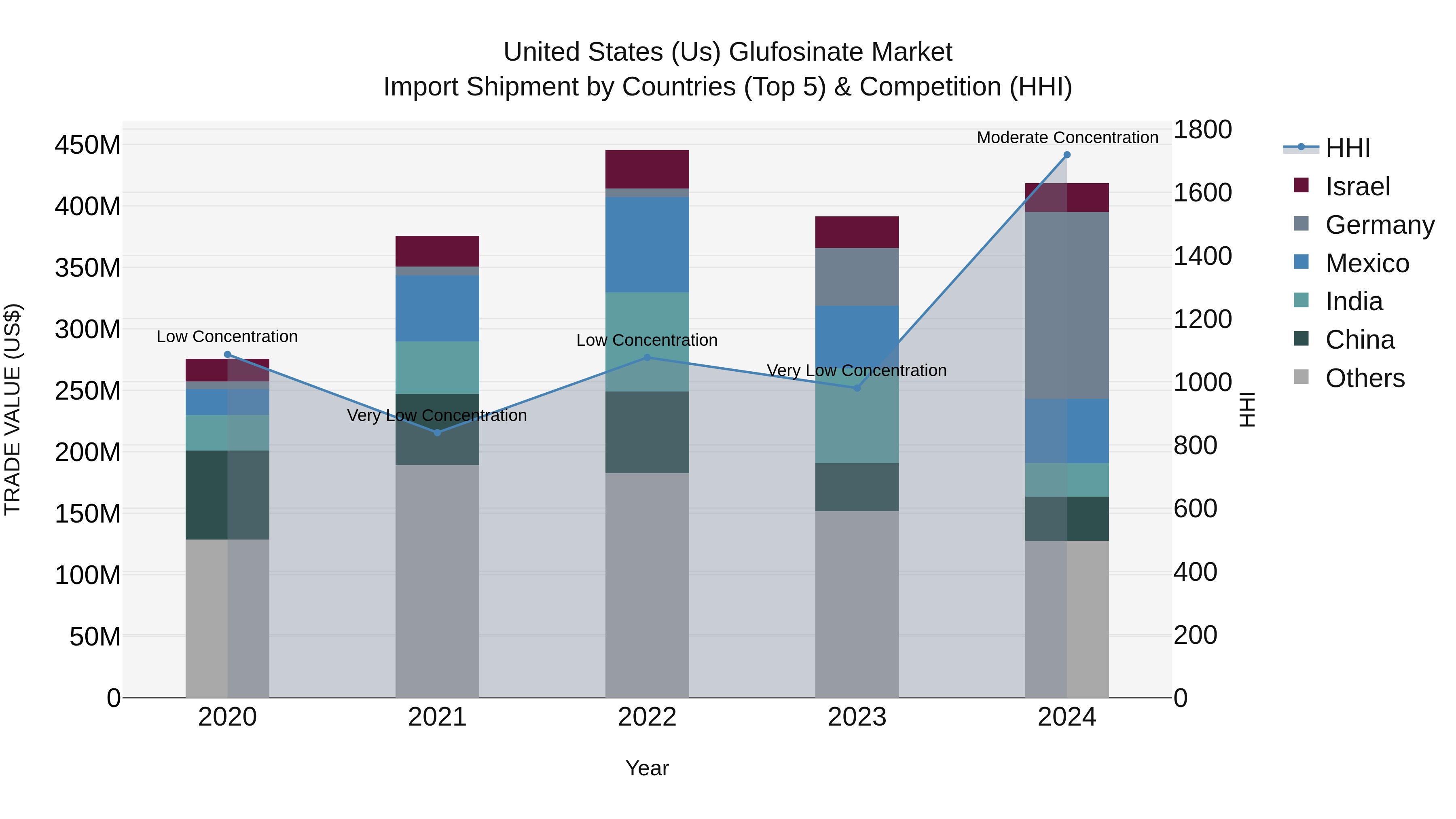
The United States saw a notable increase in glufosinate import shipments in 2024, with top exporting countries being Germany, Mexico, China, India, and Israel. The market exhibited a shift from low to moderate concentration, indicating a more competitive landscape. With a strong compound annual growth rate of 10.99% from 2020 to 2024 and a growth rate of 6.85% in 2024, the glufosinate market in the US continues to show promise for both domestic and international suppliers. The diversification of sources signals resilience and adaptability within the industry.
United States (US) Glufosinate Market Synopsis
The United States Glufosinate market is experiencing steady growth driven by the increasing demand for effective herbicides to manage weed resistance in crops such as corn, soybeans, and cotton. Glufosinate, a non-selective herbicide, is widely used due to its effectiveness in controlling a broad spectrum of weeds. The market is also influenced by the rising adoption of genetically modified (GM) crops that are engineered to be resistant to Glufosinate. Key players in the US Glufosinate market include Bayer CropScience, Corteva Agriscience, and BASF. Regulatory approvals for new formulations and increasing investments in research and development activities are expected to further propel the market growth. However, environmental concerns and stringent regulations regarding herbicide usage pose challenges for market expansion in the US.
United States (US) Glufosinate Market Trends
The United States Glufosinate market is experiencing steady growth due to the increasing adoption of genetically modified (GM) crops that are resistant to the herbicide. This trend is driving the demand for Glufosinate as a key tool in the management of resistant weeds. Additionally, the growing focus on sustainable agriculture practices and environmental concerns are pushing farmers towards herbicides with lower environmental impact, further boosting the market for Glufosinate. Opportunities in the US Glufosinate market lie in the development of new formulations and application technologies to improve efficacy and reduce environmental impact. Companies that can provide innovative solutions to address weed resistance issues and offer sustainable alternatives are well-positioned to capitalize on the evolving market trends.
United States (US) Glufosinate Market Challenges
In the US Glufosinate market, some challenges include increasing regulatory scrutiny due to environmental and health concerns associated with the use of herbicides containing Glufosinate. There is also growing competition from alternative herbicides and genetically modified crops that are resistant to other herbicides, reducing the demand for Glufosinate-based products. Additionally, resistance development in weeds to Glufosinate poses a significant challenge for farmers, leading to decreased effectiveness of the herbicide over time. Economic factors such as fluctuating prices of agricultural commodities and input costs can also impact the demand for Glufosinate products. Overall, navigating through these challenges requires continuous innovation, effective marketing strategies, and close monitoring of regulatory developments in the US agricultural sector.
United States (US) Glufosinate Market Investment Opportunities
The United States Glufosinate market is primarily driven by the increasing demand for herbicides in the agriculture sector. Farmers are adopting Glufosinate-based products due to their effectiveness in controlling a wide range of weeds, including glyphosate-resistant weeds. The growing trend towards sustainable farming practices and the need for alternative weed control solutions are also fueling the market growth. Additionally, the rising awareness about the environmental and health risks associated with certain herbicides is leading to a shift towards safer and more eco-friendly options like Glufosinate. Government regulations promoting the use of environmentally friendly products are further boosting the market. Overall, the US Glufosinate market is expected to witness significant growth in the coming years driven by these factors.
United States (US) Glufosinate Market Government Polices
The United States (US) Glufosinate Market is primarily regulated by the Environmental Protection Agency (EPA) under the Federal Insecticide, Fungicide, and Rodenticide Act (FIFRA). Glufosinate is approved for use as a herbicide in agricultural and non-agricultural settings. The EPA sets maximum residue limits for glufosinate on crops to ensure food safety and conducts risk assessments to evaluate the potential impact on human health and the environment. Additionally, the US Department of Agriculture (USDA) monitors pesticide residues in food through the Pesticide Data Program (PDP) to ensure compliance with safety standards. Overall, government policies aim to regulate the use of glufosinate to protect public health and the environment while supporting agricultural productivity.
United States (US) Glufosinate Market Future Outlook
The future outlook for the United States Glufosinate market appears promising, driven by the increasing demand for herbicides to enhance agricultural productivity. Factors such as the growing adoption of genetically modified crops, rising awareness about sustainable farming practices, and the need for effective weed management solutions are expected to fuel market growth. Additionally, the shift towards eco-friendly and less toxic alternatives to traditional herbicides is likely to create opportunities for innovative Glufosinate-based products. However, regulatory challenges and the emergence of alternative weed control methods could pose some challenges to market expansion. Overall, with advancements in agricultural technology and a focus on sustainable practices, the US Glufosinate market is anticipated to witness steady growth in the coming years.
Key Highlights of the Report:
- United States (US) Glufosinate Market Outlook
- Market Size of United States (US) Glufosinate Market, 2024
- Forecast of United States (US) Glufosinate Market, 2031
- Historical Data and Forecast of United States (US) Glufosinate Revenues & Volume for the Period 2021 - 2031
- United States (US) Glufosinate Market Trend Evolution
- United States (US) Glufosinate Market Drivers and Challenges
- United States (US) Glufosinate Price Trends
- United States (US) Glufosinate Porter's Five Forces
- United States (US) Glufosinate Industry Life Cycle
- Historical Data and Forecast of United States (US) Glufosinate Market Revenues & Volume By Crop Type for the Period 2021 - 2031
- Historical Data and Forecast of United States (US) Glufosinate Market Revenues & Volume By Genetically Modified Crops for the Period 2021 - 2031
- Historical Data and Forecast of United States (US) Glufosinate Market Revenues & Volume By Conventional Crops for the Period 2021 - 2031
- Historical Data and Forecast of United States (US) Glufosinate Market Revenues & Volume By Form for the Period 2021 - 2031
- Historical Data and Forecast of United States (US) Glufosinate Market Revenues & Volume By Liquid Formulation for the Period 2021 - 2031
- Historical Data and Forecast of United States (US) Glufosinate Market Revenues & Volume By Dry Formulation for the Period 2021 - 2031
- Historical Data and Forecast of United States (US) Glufosinate Market Revenues & Volume By Application for the Period 2021 - 2031
- Historical Data and Forecast of United States (US) Glufosinate Market Revenues & Volume By Agricultural for the Period 2021 - 2031
- Historical Data and Forecast of United States (US) Glufosinate Market Revenues & Volume By Non Agricultural for the Period 2021 - 2031
- United States (US) Glufosinate Import Export Trade Statistics
- Market Opportunity Assessment By Crop Type
- Market Opportunity Assessment By Form
- Market Opportunity Assessment By Application
- United States (US) Glufosinate Top Companies Market Share
- United States (US) Glufosinate Competitive Benchmarking By Technical and Operational Parameters
- United States (US) Glufosinate Company Profiles
- United States (US) Glufosinate Key Strategic Recommendations






































