United States (US) Hafnium Market Size, Share & Growth Rate
The United States (US) Hafnium Market was estimated at USD 121 Million in 2025 and is projected to reach USD 142 Million by 2032, growing at a CAGR of 2.3% from 2026 to 2032. This trajectory is primarily driven by the increasing applications of hafnium in aerospace, electronics, and nuclear industries. As technological advancements continue to unfold, particularly in semiconductor manufacturing, the demand for hafnium is poised to expand significantly.
United States (US) Hafnium Market Year-wise Growth Rate and Key Drivers
This graph highlights how the United States (US) Hafnium Market has steadily grown over the years, supported by major growth factors.
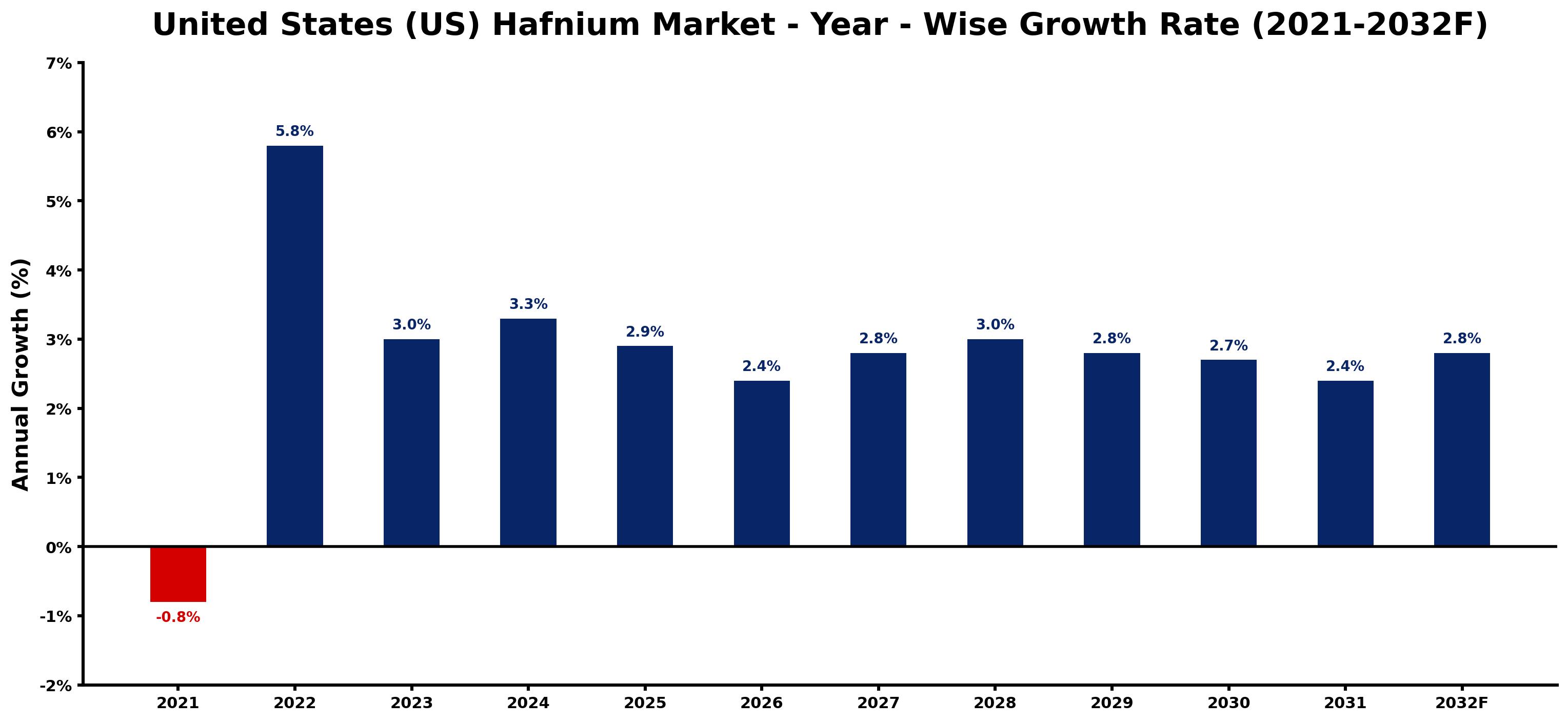
The table below presents the year‑wise growth rates along with the key drivers influencing the market
| Year | Growth Rate | Major Drivers |
| 2021 | -0.8% | decreased investment in manufacturing sectors |
| 2022 | 5.8% | increased demand from aerospace industry |
| 2023 | 3.0% | growing applications in electronics sector |
| 2024 | 3.3% | expansion of renewable energy projects |
| 2025 | 2.9% | rising interest in advanced materials |
| 2026 | 2.4% | growth in defense technology applications |
| 2027 | 2.8% | increased research in medical technologies |
| 2028 | 3.0% | increased pharmaceutical industry usage |
| 2029 | 2.8% | rising demand for high-performance alloys |
| 2030 | 2.7% | growing electric vehicle market influence |
| 2031 | 2.4% | increased focus on sustainable technologies |
| 2032 | 2.8% | rising infrastructure development spending |
Note: Market size estimations and growth projections presented in this report are based on 6Wresearch's proprietary forecasting methodology, utilizing the latest available industry data, government publications, and primary research inputs.
United States (US) Hafnium Market Synopsis
The hafnium market in the United States is heavily reliant on its unique properties, such as high melting points and excellent corrosion resistance. These attributes make hafnium indispensable in the creation of superalloys used in aerospace applications, where material performance is paramount.
Additionally, hafnium is emerging as a critical component in advanced electronic devices due to its role in semiconductor technology. Its utility as a gate material enhances the performance and efficiency of next-generation electronics, contributing to a burgeoning demand within the industry.
United States (US) Hafnium Market Key Takeaways
- The hafnium market in the US is experiencing steady growth, fueled by increasing applications in high-tech industries.
- Hafnium's unique properties are driving its demand for use in aerospace, electronics, and nuclear applications.
- The US government recognizes hafnium as a critical material, impacting policy and investment.
- Supply chain vulnerabilities due to dependence on imports pose challenges to market stability.
- Continued research and development are crucial for exploring new applications of hafnium.
Evaluation of Restraints in United States (US) Hafnium Market
One of the most significant restraints in the US hafnium market is the limited domestic production capacity. Most hafnium consumed in the country is imported, which exposes the market to global supply dynamics, trade uncertainties, and geopolitical tensions. This reliance can lead to price volatility and supply chain disruptions. Furthermore, the hafnium market's relatively small size compared to other metals like aluminum makes attracting investment for domestic production less economically viable. Efforts to increase awareness of hafnium's unique properties and applications are essential for overcoming these challenges and driving market growth.
United States (US) Hafnium Market Trends
Current trends in the US hafnium market are heavily influenced by advancements in the semiconductor industry. The increasing miniaturization of electronic devices and the demand for high-performance components are propelling the adoption of hafnium-based materials. Moreover, the growing emphasis on sustainability and energy efficiency is prompting research into renewable energy technologies that utilize hafnium. These trends are likely to shape the future demand landscape and innovation in hafnium applications.
United States (US) Hafnium Market Opportunities
The US hafnium market presents notable investment opportunities, particularly in enhancing domestic production capabilities and fostering research and development initiatives. With its critical applications in aerospace, nuclear energy, and electronics, stakeholders can explore strategic partnerships to capitalize on the growing need for high-performance materials. The limited global supply of hafnium further heightens its attractiveness as a long-term investment for entities looking to engage with advanced technological applications.
Government Initiatives in the United States (US) Hafnium Market
To address national security concerns and bolster domestic production of critical materials, the US government has implemented several initiatives related to the hafnium market. By recognizing hafnium as a vital component, the Department of Defense is taking steps to stabilize the supply chain. Additionally, tariffs have been placed on imports from certain countries to protect domestic producers, enhancing the resilience of the US hafnium market against international competition.
Future Insights of the United States (US) Hafnium Market
Looking ahead to 2026-2032, the US hafnium market is expected to thrive as demand continues to rise across key sectors. With the government focusing on strengthening domestic supply chains and reducing reliance on imports, investment in hafnium production and innovative applications will be crucial. Ongoing research initiatives will likely uncover new uses for hafnium, positioning it as a critical material in the face of advancing technologies and emerging industries.
United States (US) Hafnium Market Latest Developments (2025 - 2026)
Recent developments in the US hafnium market indicate a growing recognition of its importance across various industries. Initiatives to enhance domestic supply chains and reduce import dependence have gained momentum, with increasing public and private sector collaboration. Moreover, advancements in hafnium processing technologies are being explored, aimed at improving efficiency and cost-effectiveness, which could unlock new applications and drive future market growth.
United States (US) Hafnium Market - Key Attractiveness of the Report
- 10 Years of Market Numbers
- Historical Data Starting from 2022 to 2025
- Base Year: 2025
- Forecast Data until 2032
- Key Performance Indicators Impacting the Market
- Major Upcoming Developments and Projects
Key Highlights of the Report:
- United States (US) Hafnium Market Outlook
- Market Size of United States (US) Hafnium Market, 2025
- Forecast of United States (US) Hafnium Market, 2032
- Historical Data and Forecast of United States (US) Hafnium Revenues & Volume for the Period 2022-2032F
- United States (US) Hafnium Market Trend Evolution
- United States (US) Hafnium Market Drivers and Challenges
- United States (US) Hafnium Price Trends
- United States (US) Hafnium Porter's Five Forces
- United States (US) Hafnium Industry Life Cycle
- Historical Data and Forecast of United States (US) Hafnium Market Revenues & Volume By Type for the Period 2022-2032F
- Historical Data and Forecast of United States (US) Hafnium Market Revenues & Volume By Hafnium Oxide for the Period 2022-2032F
- Historical Data and Forecast of United States (US) Hafnium Market Revenues & Volume By Hafnium Carbide for the Period 2022-2032F
- Historical Data and Forecast of United States (US) Hafnium Market Revenues & Volume By Other for the Period 2022-2032F
- Historical Data and Forecast of United States (US) Hafnium Market Revenues & Volume By Application for the Period 2022-2032F
- Historical Data and Forecast of United States (US) Hafnium Market Revenues & Volume By Super Alloy for the Period 2022-2032F
- Historical Data and Forecast of United States (US) Hafnium Market Revenues & Volume By Optical Coating for the Period 2022-2032F
- Historical Data and Forecast of United States (US) Hafnium Market Revenues & Volume By Nuclear for the Period 2022-2032F
- Historical Data and Forecast of United States (US) Hafnium Market Revenues & Volume By Plasma Cutting for the Period 2022-2032F
- Historical Data and Forecast of United States (US) Hafnium Market Revenues & Volume By Other for the Period 2022-2032F
- United States (US) Hafnium Import Export Trade Statistics
- Market Opportunity Assessment By Type
- Market Opportunity Assessment By Application
- United States (US) Hafnium Top Companies Market Share
- United States (US) Hafnium Competitive Benchmarking By Technical and Operational Parameters
- United States (US) Hafnium Company Profiles
- United States (US) Hafnium Key Strategic Recommendations






































