United States (US) Hepatitis Vaccine Market Size, Share & Growth Rate
The United States (US) Hepatitis Vaccine Market was estimated at USD 84 Million in 2025 and is projected to reach USD 98 Million by 2032, growing at a CAGR of 2.2% from 2026 to 2032. This growth trajectory is primarily fueled by the increasing prevalence of hepatitis infections and the concerted government initiatives aimed at enhancing vaccination programs. As awareness about the significance of preventive healthcare continues to rise, the market is set to benefit from a greater push towards comprehensive vaccination strategies.
United States (US) Hepatitis Vaccine Market Year-wise Growth Rate and Key Drivers
This graph highlights how the United States (US) Hepatitis Vaccine Market has steadily grown over the years, supported by major growth factors.
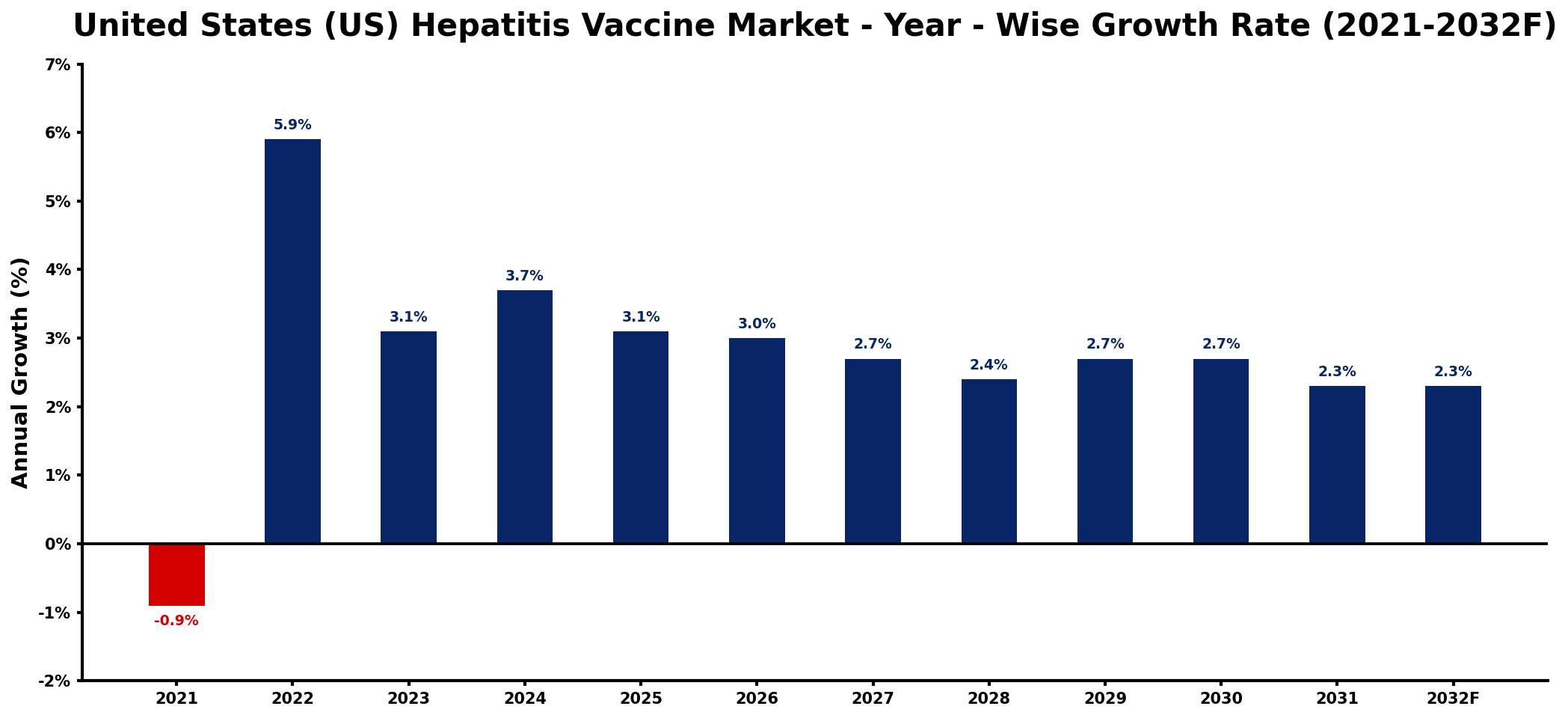
The table below presents the year‑wise growth rates along with the key drivers influencing the market
| Year | Growth Rate | Major Drivers |
| 2021 | -0.9% | decrease in preventive healthcare investments |
| 2022 | 5.9% | rising public health awareness initiatives |
| 2023 | 3.1% | increased funding for research projects |
| 2024 | 3.7% | expansion of healthcare access programs |
| 2025 | 3.1% | growth in immunization awareness campaigns |
| 2026 | 3.0% | enhanced distribution network efficiency |
| 2027 | 2.7% | rising demand for preventive measures |
| 2028 | 2.4% | increased collaboration among healthcare providers |
| 2029 | 2.7% | growing support from governmental agencies |
| 2030 | 2.7% | increased capital investment inflows |
| 2031 | 2.3% | increased production capacity utilization |
| 2032 | 2.3% | growing investments in public health |
Note: Market size estimations and growth projections presented in this report are based on 6Wresearch's proprietary forecasting methodology, utilizing the latest available industry data, government publications, and primary research inputs.
United States (US) Hepatitis Vaccine Market Synopsis
The strongest force currently shaping the United States Hepatitis Vaccine Market is the government's commitment to expanding vaccination coverage across various demographics. This drive is manifesting through comprehensive vaccination campaigns aimed at children, adolescents, and high-risk groups, effectively reducing the disease burden and increasing public health awareness.
Moreover, the heightened recognition of hepatitis as a significant health issue fosters an environment ripe for market growth. The current landscape is marked by robust competition among companies, which fuels innovation in vaccine development and the introduction of advanced formulations that enhance both efficacy and safety.
United States (US) Hepatitis Vaccine Market Key Takeaways
- The market is characterized by intense competition and continual investment in research and development.
- Combination vaccines are gaining traction due to their convenience and cost-effectiveness.
- Government programs, such as the Vaccines for Children program, play a vital role in improving access to hepatitis vaccines.
- Rising healthcare expenditure supports the market's overall expansion.
- Awareness campaigns targeting high-risk populations are crucial for increasing vaccination rates.
Evaluation of Restraints in United States (US) Hepatitis Vaccine Market
Despite the optimistic outlook for the United States Hepatitis Vaccine Market, several significant restraints exist. The high cost of hepatitis vaccines can be a barrier for some individuals, potentially leading to lower vaccination rates. This issue is particularly pressing in marginalized communities, where limited access to healthcare services compounds the challenge. Furthermore, there remains a notable gap in awareness and education regarding hepatitis vaccination, making targeted outreach efforts essential to ensure that all populations understand the importance of immunization.
United States (US) Hepatitis Vaccine Market Trends
Current trends within the United States Hepatitis Vaccine Market highlight a shift towards the adoption of combination vaccines, which simultaneously protect against Hepatitis A and B. This trend is significantly driven by the dual benefits of convenience and cost-effectiveness associated with single-dose vaccinations. Moreover, advancements in vaccine technology, including new formulations and delivery methods, are being prioritized to improve both efficacy and patient compliance. Increased focus on high-risk populations, such as healthcare workers and travelers, further shapes market demand.
United States (US) Hepatitis Vaccine Market Opportunities
The market presents numerous investment opportunities, particularly as awareness about hepatitis vaccination continues to grow. With a considerable segment of the population remaining unvaccinated, there is a pronounced demand for innovative vaccines. Potential investment avenues include funding for research and development, expanding manufacturing capabilities, and launching marketing campaigns aimed at enhancing public awareness. Additionally, government initiatives aimed at reducing hepatitis prevalence are likely to augment the market's growth potential, making it an attractive sector for stakeholders seeking to capitalize on healthcare advancements.
Government Initiatives in the United States (US) Hepatitis Vaccine Market
The United States government has enacted various policies to encourage hepatitis vaccinations. The Centers for Disease Control and Prevention (CDC) promotes routine immunization for hepatitis A and B among children, adolescents, and at-risk populations. Programs like Vaccines for Children (VFC) ensure free access to vaccines for eligible children from low-income families. The Affordable Care Act mandates that insurance plans cover recommended vaccinations, including those for hepatitis, without cost-sharing, thereby further facilitating vaccination efforts across the country.
Future Insights of the United States (US) Hepatitis Vaccine Market
Looking ahead to the years between 2026 and 2032, the United States Hepatitis Vaccine Market is expected to experience promising growth. Factors such as an increasing focus on preventive healthcare, rising prevalence of hepatitis infections, and enhanced government support for immunization initiatives will drive this upward trajectory. Additionally, the introduction of novel vaccines and ongoing advancements in research are poised to enrich the market landscape. However, factors like vaccine hesitancy and the high costs of vaccination may temper growth rates, requiring strategic interventions to address these challenges.
United States (US) Hepatitis Vaccine Market Latest Developments (2025 - 2026)
Recent developments in the United States Hepatitis Vaccine Market indicate a strong trend towards innovation in vaccine delivery mechanisms and formulations. Collaborative efforts between public health organizations and private entities are resulting in the development of more effective vaccines. Additionally, ongoing public health campaigns are reinforcing the importance of hepatitis vaccinations, significantly increasing engagement with at-risk populations. As these initiatives unfold, they contribute to improved vaccination rates across various demographics.
United States (US) Hepatitis Vaccine Market - Key Attractiveness of the Report
- 10 Years of Market Numbers
- Historical Data Starting from 2022 to 2025
- Base Year: 2025
- Forecast Data until 2032
- Key Performance Indicators Impacting the Market
- Major Upcoming Developments and Projects
Key Highlights of the Report:
- United States (US) Hepatitis Vaccine Market Outlook
- Market Size of United States (US) Hepatitis Vaccine Market, 2025
- Forecast of United States (US) Hepatitis Vaccine Market, 2032
- Historical Data and Forecast of United States (US) Hepatitis Vaccine Revenues & Volume for the Period 2022-2032F
- United States (US) Hepatitis Vaccine Market Trend Evolution
- United States (US) Hepatitis Vaccine Market Drivers and Challenges
- United States (US) Hepatitis Vaccine Price Trends
- United States (US) Hepatitis Vaccine Porter's Five Forces
- United States (US) Hepatitis Vaccine Industry Life Cycle
- Historical Data and Forecast of United States (US) Hepatitis Vaccine Market Revenues & Volume By Indication for the Period 2022-2032F
- Historical Data and Forecast of United States (US) Hepatitis Vaccine Market Revenues & Volume By Hepatitis A for the Period 2022-2032F
- Historical Data and Forecast of United States (US) Hepatitis Vaccine Market Revenues & Volume By Hepatitis B for the Period 2022-2032F
- Historical Data and Forecast of United States (US) Hepatitis Vaccine Market Revenues & Volume By Vaccine Type for the Period 2022-2032F
- Historical Data and Forecast of United States (US) Hepatitis Vaccine Market Revenues & Volume By Recombinant Vaccine for the Period 2022-2032F
- Historical Data and Forecast of United States (US) Hepatitis Vaccine Market Revenues & Volume By Inactivated Vaccine for the Period 2022-2032F
- Historical Data and Forecast of United States (US) Hepatitis Vaccine Market Revenues & Volume By Distribution Channel for the Period 2022-2032F
- Historical Data and Forecast of United States (US) Hepatitis Vaccine Market Revenues & Volume By Hospitals for the Period 2022-2032F
- Historical Data and Forecast of United States (US) Hepatitis Vaccine Market Revenues & Volume By Retail Pharmacy for the Period 2022-2032F
- Historical Data and Forecast of United States (US) Hepatitis Vaccine Market Revenues & Volume By Online Pharmacy for the Period 2022-2032F
- United States (US) Hepatitis Vaccine Import Export Trade Statistics
- Market Opportunity Assessment By Indication
- Market Opportunity Assessment By Vaccine Type
- Market Opportunity Assessment By Distribution Channel
- United States (US) Hepatitis Vaccine Top Companies Market Share
- United States (US) Hepatitis Vaccine Competitive Benchmarking By Technical and Operational Parameters
- United States (US) Hepatitis Vaccine Company Profiles
- United States (US) Hepatitis Vaccine Key Strategic Recommendations






































