United States (US) Infrared Imaging Market Size, Share & Growth Rate
The United States (US) Infrared Imaging Market was estimated at USD 188 Million in 2025 and is projected to reach USD 221 Million by 2032, growing at a CAGR of 2.3% from 2026 to 2032. This growth trajectory is primarily driven by a surge in applications across critical sectors, including healthcare and defense, as well as increasing technological advancements in infrared sensor capabilities. The growing need for efficient surveillance and predictive maintenance solutions is further propelling the market's expansion.
United States (US) Infrared Imaging Market Year-wise Growth Rate and Key Drivers
This graph highlights how the United States (US) Infrared Imaging Market has steadily grown over the years, supported by major growth factors.
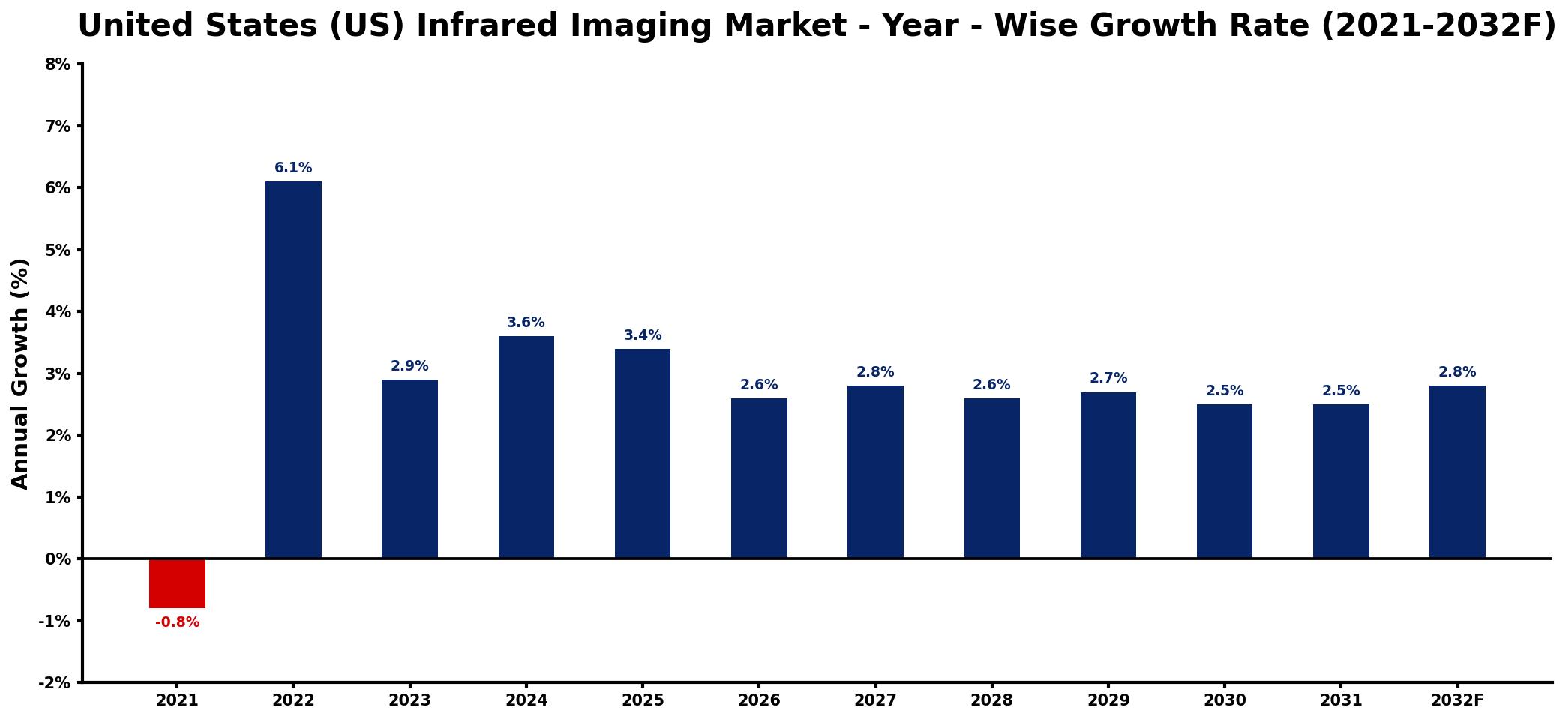
The table below presents the year‑wise growth rates along with the key drivers influencing the market
| Year | Growth Rate | Major Drivers |
| 2021 | -0.8% | decreased industrial sector investments |
| 2022 | 6.1% | rising demand in healthcare applications |
| 2023 | 2.9% | increased adoption in manufacturing processes |
| 2024 | 3.6% | growing interest in energy efficiency |
| 2025 | 3.4% | expansion in automotive safety technologies |
| 2026 | 2.6% | higher funding for research initiatives |
| 2027 | 2.8% | advancements in security and surveillance |
| 2028 | 2.6% | increased usage in building inspections |
| 2029 | 2.7% | growing popularity in agricultural monitoring |
| 2030 | 2.5% | expanding applications in military operations |
| 2031 | 2.5% | increased integration with smart devices |
| 2032 | 2.8% | growing focus on environmental monitoring |
Note: Market size estimations and growth projections presented in this report are based on 6Wresearch's proprietary forecasting methodology, utilizing the latest available industry data, government publications, and primary research inputs.
United States (US) Infrared Imaging Market Synopsis
The United States Infrared Imaging Market is witnessing a notable shift, propelled by recent momentum in technology adoption across various industries. As businesses increasingly integrate infrared imaging solutions, particularly for security and diagnostic purposes, the market is poised for robust growth.
Looking ahead, the adoption of innovative infrared imaging technologies is expected to significantly enhance operational efficiencies. With a focus on developing higher-resolution and compact devices, the market is on track to explore new applications, particularly in emerging sectors such as automotive and autonomous systems.
United States (US) Infrared Imaging Market Key Takeaways
- The market is driven by the rising demand for thermal imaging in various sectors such as healthcare, automotive, and defense.
- Technological innovations are enhancing the quality and functionalities of infrared imaging systems.
- Growing applications in emerging fields like autonomous vehicles and predictive maintenance are creating new opportunities.
- Increased emphasis on security and surveillance is fueling the demand for advanced infrared imaging technologies.
- Strategic investments in R&D are vital for companies to maintain a competitive edge and navigate regulatory landscapes.
Evaluation of Restraints in United States (US) Infrared Imaging Market
Despite its promising growth, the US Infrared Imaging Market faces challenges that could hinder expansion. Increased competition from foreign manufacturers offering cost-effective alternatives places pressure on domestic companies to innovate continuously or reduce prices. Moreover, the rapid pace of technological change and shifting consumer preferences necessitate consistent upgrades and advancements. Compliance with stringent regulations concerning the use of infrared technology in sensitive industries adds another layer of complexity, as companies must align with legal requirements while striving to expand their market presence.
United States (US) Infrared Imaging Market Trends
Current trends in the US Infrared Imaging Market highlight a significant shift towards the integration of artificial intelligence and machine learning capabilities. These technologies are enhancing data analysis and decision-making processes, resulting in improved operational efficiencies. The development of compact and portable thermal cameras is also notable, catering to the growing demand for mobility in various applications. Furthermore, there is an increasing focus on enhancing image quality and resolution, which is critical for accurate thermal imaging, especially in fields like healthcare and industrial monitoring.
United States (US) Infrared Imaging Market Opportunities
The US Infrared Imaging Market offers substantial investment opportunities across several sectors. In defense and security, the escalating need for advanced surveillance and monitoring systems provides a fertile ground for growth. The healthcare industry is also ripe for innovation, with infrared imaging increasingly utilized for non-invasive diagnostic procedures. Additionally, the automotive sector's embrace of infrared technologies for driver assistance systems and autonomous vehicle applications presents significant prospects. Industrial applications, particularly in predictive maintenance and quality control, are further enhancing the market's attractiveness for investors.
Government Initiatives in the United States (US) Infrared Imaging Market
Government initiatives play a crucial role in shaping the landscape of the US Infrared Imaging Market. Regulations regarding export controls for infrared technology are designed to prevent misuse and ensure national security, particularly in sensitive sectors like defense and aerospace. These policies, enforced by agencies such as the Department of State and Department of Commerce, help maintain a secure business environment while fostering innovation. Furthermore, public funding and support for R&D initiatives are essential to drive advancements in infrared imaging technology, ensuring that the US remains competitive in the global market.
Future Insights of the United States (US) Infrared Imaging Market
Looking towards 2026-2032, the United States Infrared Imaging Market is set to experience sustained growth, driven by continued technological advancements and the expanding scope of applications. Rising demand for thermal imaging, particularly in security and surveillance, coupled with the integration of infrared technology into healthcare diagnostics, will likely fuel the market's momentum. Ongoing investments in R&D are anticipated to enhance infrared imaging capabilities, positioning the market for innovation and increased revenue generation in the coming years.
United States (US) Infrared Imaging Market Latest Developments (2025 - 2026)
Recent developments in the United States Infrared Imaging Market indicate a clear trend towards enhancing the portability and performance of infrared imaging devices. Companies are increasingly focusing on developing compact thermal cameras equipped with advanced analytics capabilities, driven by customer demand for higher accuracy and usability. Collaborations between technology providers and end-users are also on the rise, emphasizing the importance of tailored solutions to meet specific industry needs.
United States (US) Infrared Imaging Market - Key Attractiveness of the Report
- 10 Years of Market Numbers
- Historical Data Starting from 2022 to 2025
- Base Year: 2025
- Forecast Data until 2032
- Key Performance Indicators Impacting the Market
- Major Upcoming Developments and Projects
Key Highlights of the Report:
- United States (US) Infrared Imaging Market Outlook
- Market Size of United States (US) Infrared Imaging Market, 2025
- Forecast of United States (US) Infrared Imaging Market, 2032
- Historical Data and Forecast of United States (US) Infrared Imaging Revenues & Volume for the Period 2022-2032F
- United States (US) Infrared Imaging Market Trend Evolution
- United States (US) Infrared Imaging Market Drivers and Challenges
- United States (US) Infrared Imaging Price Trends
- United States (US) Infrared Imaging Porter's Five Forces
- United States (US) Infrared Imaging Industry Life Cycle
- Historical Data and Forecast of United States (US) Infrared Imaging Market Revenues & Volume By Technology for the Period 2022-2032F
- Historical Data and Forecast of United States (US) Infrared Imaging Market Revenues & Volume By Cooled Infrared Imaging for the Period 2022-2032F
- Historical Data and Forecast of United States (US) Infrared Imaging Market Revenues & Volume By Uncooled Infrared Imaging for the Period 2022-2032F
- Historical Data and Forecast of United States (US) Infrared Imaging Market Revenues & Volume By Wavelength for the Period 2022-2032F
- Historical Data and Forecast of United States (US) Infrared Imaging Market Revenues & Volume By Near Infrared for the Period 2022-2032F
- Historical Data and Forecast of United States (US) Infrared Imaging Market Revenues & Volume By Shortwave Infrared for the Period 2022-2032F
- Historical Data and Forecast of United States (US) Infrared Imaging Market Revenues & Volume By Mid-wave Infrared for the Period 2022-2032F
- Historical Data and Forecast of United States (US) Infrared Imaging Market Revenues & Volume By Long-wave Infrared for the Period 2022-2032F
- Historical Data and Forecast of United States (US) Infrared Imaging Market Revenues & Volume By Application for the Period 2022-2032F
- Historical Data and Forecast of United States (US) Infrared Imaging Market Revenues & Volume By Security & Surveillance for the Period 2022-2032F
- Historical Data and Forecast of United States (US) Infrared Imaging Market Revenues & Volume By Monitoring & Inspection for the Period 2022-2032F
- Historical Data and Forecast of United States (US) Infrared Imaging Market Revenues & Volume By Detection for the Period 2022-2032F
- Historical Data and Forecast of United States (US) Infrared Imaging Market Revenues & Volume By Vertical for the Period 2022-2032F
- Historical Data and Forecast of United States (US) Infrared Imaging Market Revenues & Volume By Industrial for the Period 2022-2032F
- Historical Data and Forecast of United States (US) Infrared Imaging Market Revenues & Volume By Nonindustrial for the Period 2022-2032F
- United States (US) Infrared Imaging Import Export Trade Statistics
- Market Opportunity Assessment By Technology
- Market Opportunity Assessment By Wavelength
- Market Opportunity Assessment By Application
- Market Opportunity Assessment By Vertical
- United States (US) Infrared Imaging Top Companies Market Share
- United States (US) Infrared Imaging Competitive Benchmarking By Technical and Operational Parameters
- United States (US) Infrared Imaging Company Profiles
- United States (US) Infrared Imaging Key Strategic Recommendations






































