United States (US) Optical Disc Drive Market Size, Share & Growth Rate
The United States (US) Optical Disc Drive Market was estimated at USD 218 Million in 2025 and is projected to reach USD 258 Million by 2032, growing at a CAGR of 2.4% from 2026 to 2032. Despite a prevailing decline in overall demand driven by the shift towards digital consumption, niche sectors such as data storage and professional media are sustaining market activity. The persistence of Blu-ray technology and the need for physical media in certain professional environments contribute to this market growth.
United States (US) Optical Disc Drive Market Year-wise Growth Rate and Key Drivers
This graph highlights how the United States (US) Optical Disc Drive Market has steadily grown over the years, supported by major growth factors.
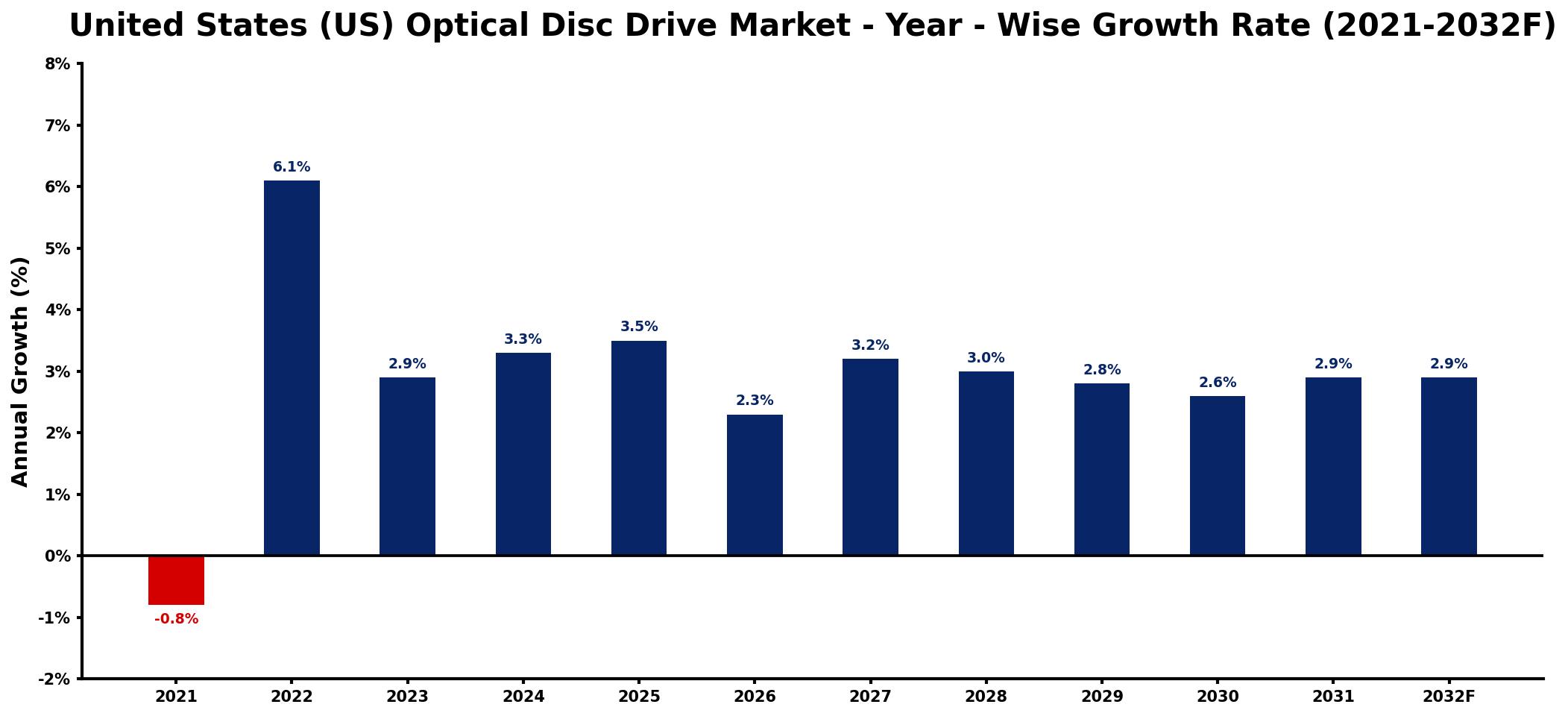
The table below presents the year‑wise growth rates along with the key drivers influencing the market
| Year | Growth Rate | Major Drivers |
| 2021 | -0.8% | decreased consumer electronics production |
| 2022 | 6.1% | rise in digital media consumption |
| 2023 | 2.9% | increased home entertainment investments |
| 2024 | 3.3% | growing demand for retro technology |
| 2025 | 3.5% | expansion of gaming industry sales |
| 2026 | 2.3% | surge in educational content usage |
| 2027 | 3.2% | growth in archival storage needs |
| 2028 | 3.0% | increased multimedia content creation |
| 2029 | 2.8% | enhanced product quality standards |
| 2030 | 2.6% | rising demand from electronics |
| 2031 | 2.9% | growing interest in physical media |
| 2032 | 2.9% | increased demand for multimedia playback |
Note: Market size estimations and growth projections presented in this report are based on 6Wresearch's proprietary forecasting methodology, utilizing the latest available industry data, government publications, and primary research inputs.
United States (US) Optical Disc Drive Market Synopsis
In the United States, the demand for optical disc drives is primarily fueled by professional applications that necessitate high-quality data storage solutions. The archival needs in sectors such as education and video production continue to drive the use of these drives despite the prevailing shift to digital alternatives.
The market is characterized by the presence of slim and lightweight optical drives, catering to the growing demand for portable devices. This shift is notable as consumer preferences increasingly gravitate towards compact devices that maintain functionality without compromising on design.
United States (US) Optical Disc Drive Market Key Takeaways
- The market is expected to continue its gradual decline, yet still presents niche opportunities in specific sectors.
- Strong demand persists for Blu-ray drives in professional video editing and high-definition media playback.
- Manufacturers are innovating towards ultra-slim drives to align with trends in portable technology.
- Professionals and enthusiasts remain loyal to physical media, ensuring a steady segment of demand.
- The market landscape faces competition from lower-priced international products, impacting profitability.
Evaluation of Restraints in United States (US) Optical Disc Drive Market
The primary restraint on the United States Optical Disc Drive Market is the diminishing demand for physical media, stemming from the robust rise of digital streaming and cloud storage solutions. As consumers increasingly adopt online platforms, the need for traditional optical drives has waned. Furthermore, technological advancements introduce alternative data storage methods, such as USB drives and external hard drives, which encroach on the market territory of optical drives. As a result, manufacturers must navigate a complex landscape marked by rapidly shifting consumer preferences and competitive pricing pressures.
United States (US) Optical Disc Drive Market Trends
The ongoing evolution in consumer technology is reshaping the US Optical Disc Drive Market. There's a noticeable trend towards the integration of optical drives in specialized devices, with an emphasis on enhancing speed and reliability. Furthermore, as gaming remains a significant market for physical media, manufacturers are increasingly targeting gamers by offering high-capacity drives that appeal to this demographic. The rise of ultra-thin devices also pushes innovation in design, prompting companies to develop more compact yet efficient optical drive solutions.
United States (US) Optical Disc Drive Market Opportunities
Despite the overall market decline, opportunities for investment are manifesting in niche sectors. The professional and archival segments offer potential, as organizations seek durable and reliable long-term data storage options. The education sector also presents avenues for growth, particularly in accessing legacy software and materials that rely on optical media. Additionally, aftermarket services and refurbishment markets are emerging, catering to businesses and individuals who wish to prolong the lifespan of existing optical drives.
Government Initiatives in the United States (US) Optical Disc Drive Market
While there are no specific government policies targeting the Optical Disc Drive market in the United States, the industry is governed by overarching regulations related to intellectual property, trade, and environmental standards. The enforcement of intellectual property rights impacts technology and innovation within the sector, while broader trade policies can influence market dynamics and the cost of imported optical drive products. Environmental regulations surrounding e-waste management also play a critical role in shaping the operational practices of manufacturers in the market.
Future Insights of the United States (US) Optical Disc Drive Market
Looking ahead, the United States Optical Disc Drive Market is poised for continued contraction as consumer preferences firmly shift towards digital solutions. The increasing prevalence of streaming services and cloud storage is likely to further diminish demand for traditional optical drives. However, emerging sectors such as gaming and professional media production may provide glimmers of growth, prompting companies to pivot strategically towards these segments. The focus on innovation and diversification in product offerings will be crucial for firms aiming to remain relevant in this evolving landscape.
United States (US) Optical Disc Drive Market Latest Developments (2025 - 2026)
Recent industry developments highlight a shift towards the production of high-quality optical disc drives tailored for professional use. Companies are increasingly emphasizing durability and speed in their offerings. Furthermore, there has been a notable uptick in demand for external optical drives in educational settings, as schools and universities look to incorporate legacy software in their curricula. The focus on sustainability has also spurred interest in refurbishment programs and eco-friendly manufacturing practices within the market.
United States (US) Optical Disc Drive Market - Key Attractiveness of the Report
- 10 Years of Market Numbers
- Historical Data Starting from 2022 to 2025
- Base Year: 2025
- Forecast Data until 2032
- Key Performance Indicators Impacting the Market
- Major Upcoming Developments and Projects
Key Highlights of the Report:
- United States (US) Optical Disc Drive Market Outlook
- Market Size of United States (US) Optical Disc Drive Market, 2025
- Forecast of United States (US) Optical Disc Drive Market, 2032
- Historical Data and Forecast of United States (US) Optical Disc Drive Revenues & Volume for the Period 2022-2032F
- United States (US) Optical Disc Drive Market Trend Evolution
- United States (US) Optical Disc Drive Market Drivers and Challenges
- United States (US) Optical Disc Drive Price Trends
- United States (US) Optical Disc Drive Porter's Five Forces
- United States (US) Optical Disc Drive Industry Life Cycle
- Historical Data and Forecast of United States (US) Optical Disc Drive Market Revenues & Volume By Types for the Period 2022-2032F
- Historical Data and Forecast of United States (US) Optical Disc Drive Market Revenues & Volume By DVD for the Period 2022-2032F
- Historical Data and Forecast of United States (US) Optical Disc Drive Market Revenues & Volume By BD for the Period 2022-2032F
- Historical Data and Forecast of United States (US) Optical Disc Drive Market Revenues & Volume By Applications for the Period 2022-2032F
- Historical Data and Forecast of United States (US) Optical Disc Drive Market Revenues & Volume By Desktop for the Period 2022-2032F
- Historical Data and Forecast of United States (US) Optical Disc Drive Market Revenues & Volume By Laptop for the Period 2022-2032F
- United States (US) Optical Disc Drive Import Export Trade Statistics
- Market Opportunity Assessment By Types
- Market Opportunity Assessment By Applications
- United States (US) Optical Disc Drive Top Companies Market Share
- United States (US) Optical Disc Drive Competitive Benchmarking By Technical and Operational Parameters
- United States (US) Optical Disc Drive Company Profiles
- United States (US) Optical Disc Drive Key Strategic Recommendations






































