United States (US) Payment Security Market Size & Growth Rate (2026-2032)
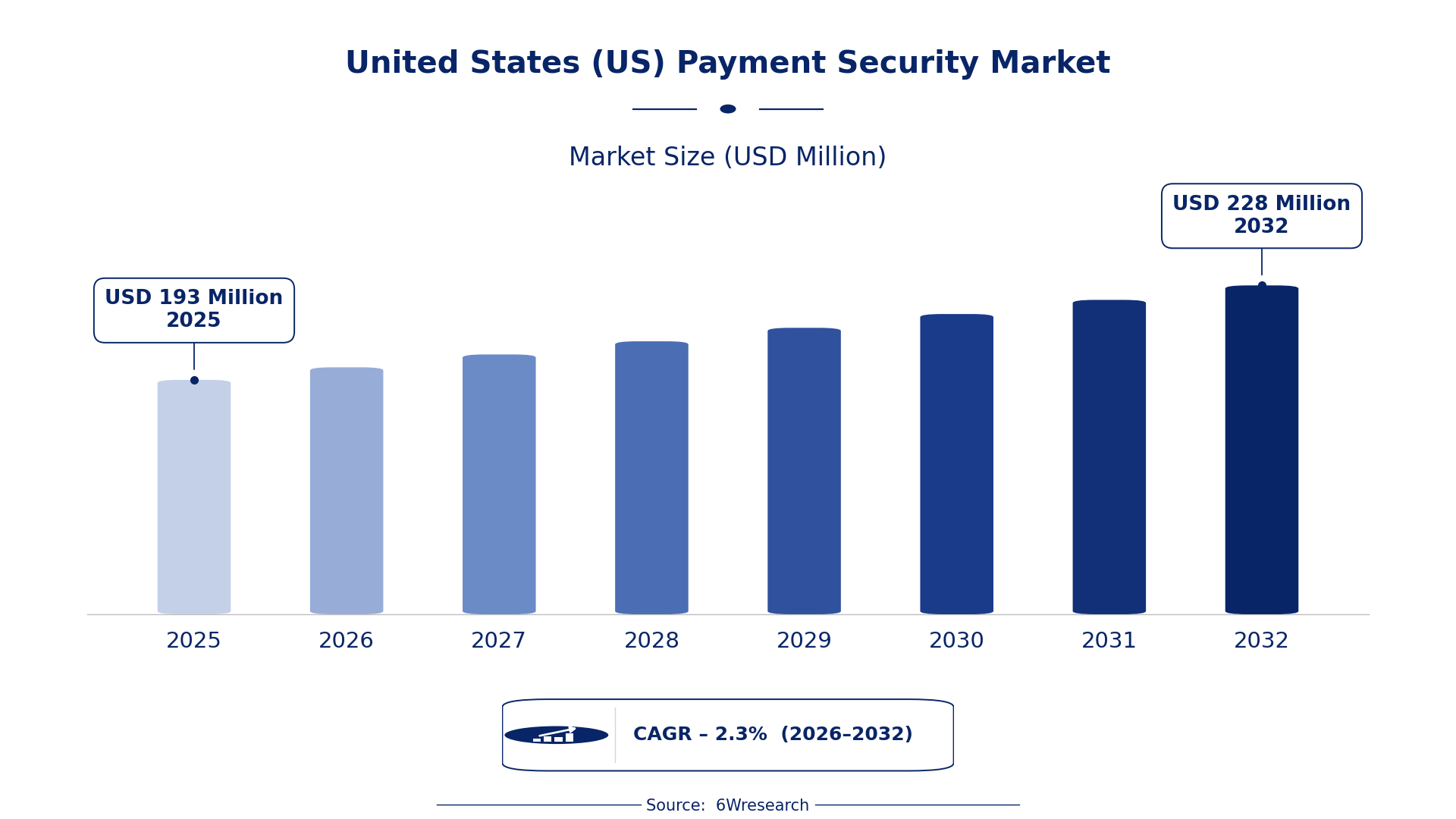
The United States (US) Payment Security Market was estimated at USD 193 Million in 2025 and is projected to reach USD 228 Million by 2032, growing at a CAGR of 2.3% from 2026 to 2032.
United States (US) Payment Security Market Synopsis
As online transactions surge, the demand for comprehensive payment security solutions is skyrocketing. This shift is primarily driven by consumer preferences for mobile and digital payment methods, which have become the norm rather than the exception.
Amidst these changes, businesses are increasingly recognizing that robust security measures are not just optional but essential for maintaining customer trust. Investment in technologies like encryption and tokenization is critical for safeguarding sensitive payment information.
United States (US) Payment Security Market Year-wise Growth Rate and Key Drivers
This graph illustrates the annual growth rates of the United States (US) Payment Security Market from 2021 to 2032, highlighting a steady upward trajectory and projected expansion over the forecast period.
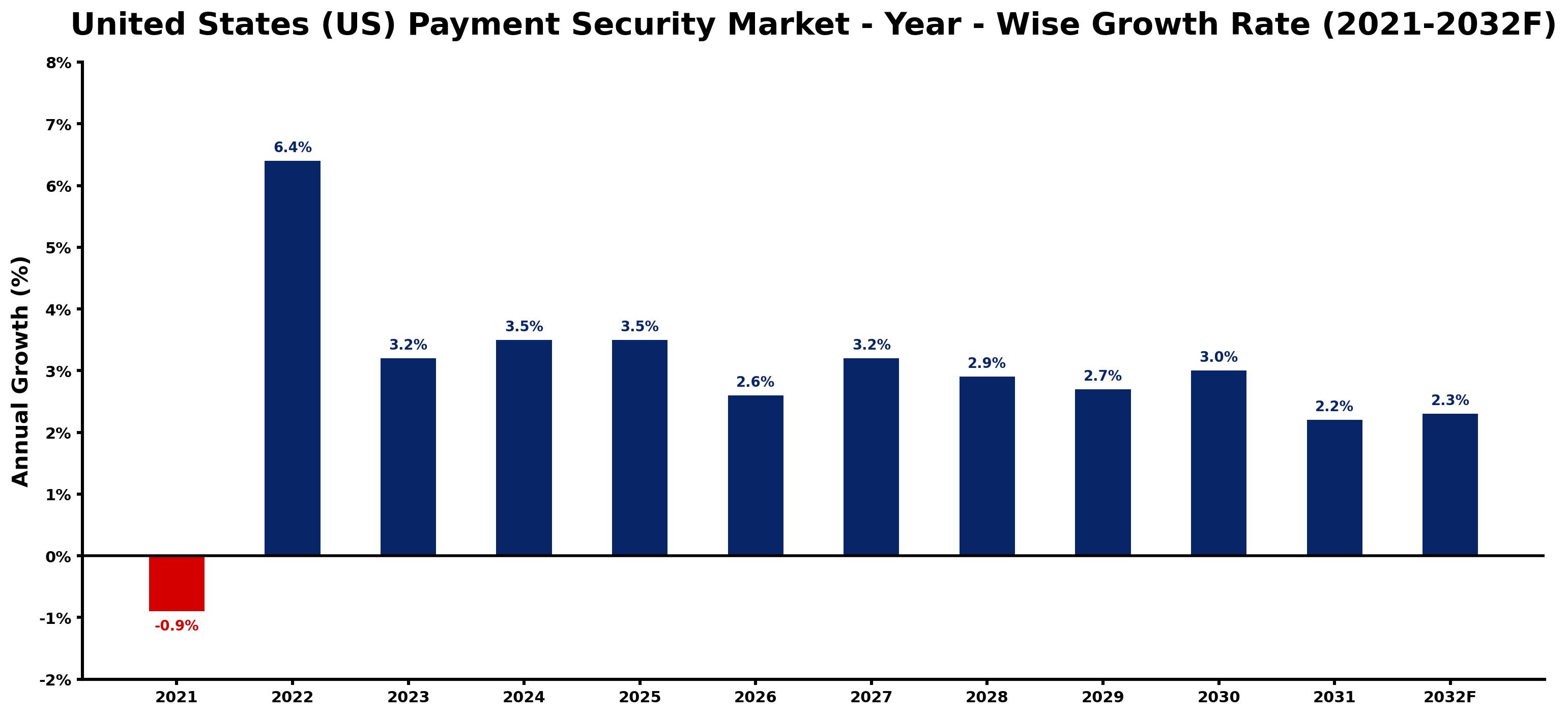
The table below presents the year‑wise growth rates along with the key drivers influencing the market
| Year | Growth Rate | Major Drivers |
| 2021 | -0.9% | Visa and Mastercard increase transaction fee structure |
| 2022 | 6.4% | Increased regulatory scrutiny from PCI DSS compliance requirements |
| 2023 | 3.2% | Rise in contactless payment adoption boosting security solutions |
| 2024 | 3.5% | Surge in e-commerce fueling demand for fraud prevention tools |
| 2025 | 3.5% | Growth of mobile banking prompting stronger identity verification standards |
| 2026 | 2.6% | Cybersecurity insurance incentives for enhanced payment security practices |
| 2027 | 3.2% | Emergence of real-time payment systems necessitating advanced security protocols |
| 2028 | 2.9% | Demand for biometric authentication in retail boosting market growth |
| 2029 | 2.7% | Integration of AI in fraud detection enhancing security measures |
| 2030 | 3.0% | Legislation encouraging encryption standards driving technology investments |
| 2031 | 2.2% | Consumer awareness around phishing attacks elevating security spending |
| 2032 | 2.3% | Partnerships between fintechs and traditional banks for secure transactions |
Note: Market size estimations and growth projections presented in this report are based on 6Wresearch's proprietary forecasting methodology, utilizing the latest available industry data, government publications, and primary research inputs.
United States (US) Payment Security Market Key Takeaways
Below are some of the specific key takeaways from the market, including:
- Growing cyber threats are propelling the need for advanced payment security solutions.
- Compliance with regulations like PCI DSS is a key driver for security investments among businesses.
- Mobile wallets and contactless payments are pushing for enhanced security technologies.
- Increased awareness about data breaches is leading to higher consumer expectations for security.
- Innovative technologies such as machine learning are being integrated to improve fraud detection.
Evaluation of Restraints in United States (US) Payment Security Market
Despite the growth potential, the market is not without its constraints. The escalating sophistication of cyber threats presents a continuous challenge for security providers. Businesses must constantly update their technologies to combat these evolving risks, which often requires significant investment. on top of that, the fragmented nature of the market complicates coordination among stakeholders, making it difficult to implement a unified approach to payment security. As digital payment methods expand, new vulnerabilities emerge, further exacerbating security concerns.
United States (US) Payment Security Market Trends
There is a marked shift towards adopting cutting-edge technologies like biometric authentication and advanced encryption methods. Organizations are increasingly investing in multi-factor authentication and machine learning to enhance fraud detection capabilities. The COVID-19 pandemic has accelerated trends towards mobile and contactless payments, necessitating stronger security measures to protect users. Additionally, businesses are prioritizing investments that bolster customer trust through improved security protocols.
United States (US) Payment Security Market Opportunities
Investment opportunities are ripe as more businesses adopt digital payment solutions. Firms specializing in encryption technologies, tokenization, and fraud detection services stand to benefit from increased demand. The ongoing evolution of payment methods provides a fertile ground for innovative security solutions, particularly those leveraging artificial intelligence and machine learning to stay one step ahead of fraud tactics.
Government Initiatives in the United States (US) Payment Security Market
Government policies are crucial for shaping the United States Payment Security Market, focusing on protecting consumer data and minimizing fraud. Regulations like the Payment Card Industry Data Security Standard (PCI DSS) set essential security protocols that businesses must adhere to. Such frameworks foster a culture of compliance and encourage investment in security technologies.
- A recently completed initiative included the update of PCI DSS regulations, reinforcing security measures for all businesses that handle card payments.
- Currently ongoing efforts involve increased funding for cybersecurity training programs aimed at small businesses to enhance their payment security practices.
- Planned initiatives include a new regulatory framework slated for introduction in late 2025 that will mandate stronger encryption protocols across all payment platforms.
- The establishment of a federal cybersecurity task force in early 2025 is also underway, aiming to streamline efforts between various sectors in safeguarding payment systems.
- Upcoming consultations with industry stakeholders will address the integration of emerging technologies in compliance frameworks, ensuring that security measures keep pace with innovation.
Future Insights of the United States (US) Payment Security Market
From 2026 to 2032, the United States Payment Security Market is likely to experience substantial growth, driven by the increasing reliance on digital transactions. As consumer awareness around payment security heightens, businesses will be compelled to adopt more sophisticated security measures. The anticipated tightening of regulations will further necessitate investments in advanced technologies, ensuring that security remains a top priority amid ongoing cyber threats. The continuous innovation in payment methods will pave the way for dynamic security solutions, shaping the market’s trajectory.
United States (US) Payment Security Market Latest Developments
In recent months, the United States Payment Security Market has witnessed a surge in activity as companies respond to the pressing need for advanced security solutions. The focus has intensified on integrating innovative technologies to counter increasing cyber threats and enhance consumer trust.
- A leading technology vendor initiated a rollout of enhanced biometric authentication solutions in early 2025, aimed at improving the security of mobile payments.
- A major regional payment processor announced a partnership with cybersecurity firms in mid-2025 to develop a new fraud detection system that is currently underway.
- In Q3 2025, a financial institution launched an upgraded encryption protocol designed to protect customer data during transactions.
- An initiative that began in early 2025 aims to promote consumer awareness regarding payment security, emphasizing the importance of secure practices.
- Looking ahead, a significant upgrade to the national digital payment infrastructure is expected to begin in late 2026, enhancing security across various platforms.
United States (US) Payment Security Market - Key Attractiveness of the Report
- 10 Years of Market Numbers
- Historical Data Starting from 2022 to 2025
- Base Year: 2025
- Forecast Data until 2032
- Key Performance Indicators Impacting the Market
- Major Upcoming Developments and Projects
Key Highlights of the Report:
- United States (US) Payment Security Market Outlook
- Market Size of United States (US) Payment Security Market, 2025
- Forecast of United States (US) Payment Security Market, 2032
- Historical Data and Forecast of United States (US) Payment Security Revenues & Volume for the Period 2022-2032F
- United States (US) Payment Security Market Trend Evolution
- United States (US) Payment Security Market Drivers and Challenges
- United States (US) Payment Security Price Trends
- United States (US) Payment Security Porter's Five Forces
- United States (US) Payment Security Industry Life Cycle
- Historical Data and Forecast of United States (US) Payment Security Market Revenues & Volume By Solution for the Period 2022-2032F
- Historical Data and Forecast of United States (US) Payment Security Market Revenues & Volume By Encryption for the Period 2022-2032F
- Historical Data and Forecast of United States (US) Payment Security Market Revenues & Volume By Tokenization for the Period 2022-2032F
- Historical Data and Forecast of United States (US) Payment Security Market Revenues & Volume By Fraud Detection for the Period 2022-2032F
- Historical Data and Forecast of United States (US) Payment Security Market Revenues & Volume By Prevention for the Period 2022-2032F
- Historical Data and Forecast of United States (US) Payment Security Market Revenues & Volume By Service for the Period 2022-2032F
- Historical Data and Forecast of United States (US) Payment Security Market Revenues & Volume By Integration for the Period 2022-2032F
- Historical Data and Forecast of United States (US) Payment Security Market Revenues & Volume By Support for the Period 2022-2032F
- Historical Data and Forecast of United States (US) Payment Security Market Revenues & Volume By Consulting for the Period 2022-2032F
- Historical Data and Forecast of United States (US) Payment Security Market Revenues & Volume By Organization Size for the Period 2022-2032F
- Historical Data and Forecast of United States (US) Payment Security Market Revenues & Volume By Large Enterprises for the Period 2022-2032F
- Historical Data and Forecast of United States (US) Payment Security Market Revenues & Volume By SMEs for the Period 2022-2032F
- Historical Data and Forecast of United States (US) Payment Security Market Revenues & Volume By Industry Vertical for the Period 2022-2032F
- United States (US) Payment Security Import Export Trade Statistics
- Market Opportunity Assessment By Solution
- Market Opportunity Assessment By Service
- Market Opportunity Assessment By Organization Size
- Market Opportunity Assessment By Industry Vertical
- United States (US) Payment Security Top Companies Market Share
- United States (US) Payment Security Competitive Benchmarking By Technical and Operational Parameters
- United States (US) Payment Security Company Profiles
- United States (US) Payment Security Key Strategic Recommendations






































