United States (US) Propane Market Top 5 Importing Countries and Market Competition (HHI) Analysis
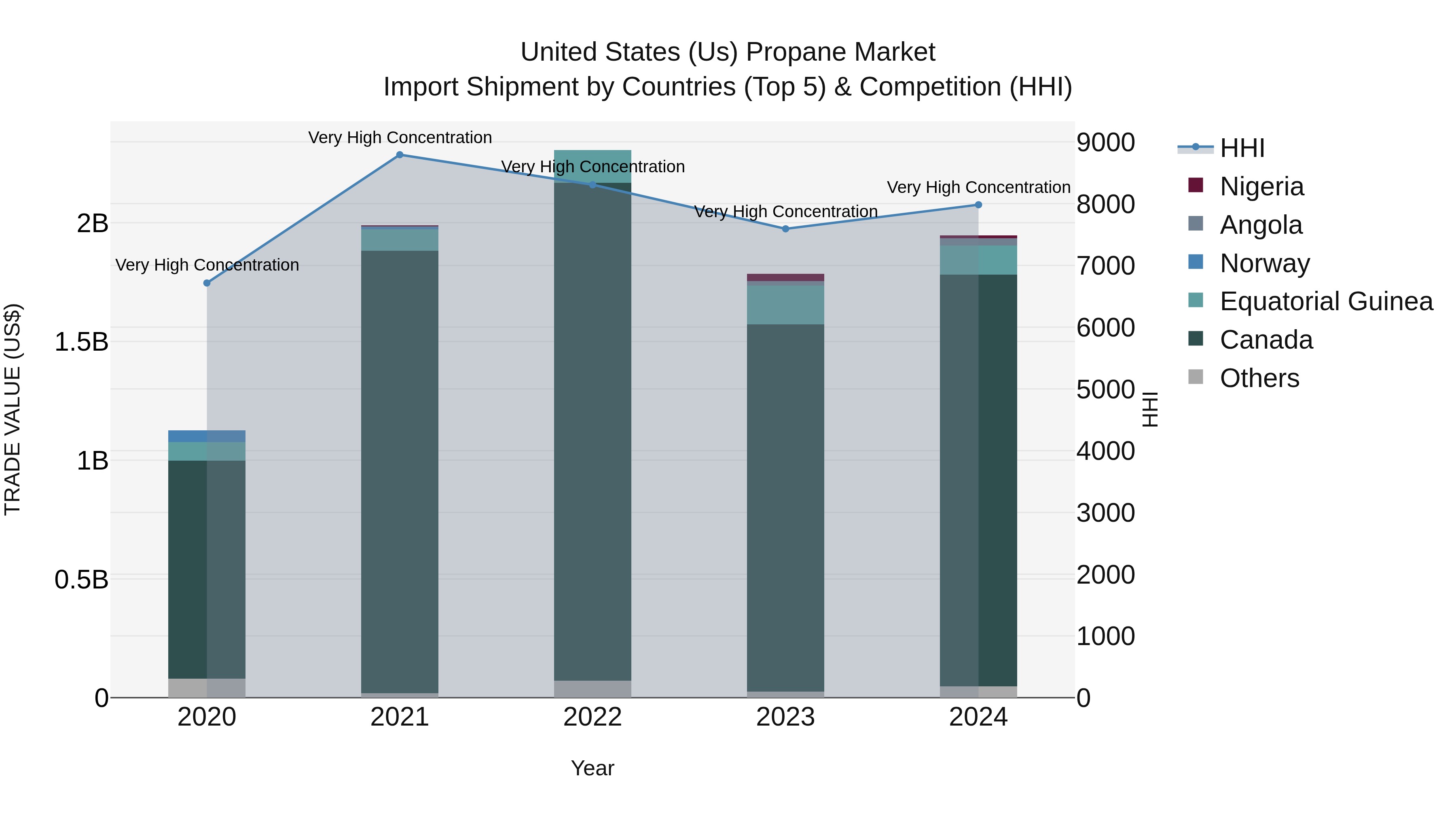
The United States saw a significant increase in propane import shipments in 2024, with top exporting countries being Canada, Equatorial Guinea, Angola, Chile, and the UK. The market remained highly concentrated, with a high Herfindahl-Hirschman Index (HHI). The compound annual growth rate (CAGR) from 2020 to 2024 was robust at 14.67%, indicating sustained growth in propane imports. Additionally, the growth rate from 2023 to 2024 was impressive at 9.02%, showcasing a continued upward trend in propane shipments to the US.
United States (US) Propane Market Overview
The United States propane market is a significant sector within the energy industry, valued at approximately $10 billion annually. Propane is a versatile fuel widely used for residential heating, agricultural applications, transportation, and industrial purposes. The market is driven by factors such as the demand for cleaner and more efficient energy sources, especially in rural and off-grid areas. Key players in the US propane market include major suppliers, distributors, and retailers who cater to a diverse range of customers. Market trends include the increasing adoption of propane for environmentally-friendly practices, such as reducing emissions and carbon footprints. Government regulations and incentives also impact the market, influencing pricing and consumption patterns. Overall, the US propane market continues to evolve in response to changing energy needs and environmental considerations.
United States (US) Propane Market Trends
The US propane market is currently experiencing several key trends. One major trend is the increasing demand for propane as a clean and efficient alternative fuel source, particularly in the residential and commercial sectors for heating and power generation. Another trend is the growing use of propane in the transportation sector, as more vehicles and fleets are converting to propane autogas for environmental and cost-saving benefits. Additionally, the rise of propane exports from the US to international markets is shaping the industry, driven by factors such as increased production capacity and global demand for propane products. Overall, these trends indicate a promising outlook for the US propane market, with continued growth opportunities in various sectors both domestically and internationally.
United States (US) Propane Market Challenges
In the US Propane Market, some of the key challenges faced include fluctuating propane prices influenced by factors such as crude oil prices, weather patterns affecting demand for heating and agriculture, regulatory changes impacting production and distribution, and competition from alternative energy sources. Additionally, infrastructure constraints, such as limited storage capacity and transportation networks, can create supply chain disruptions during high-demand periods. Market volatility and geopolitical events can also impact the availability and cost of propane. Sustainability concerns and the push for renewable energy sources pose a long-term challenge for the propane industry to adapt and remain competitive in a rapidly evolving energy landscape. Overall, navigating these challenges requires proactive risk management strategies and continuous adaptation to market dynamics.
United States (US) Propane Market Investment Opportunities
The US Propane Market presents several investment opportunities due to its diverse applications and growing demand. Investing in propane production and distribution companies can be lucrative, especially considering the increasing adoption of propane as a cleaner alternative to traditional fuels in residential, commercial, and industrial sectors. Additionally, investing in infrastructure development for propane storage and transportation can yield long-term returns as the market continues to expand. With the growing interest in renewable propane and sustainable energy solutions, there is also potential for investments in research and development of new propane technologies. Overall, the US Propane Market offers a range of investment prospects for those looking to capitalize on the shift towards cleaner energy sources.
United States (US) Propane Market Government Policy
The US propane market is significantly influenced by government policies, such as regulations set by the Department of Transportation (DOT) for the safe transportation of propane, including guidelines on handling, storage, and labeling. The Environmental Protection Agency (EPA) also plays a role in regulating emissions from propane use, with standards for propane-powered vehicles and equipment. Additionally, tax credits and incentives are available to promote the use of propane as a cleaner alternative fuel, stimulating market growth. The Department of Energy (DOE) provides research funding for propane-related technologies and efficiency programs. Overall, government policies in the US propane market aim to ensure safety, environmental compliance, and support for the adoption of propane as a sustainable energy source.
United States (US) Propane Market Future Outlook
The future outlook for the United States Propane Market appears positive, driven by several key factors. The increasing demand for propane as a clean-burning and versatile energy source is expected to fuel market growth. Additionally, the growing adoption of propane in various applications such as residential heating, industrial processes, and transportation is projected to drive market expansion. The development of infrastructure for propane distribution and storage, along with technological advancements in propane production and transportation, are likely to further boost market opportunities. However, factors such as fluctuating crude oil prices, regulatory challenges, and competition from alternative energy sources could pose challenges to the market`s growth trajectory. Overall, the US Propane Market is anticipated to witness steady growth in the coming years, supported by increasing demand and ongoing industry developments.
Key Highlights of the Report:
- United States (US) Propane Market Outlook
- Market Size of United States (US) Propane Market, 2021
- Forecast of United States (US) Propane Market, 2027
- Historical Data and Forecast of United States (US) Propane Revenues & Volume for the Period 2018 - 2027
- United States (US) Propane Market Trend Evolution
- United States (US) Propane Market Drivers and Challenges
- United States (US) Propane Price Trends
- United States (US) Propane Porter's Five Forces
- United States (US) Propane Industry Life Cycle
- Historical Data and Forecast of United States (US) Propane Market Revenues & Volume By Applications for the Period 2018 - 2027
- Historical Data and Forecast of United States (US) Propane Market Revenues & Volume By Industrial for the Period 2018 - 2027
- Historical Data and Forecast of United States (US) Propane Market Revenues & Volume By Commercial for the Period 2018 - 2027
- Historical Data and Forecast of United States (US) Propane Market Revenues & Volume By Residential for the Period 2018 - 2027
- Historical Data and Forecast of United States (US) Propane Market Revenues & Volume By Transportation for the Period 2018 - 2027
- Historical Data and Forecast of United States (US) Propane Market Revenues & Volume By Agriculture for the Period 2018 - 2027
- Historical Data and Forecast of United States (US) Propane Market Revenues & Volume By Chemicals and Refineries for the Period 2018 - 2027
- United States (US) Propane Import Export Trade Statistics
- Market Opportunity Assessment By Applications
- United States (US) Propane Top Companies Market Share
- United States (US) Propane Competitive Benchmarking By Technical and Operational Parameters
- United States (US) Propane Company Profiles
- United States (US) Propane Key Strategic Recommendations






































