Sri Lanka Propane Market: Import Trend Analysis
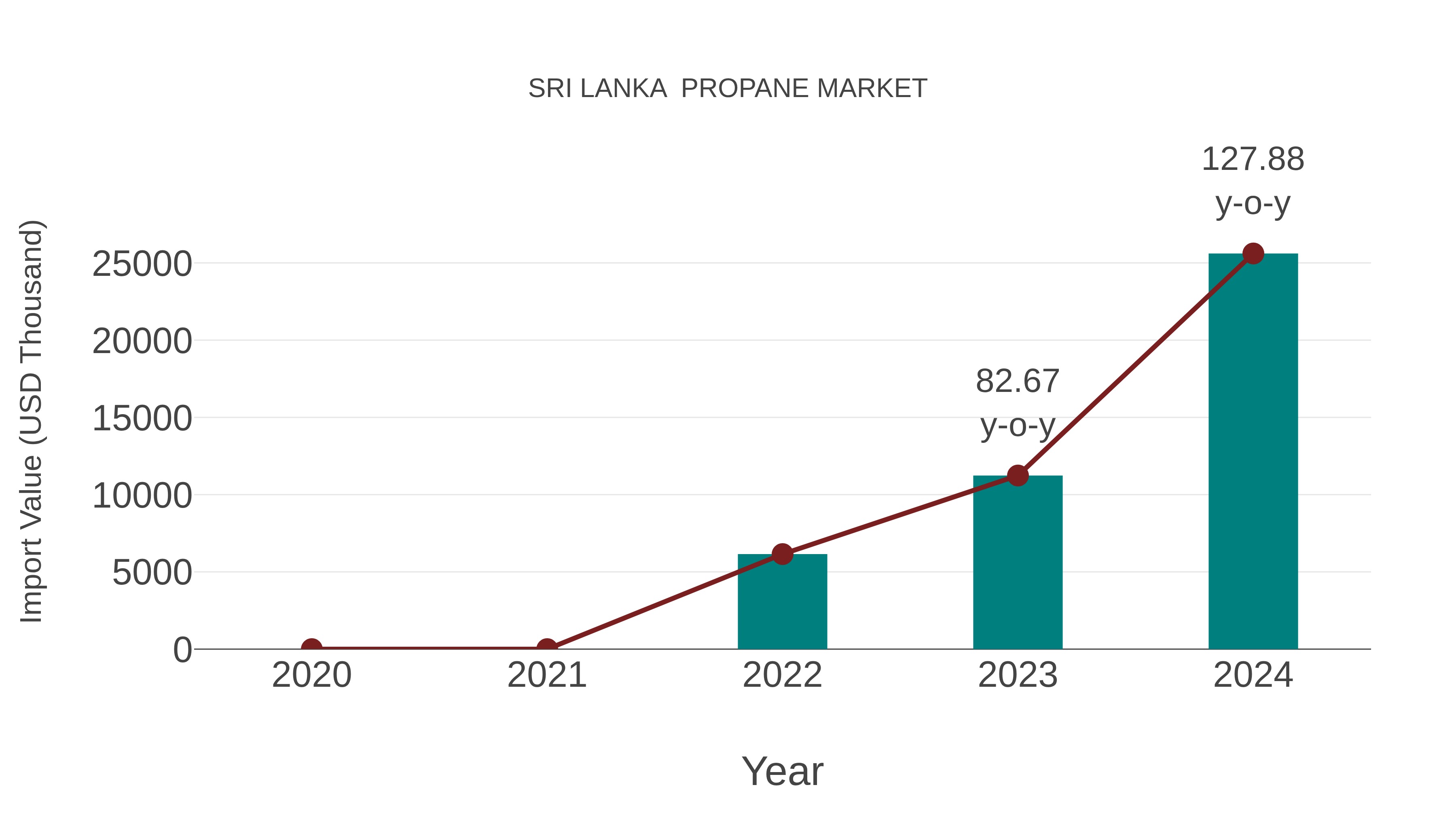
Sri Lanka propane imports exhibited a significant growth trend, with a growth rate of 127.88% from 2023 to 2024. The compound annual growth rate (CAGR) for the period 2020-2024 stood at 104.03%. This surge in imports can be attributed to increasing industrial demand and a shift in energy consumption patterns.
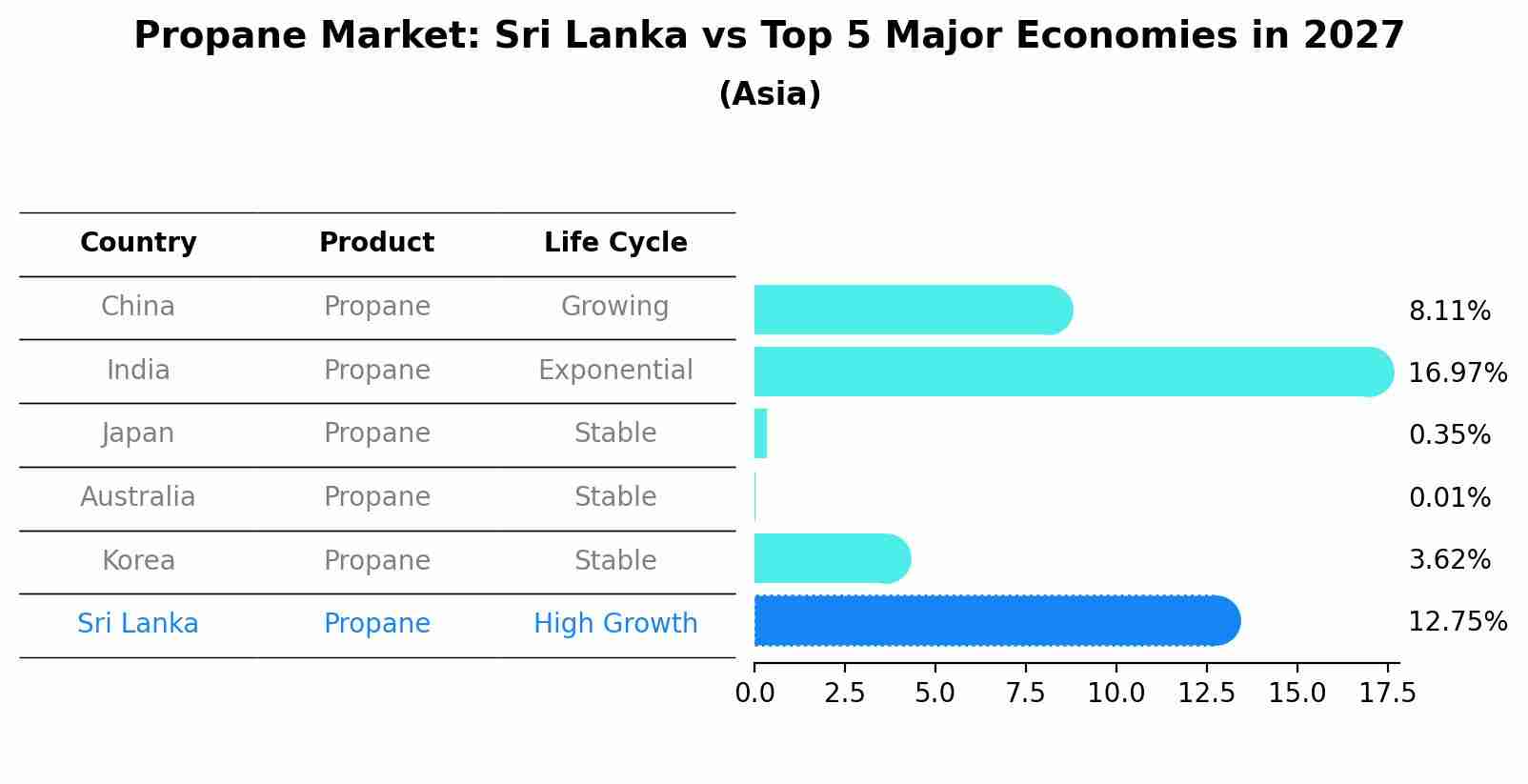
Propane Market: Sri Lanka vs Top 5 Major Economies in 2027 (Asia)
The Propane market in Sri Lanka is projected to grow at a high growth rate of 12.75% by 2027, highlighting the country's increasing focus on advanced technologies within the Asia region, where China holds the dominant position, followed closely by India, Japan, Australia and South Korea, shaping overall regional demand.
Sri Lanka Propane Market Overview
The Sri Lanka propane market is integral to meeting the country`s energy needs across residential, commercial, industrial, and automotive sectors. Propane, known for its versatility and efficiency, serves as a clean-burning alternative fuel for cooking, heating, power generation, and transportation. The market`s growth is driven by initiatives promoting rural electrification, expansion of LPG distribution networks, and government incentives favoring cleaner energy sources. Key stakeholders include propane suppliers, distributors, and energy service providers catering to diverse consumer demands and ensuring reliable supply chains across the island nation.
Drivers of the market
The Sri Lanka propane market is experiencing steady growth driven by the increasing demand for clean energy solutions, residential heating, and industrial applications. Propane, a versatile fuel with lower emissions compared to traditional fuels, is gaining popularity in Sri Lanka energy transition initiatives. Market drivers include rural energy access programs, infrastructure development, and government subsidies promoting clean cooking fuels. Propane suppliers, distributors, and appliance manufacturers are expanding distribution networks, promoting energy-efficient appliances, and offering customer education programs to enhance propane adoption in Sri Lanka. Investments in storage facilities, safety regulations compliance, and renewable propane production are driving market expansion and supporting sustainable energy goals in Sri Lanka.
Challenges of the market
The Propane market in Sri Lanka struggles with high production and import costs. The market`s reliance on imported propane and technology increases costs and susceptibility to global market fluctuations. There is a need for better infrastructure and regulatory frameworks to support the growth of the propane market. Additionally, environmental regulations and the need for adherence to strict safety standards add complexity to the market dynamics. The competition from alternative energy sources and the demand for sustainable propane solutions further complicate the market.
Government Policy of the market
Policies in Sri Lanka propane market focus on energy security, safety regulations, and environmental sustainability. Government initiatives may include licensing requirements for propane distribution, safety standards for storage and handling, and incentives for renewable energy alternatives.
Key Highlights of the Report:
- Sri Lanka Propane Market Outlook
- Market Size of Sri Lanka Propane Market, 2025
- Forecast of Sri Lanka Propane Market, 2032
- Historical Data and Forecast of Sri Lanka Propane Revenues & Volume for the Period 2022-2032F
- Sri Lanka Propane Market Trend Evolution
- Sri Lanka Propane Market Drivers and Challenges
- Sri Lanka Propane Price Trends
- Sri Lanka Propane Porter's Five Forces
- Sri Lanka Propane Industry Life Cycle
- Historical Data and Forecast of Sri Lanka Propane Market Revenues & Volume By Applications for the Period 2022-2032F
- Historical Data and Forecast of Sri Lanka Propane Market Revenues & Volume By Industrial for the Period 2022-2032F
- Historical Data and Forecast of Sri Lanka Propane Market Revenues & Volume By Commercial for the Period 2022-2032F
- Historical Data and Forecast of Sri Lanka Propane Market Revenues & Volume By Residential for the Period 2022-2032F
- Historical Data and Forecast of Sri Lanka Propane Market Revenues & Volume By Transportation for the Period 2022-2032F
- Historical Data and Forecast of Sri Lanka Propane Market Revenues & Volume By Agriculture for the Period 2022-2032F
- Historical Data and Forecast of Sri Lanka Propane Market Revenues & Volume By Chemicals and Refineries for the Period 2022-2032F
- Sri Lanka Propane Import Export Trade Statistics
- Market Opportunity Assessment By Applications
- Sri Lanka Propane Top Companies Market Share
- Sri Lanka Propane Competitive Benchmarking By Technical and Operational Parameters
- Sri Lanka Propane Company Profiles
- Sri Lanka Propane Key Strategic Recommendations






































