United States (US) Railway Maintenance Machinery Market Size, Share & Growth Rate
The United States (US) Railway Maintenance Machinery Market was estimated at USD 201 Million in 2025 and is projected to reach USD 274 Million by 2032, growing at a CAGR of 4.5% from 2026 to 2032. This upward trajectory is largely driven by the increasing investments aimed at modernizing rail infrastructure and a heightened focus on safety and efficiency within the industry. The demand for advanced machinery that enhances the reliability of rail operations is also pivotal, as it aligns with governmental initiatives and private sector investments to upgrade aging systems.
United States (US) Railway Maintenance Machinery Market Year-wise Growth Rate and Key Drivers
This graph highlights how the United States (US) Railway Maintenance Machinery Market has steadily grown over the years, supported by major growth factors.
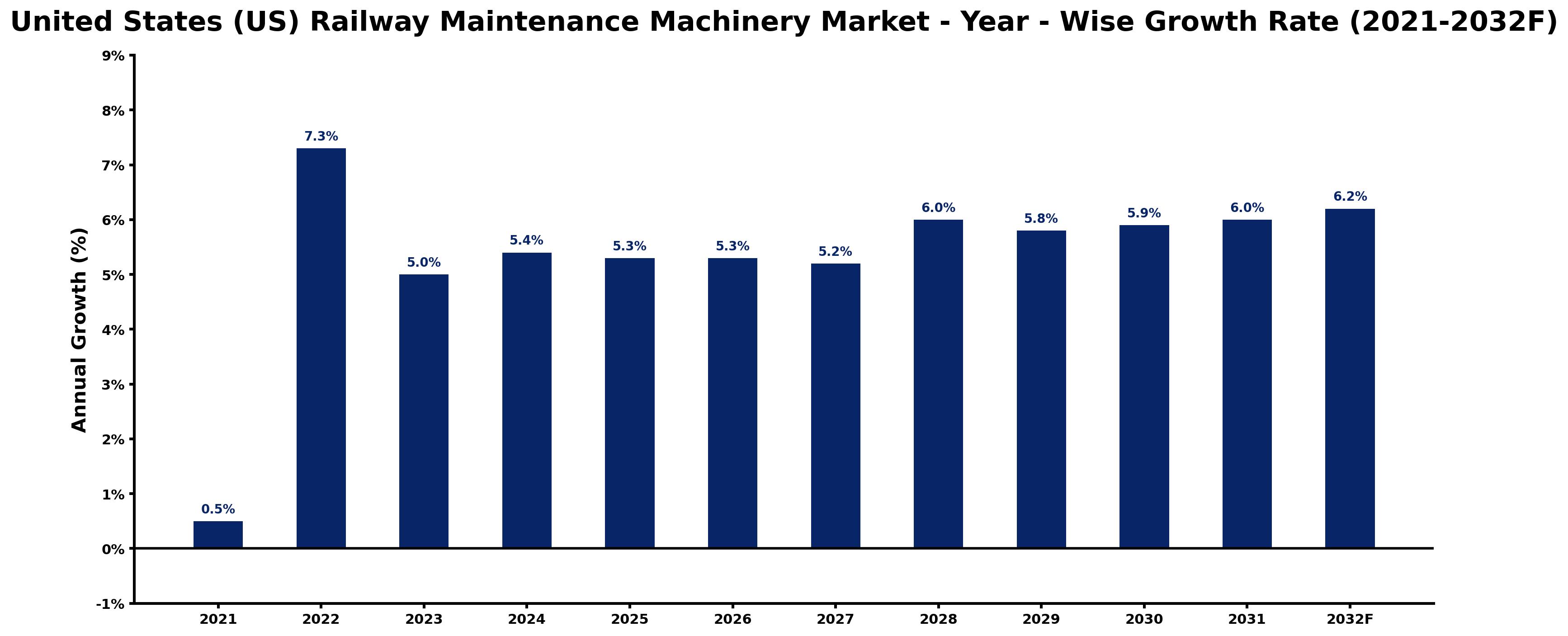
The table below presents the year‑wise growth rates along with the key drivers influencing the market
| Year | Growth Rate | Major Drivers |
| 2021 | 0.5% | Growing urbanization and commercial development |
| 2022 | 7.3% | Rapid growth in telecom and data center sectors |
| 2023 | 5.0% | Expansion of manufacturing activities |
| 2024 | 5.4% | Expansion of manufacturing activities |
| 2025 | 5.3% | Increasing adoption of advanced technologies |
| 2026 | 5.3% | Expansion of transportation and logistics networks |
| 2027 | 5.2% | Increasing smart city development projects |
| 2028 | 6.0% | Increasing smart city development projects |
| 2029 | 5.8% | Expansion of transportation and logistics networks |
| 2030 | 5.9% | Increasing smart city development projects |
| 2031 | 6.0% | Increasing industrial infrastructure investments |
| 2032 | 6.2% | Government infrastructure modernization initiatives |
Note - Market size estimations and growth projections presented in this report are based on 6Wresearch’s advanced forecasting approach, validated with industry datasets as of June 2026.
United States (US) Railway Maintenance Machinery Market Synopsis
The demand for specialized railway maintenance machinery in the United States is being propelled by a robust focus on preventive maintenance strategies. As operators seek to mitigate disruptions and ensure safe rail transport, the need for advanced equipment like rail grinders and ballast regulators continues to rise. This trend is crucial, as maintaining high standards of operational integrity is paramount for both freight and passenger rail services.
In addition, the market is characterized by an increasing emphasis on sustainable practices, as companies are gradually shifting towards eco-friendly machinery options. This reflects broader societal trends prioritizing environmental sustainability, thus creating a dynamic environment where innovation in machinery design and functionality becomes a key competitive factor.
United States (US) Railway Maintenance Machinery Market Key Takeaways
- The market is witnessing significant growth due to ongoing infrastructure investments and technological advancements.
- There is a strong emphasis on sustainable and energy-efficient machinery solutions in railway maintenance.
- The adoption of IoT and AI technologies is enhancing the precision and efficiency of maintenance processes.
- Predictive maintenance solutions are becoming increasingly popular, leveraging data analytics to optimize operations.
- Companies are focusing on modular and customizable equipment to meet diverse operational requirements.
Evaluation of Restraints in United States (US) Railway Maintenance Machinery Market
Despite the promising growth outlook, the market faces significant hurdles. Chief among these are the high costs associated with acquiring and maintaining specialized machinery, which can limit access for smaller operators. Continuous innovation is essential, as companies must keep pace with rapid technological advancements and evolving regulatory standards. Furthermore, the aging infrastructure of rail networks necessitates frequent updates and maintenance, creating additional pressures on resources and investment capabilities.
United States (US) Railway Maintenance Machinery Market Trends
Current trends in the US Railway Maintenance Machinery Market are leaning towards automation and smart technology integration. The introduction of IoT devices and AI-driven maintenance tools is streamlining operations, allowing for real-time data collection and analysis. Another notable trend is the increasing demand for modular designs, enabling operators to customize machinery for specific needs. Moreover, sustainability initiatives are influencing machinery design, as manufacturers seek to reduce the environmental impact of operations.
United States (US) Railway Maintenance Machinery Market Opportunities
The market presents numerous investment opportunities, particularly in advanced maintenance technologies. There is an urgent need for modern equipment that enhances operational safety and efficiency amid growing rail traffic. Investors could benefit significantly from focusing on companies that specialize in developing innovative maintenance solutions, especially those that incorporate eco-friendly technologies and predictive analytics to improve performance and reduce downtime.
Government Initiatives in the United States (US) Railway Maintenance Machinery Market
Government policies are crucial in shaping the US Railway Maintenance Machinery Market. The Federal Railroad Administration (FRA) establishes safety standards and regulations designed to protect workers and maintain operational integrity. Financial support from governmental initiatives, including grants for infrastructure improvements, further encourages the acquisition of modern maintenance machinery. Efforts to prioritize environmental sustainability are also evident, influencing the types of technologies adopted within the market.
Future Insights of the United States (US) Railway Maintenance Machinery Market
Looking ahead to 2026-2032, the US Railway Maintenance Machinery Market is expected to continue its trajectory of steady growth. The ongoing push towards enhancing infrastructure, coupled with technological advancements in maintenance practices, will underpin this expansion. As urbanization and freight demands increase, the need for reliable rail systems will only intensify, prompting further investment in innovative maintenance solutions. Companies that adapt to these evolving needs and leverage strategic partnerships will likely emerge as market leaders.
United States (US) Railway Maintenance Machinery Market Latest Developments (May 2025 - June 2026)
Recent industry movements indicate a growing integration of automation technologies within maintenance operations. Companies are increasingly experimenting with AI-driven analytics tools to enhance predictive maintenance capabilities. Furthermore, there is a noticeable trend towards collaboration between tech firms and traditional machinery manufacturers aimed at developing sustainable solutions, reflecting a broader industry shift towards operational efficiency and environmental responsibility.
United States (US) Railway Maintenance Machinery Market - Key Attractiveness of the Report
- 10 Years of Market Numbers
- Historical Data Starting from 2022 to 2025
- Base Year: 2025
- Forecast Data until 2032
- Key Performance Indicators Impacting the Market
- Major Upcoming Developments and Projects
Key Highlights of the Report:
- United States (US) Railway Maintenance Machinery Market Outlook
- Market Size of United States (US) Railway Maintenance Machinery Market, 2025
- Forecast of United States (US) Railway Maintenance Machinery Market, 2032
- Historical Data and Forecast of United States (US) Railway Maintenance Machinery Revenues & Volume for the Period 2022-2032F
- United States (US) Railway Maintenance Machinery Market Trend Evolution
- United States (US) Railway Maintenance Machinery Market Drivers and Challenges
- United States (US) Railway Maintenance Machinery Price Trends
- United States (US) Railway Maintenance Machinery Porter's Five Forces
- United States (US) Railway Maintenance Machinery Industry Life Cycle
- Historical Data and Forecast of United States (US) Railway Maintenance Machinery Market Revenues & Volume By Type for the Period 2022-2032F
- Historical Data and Forecast of United States (US) Railway Maintenance Machinery Market Revenues & Volume By Tamping Machine for the Period 2022-2032F
- Historical Data and Forecast of United States (US) Railway Maintenance Machinery Market Revenues & Volume By Stabilizing Machinery for the Period 2022-2032F
- Historical Data and Forecast of United States (US) Railway Maintenance Machinery Market Revenues & Volume By Rail Handling Machinery for the Period 2022-2032F
- Historical Data and Forecast of United States (US) Railway Maintenance Machinery Market Revenues & Volume By Ballast Cleaning Machine for the Period 2022-2032F
- Historical Data and Forecast of United States (US) Railway Maintenance Machinery Market Revenues & Volume By Other for the Period 2022-2032F
- Historical Data and Forecast of United States (US) Railway Maintenance Machinery Market Revenues & Volume By Applications for the Period 2022-2032F
- Historical Data and Forecast of United States (US) Railway Maintenance Machinery Market Revenues & Volume By Ballast Track for the Period 2022-2032F
- Historical Data and Forecast of United States (US) Railway Maintenance Machinery Market Revenues & Volume By Ballastless Track for the Period 2022-2032F
- United States (US) Railway Maintenance Machinery Import Export Trade Statistics
- Market Opportunity Assessment By Type
- Market Opportunity Assessment By Applications
- United States (US) Railway Maintenance Machinery Top Companies Market Share
- United States (US) Railway Maintenance Machinery Competitive Benchmarking By Technical and Operational Parameters
- United States (US) Railway Maintenance Machinery Company Profiles
- United States (US) Railway Maintenance Machinery Key Strategic Recommendations






































