United States (US) Telecom Cloud Billing Market Size & Growth Rate (2026-2032)
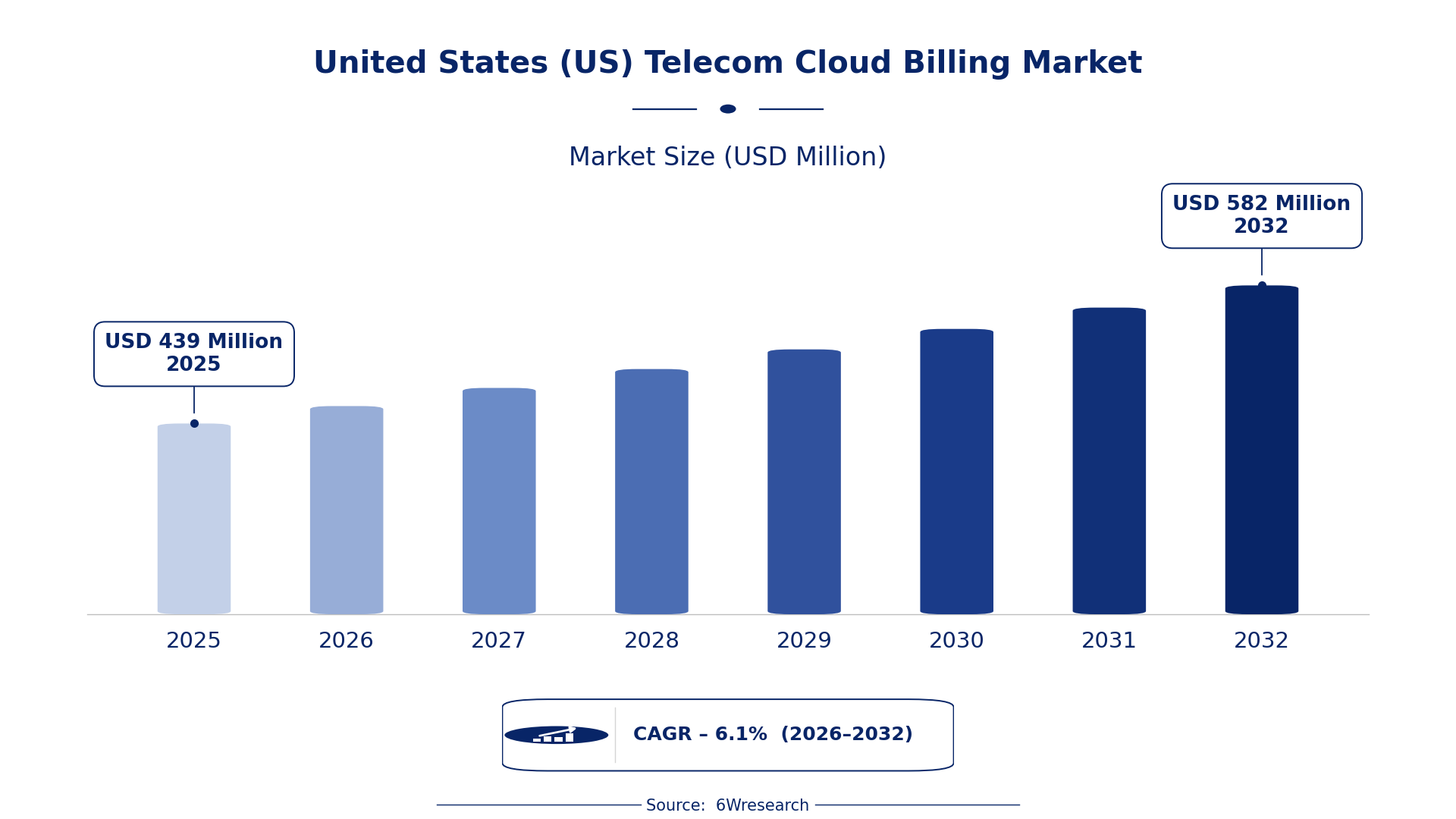
The United States (US) Telecom Cloud Billing Market was estimated at USD 439 Million in 2025 and is projected to reach USD 582 Million by 2032, growing at a CAGR of 6.1% from 2026 to 2032.
United States (US) Telecom Cloud Billing Market Synopsis
The US Telecom Cloud Billing Market is on an upward trajectory, propelled by telecom operators seeking to optimize billing processes through cloud technology. As customer expectations evolve, the industry's move towards personalized and flexible billing models becomes essential for retention and growth.
While the initial momentum showcases significant innovation, the market is bracing for transformative changes driven by advanced technologies such as AI and machine learning. As operators increasingly integrate these capabilities, the demand for real-time billing and dynamic pricing will only intensify, reshaping the market's future.
United States (US) Telecom Cloud Billing Market Year-wise Growth Rate and Key Drivers
This graph illustrates the annual growth rates of the United States (US) Telecom Cloud Billing Market from 2021 to 2032, highlighting a steady upward trajectory and projected expansion over the forecast period.
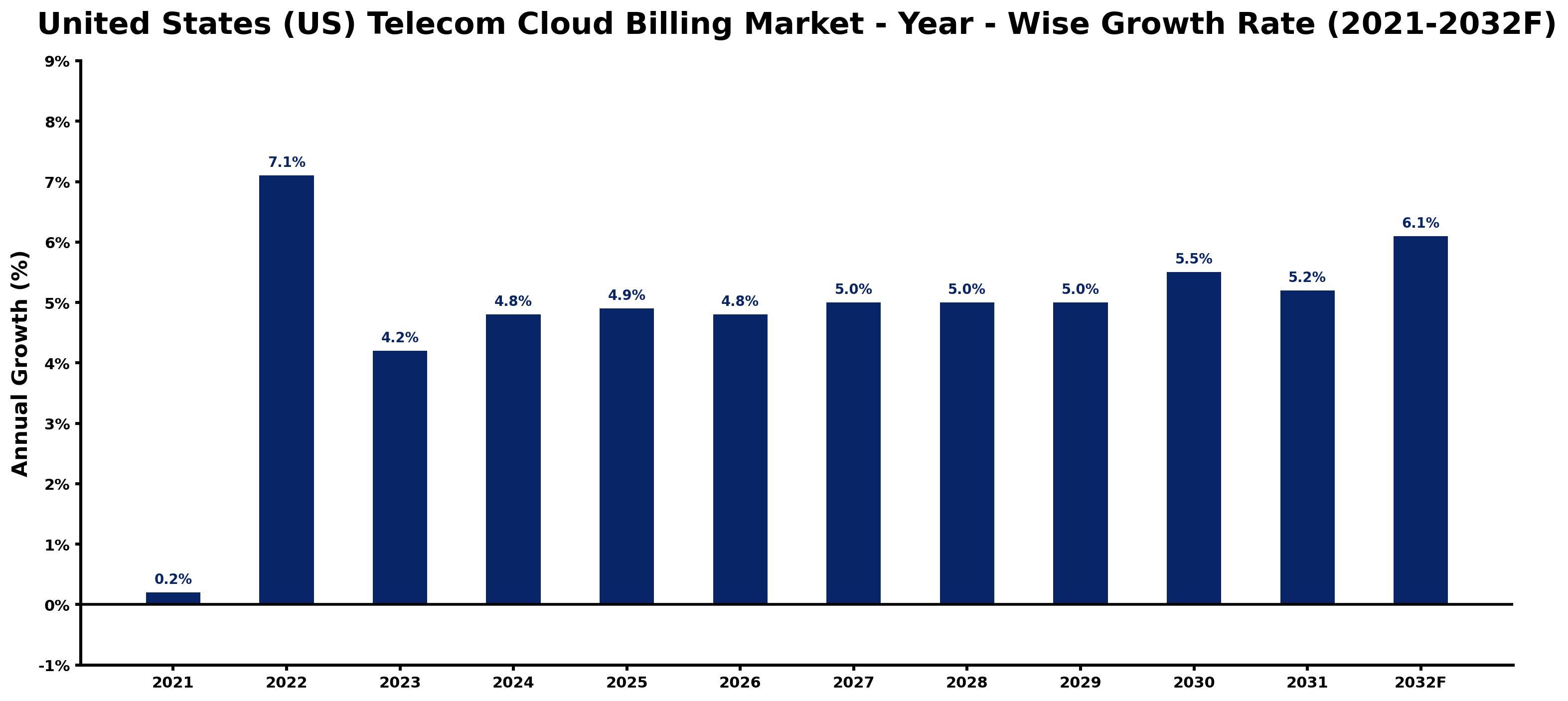
The table below presents the year‑wise growth rates along with the key drivers influencing the market
| Year | Growth Rate | Major Drivers |
| 2021 | 0.2% | FCC's push for broadband access boosting telecom services. |
| 2022 | 7.1% | Rise in digital transformation adoption among telecom providers. |
| 2023 | 4.2% | Increased focus on customer-centric billing solutions post-COVID. |
| 2024 | 4.8% | Regulatory compliance pushing telecoms to adopt cloud billing. |
| 2025 | 4.9% | Emerging fintech partnerships improving billing efficiencies in telecoms. |
| 2026 | 4.8% | Demand for seamless cross-border billing solutions rising. |
| 2027 | 5.0% | Adoption of subscription models increasing complexity of billing. |
| 2028 | 5.0% | Regulatory trends favoring cloud services in telecom sector. |
| 2029 | 5.0% | Corporate consolidation in telecom driving unified billing solutions. |
| 2030 | 5.5% | Growth of remote work spurring demand for flexible billing. |
| 2031 | 5.2% | Increased competition driving innovation in billing platforms. |
| 2032 | 6.1% | Sustainability initiatives prompting green billing practices. |
Note: Market size estimations and growth projections presented in this report are based on 6Wresearch's proprietary forecasting methodology, utilizing the latest available industry data, government publications, and primary research inputs.
United States (US) Telecom Cloud Billing Market Key Takeaways
Below are some of the specific key takeaways from the market, including:
- Telecom operators are shifting towards usage-based billing and personalized options to meet customer demands.
- Integration of AI and machine learning technologies is enhancing billing accuracy and operational efficiency.
- Cloud-based solutions offer scalability and flexibility, which are crucial for adapting to market changes.
- Real-time billing capabilities are becoming essential to support dynamic pricing strategies.
- The demand for subscription-based services continues to drive revenue growth within the telecom sector.
Evaluation of Restraints in United States (US) Telecom Cloud Billing Market
The US Telecom Cloud Billing Market faces notable constraints, primarily due to intense competition among service providers, which leads to constant pricing pressures. Regulatory complexities, which differ across states, pose additional challenges for telecom operators in maintaining compliance while innovating.
Moreover, the integration of legacy billing systems with new cloud technologies remains a critical hurdle. As telecom companies aim to transition without compromising customer experience, the challenge of ensuring data security and privacy further complicates the landscape. Meeting the rapidly changing customer expectations for flexible billing options is essential for sustained market growth.
United States (US) Telecom Cloud Billing Market Trends
Several trends are shaping the US Telecom Cloud Billing Market. A clear move towards real-time billing reflects the need for operators to adopt more dynamic pricing models. This trend is bolstered by growing consumer demands for transparency and immediacy in billing.
The emphasis on integrating AI and machine learning facilitates better analytics, allowing providers to offer tailored billing solutions that enhance customer experience. Additionally, the rise of subscription-based services indicates a shift in consumer behavior, leading telecom operators to seek billing systems that support consistent revenue streams.
United States (US) Telecom Cloud Billing Market Opportunities
The US Telecom Cloud Billing Market presents lucrative investment opportunities, particularly as telecom companies strive for operational efficiencies. As the demand for subscription-based services grows, providers who can deliver flexible and scalable billing solutions are well-positioned to capture market share.
Investment in advanced technologies like AI and machine learning will likely yield significant returns, as these tools enhance billing accuracy and customer satisfaction. The market’s evolution creates an environment ripe for innovation, making it a compelling sector for stakeholders seeking to leverage emerging technologies.
Government Initiatives in the United States (US) Telecom Cloud Billing Market
Government policies are actively shaping the US Telecom Cloud Billing Market through regulatory measures and public initiatives aimed at enhancing competition and consumer protection. The Federal Communications Commission (FCC) has instituted various guidelines to ensure fair practices, influencing how telecom providers bill for cloud services.
- A recently completed initiative by the FCC established new transparency rules for billing practices in response to growing consumer demand for clarity.
- Currently underway is the Rural Digital Opportunity Fund, which aims to extend broadband access to underserved regions, potentially increasing cloud billing adoption.
- A planned public-private partnership set to launch in 2026 intends to modernize telecom infrastructure, directly affecting the cloud billing ecosystem.
- New data privacy regulations, including the California Consumer Privacy Act, emphasize compliance for handling customer billing information securely.
- Upcoming revisions to state-level telecom regulations will introduce additional compliance requirements affecting billing practices throughout the industry.
Future Insights of the United States (US) Telecom Cloud Billing Market
Looking ahead to 2026-2032, the US Telecom Cloud Billing Market is poised for substantial evolution. The demand for cloud-based solutions is expected to rise sharply as telecom companies streamline their operations to enhance customer experiences. Rapid technological advancements will continue to drive innovation, particularly in the realms of AI and machine learning.
In addition, the transition toward digital services will play a critical role in shaping billing strategies, with subscription models becoming increasingly prevalent. As operators adjust to these trends, the market will likely see significant investment and growth opportunities over the next several years.
United States (US) Telecom Cloud Billing Market Latest Developments
Recent industry activity in the US Telecom Cloud Billing Market has reflected a strong focus on technological advancements and customer-centric solutions. Companies are increasingly prioritizing the implementation of AI-driven analytics to enhance billing precision and efficiency.
- A leading telecom operator announced a cloud billing platform upgrade completed in early 2025, introducing enhanced real-time billing features.
- Currently, several regional operators are piloting subscription-based billing models that utilize AI for improved customer segmentation and experience.
- A planned technology rollout by a major vendor is expected to start in late 2026, focusing on integrating machine learning capabilities into existing cloud billing systems.
- An initiative that began in mid-2025 aims to address customer security concerns by upgrading data encryption protocols in billing systems.
- A new collaborative project between technology firms and telecom providers is anticipated to launch by early 2026, exploring innovative billing solutions tailored for IoT services.
United States (US) Telecom Cloud Billing Market - Key Attractiveness of the Report
- 10 Years of Market Numbers
- Historical Data Starting from 2022 to 2025
- Base Year: 2025
- Forecast Data until 2032
- Key Performance Indicators Impacting the Market
- Major Upcoming Developments and Projects
Key Highlights of the Report:
- United States (US) Telecom Cloud Billing Market Outlook
- Market Size of United States (US) Telecom Cloud Billing Market, 2025
- Forecast of United States (US) Telecom Cloud Billing Market, 2032
- Historical Data and Forecast of United States (US) Telecom Cloud Billing Revenues & Volume for the Period 2022-2032F
- United States (US) Telecom Cloud Billing Market Trend Evolution
- United States (US) Telecom Cloud Billing Market Drivers and Challenges
- United States (US) Telecom Cloud Billing Price Trends
- United States (US) Telecom Cloud Billing Porter's Five Forces
- United States (US) Telecom Cloud Billing Industry Life Cycle
- Historical Data and Forecast of United States (US) Telecom Cloud Billing Market Revenues & Volume By Type of Billing for the Period 2022-2032F
- Historical Data and Forecast of United States (US) Telecom Cloud Billing Market Revenues & Volume By Convergent for the Period 2022-2032F
- Historical Data and Forecast of United States (US) Telecom Cloud Billing Market Revenues & Volume By Prepaid for the Period 2022-2032F
- Historical Data and Forecast of United States (US) Telecom Cloud Billing Market Revenues & Volume By Postpaid for the Period 2022-2032F
- Historical Data and Forecast of United States (US) Telecom Cloud Billing Market Revenues & Volume By Interconnect for the Period 2022-2032F
- Historical Data and Forecast of United States (US) Telecom Cloud Billing Market Revenues & Volume By Roaming for the Period 2022-2032F
- Historical Data and Forecast of United States (US) Telecom Cloud Billing Market Revenues & Volume By Others (Direct to Consumer (D2C) and Metered) for the Period 2022-2032F
- Historical Data and Forecast of United States (US) Telecom Cloud Billing Market Revenues & Volume By Cloud Platform for the Period 2022-2032F
- Historical Data and Forecast of United States (US) Telecom Cloud Billing Market Revenues & Volume By SaaS for the Period 2022-2032F
- Historical Data and Forecast of United States (US) Telecom Cloud Billing Market Revenues & Volume By Others (IaaS and PaaS) for the Period 2022-2032F
- Historical Data and Forecast of United States (US) Telecom Cloud Billing Market Revenues & Volume By End User for the Period 2022-2032F
- Historical Data and Forecast of United States (US) Telecom Cloud Billing Market Revenues & Volume By Individuals for the Period 2022-2032F
- Historical Data and Forecast of United States (US) Telecom Cloud Billing Market Revenues & Volume By Enterprises for the Period 2022-2032F
- Historical Data and Forecast of United States (US) Telecom Cloud Billing Market Revenues & Volume By Application for the Period 2022-2032F
- Historical Data and Forecast of United States (US) Telecom Cloud Billing Market Revenues & Volume By Revenue Management for the Period 2022-2032F
- Historical Data and Forecast of United States (US) Telecom Cloud Billing Market Revenues & Volume By Account Management for the Period 2022-2032F
- Historical Data and Forecast of United States (US) Telecom Cloud Billing Market Revenues & Volume By Customer Management for the Period 2022-2032F
- Historical Data and Forecast of United States (US) Telecom Cloud Billing Market Revenues & Volume By Rate of Charging Mode for the Period 2022-2032F
- Historical Data and Forecast of United States (US) Telecom Cloud Billing Market Revenues & Volume By Subscription-Based for the Period 2022-2032F
- Historical Data and Forecast of United States (US) Telecom Cloud Billing Market Revenues & Volume By Usage-Based for the Period 2022-2032F
- Historical Data and Forecast of United States (US) Telecom Cloud Billing Market Revenues & Volume By Service for the Period 2022-2032F
- Historical Data and Forecast of United States (US) Telecom Cloud Billing Market Revenues & Volume By Professional for the Period 2022-2032F
- Historical Data and Forecast of United States (US) Telecom Cloud Billing Market Revenues & Volume By Managed for the Period 2022-2032F
- United States (US) Telecom Cloud Billing Import Export Trade Statistics
- Market Opportunity Assessment By Type of Billing
- Market Opportunity Assessment By Cloud Platform
- Market Opportunity Assessment By End User
- Market Opportunity Assessment By Application
- Market Opportunity Assessment By Rate of Charging Mode
- Market Opportunity Assessment By Service
- United States (US) Telecom Cloud Billing Top Companies Market Share
- United States (US) Telecom Cloud Billing Competitive Benchmarking By Technical and Operational Parameters
- United States (US) Telecom Cloud Billing Company Profiles
- United States (US) Telecom Cloud Billing Key Strategic Recommendations






































