United States (US) Transport Packaging Market Summary
The united states (us) transport packaging market was estimated at USD 138 Million in 2025 and is projected to reach USD 162 Million by 2032, growing at a CAGR of 2.5% from 2026 to 2032.
United States (US) Transport Packaging Market Year-wise Growth Rate and Key Drivers
This graph highlights how the United States (US) Transport Packaging Market has steadily grown over the past five years, supported by major growth factors.
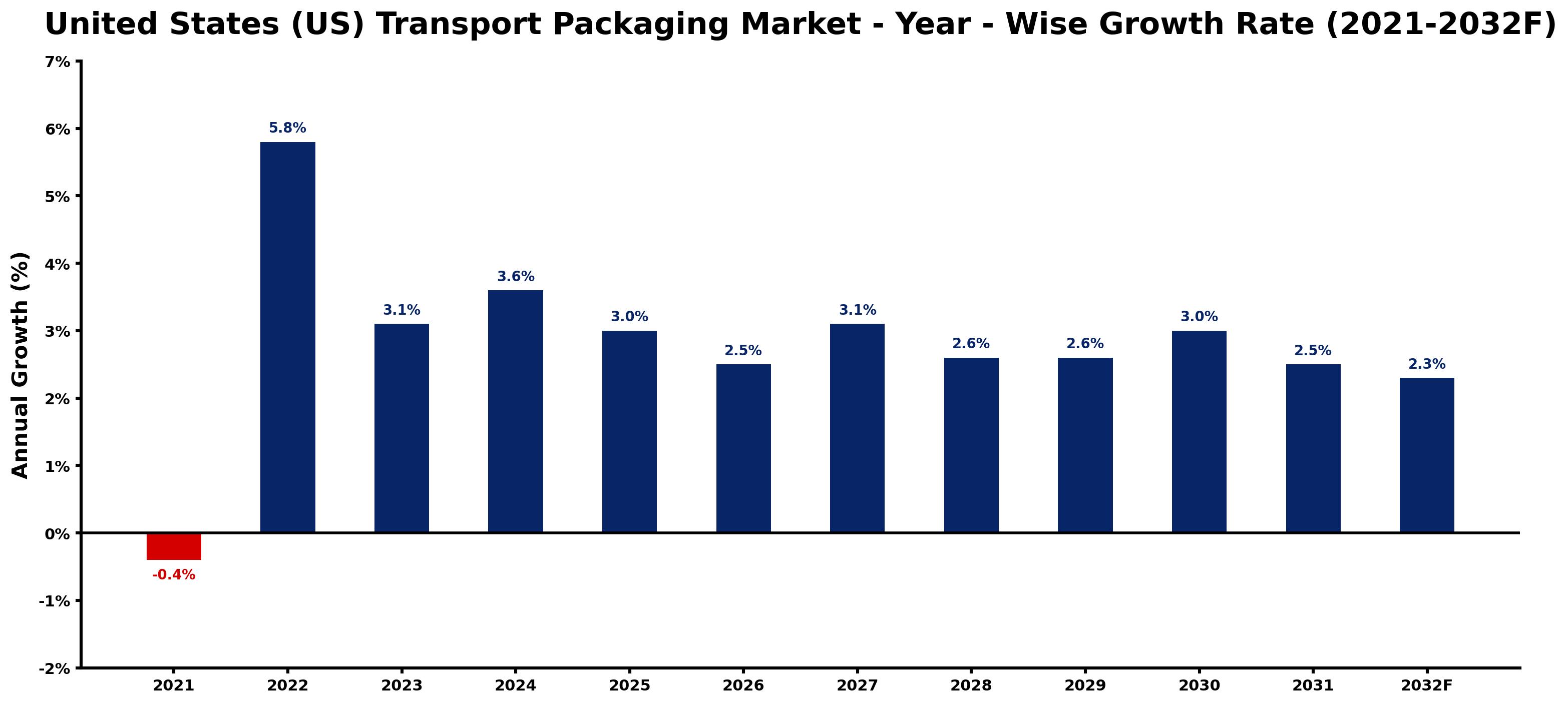
The table below presents the year wise growth rates along with the key drivers influencing the market
| Year | Growth Rate | Major Drivers |
| 2021 | -0.4% | Supply chain disruptions caused by the pandemic hampered availability and timeliness of transport packaging materials. |
| 2022 | 5.8% | E-commerce's expansion demands innovative transport packaging for last-mile delivery optimization. |
| 2023 | 3.1% | Consumer preferences shift towards eco-friendly materials, influencing packaging design strategies. |
| 2024 | 3.6% | Supply chain disruptions ignite interest in robust, resilient packaging solutions. |
| 2025 | 3.0% | Technological improvements in packaging machinery enhance production efficiency and sustainability. |
| 2026 | 2.5% | Corporate sustainability pledges stimulate investment in biodegradable and recyclable packaging options. |
| 2027 | 3.1% | Emerging market entrants focus on niche transport packaging markets, diversifying offerings. |
| 2028 | 2.6% | Retailer collaborations promote standardized packaging to simplify logistics and reduce waste. |
| 2029 | 2.6% | Innovations in smart packaging technologies provide real-time tracking and inventory management. |
| 2030 | 3.0% | Rising consumer awareness of environmental issues reshapes transport packaging industry standards. |
| 2031 | 2.5% | Integration of AI and IoT in packaging systems improves operational efficiency and analytics. |
| 2032 | 2.3% | Circular economy principles gain traction, encouraging packaging reuse and recycling initiatives. |
Note - Market size estimations and growth projections presented in this report are based on 6Wresearch's advanced forecasting approach, validated with industry datasets as of June 2026.
United States (US) Transport Packaging Market Synopsis
The United States (US) Transport Packaging Market is projected to reach 2.5% and witness significant growth during the forecast period (2026-2032). This market is characterized by a robust demand for advanced packaging solutions that ensure the safe transportation of goods across diverse sectors, including food and beverage, electronics, pharmaceuticals, and automotive. With sustainability as a growing concern, the market is evolving towards eco-friendly materials and technologies that enhance efficiency and compliance with regulatory standards.
United States (US) Transport Packaging Market Growth Drivers
Several factors are driving the expansion of the United States (US) Transport Packaging Market. Key drivers include:
- Increased e-commerce activities, which have amplified the demand for packaging solutions that can withstand various shipping conditions while ensuring product integrity.
- The globalization of supply chains necessitating reliable, efficient transport packaging to meet international shipping standards.
- Heightened awareness regarding environmental sustainability propelling the adoption of recyclable and biodegradable packaging materials.
- Technological advancements, including RFID and IoT, facilitating enhanced tracking and monitoring systems during transit.
- Regulatory requirements demanding higher safety standards in product packaging, particularly in sensitive industries such as pharmaceuticals and food.
United States (US) Transport Packaging Market Trends and Opportunities
The landscape of the United States (US) Transport Packaging Market is marked by several notable trends that present promising opportunities for stakeholders:
- A shift towards sustainable packaging solutions is evident, with companies increasingly investing in eco-friendly materials that minimize environmental impact.
- Automation in packaging processes is becoming prevalent, enhancing operational efficiency and reducing human error in packaging operations.
- Innovative packaging designs are emerging to improve consumer experience, particularly in e-commerce, where unboxing plays a pivotal role in customer satisfaction.
- There is a rising emphasis on lightweight packaging materials that reduce shipping costs and carbon footprint without compromising durability.
- Collaborations between technology providers and packaging manufacturers are fostering the development of smart packaging solutions that integrate advanced tracking technologies.
United States (US) Transport Packaging Market Challenges and Restraints
Despite its growth potential, the United States (US) Transport Packaging Market faces several challenges that could impact its trajectory:
- Fluctuations in raw material prices impacting production costs and profit margins for manufacturers.
- The increasing pressure to adopt sustainable practices leading to higher research and development investments.
- Evolving regulatory frameworks that may impose additional compliance costs and operational challenges.
- The demand for innovative packaging solutions necessitating continuous investment in technology and design.
- Competition among market players for market share, pushing companies to differentiate their offerings amidst changing consumer preferences.
United States (US) Transport Packaging Market Government Investment and Initiatives
Government initiatives in the United States are playing a significant role in shaping the transport packaging sector. Focused predominantly on sustainability, these initiatives encourage the use of eco-friendly packaging solutions. Key actions include:
- Establishment of regulations aimed at reducing carbon emissions through enhanced packaging practices.
- The promotion of programs like the Sustainable Packaging Coalition advocating for innovative and environmentally responsible packaging materials.
- Projects under the Environmental Protection Agency's SmartWay Transport Partnership focusing on improving logistic efficiency and environmental performance.
- Funding and grants allocated for research and development of sustainable packaging technologies.
- Collaboration with industry stakeholders to develop guidelines for best practices in transport packaging, ensuring compliance with safety and environmental standards.
United States (US) Transport Packaging Market Latest Developments (May 2025 - June 2026)
In the period from May 2025 to June 2026, the United States (US) Transport Packaging Market has witnessed several noteworthy developments that reflect its adaptive nature:
- A surge in demand for packaging solutions that cater to the unique requirements of the growing e-commerce sector, emphasizing durability and customer experience.
- Increased investments in smart packaging technology, supporting better supply chain visibility and efficiency.
- Enhanced focus on sustainable practices, with more companies committing to reducing their carbon footprint through innovative packaging materials.
- Ongoing collaborations between packaging firms and technology developers to create packaging solutions that provide real-time tracking capabilities.
- Regulatory changes encouraging the adoption of sustainable packaging practices have prompted many companies to reassess their packaging strategies in compliance with new standards.
United States (US) Transport Packaging Market - Key Attractiveness of the Report
- 10 Years of Market Numbers
- Historical Data Starting from 2022 to 2025
- Base Year: 2025
- Forecast Data until 2032
- Key Performance Indicators Impacting the Market
- Major Upcoming Developments and Projects
Key Highlights of the Report:
- United States (US) Transport Packaging Market Outlook
- Market Size of United States (US) Transport Packaging Market, 2025
- Forecast of United States (US) Transport Packaging Market, 2032F
- Historical Data and Forecast of United States (US) Transport Packaging Revenues & Volume for the Period 2022-2032F
- United States (US) Transport Packaging Market Trend Evolution
- United States (US) Transport Packaging Market Drivers and Challenges
- United States (US) Transport Packaging Price Trends
- United States (US) Transport Packaging Porter's Five Forces
- United States (US) Transport Packaging Industry Life Cycle
- Historical Data and Forecast of United States (US) Transport Packaging Market Revenues & Volume By Material Type for the Period 2022-2032F
- Historical Data and Forecast of United States (US) Transport Packaging Market Revenues & Volume By Plastic for the Period 2022-2032F
- Historical Data and Forecast of United States (US) Transport Packaging Market Revenues & Volume By Polyethylene (PE) for the Period 2022-2032F
- Historical Data and Forecast of United States (US) Transport Packaging Market Revenues & Volume By Polypropylene (PP) for the Period 2022-2032F
- Historical Data and Forecast of United States (US) Transport Packaging Market Revenues & Volume By Polyethylene Terephthalate (PET) for the Period 2022-2032F
- Historical Data and Forecast of United States (US) Transport Packaging Market Revenues & Volume By Paper & Paperboard for the Period 2022-2032F
- Historical Data and Forecast of United States (US) Transport Packaging Market Revenues & Volume By Metal for the Period 2022-2032F
- Historical Data and Forecast of United States (US) Transport Packaging Market Revenues & Volume By Wood for the Period 2022-2032F
- Historical Data and Forecast of United States (US) Plastic Transport Packaging Market Revenues & Volume By Others for the Period 2022-2032F
- Historical Data and Forecast of United States (US) Transport Packaging Market Revenues & Volume By Packaging Types for the Period 2022-2032F
- Historical Data and Forecast of United States (US) Transport Packaging Market Revenues & Volume By Cartons for the Period 2022-2032F
- Historical Data and Forecast of United States (US) Transport Packaging Market Revenues & Volume By Wooden crates for the Period 2022-2032F
- Historical Data and Forecast of United States (US) Transport Packaging Market Revenues & Volume By Containers for the Period 2022-2032F
- Historical Data and Forecast of United States (US) Transport Packaging Market Revenues & Volume By Corrugated boxes for the Period 2022-2032F
- Historical Data and Forecast of United States (US) Transport Packaging Market Revenues & Volume By Barrels for the Period 2022-2032F
- Historical Data and Forecast of United States (US) Transport Packaging Market Revenues & Volume By IBCs for the Period 2022-2032F
- Historical Data and Forecast of United States (US) Transport Packaging Market Revenues & Volume By Strapping for the Period 2022-2032F
- Historical Data and Forecast of United States (US) Transport Packaging Market Revenues & Volume By Others for the Period 2022-2032F
- Historical Data and Forecast of United States (US) Transport Packaging Market Revenues & Volume By End-users for the Period 2022-2032F
- Historical Data and Forecast of United States (US) Transport Packaging Market Revenues & Volume By Agriculture for the Period 2022-2032F
- Historical Data and Forecast of United States (US) Transport Packaging Market Revenues & Volume By Automotive for the Period 2022-2032F
- Historical Data and Forecast of United States (US) Transport Packaging Market Revenues & Volume By Building & Construction for the Period 2022-2032F
- Historical Data and Forecast of United States (US) Transport Packaging Market Revenues & Volume By Chemicals & Pharmaceuticals for the Period 2022-2032F
- Historical Data and Forecast of United States (US) Transport Packaging Market Revenues & Volume By Food & Beverages for the Period 2022-2032F
- Historical Data and Forecast of United States (US) Transport Packaging Market Revenues & Volume By Metallurgical for the Period 2022-2032F
- Historical Data and Forecast of United States (US) Transport Packaging Market Revenues & Volume By Electrical & Electronics for the Period 2022-2032F
- Historical Data and Forecast of United States (US) Transport Packaging Market Revenues & Volume By Others for the Period 2022-2032F
- United States (US) Transport Packaging Import Export Trade Statistics
- Market Opportunity Assessment By Material Type
- Market Opportunity Assessment By Packaging Types
- Market Opportunity Assessment By End-users
- United States (US) Transport Packaging Top Companies Market Share
- United States (US) Transport Packaging Competitive Benchmarking By Technical and Operational Parameters
- United States (US) Transport Packaging Company Profiles
- United States (US) Transport Packaging Key Strategic Recommendations






































