United States (US) Washable Markers Market Top 5 Importing Countries and Market Competition (HHI) Analysis
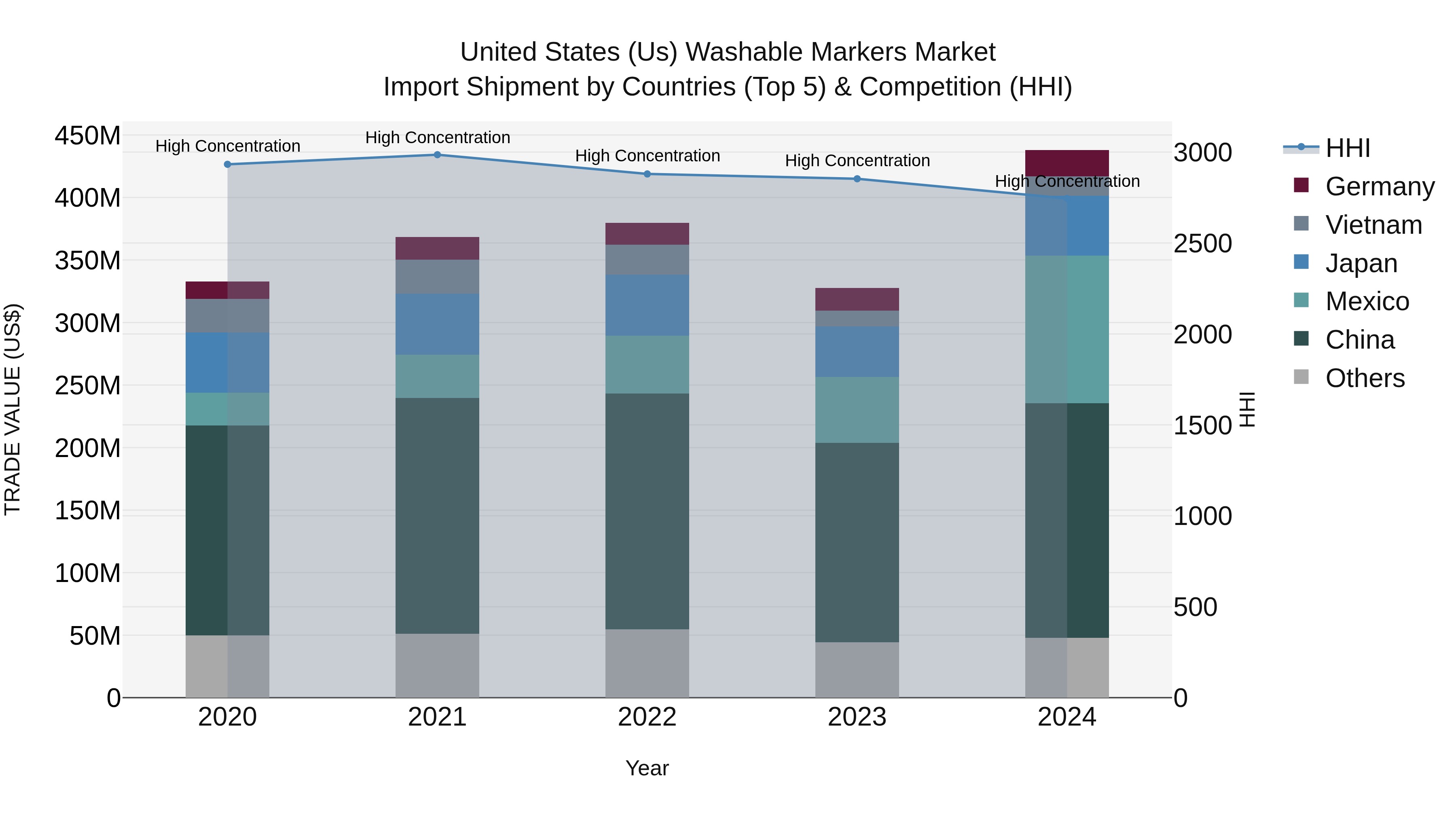
The United States saw a significant increase in washable markers import shipments in 2024, with top exporting countries including China, Mexico, Japan, Germany, and Vietnam. The market remained highly concentrated, indicating strong competition among key players. The compound annual growth rate (CAGR) from 2020 to 2024 was 7.1%, reflecting a steady upward trend in market demand. Notably, the growth rate from 2023 to 2024 surged by 33.68%, suggesting a rapid acceleration in imports for washable markers. This data points to a flourishing market for washable markers in the United States, driven by diverse international suppliers.
United States (US) Washable Markers Market Overview
The United States washable markers market is characterized by a high demand for non-toxic and easily washable markers, particularly driven by the growing emphasis on child safety and environmental consciousness. With a focus on products that are safe for children to use and easy to clean, manufacturers are incorporating water-based ink and washable formulas to meet consumer preferences. The market is highly competitive with key players such as Crayola, Faber-Castell, and Sharpie dominating the landscape. In addition to the traditional school and office supply stores, online retail channels have also been instrumental in driving sales growth. As consumers increasingly prioritize sustainability and safety in their purchasing decisions, the washable markers market in the US is expected to continue growing as manufacturers innovate to meet these evolving demands.
United States (US) Washable Markers Market Trends
In the US Washable Markers Market, there is a growing demand for eco-friendly and non-toxic options as consumers become more conscious of sustainability and safety. Manufacturers are responding to this trend by producing washable markers that are free from harmful chemicals and can be easily washed off clothes and surfaces. Additionally, there is a rise in the popularity of specialty washable markers, such as scented markers, dual-tip markers, and neon colors, catering to both children and adults who use them for various creative purposes. Online sales channels are also gaining momentum, offering a convenient way for consumers to purchase a wide range of washable markers from the comfort of their homes. Overall, the US Washable Markers Market is witnessing a shift towards environmentally-friendly products and innovative designs to meet evolving consumer preferences.
United States (US) Washable Markers Market Challenges
In the US Washable Markers Market, challenges include increasing competition from other art supplies such as colored pencils and crayons, as well as the growing popularity of digital art mediums among younger consumers. Additionally, concerns about the environmental impact of disposable markers and the push for more sustainable and eco-friendly products pose a challenge for traditional washable markers. Pricing pressures from low-cost alternatives and private label brands also impact market growth. Furthermore, the COVID-19 pandemic has disrupted supply chains and distribution channels, leading to inventory shortages and logistical challenges for manufacturers and retailers. Adapting to changing consumer preferences, addressing sustainability issues, and navigating the impacts of the pandemic are key challenges faced by players in the US Washable Markers Market.
United States (US) Washable Markers Market Investment Opportunities
The US Washable Markers Market presents attractive investment opportunities due to increasing demand driven by the growing trend of coloring activities among children and adults, as well as the rising popularity of DIY crafts and art projects. With consumers placing a premium on products that are non-toxic, easy to clean, and environmentally friendly, washable markers are gaining traction in the market. Investors can capitalize on this trend by investing in companies that offer innovative and high-quality washable marker products, expanding distribution channels to reach a wider consumer base, and leveraging marketing strategies to promote the benefits of washable markers. Additionally, exploring partnerships with educational institutions, art supply stores, and online retailers can further drive growth in this market segment.
United States (US) Washable Markers Market Government Policy
Government policies related to the US Washable Markers Market focus primarily on product safety regulations, environmental sustainability, and labeling requirements. The Consumer Product Safety Commission (CPSC) sets standards for washable markers to ensure they are non-toxic and safe for children to use. Additionally, the Environmental Protection Agency (EPA) monitors the environmental impact of marker production and usage, encouraging manufacturers to use eco-friendly materials and reduce waste. Labeling regulations enforced by the Federal Trade Commission (FTC) require accurate information regarding ingredients, age appropriateness, and potential hazards on marker packaging. Overall, these policies aim to protect consumers, promote sustainability, and ensure transparency in the washable markers market in the US.
United States (US) Washable Markers Market Future Outlook
The future outlook for the United States washable markers market appears positive, driven by increasing demand for child-safe and environmentally friendly art supplies. With a growing focus on non-toxic and washable products among parents and educators, washable markers are expected to continue gaining popularity in schools, households, and recreational settings. The market is likely to witness innovations in terms of colors, tip designs, and packaging to cater to evolving consumer preferences. Additionally, the rise of online retail channels and e-commerce platforms is anticipated to further boost market growth by expanding product accessibility and reaching a broader customer base. Overall, the US washable markers market is poised for steady expansion in the coming years, fueled by a combination of safety concerns, product innovations, and market reach enhancements.
Key Highlights of the Report:
- United States (US) Washable Markers Market Outlook
- Market Size of United States (US) Washable Markers Market, 2024
- Forecast of United States (US) Washable Markers Market, 2031
- Historical Data and Forecast of United States (US) Washable Markers Revenues & Volume for the Period 2021 - 2031
- United States (US) Washable Markers Market Trend Evolution
- United States (US) Washable Markers Market Drivers and Challenges
- United States (US) Washable Markers Price Trends
- United States (US) Washable Markers Porter's Five Forces
- United States (US) Washable Markers Industry Life Cycle
- Historical Data and Forecast of United States (US) Washable Markers Market Revenues & Volume By Washability for the Period 2021 - 2031
- Historical Data and Forecast of United States (US) Washable Markers Market Revenues & Volume By Basic- Washable for the Period 2021 - 2031
- Historical Data and Forecast of United States (US) Washable Markers Market Revenues & Volume By Super-washable for the Period 2021 - 2031
- Historical Data and Forecast of United States (US) Washable Markers Market Revenues & Volume By End User for the Period 2021 - 2031
- Historical Data and Forecast of United States (US) Washable Markers Market Revenues & Volume By Children for the Period 2021 - 2031
- Historical Data and Forecast of United States (US) Washable Markers Market Revenues & Volume By Professionals for the Period 2021 - 2031
- United States (US) Washable Markers Import Export Trade Statistics
- Market Opportunity Assessment By Washability
- Market Opportunity Assessment By End User
- United States (US) Washable Markers Top Companies Market Share
- United States (US) Washable Markers Competitive Benchmarking By Technical and Operational Parameters
- United States (US) Washable Markers Company Profiles
- United States (US) Washable Markers Key Strategic Recommendations






































