United States (US) Wheel Loader Market Size, Share & Growth Rate
The United States (US) Wheel Loader Market was estimated at USD 112 Million in 2025 and is projected to reach USD 131 Million by 2032, growing at a CAGR of 2.3% from 2026 to 2032. This steady growth trajectory can be attributed to a robust infrastructure development plan and a resurgence in residential construction projects across the country. Additionally, the increasing demand for fuel-efficient and advanced machinery is further driving this market forward.
United States (US) Wheel Loader Market Year-wise Growth Rate and Key Drivers
This graph highlights how the United States (US) Wheel Loader Market has steadily grown over the years, supported by major growth factors.
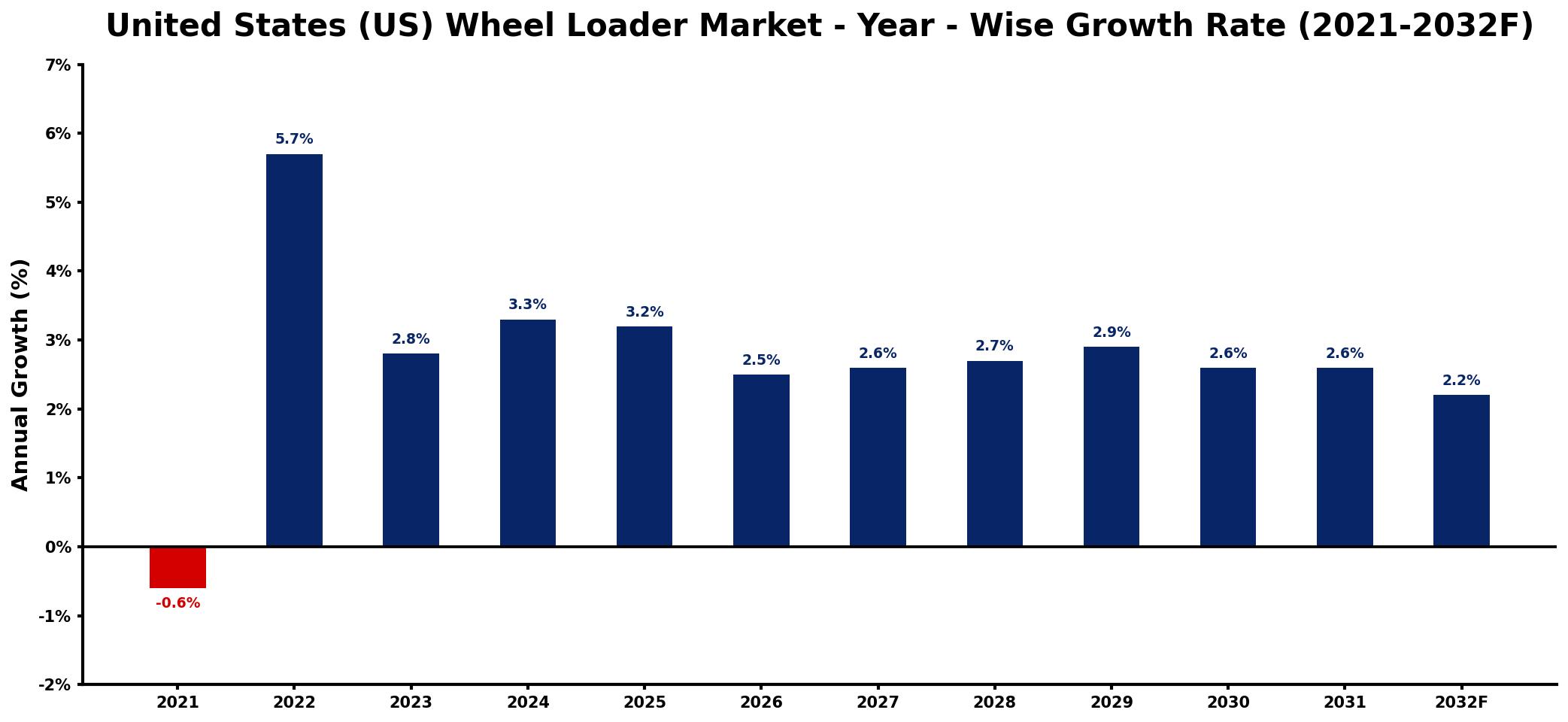
The table below presents the year‑wise growth rates along with the key drivers influencing the market
| Year | Growth Rate | Major Drivers |
| 2021 | -0.6% | Construction projects facing delays |
| 2022 | 5.7% | Infrastructure investments gaining momentum |
| 2023 | 2.8% | Rising demand in construction sector |
| 2024 | 3.3% | Growing rental market opportunities |
| 2025 | 3.2% | Increased government spending initiatives |
| 2026 | 2.5% | Expansion in mining activities |
| 2027 | 2.6% | Urban development projects accelerating |
| 2028 | 2.7% | Technological advancements driving efficiency |
| 2029 | 2.9% | Sustainable practices boosting demand |
| 2030 | 2.6% | Rising construction material needs |
| 2031 | 2.6% | Enhanced logistics and transportation networks |
| 2032 | 2.2% | Continued urbanization trends persisting |
Note: Market size estimations and growth projections presented in this report are based on 6Wresearch's proprietary forecasting methodology, utilizing the latest available industry data, government publications, and primary research inputs.
United States (US) Wheel Loader Market Synopsis
The US wheel loader market is witnessing substantial demand, propelled by ongoing public and private investments in infrastructure. As urban areas expand and require modernization, wheel loaders are essential for effective material handling and project execution. Their versatility in various applications, from construction to mining, makes them vital in the current market landscape.
Furthermore, technological innovation plays a significant role in shaping this market. As companies introduce more advanced models with automation and telematics features, customers increasingly seek efficient, reliable equipment that not only enhances productivity but also adheres to stringent environmental standards.
United States (US) Wheel Loader Market Key Takeaways
- The market is expected to see consistent growth driven by increased infrastructure investments.
- Technological advancements are reshaping customer expectations and product offerings.
- Adoption of environmentally friendly equipment is gaining traction among consumers.
- Rental and leasing options are emerging as popular alternatives to purchasing machinery.
- Market participants must navigate challenges such as fluctuating material costs and regulatory compliance.
Evaluation of Restraints in United States (US) Wheel Loader Market
Several factors may restrain growth in the US wheel loader market. Intense competition among leading manufacturers means constant innovation is crucial for maintaining market share. Additionally, fluctuations in raw material prices can disrupt production costs, directly affecting pricing strategies. Moreover, regulatory changes related to emissions and sustainability require ongoing adaptation from manufacturers, creating pressure to develop compliant yet high-performance machinery. These challenges necessitate a strategic focus on efficiency and market responsiveness.
United States (US) Wheel Loader Market Trends
Current trends in the US wheel loader market include a marked shift towards advanced technological integration, such as GPS systems and automated controls, which enhance operational efficiency. Another trend is the growing preference for sustainability, leading to increased demand for electric and hybrid wheel loaders. This emphasis on greener options aligns with industry-wide goals to reduce carbon footprints. Additionally, the construction industry's post-pandemic recovery is revitalizing demand, particularly in infrastructure and residential sectors, prompting a reassessment of fleet capabilities.
United States (US) Wheel Loader Market Opportunities
Investment opportunities in the US wheel loader market are primarily driven by rising urbanization and ongoing infrastructure projects. Companies can capitalize on the increasing demand for high-tech, fuel-efficient loaders, particularly those incorporating automation and telematics. Additionally, the aftermarket service sector, focusing on maintenance and repair, represents a viable growth avenue as operators seek to maximize equipment lifespan and productivity. Investing in these areas promises substantial returns amid a dynamic market landscape.
Government Initiatives in the United States (US) Wheel Loader Market
Government policies are increasingly focused on enhancing environmental regulations and safety standards in the construction sector. Agencies such as the Environmental Protection Agency (EPA) enforce strict emissions guidelines, prompting manufacturers to innovate cleaner technologies. Concurrently, safety mandates from the Occupational Safety and Health Administration (OSHA) ensure operators' well-being, further influencing machinery design. These initiatives drive market participants to align product offerings with regulatory requirements while addressing industry demands.
Future Insights of the United States (US) Wheel Loader Market
Looking forward to 2026-2032, the US wheel loader market is poised for steady growth, underpinned by an increased emphasis on modernization and equipment efficiency. Technological advancements will continue to play a pivotal role, with enhanced automation and telematics driving productivity gains. Moreover, the trend toward environmentally sustainable practices will shape future developments, as companies innovate to meet these expectations. Overall, the market's trajectory remains optimistic, supported by a robust pipeline of infrastructure projects and ongoing demand for advanced machinery.
United States (US) Wheel Loader Market Latest Developments (2025 - 2026)
Recent developments in the US wheel loader market indicate a strong focus on the integration of smart technologies. Companies are increasingly investing in research and development to enhance product capabilities and improve operational efficiency. Furthermore, partnerships and collaborations are being established to accelerate the deployment of innovative solutions in the market. The industry's ongoing adaptation to customer needs and regulatory changes highlights its dynamic nature as it navigates the evolving landscape.
United States (US) Wheel Loader Market - Key Attractiveness of the Report
- 10 Years of Market Numbers
- Historical Data Starting from 2022 to 2025
- Base Year: 2025
- Forecast Data until 2032
- Key Performance Indicators Impacting the Market
- Major Upcoming Developments and Projects
Key Highlights of the Report:
- United States (US) Wheel Loader Market Outlook
- Market Size of United States (US) Wheel Loader Market, 2025
- Forecast of United States (US) Wheel Loader Market, 2032
- Historical Data and Forecast of United States (US) Wheel Loader Revenues & Volume for the Period 2022-2032F
- United States (US) Wheel Loader Market Trend Evolution
- United States (US) Wheel Loader Market Drivers and Challenges
- United States (US) Wheel Loader Price Trends
- United States (US) Wheel Loader Porter's Five Forces
- United States (US) Wheel Loader Industry Life Cycle
- Historical Data and Forecast of United States (US) Wheel Loader Market Revenues & Volume By Types for the Period 2022-2032F
- Historical Data and Forecast of United States (US) Wheel Loader Market Revenues & Volume By Armored Wheel Loaders for the Period 2022-2032F
- Historical Data and Forecast of United States (US) Wheel Loader Market Revenues & Volume By Tractor Front Loaders for the Period 2022-2032F
- Historical Data and Forecast of United States (US) Wheel Loader Market Revenues & Volume By Compact Front End Loaders for the Period 2022-2032F
- Historical Data and Forecast of United States (US) Wheel Loader Market Revenues & Volume By Skid Loaders & Track Loaders for the Period 2022-2032F
- Historical Data and Forecast of United States (US) Wheel Loader Market Revenues & Volume By Operating Power for the Period 2022-2032F
- Historical Data and Forecast of United States (US) Wheel Loader Market Revenues & Volume By 20 ?? 40 Hp for the Period 2022-2032F
- Historical Data and Forecast of United States (US) Wheel Loader Market Revenues & Volume By 40 ?? 80 Hp for the Period 2022-2032F
- Historical Data and Forecast of United States (US) Wheel Loader Market Revenues & Volume By 80 ?? 120 Hp for the Period 2022-2032F
- Historical Data and Forecast of United States (US) Wheel Loader Market Revenues & Volume By 120 ?? 160 Hp for the Period 2022-2032F
- Historical Data and Forecast of United States (US) Wheel Loader Market Revenues & Volume By 160 Hp for the Period 2022-2032F
- Historical Data and Forecast of United States (US) Wheel Loader Market Revenues & Volume By Above for the Period 2022-2032F
- Historical Data and Forecast of United States (US) Wheel Loader Market Revenues & Volume By Types Of Bucket for the Period 2022-2032F
- Historical Data and Forecast of United States (US) Wheel Loader Market Revenues & Volume By Bottom Bucket for the Period 2022-2032F
- Historical Data and Forecast of United States (US) Wheel Loader Market Revenues & Volume By Flat Bottom Bucket for the Period 2022-2032F
- Historical Data and Forecast of United States (US) Wheel Loader Market Revenues & Volume By Backhoe Bucket for the Period 2022-2032F
- Historical Data and Forecast of United States (US) Wheel Loader Market Revenues & Volume By Demolition Bucket for the Period 2022-2032F
- Historical Data and Forecast of United States (US) Wheel Loader Market Revenues & Volume By Excavating Buckets for the Period 2022-2032F
- Historical Data and Forecast of United States (US) Wheel Loader Market Revenues & Volume By Others for the Period 2022-2032F
- Historical Data and Forecast of United States (US) Wheel Loader Market Revenues & Volume By End-use Application for the Period 2022-2032F
- Historical Data and Forecast of United States (US) Wheel Loader Market Revenues & Volume By Stone Quarries for the Period 2022-2032F
- Historical Data and Forecast of United States (US) Wheel Loader Market Revenues & Volume By Mining Zones for the Period 2022-2032F
- Historical Data and Forecast of United States (US) Wheel Loader Market Revenues & Volume By Construction Sites for the Period 2022-2032F
- Historical Data and Forecast of United States (US) Wheel Loader Market Revenues & Volume By Military & Defense for the Period 2022-2032F
- Historical Data and Forecast of United States (US) Wheel Loader Market Revenues & Volume By Public Sectors for the Period 2022-2032F
- United States (US) Wheel Loader Import Export Trade Statistics
- Market Opportunity Assessment By Types
- Market Opportunity Assessment By Operating Power
- Market Opportunity Assessment By Types Of Bucket
- Market Opportunity Assessment By End-use Application
- United States (US) Wheel Loader Top Companies Market Share
- United States (US) Wheel Loader Competitive Benchmarking By Technical and Operational Parameters
- United States (US) Wheel Loader Company Profiles
- United States (US) Wheel Loader Key Strategic Recommendations






































