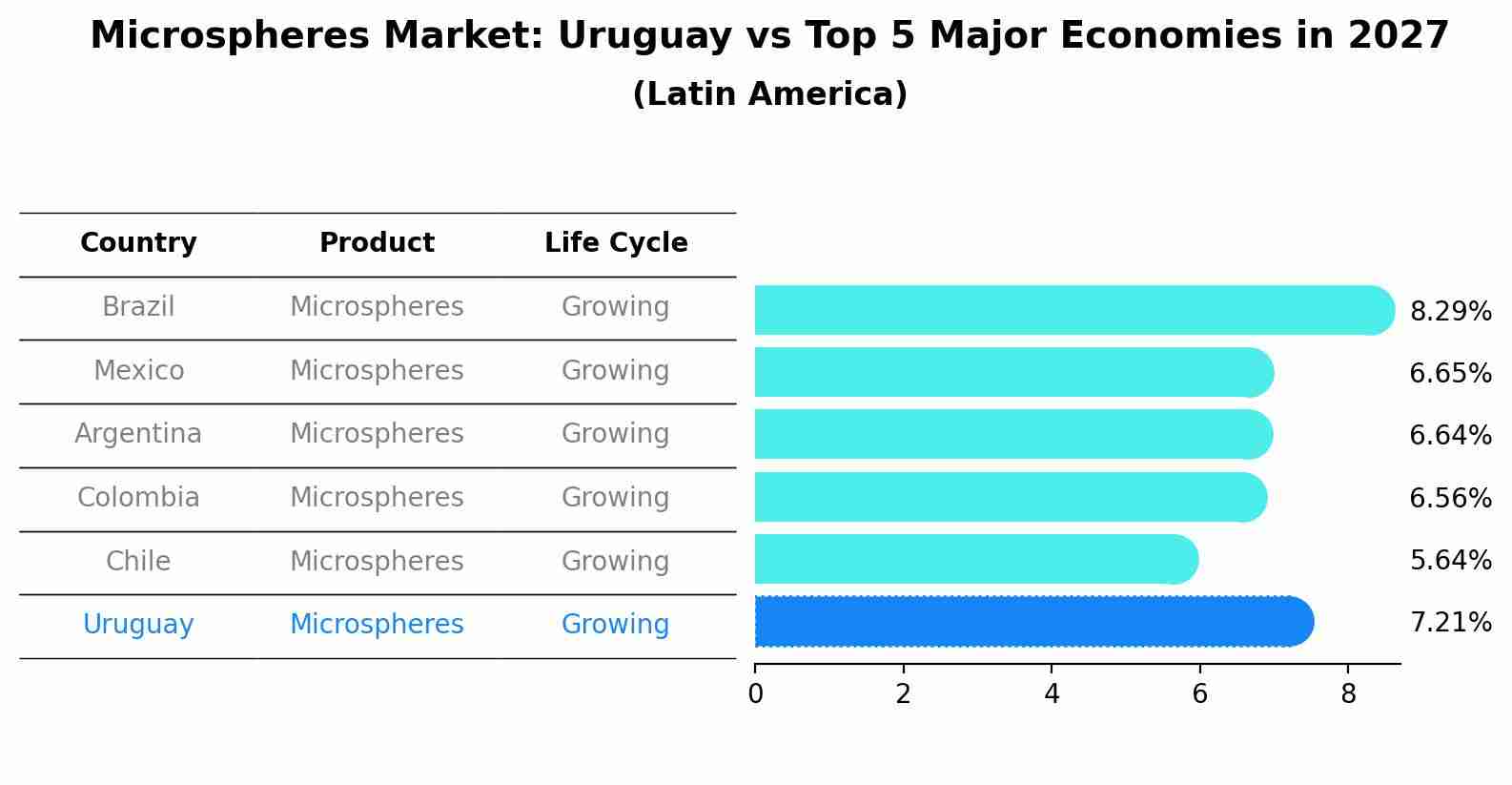
Microspheres Market: Uruguay vs Top 5 Major Economies in 2027 (Latin America)
Uruguay's Microspheres market is anticipated to experience a growing growth rate of 7.21% by 2027, reflecting trends observed in the largest economy Brazil, followed by Mexico, Argentina, Colombia and Chile.
Key Highlights of the Report:
- Uruguay Microspheres Market Outlook
- Market Size of Uruguay Microspheres Market, 2024
- Forecast of Uruguay Microspheres Market, 2031
- Historical Data and Forecast of Uruguay Microspheres Revenues & Volume for the Period 2021-2031
- Uruguay Microspheres Market Trend Evolution
- Uruguay Microspheres Market Drivers and Challenges
- Uruguay Microspheres Price Trends
- Uruguay Microspheres Porter`s Five Forces
- Uruguay Microspheres Industry Life Cycle
- Historical Data and Forecast of Uruguay Microspheres Market Revenues & Volume By Type for the Period 2021-2031
- Historical Data and Forecast of Uruguay Microspheres Market Revenues & Volume By Hollow for the Period 2021-2031
- Historical Data and Forecast of Uruguay Microspheres Market Revenues & Volume By Solid for the Period 2021-2031
- Historical Data and Forecast of Uruguay Microspheres Market Revenues & Volume By Raw Material for the Period 2021-2031
- Historical Data and Forecast of Uruguay Microspheres Market Revenues & Volume By Glass for the Period 2021-2031
- Historical Data and Forecast of Uruguay Microspheres Market Revenues & Volume By Ceramic for the Period 2021-2031
- Historical Data and Forecast of Uruguay Microspheres Market Revenues & Volume By Fly Ash for the Period 2021-2031
- Historical Data and Forecast of Uruguay Microspheres Market Revenues & Volume By Polymer for the Period 2021-2031
- Historical Data and Forecast of Uruguay Microspheres Market Revenues & Volume By Metallic for the Period 2021-2031
- Historical Data and Forecast of Uruguay Microspheres Market Revenues & Volume By Application for the Period 2021-2031
- Historical Data and Forecast of Uruguay Microspheres Market Revenues & Volume By Construction Composites for the Period 2021-2031
- Historical Data and Forecast of Uruguay Microspheres Market Revenues & Volume By Medical Technology for the Period 2021-2031
- Historical Data and Forecast of Uruguay Microspheres Market Revenues & Volume By Cosmetics & Personal Care for the Period 2021-2031
- Historical Data and Forecast of Uruguay Microspheres Market Revenues & Volume By Automotive for the Period 2021-2031
- Historical Data and Forecast of Uruguay Microspheres Market Revenues & Volume By Oil & Gas for the Period 2021-2031
- Uruguay Microspheres Import Export Trade Statistics
- Market Opportunity Assessment By Type
- Market Opportunity Assessment By Raw Material
- Market Opportunity Assessment By Application
- Uruguay Microspheres Top Companies Market Share
- Uruguay Microspheres Competitive Benchmarking By Technical and Operational Parameters
- Uruguay Microspheres Company Profiles
- Uruguay Microspheres Key Strategic Recommendations






































