Venezuela Adipic Acid Market Size, Share & Growth Rate
The Venezuela Adipic Acid Market was estimated at USD 481 Million in 2025 and is projected to reach USD 673 Million by 2032, growing at a CAGR of 4.9% from 2026 to 2032. This growth trajectory is primarily driven by the increasing demand for nylon products across various applications, particularly in the automotive and textile sectors. Furthermore, a rising focus on sustainable production methods is prompting innovation and adaptation within the market, positioning it for potential expansion despite underlying economic challenges.
Venezuela Adipic Acid Market Year-wise Growth Rate and Key Drivers
This graph highlights how the Venezuela Adipic Acid Market has steadily grown over the years, supported by major growth factors.
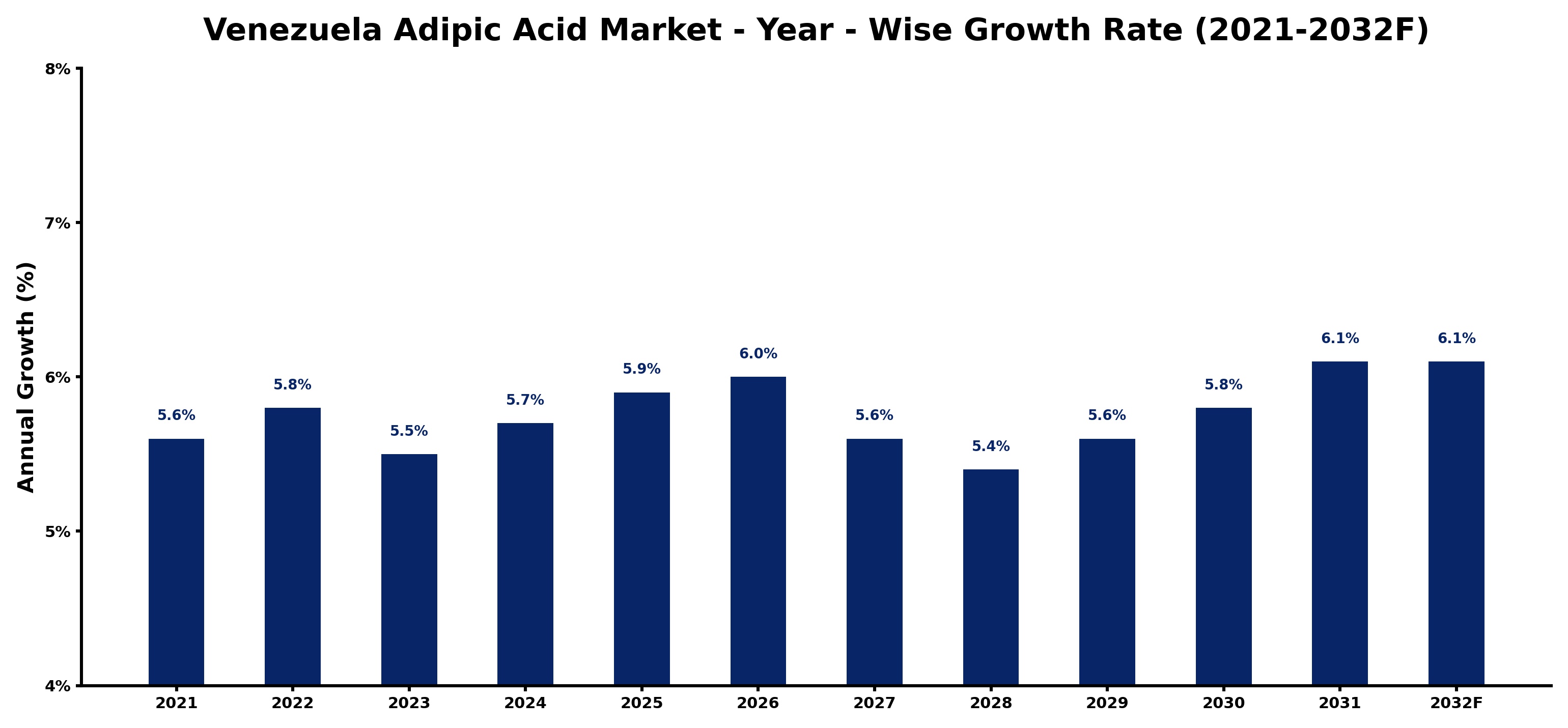
The table below presents the year‑wise growth rates along with the key drivers influencing the market
| Year | Growth Rate | Major Drivers |
| 2021 | 5.6% | Rising demand for nylon production |
| 2022 | 5.8% | Increased automotive industry requirements |
| 2023 | 5.5% | Growing consumer goods manufacturing needs |
| 2024 | 5.7% | Expansion of textile applications utilization |
| 2025 | 5.9% | Surge in biodegradable plastics interest |
| 2026 | 6.0% | Growth in pharmaceutical applications demand |
| 2027 | 5.6% | Enhanced production capabilities established |
| 2028 | 5.4% | Emerging markets adoption accelerated |
| 2029 | 5.6% | Sustainable product innovations gained traction |
| 2030 | 5.8% | Technological advancements improved efficiency |
| 2031 | 6.1% | Industrial activity supported growth |
| 2032 | 6.1% | Increased focus on renewable resources |
Note - Market size estimations and growth projections presented in this report are based on 6Wresearch's advanced forecasting approach, validated with industry datasets as of June 2026.
Venezuela Adipic Acid Market Synopsis
Currently, the Venezuela Adipic Acid Market operates amidst a climate of economic volatility that affects both supply and demand. While the production of adipic acid is essential for the manufacturing of nylon, fluctuating raw material costs and currency devaluation present ongoing challenges for local producers.
Yet, the market demonstrates signs of resilience, bolstered by the expansion of automotive and textile industries. This is particularly noteworthy given the increased emphasis on environmentally friendly and sustainable solutions, stimulating interest in bio-based alternatives to traditional adipic acid.
Venezuela Adipic Acid Market Key Takeaways
- The Venezuela Adipic Acid Market is projected to grow from USD 481 Million in 2025 to USD 673 Million by 2032, with a CAGR of 4.9%.
- Economic and political instability continues to impact the production and distribution dynamics of the market.
- Innovations focusing on bio-based alternatives are becoming prominent as sustainability gains traction in various industries.
- The automotive and textile sectors are identified as significant growth drivers for adipic acid demand.
- Government initiatives aim to promote local production and enhance self-sufficiency within the market.
Evaluation of Restraints in Venezuela Adipic Acid Market
The Venezuela Adipic Acid Market is confronted with several systemic restraints that hinder its overall development. Economic instability, characterized by hyperinflation and fluctuating currency values, exerts pressure on production costs and operational viability. Moreover, geopolitical tensions and international sanctions complicate the procurement of raw materials, creating vulnerabilities within the supply chain. The lack of robust infrastructure further exacerbates these challenges, making it difficult for local manufacturers to sustain competitive advantages or pursue necessary technological advancements.
Venezuela Adipic Acid Market Trends
Currently, the market is witnessing a shift towards eco-friendly practices, with an increasing emphasis on bio-based adipic acid. This is part of a broader global trend towards sustainability that is reshaping manufacturing processes across various industries. Additionally, advances in nylon production technology and engineering plastics are gaining traction, with applications extending into innovative sectors such as biodegradable packaging. Strategic partnerships and R&D investments are also on the rise as market players seek to enhance product offerings and meet evolving consumer demands.
Venezuela Adipic Acid Market Opportunities
Investment opportunities in the Venezuela Adipic Acid Market are notably promising, particularly in sectors poised for growth such as textiles and automotive. As demand for nylon and synthetic fibers continues to increase, companies involved in the production of adipic acid could see significant returns. Moreover, the shift toward sustainable packaging presents a unique chance for local producers to innovate and expand their product lines. Collaborations aimed at improving production efficiencies and technological upgrades can further enhance competitive positioning within the marketplace.
Government Initiatives in the Venezuela Adipic Acid Market
The Venezuelan government is actively pursuing policies that aim to bolster local production of adipic acid and reduce dependence on imports. Initiatives include import restrictions and tariffs designed to support domestic manufacturers. Furthermore, the government is focused on ensuring that quality standards and environmental regulations are met, providing a framework for sustainable production practices. Investment incentives and support for R&D are also part of the overarching strategy to strengthen the local industry and foster economic resilience.
Future Insights of the Venezuela Adipic Acid Market
The outlook for the Venezuela Adipic Acid Market through 2026 to 2032 remains contingent on the stabilization of the country's economic environment. While challenges persist, particularly regarding global market fluctuations and domestic political dynamics, the potential for recovery exists. If the government can successfully implement strategies to attract foreign investment and enhance the business landscape, the market could witness notable advancements in production capabilities and competitiveness. The trend towards sustainable practices will likely continue to shape market dynamics, influencing both supply chains and consumer preferences.
Venezuela Adipic Acid Market Latest Developments (May 2025 - June 2026)
In recent months, the Venezuela Adipic Acid Market has seen a renewed focus on local production capabilities, with several initiatives aimed at enhancing manufacturing efficiencies. Additionally, collaborations with international entities are emerging, aiming to leverage foreign expertise in sustainable production practices. The ongoing adaptation to shifting market demands, particularly in the context of eco-friendly products, signifies a transformative phase for the industry.
Venezuela Adipic Acid Market - Key Attractiveness of the Report
- 10 Years of Market Numbers
- Historical Data Starting from 2022 to 2025
- Base Year: 2025
- Forecast Data until 2032
- Key Performance Indicators Impacting the Market
- Major Upcoming Developments and Projects
Key Highlights of the Report:
- Venezuela Adipic Acid Market Outlook
- Market Size of Venezuela Adipic Acid Market, 2025
- Forecast of Venezuela Adipic Acid Market, 2032
- Historical Data and Forecast of Venezuela Adipic Acid Revenues & Volume for the Period 2022-2032F
- Venezuela Adipic Acid Market Trend Evolution
- Venezuela Adipic Acid Market Drivers and Challenges
- Venezuela Adipic Acid Price Trends
- Venezuela Adipic Acid Porter's Five Forces
- Venezuela Adipic Acid Industry Life Cycle
- Historical Data and Forecast of Venezuela Adipic Acid Market Revenues & Volume By Applications for the Period 2022-2032F
- Historical Data and Forecast of Venezuela Adipic Acid Market Revenues & Volume By Nylon 66 for the Period 2022-2032F
- Historical Data and Forecast of Venezuela Adipic Acid Market Revenues & Volume By Plasticizers for the Period 2022-2032F
- Historical Data and Forecast of Venezuela Adipic Acid Market Revenues & Volume By Polyurethanes for the Period 2022-2032F
- Historical Data and Forecast of Venezuela Adipic Acid Market Revenues & Volume By Automotive for the Period 2022-2032F
- Historical Data and Forecast of Venezuela Adipic Acid Market Revenues & Volume By Polyester Staple Fiber for the Period 2022-2032F
- Venezuela Adipic Acid Import Export Trade Statistics
- Market Opportunity Assessment By Applications
- Venezuela Adipic Acid Top Companies Market Share
- Venezuela Adipic Acid Competitive Benchmarking By Technical and Operational Parameters
- Venezuela Adipic Acid Company Profiles
- Venezuela Adipic Acid Key Strategic Recommendations






































