Venezuela Critical Infrastructure Protection Market Size & Growth Rate (2026-2032)
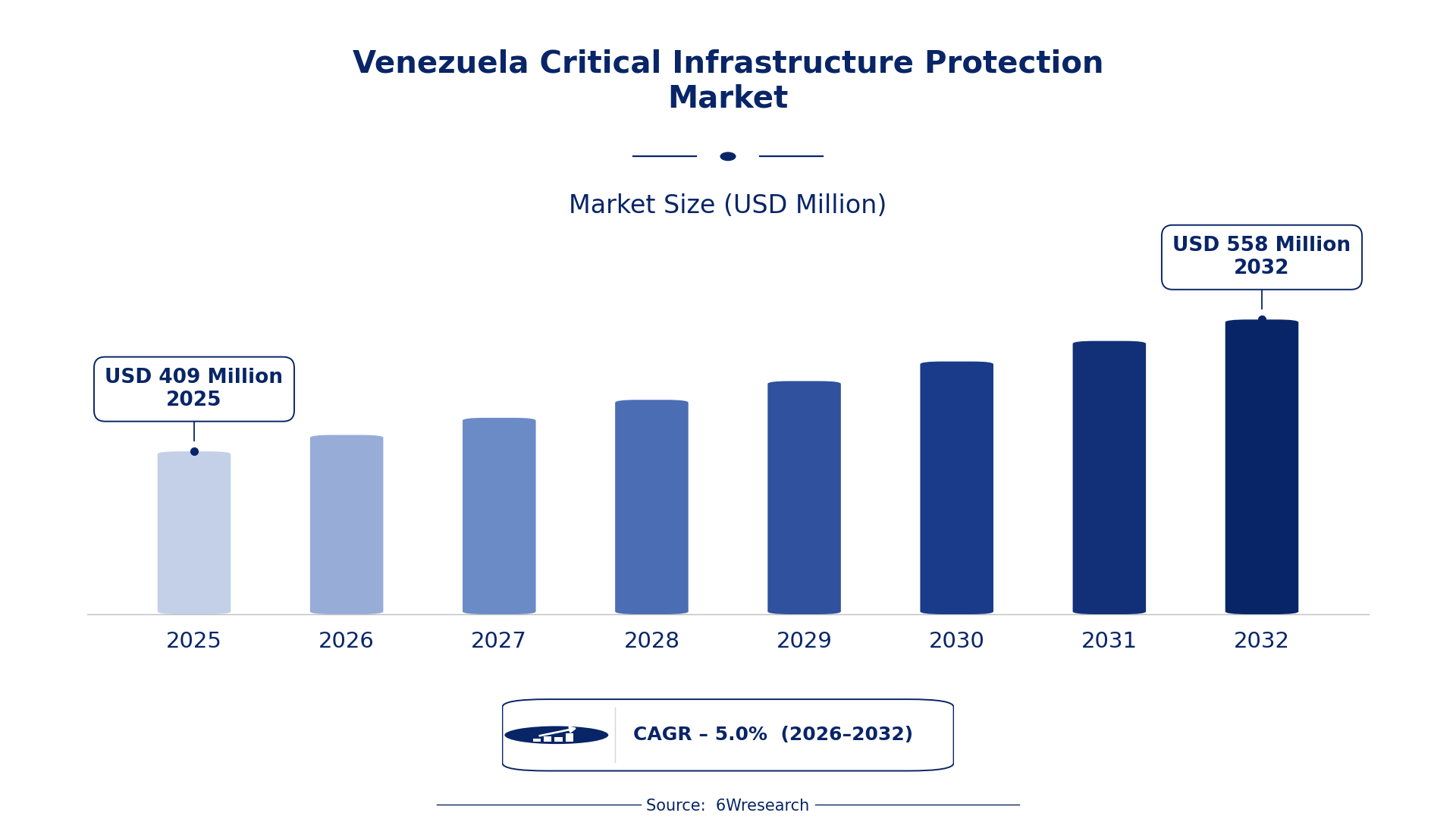
The Venezuela Critical Infrastructure Protection Market was estimated at USD 409 Million in 2025 and is projected to reach USD 558 Million by 2032, growing at a CAGR of 5.0% from 2026 to 2032.
Venezuela Critical Infrastructure Protection Market Synopsis
The Venezuelan economy’s heavy dependence on oil production makes the protection of critical infrastructure an urgent priority. Key sectors, including energy, transportation, and telecommunications, face threats from both internal instability and external cyberattacks, underscoring the necessity for fortified security measures.
In light of ongoing political turmoil, the demand for comprehensive protection solutions has intensified. The market offers a diverse range of technologies and services that aim to safeguard essential infrastructure from an array of risks, highlighting a critical need for resilience amidst Venezuela's challenges.
Venezuela Critical Infrastructure Protection Market Year-wise Growth Rate and Key Drivers
This graph illustrates the annual growth rates of the Venezuela Critical Infrastructure Protection Market from 2021 to 2032, highlighting a steady upward trajectory and projected expansion over the forecast period.
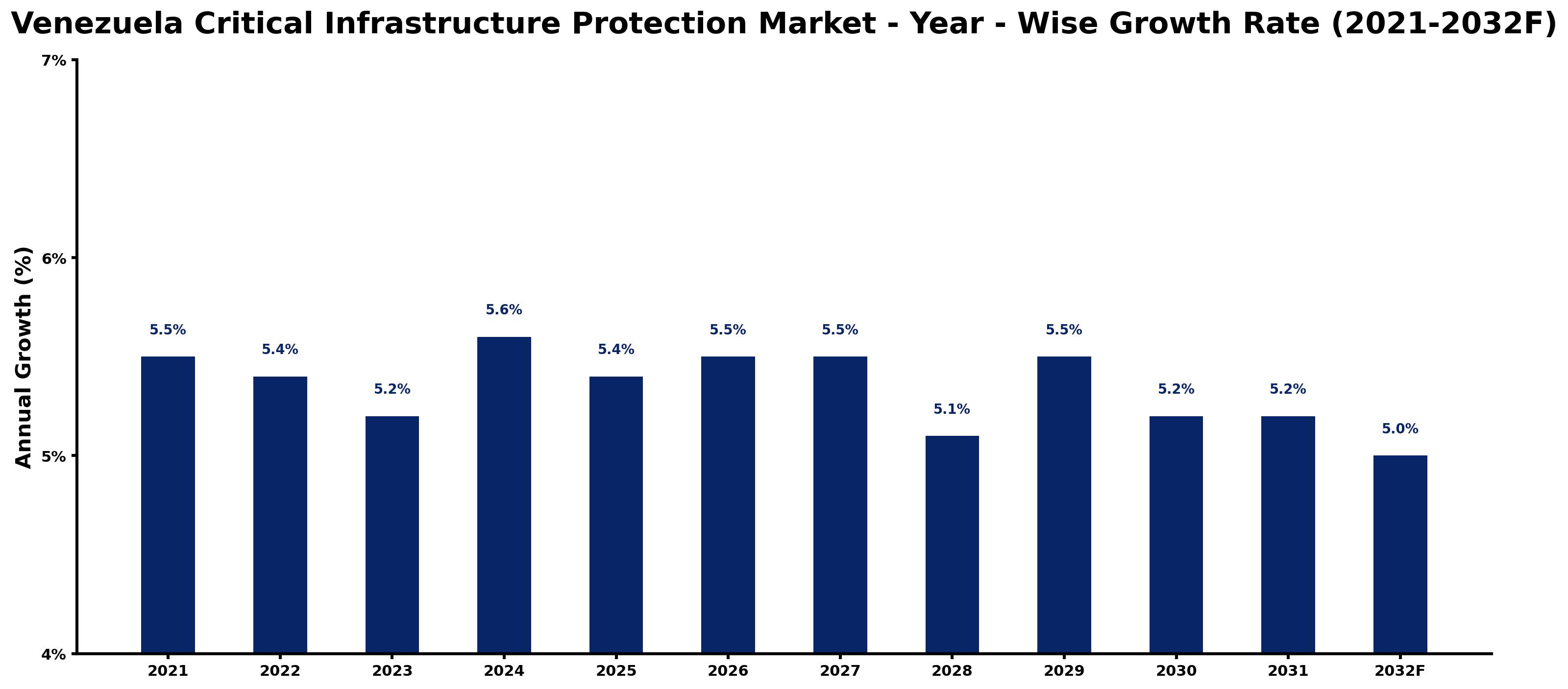
The table below presents the year‑wise growth rates along with the key drivers influencing the market
| Year | Growth Rate | Major Drivers |
| 2021 | 5.5% | Increased investment in national oil sector security protocols. |
| 2022 | 5.4% | Implementation of state cybersecurity awareness training programs. |
| 2023 | 5.2% | Adoption of biometrics for oil field access control. |
| 2024 | 5.6% | Enhancement of surveillance technologies for border protection. |
| 2025 | 5.4% | Government partnership with private firms for infrastructure upgrades. |
| 2026 | 5.5% | Strengthening of regulations on private security firm standards. |
| 2027 | 5.5% | Rise in cyberattack threats prompting emergency response development. |
| 2028 | 5.1% | Focus on protecting water supply infrastructure from sabotage. |
| 2029 | 5.5% | Initiatives for securing electric grid against natural disasters. |
| 2030 | 5.2% | Legislation mandating critical infrastructure risk assessments. |
| 2031 | 5.2% | Training programs for local authorities on disaster preparedness. |
| 2032 | 5.0% | Increased public-private collaboration on emergency response strategies. |
Note: Market size estimations and growth projections presented in this report are based on 6Wresearch's proprietary forecasting methodology, utilizing the latest available industry data, government publications, and primary research inputs.
Venezuela Critical Infrastructure Protection Market Key Takeaways
Below are some of the specific key takeaways from the market, including:
- Government initiatives are driving significant investments in infrastructure protection.
- Advanced technologies like AI and machine learning are increasingly being utilized for threat detection.
- Public-private partnerships are becoming essential in addressing the security challenges faced by key sectors.
- Cloud-based security solutions are gaining traction as organizations seek flexible, scalable protection measures.
- The market is expanding due to a heightened awareness of the vulnerabilities of critical assets.
Evaluation of Restraints in Venezuela Critical Infrastructure Protection Market
The Venezuela Critical Infrastructure Protection Market faces significant constraints primarily stemming from economic challenges and political instability. Limited financial resources hinder the procurement and implementation of advanced security measures, leaving critical infrastructure susceptible to various threats. Uncertainties in regulatory frameworks complicate the establishment of consistent security protocols, further aggravating the vulnerabilities present in critical sectors. The shortage of trained professionals exacerbates these challenges, making it difficult to effectively address the urgent security needs of the nation.
Venezuela Critical Infrastructure Protection Market Trends
Current trends within the Venezuela Critical Infrastructure Protection Market reveal a marked shift toward integrated security solutions that provide a comprehensive approach to safeguarding critical assets. The adoption of cloud-based technologies is increasing as organizations seek more efficient and scalable options. There is a notable rise in the application of artificial intelligence and machine learning for proactive threat detection, enabling faster response times. The market is also seeing greater collaboration between public and private sectors to enhance the resilience of essential services.
Venezuela Critical Infrastructure Protection Market Opportunities
Investment opportunities are plentiful within the Venezuela Critical Infrastructure Protection Market, particularly as the government prioritizes the protection of its most vital sectors. Areas ripe for investment include advanced cybersecurity solutions, integrated surveillance systems, and access control technologies. on top of that, partnerships with local firms present a strategic avenue for investors looking to provide training and consultancy that will bolster the security capacities of critical infrastructure operators.
Government Initiatives in the Venezuela Critical Infrastructure Protection Market
Government policies have become increasingly focused on enhancing the security of Venezuela's critical infrastructure. Recent initiatives have aimed to streamline regulatory frameworks and encourage investment in protective measures. The importance of collaboration between public and private entities in developing these initiatives cannot be overstated, as it plays a crucial role in strengthening overall security posture.
- A regulatory framework established in early 2025 mandates comprehensive risk assessments for critical infrastructure operators.
- A national initiative launched in mid-2025 focuses on public-private partnerships to improve infrastructure resilience and security.
- Currently ongoing is a capacity-building program that enhances training and resources for cybersecurity professionals across critical sectors.
- A planned upgrade of communication networks is set to commence by late 2026 to ensure better response capabilities to emerging threats.
Future Insights of the Venezuela Critical Infrastructure Protection Market
Looking ahead to 2026-2032, the Venezuela Critical Infrastructure Protection Market is expected to continue its growth trajectory, albeit with challenges. Political and economic stabilization efforts will be pivotal in determining the investment levels in security technologies. As vulnerabilities persist, the drive for enhanced protection measures will likely lead to increased adoption of integrated solutions. Future market players will need to demonstrate adaptability and innovation to meet evolving security demands.
Venezuela Critical Infrastructure Protection Market Latest Developments
Recent industry activity in the Venezuela Critical Infrastructure Protection Market illustrates a commitment to advancing security measures despite ongoing challenges. Companies and government bodies are increasingly focused on collaborating to enhance the robustness of critical infrastructure protection. The last 12-14 months have seen various initiatives aimed at modernizing security capabilities and addressing vulnerabilities.
- A major technology vendor launched a new AI-driven surveillance solution aimed at critical infrastructure protection in Q1 2025, enhancing threat detection capabilities.
- An ongoing initiative focuses on the integration of cybersecurity measures into the operations of energy facilities, expected to finalize by the end of 2025.
- In mid-2025, a leading regional operator began a partnership with local authorities to develop a comprehensive training program for cybersecurity personnel.
- A planned rollout of advanced access control systems for transportation hubs is anticipated to start in late 2026.
Venezuela Critical Infrastructure Protection Market - Key Attractiveness of the Report
- 10 Years of Market Numbers
- Historical Data Starting from 2022 to 2025
- Base Year: 2025
- Forecast Data until 2032
- Key Performance Indicators Impacting the Market
- Major Upcoming Developments and Projects
Key Highlights of the Report:
- Venezuela Critical Infrastructure Protection Market Outlook
- Market Size of Venezuela Critical Infrastructure Protection Market, 2025
- Forecast of Venezuela Critical Infrastructure Protection Market, 2032
- Historical Data and Forecast of Venezuela Critical Infrastructure Protection Revenues & Volume for the Period 2022-2032F
- Venezuela Critical Infrastructure Protection Market Trend Evolution
- Venezuela Critical Infrastructure Protection Market Drivers and Challenges
- Venezuela Critical Infrastructure Protection Price Trends
- Venezuela Critical Infrastructure Protection Porter's Five Forces
- Venezuela Critical Infrastructure Protection Industry Life Cycle
- Historical Data and Forecast of Venezuela Critical Infrastructure Protection Market Revenues & Volume By Solution for the Period 2022-2032F
- Historical Data and Forecast of Venezuela Critical Infrastructure Protection Market Revenues & Volume By Physical Safety for the Period 2022-2032F
- Historical Data and Forecast of Venezuela Critical Infrastructure Protection Market Revenues & Volume By Security Video Surveillance Systems for the Period 2022-2032F
- Historical Data and Forecast of Venezuela Critical Infrastructure Protection Market Revenues & Volume By Screening for the Period 2022-2032F
- Historical Data and Forecast of Venezuela Critical Infrastructure Protection Market Revenues & Volume By Scanning for the Period 2022-2032F
- Historical Data and Forecast of Venezuela Critical Infrastructure Protection Market Revenues & Volume By Cybersecurity for the Period 2022-2032F
- Historical Data and Forecast of Venezuela Critical Infrastructure Protection Market Revenues & Volume By Encryption for the Period 2022-2032F
- Historical Data and Forecast of Venezuela Critical Infrastructure Protection Market Revenues & Volume By Threat Intelligence for the Period 2022-2032F
- Historical Data and Forecast of Venezuela Critical Infrastructure Protection Market Revenues & Volume By Component for the Period 2022-2032F
- Historical Data and Forecast of Venezuela Critical Infrastructure Protection Market Revenues & Volume By Solution for the Period 2022-2032F
- Historical Data and Forecast of Venezuela Critical Infrastructure Protection Market Revenues & Volume By Services for the Period 2022-2032F
- Historical Data and Forecast of Venezuela Critical Infrastructure Protection Market Revenues & Volume By Vertical for the Period 2022-2032F
- Historical Data and Forecast of Venezuela Critical Infrastructure Protection Market Revenues & Volume By Financial Institutions for the Period 2022-2032F
- Historical Data and Forecast of Venezuela Critical Infrastructure Protection Market Revenues & Volume By Government for the Period 2022-2032F
- Historical Data and Forecast of Venezuela Critical Infrastructure Protection Market Revenues & Volume By Defense for the Period 2022-2032F
- Historical Data and Forecast of Venezuela Critical Infrastructure Protection Market Revenues & Volume By Transport and Logistics for the Period 2022-2032F
- Historical Data and Forecast of Venezuela Critical Infrastructure Protection Market Revenues & Volume By Energy and Power for the Period 2022-2032F
- Historical Data and Forecast of Venezuela Critical Infrastructure Protection Market Revenues & Volume By Commercial Sector for the Period 2022-2032F
- Historical Data and Forecast of Venezuela Critical Infrastructure Protection Market Revenues & Volume By Telecom for the Period 2022-2032F
- Historical Data and Forecast of Venezuela Critical Infrastructure Protection Market Revenues & Volume By Chemicals and Manufacturing for the Period 2022-2032F
- Venezuela Critical Infrastructure Protection Import Export Trade Statistics
- Market Opportunity Assessment By Solution
- Market Opportunity Assessment By Cybersecurity
- Market Opportunity Assessment By Component
- Market Opportunity Assessment By Vertical
- Venezuela Critical Infrastructure Protection Top Companies Market Share
- Venezuela Critical Infrastructure Protection Competitive Benchmarking By Technical and Operational Parameters
- Venezuela Critical Infrastructure Protection Company Profiles
- Venezuela Critical Infrastructure Protection Key Strategic Recommendations






































