Venezuela Cultured Meat Market Size, Share & Growth Rate
The Venezuela Cultured Meat Market was estimated at USD 365 Million in 2025 and is projected to reach USD 501 Million by 2032, growing at a CAGR of 4.6% from 2026 to 2032. This growth is largely driven by the increasing demand for sustainable food solutions and heightened consumer awareness regarding the environmental and ethical implications of traditional meat production. Additionally, as technological advancements make cultured meat production more accessible, investment and interest in this sector are likely to see significant upticks.
Venezuela Cultured Meat Market Year-wise Growth Rate and Key Drivers
This graph highlights how the Venezuela Cultured Meat Market has steadily grown over the years, supported by major growth factors.
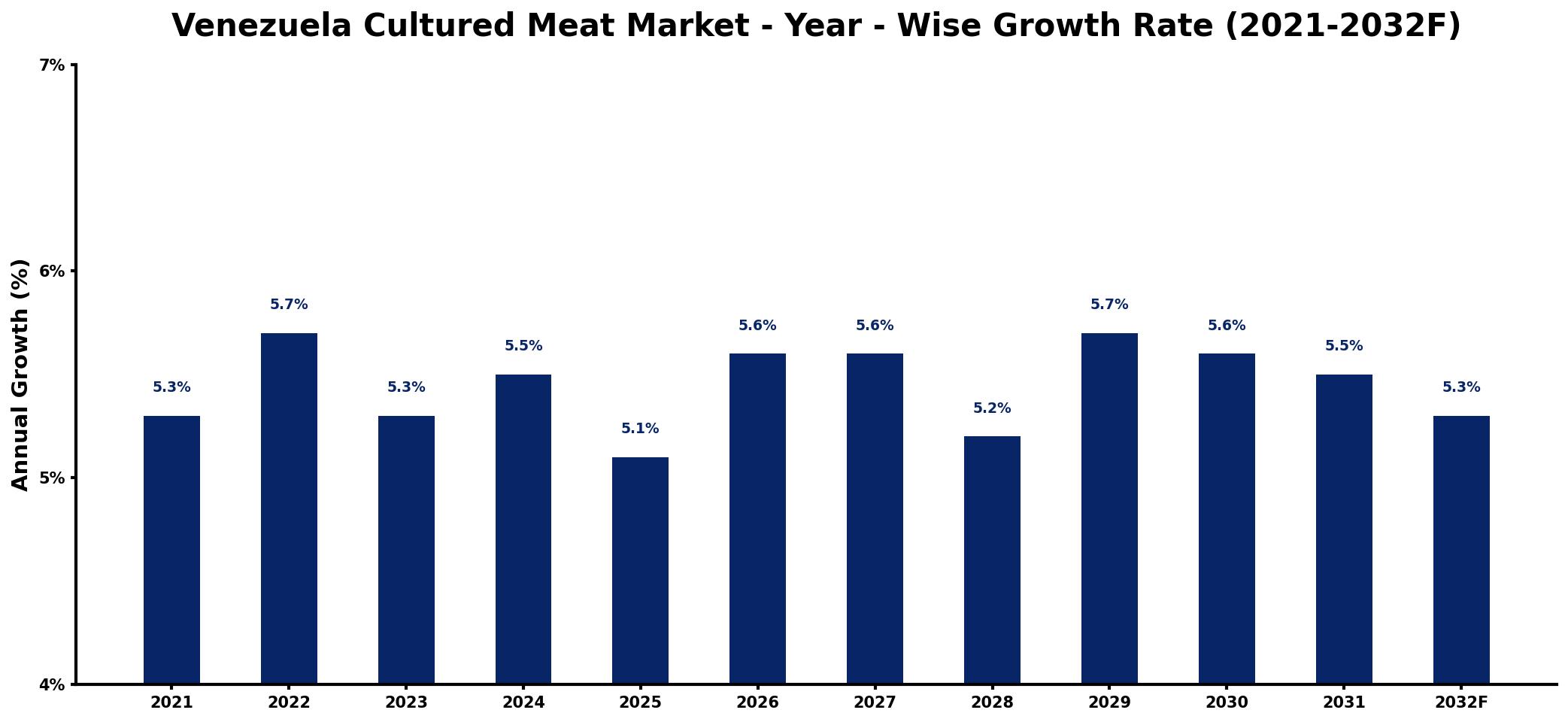
The table below presents the year‑wise growth rates along with the key drivers influencing the market
| Year | Growth Rate | Major Drivers |
| 2021 | 5.3% | Rising consumer awareness sustainability |
| 2022 | 5.7% | Increased investment alternative proteins |
| 2023 | 5.3% | Growing interest ethical food sources |
| 2024 | 5.5% | Expansion of production facilities |
| 2025 | 5.1% | Enhanced distribution network efficiency |
| 2026 | 5.6% | Emergence of innovative technologies |
| 2027 | 5.6% | Strengthening regulatory support frameworks |
| 2028 | 5.2% | Diversification of product offerings |
| 2029 | 5.7% | Collaborations with food service industry |
| 2030 | 5.6% | Surge in health-conscious consumers |
| 2031 | 5.5% | Growing demand for local sourcing |
| 2032 | 5.3% | Increased focus on food security |
Note: Market size estimations and growth projections presented in this report are based on 6Wresearch's proprietary forecasting methodology, utilizing the latest available industry data, government publications, and primary research inputs.
Venezuela Cultured Meat Market Synopsis
The Venezuela Cultured Meat Market is in its infancy but has already garnered attention for its potential to revolutionize the nations food system. Current consumer sentiments reflect a growing recognition of the sustainability benefits associated with lab-grown meat, positioning it as a viable alternative amidst the challenges posed by traditional agriculture.
Despite being nascent, interest in cultured meat is surging, fueled by societal concerns over animal welfare and environmental sustainability. This market holds promise in addressing Venezuelas pressing food security issues while potentially mitigating the severe ecological impacts of conventional livestock farming.
Venezuela Cultured Meat Market Key Takeaways
- The market is projected to experience significant growth, driven by increased consumer awareness and sustainability concerns.
- Technological advancements are enhancing the feasibility and scalability of cultured meat production in Venezuela.
- Investment opportunities are ripe for stakeholders looking to innovate within the alternative protein sector.
- Current economic and political challenges present hurdles but also incentivize the search for innovative food solutions.
- Collaboration among various sectors is essential for the market's sustainable development and overcoming existing barriers.
Evaluation of Restraints in Venezuela Cultured Meat Market
The Venezuela Cultured Meat Market faces a multifaceted set of restraints that hinder its growth potential. Chief among these is the limited access to cutting-edge technology and the resources necessary for large-scale cultured meat production. High research and development costs pose significant barriers to entry, restricting the ability of local companies to innovate effectively. Furthermore, regulatory uncertainties and the need for broader consumer acceptance add layers of complexity to the market landscape. Political instability and ongoing economic turmoil further amplify these challenges, making it crucial for stakeholders to navigate these obstacles thoughtfully while pursuing collaborative avenues for growth.
Venezuela Cultured Meat Market Trends
The current trends in the Venezuela Cultured Meat Market illustrate a growing shift towards alternative protein sources, particularly among environmentally conscious consumers. The rising discourse around animal rights and ecological preservation is influencing public perceptions and increasing demand. Technological innovations, including advancements in cellular agriculture, are contributing to more cost-effective production methods, thereby making cultured meat more commercially viable. As awareness of the health and ethical benefits of cultured meat continues to spread, the market is likely to witness further development in consumer-friendly products.
Venezuela Cultured Meat Market Opportunities
The Venezuela Cultured Meat Market represents a fertile ground for investment and innovation. Stakeholders keen on addressing food security issues can explore funding opportunities with local startups and companies focused on alternative protein solutions. As consumer consciousness surrounding sustainable food grows, companies that adapt to these preferences stand to benefit significantly. The intersection of biotechnology and sustainable agricultural practices offers a unique landscape for developing solutions that not only provide financial returns but also contribute positively to the social and environmental fabric of the nation.
Government Initiatives in the Venezuela Cultured Meat Market
Currently, government initiatives specifically supporting the cultured meat sector in Venezuela are limited due to broader economic and political challenges. While the government is focused on addressing urgent social issues such as food shortages and economic instability, the absence of dedicated regulations or incentives for cultured meat poses challenges. For companies looking to penetrate this emerging market, understanding the regulatory environment and forging partnerships with international entities can be critical strategies for overcoming barriers to growth.
Future Insights of the Venezuela Cultured Meat Market
Looking ahead to the years 2026-2032, the Venezuela Cultured Meat Market is positioned for notable growth, driven by rising consumer demand for sustainable protein sources. As technological innovations continue to improve production methods, the feasibility of cultured meat will increase, fostering wider acceptance. If political and economic challenges stabilize, there is significant potential for government support to materialize, further catalyzing industry development. Overall, with the right investments and strategic collaborations, the cultured meat sector can emerge as a cornerstone of Venezuela's future food landscape.
Venezuela Cultured Meat Market Latest Developments (2025 - 2026)
In recent months, the Venezuela Cultured Meat Market has begun to witness a notable shift as consumer interest accelerates. Various initiatives are being discussed at local forums aimed at promoting innovation in the food sector, specifically within cellular agriculture. Collaborations among academic institutions and private sector players are reportedly underway, aiming to tackle the technological challenges faced by the industry. These developments signal a potentially transformative period for the market, where sustained focus could foster advancements in research and development, bringing lab-grown meat closer to mainstream acceptance.
Venezuela Cultured Meat Market - Key Attractiveness of the Report
- 10 Years of Market Numbers
- Historical Data Starting from 2022 to 2025
- Base Year: 2025
- Forecast Data until 2032
- Key Performance Indicators Impacting the Market
- Major Upcoming Developments and Projects
Key Highlights of the Report:
- Venezuela Cultured Meat Market Outlook
- Market Size of Venezuela Cultured Meat Market, 2025
- Forecast of Venezuela Cultured Meat Market, 2032
- Historical Data and Forecast of Venezuela Cultured Meat Revenues & Volume for the Period 2022-2032F
- Venezuela Cultured Meat Market Trend Evolution
- Venezuela Cultured Meat Market Drivers and Challenges
- Venezuela Cultured Meat Price Trends
- Venezuela Cultured Meat Porter's Five Forces
- Venezuela Cultured Meat Industry Life Cycle
- Historical Data and Forecast of Venezuela Cultured Meat Market Revenues & Volume By Product Type for the Period 2022-2032F
- Historical Data and Forecast of Venezuela Cultured Meat Market Revenues & Volume By Poultry for the Period 2022-2032F
- Historical Data and Forecast of Venezuela Cultured Meat Market Revenues & Volume By Beef for the Period 2022-2032F
- Historical Data and Forecast of Venezuela Cultured Meat Market Revenues & Volume By Seafood for the Period 2022-2032F
- Historical Data and Forecast of Venezuela Cultured Meat Market Revenues & Volume By Pork for the Period 2022-2032F
- Historical Data and Forecast of Venezuela Cultured Meat Market Revenues & Volume By Duck for the Period 2022-2032F
- Historical Data and Forecast of Venezuela Cultured Meat Market Revenues & Volume By End-Use for the Period 2022-2032F
- Historical Data and Forecast of Venezuela Cultured Meat Market Revenues & Volume By Nuggets for the Period 2022-2032F
- Historical Data and Forecast of Venezuela Cultured Meat Market Revenues & Volume By Burgers for the Period 2022-2032F
- Historical Data and Forecast of Venezuela Cultured Meat Market Revenues & Volume By Meatballs for the Period 2022-2032F
- Historical Data and Forecast of Venezuela Cultured Meat Market Revenues & Volume By Sausage for the Period 2022-2032F
- Historical Data and Forecast of Venezuela Cultured Meat Market Revenues & Volume By Hot dogs for the Period 2022-2032F
- Historical Data and Forecast of Venezuela Cultured Meat Market Revenues & Volume By Others for the Period 2022-2032F
- Venezuela Cultured Meat Import Export Trade Statistics
- Market Opportunity Assessment By Product Type
- Market Opportunity Assessment By End-Use
- Venezuela Cultured Meat Top Companies Market Share
- Venezuela Cultured Meat Competitive Benchmarking By Technical and Operational Parameters
- Venezuela Cultured Meat Company Profiles
- Venezuela Cultured Meat Key Strategic Recommendations






































