Venezuela Edible Oil Market Size, Share & Growth Rate
The Venezuela Edible Oil Market was estimated at USD 344 Million in 2025 and is projected to reach USD 474 Million by 2032, growing at a CAGR of 4.7% from 2026 to 2032. This growth trajectory is driven by a gradual recovery in consumer purchasing power and increasing demand for healthier cooking oil alternatives among the population. Moreover, the potential for revitalizing local production and reducing reliance on imports could serve as pivotal factors in reversing the decline of domestic output.
Venezuela Edible Oil Market Year-wise Growth Rate and Key Drivers
This graph highlights how the Venezuela Edible Oil Market has steadily grown over the years, supported by major growth factors.
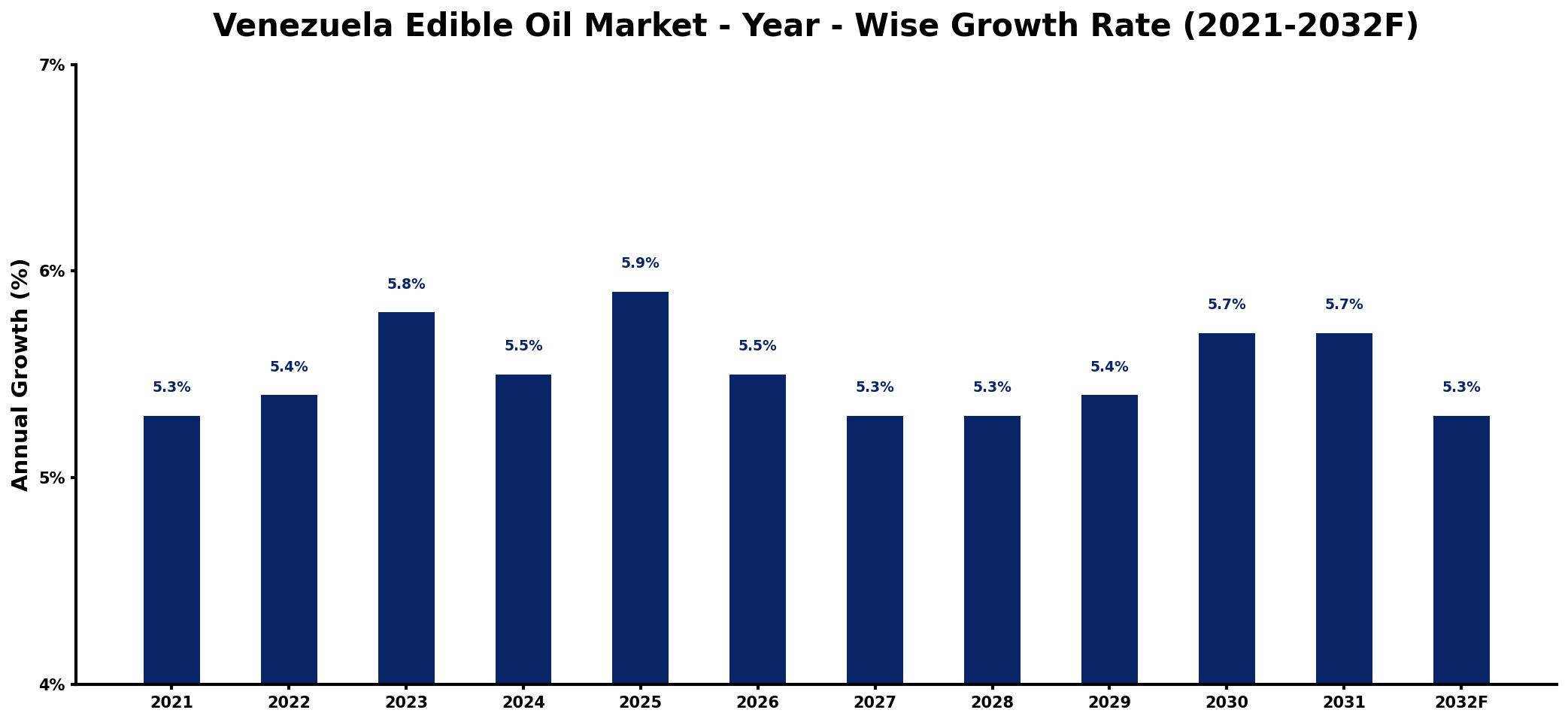
The table below presents the year‑wise growth rates along with the key drivers influencing the market
| Year | Growth Rate | Major Drivers |
| 2021 | 5.3% | Increased agricultural production capacity |
| 2022 | 5.4% | Expansion of local processing facilities |
| 2023 | 5.8% | Rising consumer health awareness |
| 2024 | 5.5% | Growth in food service sector |
| 2025 | 5.9% | Higher disposable income levels |
| 2026 | 5.5% | Investments in sustainable practices |
| 2027 | 5.3% | Diversification of product offerings |
| 2028 | 5.3% | Emergence of new market players |
| 2029 | 5.4% | growing downstream application demand |
| 2030 | 5.7% | increased capital investment inflows |
| 2031 | 5.7% | Technological advancements in production |
| 2032 | 5.3% | Growing demand for alternatives |
Note: Market size estimations and growth projections presented in this report are based on 6Wresearch's proprietary forecasting methodology, utilizing the latest available industry data, government publications, and primary research inputs.
Venezuela Edible Oil Market Synopsis
The Venezuela Edible Oil Market has shown resilience despite the ongoing economic turmoil, characterized by fluctuating prices and product shortages. As consumer preferences shift towards healthier oils, such as sunflower and olive oil, the market is poised for transformation. However, significant hurdles remain, including political instability and economic constraints that threaten future growth.
Currently, government intervention in the form of price controls complicates the landscape, leading to imbalances in supply and demand. While manufacturers innovate to meet the changing needs of health-conscious consumers, navigating this complex environment remains a daunting task. The future will hinge on stabilizing the economic climate and fostering an environment conducive to investment and production.
Venezuela Edible Oil Market Key Takeaways
- Palm oil dominates the Venezuelan edible oil sector, while health trends are shifting consumer preferences.
- Government policies, including price controls and import restrictions, create a volatile market environment.
- Investment in local production capabilities presents a significant opportunity to reduce reliance on imports.
- Emerging consumer demand for organic and specialty oils reflects a growing awareness of health and sustainability.
- Political and economic instability continues to pose risks to market growth and operational profitability.
Evaluation of Restraints in Venezuela Edible Oil Market
The Venezuelan Edible Oil Market is constrained by severe economic instability, characterized by hyperinflation and fluctuating currency values. This volatility limits consumer purchasing power and drives up prices for essential cooking oils, making them unaffordable for many households. Additionally, a heavy reliance on imported oils, exacerbated by trade restrictions and government interventions, results in frequent shortages. Manufacturers face operational challenges due to outdated infrastructure and insufficient investment, further complicating the supply chain and affecting the overall availability of products in the market.
Venezuela Edible Oil Market Trends
A notable trend in the Venezuela Edible Oil Market is the growing consumer inclination towards healthier and more sustainable oil options. This shift is driven by increased awareness of health benefits, particularly regarding oils with lower saturated fat content. Products like avocado and organic sunflower oils are gaining traction as consumers prioritize quality and health. Furthermore, manufacturers are responding to these trends by innovating their offerings, including cold-pressed and organic varieties, to cater to the evolving market demands.
Venezuela Edible Oil Market Opportunities
Despite the prevailing challenges, there are significant investment opportunities within the Venezuelan Edible Oil Market. The high demand for essential cooking oils like corn and soybean oil presents a lucrative landscape for new entrants and existing players. Additionally, tapping into the organic and specialty oil segments can yield substantial returns, appealing to the health-conscious segment of the population. Investments directed towards enhancing production efficiency and quality control measures are likely to yield competitive advantages in this fragmented market.
Government Initiatives in the Venezuela Edible Oil Market
The Venezuelan government has enacted a variety of initiatives aimed at stabilizing the edible oil market. These include imposing price controls on essential products, implementing subsidies to promote domestic production, and imposing import restrictions to foster self-sufficiency. While these policies aim to ensure availability and affordability for consumers, they have also led to unintended consequences such as black market activities and supply shortages. The complex landscape created by these initiatives continues to challenge manufacturers and distributors operating in the market.
Future Insights of the Venezuela Edible Oil Market
Looking ahead to 2026-2032, the future of the Venezuela Edible Oil Market will largely depend on the country's ability to stabilize its economy and implement necessary structural reforms. While the political landscape remains tumultuous, there is potential for recovery if foreign investment can be attracted and domestic production bolstered. Continued consumer trends towards health and sustainability will likely shape product offerings and market dynamics. Companies that can adapt to these changes will find opportunities for growth, provided they can effectively navigate the existing challenges.
Venezuela Edible Oil Market Latest Developments (2025 - 2026)
In recent months, the Venezuela Edible Oil Market has seen shifts in consumer buying patterns as households increasingly opt for healthier oil options amidst ongoing economic challenges. The government's focus on bolstering local production has led to pilot programs aimed at revitalizing domestic agriculture, although progress has been slow. Additionally, innovations in product formulations are emerging, with manufacturers experimenting with blends that cater to both health-conscious consumers and traditional preferences.
Venezuela Edible Oil Market - Key Attractiveness of the Report
- 10 Years of Market Numbers
- Historical Data Starting from 2022 to 2025
- Base Year: 2025
- Forecast Data until 2032
- Key Performance Indicators Impacting the Market
- Major Upcoming Developments and Projects
Key Highlights of the Report:
- Venezuela Edible Oil Market Outlook
- Market Size of Venezuela Edible Oil Market, 2025
- Forecast of Venezuela Edible Oil Market, 2032
- Historical Data and Forecast of Venezuela Edible Oil Revenues & Volume for the Period 2022-2032F
- Venezuela Edible Oil Market Trend Evolution
- Venezuela Edible Oil Market Drivers and Challenges
- Venezuela Edible Oil Price Trends
- Venezuela Edible Oil Porter's Five Forces
- Venezuela Edible Oil Industry Life Cycle
- Historical Data and Forecast of Venezuela Edible Oil Market Revenues & Volume By Type for the Period 2022-2032F
- Historical Data and Forecast of Venezuela Edible Oil Market Revenues & Volume By Palm Oil for the Period 2022-2032F
- Historical Data and Forecast of Venezuela Edible Oil Market Revenues & Volume By Soybean Oil for the Period 2022-2032F
- Historical Data and Forecast of Venezuela Edible Oil Market Revenues & Volume By Mustard Oil for the Period 2022-2032F
- Historical Data and Forecast of Venezuela Edible Oil Market Revenues & Volume By Sunflower Oil for the Period 2022-2032F
- Historical Data and Forecast of Venezuela Edible Oil Market Revenues & Volume By Others for the Period 2022-2032F
- Historical Data and Forecast of Venezuela Edible Oil Market Revenues & Volume By for the Period 2022-2032F
- Historical Data and Forecast of Venezuela Edible Oil Market Revenues & Volume By Packaging Type for the Period 2022-2032F
- Historical Data and Forecast of Venezuela Edible Oil Market Revenues & Volume By Pouches for the Period 2022-2032F
- Historical Data and Forecast of Venezuela Edible Oil Market Revenues & Volume By Jars for the Period 2022-2032F
- Historical Data and Forecast of Venezuela Edible Oil Market Revenues & Volume By Cans for the Period 2022-2032F
- Historical Data and Forecast of Venezuela Edible Oil Market Revenues & Volume By Bottles for the Period 2022-2032F
- Historical Data and Forecast of Venezuela Edible Oil Market Revenues & Volume By for the Period 2022-2032F
- Historical Data and Forecast of Venezuela Edible Oil Market Revenues & Volume By Pack Size for the Period 2022-2032F
- Historical Data and Forecast of Venezuela Edible Oil Market Revenues & Volume By Less than 1 Litres for the Period 2022-2032F
- Historical Data and Forecast of Venezuela Edible Oil Market Revenues & Volume By 1 Litres for the Period 2022-2032F
- Historical Data and Forecast of Venezuela Edible Oil Market Revenues & Volume By 1 Litres - 5 litres for the Period 2022-2032F
- Historical Data and Forecast of Venezuela Edible Oil Market Revenues & Volume By 5 Litres - 10 Litres for the Period 2022-2032F
- Historical Data and Forecast of Venezuela Edible Oil Market Revenues & Volume By 10 Litres and Above for the Period 2022-2032F
- Historical Data and Forecast of Venezuela Edible Oil Market Revenues & Volume By for the Period 2022-2032F
- Historical Data and Forecast of Venezuela Edible Oil Market Revenues & Volume By Packaging Material for the Period 2022-2032F
- Historical Data and Forecast of Venezuela Edible Oil Market Revenues & Volume By Metal for the Period 2022-2032F
- Historical Data and Forecast of Venezuela Edible Oil Market Revenues & Volume By Plastic for the Period 2022-2032F
- Historical Data and Forecast of Venezuela Edible Oil Market Revenues & Volume By Paper for the Period 2022-2032F
- Historical Data and Forecast of Venezuela Edible Oil Market Revenues & Volume By Others for the Period 2022-2032F
- Historical Data and Forecast of Venezuela Edible Oil Market Revenues & Volume By Application for the Period 2022-2032F
- Historical Data and Forecast of Venezuela Edible Oil Market Revenues & Volume By HoReCa for the Period 2022-2032F
- Historical Data and Forecast of Venezuela Edible Oil Market Revenues & Volume By Home Users for the Period 2022-2032F
- Historical Data and Forecast of Venezuela Edible Oil Market Revenues & Volume By Food Processing Industry for the Period 2022-2032F
- Historical Data and Forecast of Venezuela Edible Oil Market Revenues & Volume By for the Period 2022-2032F
- Historical Data and Forecast of Venezuela Edible Oil Market Revenues & Volume By Distribution Channel for the Period 2022-2032F
- Historical Data and Forecast of Venezuela Edible Oil Market Revenues & Volume By Direct/Institutional Sales for the Period 2022-2032F
- Historical Data and Forecast of Venezuela Edible Oil Market Revenues & Volume By Supermarkets and Hypermarkets for the Period 2022-2032F
- Historical Data and Forecast of Venezuela Edible Oil Market Revenues & Volume By Convenience Stores for the Period 2022-2032F
- Historical Data and Forecast of Venezuela Edible Oil Market Revenues & Volume By Online for the Period 2022-2032F
- Historical Data and Forecast of Venezuela Edible Oil Market Revenues & Volume By Others for the Period 2022-2032F
- Venezuela Edible Oil Import Export Trade Statistics
- Market Opportunity Assessment By Type
- Market Opportunity Assessment By Packaging Type
- Market Opportunity Assessment By Pack Size
- Market Opportunity Assessment By Packaging Material
- Market Opportunity Assessment By Application
- Market Opportunity Assessment By Distribution Channel
- Venezuela Edible Oil Top Companies Market Share
- Venezuela Edible Oil Competitive Benchmarking By Technical and Operational Parameters
- Venezuela Edible Oil Company Profiles
- Venezuela Edible Oil Key Strategic Recommendations






































