Venezuela Electric Hair Clipper & Trimmer Market Size, Share & Growth Rate
The Venezuela Electric Hair Clipper & Trimmer Market was estimated at USD 1005 Million in 2025 and is projected to reach USD 1770 Million by 2032, growing at a CAGR of 8.4% from 2026 to 2032. This growth trajectory is largely fueled by an evolving cultural landscape that places increased emphasis on personal grooming, driven in part by the proliferation of grooming content on social media and the influence of lifestyle trends. Moreover, the growing presence of barbershops and salons throughout the nation is propelling demand for advanced grooming tools, indicating a shift toward professional-grade products that cater to both consumers and professionals.
Venezuela Electric Hair Clipper & Trimmer Market Year-wise Growth Rate and Key Drivers
This graph highlights how the Venezuela Electric Hair Clipper & Trimmer Market has steadily grown over the years, supported by major growth factors.
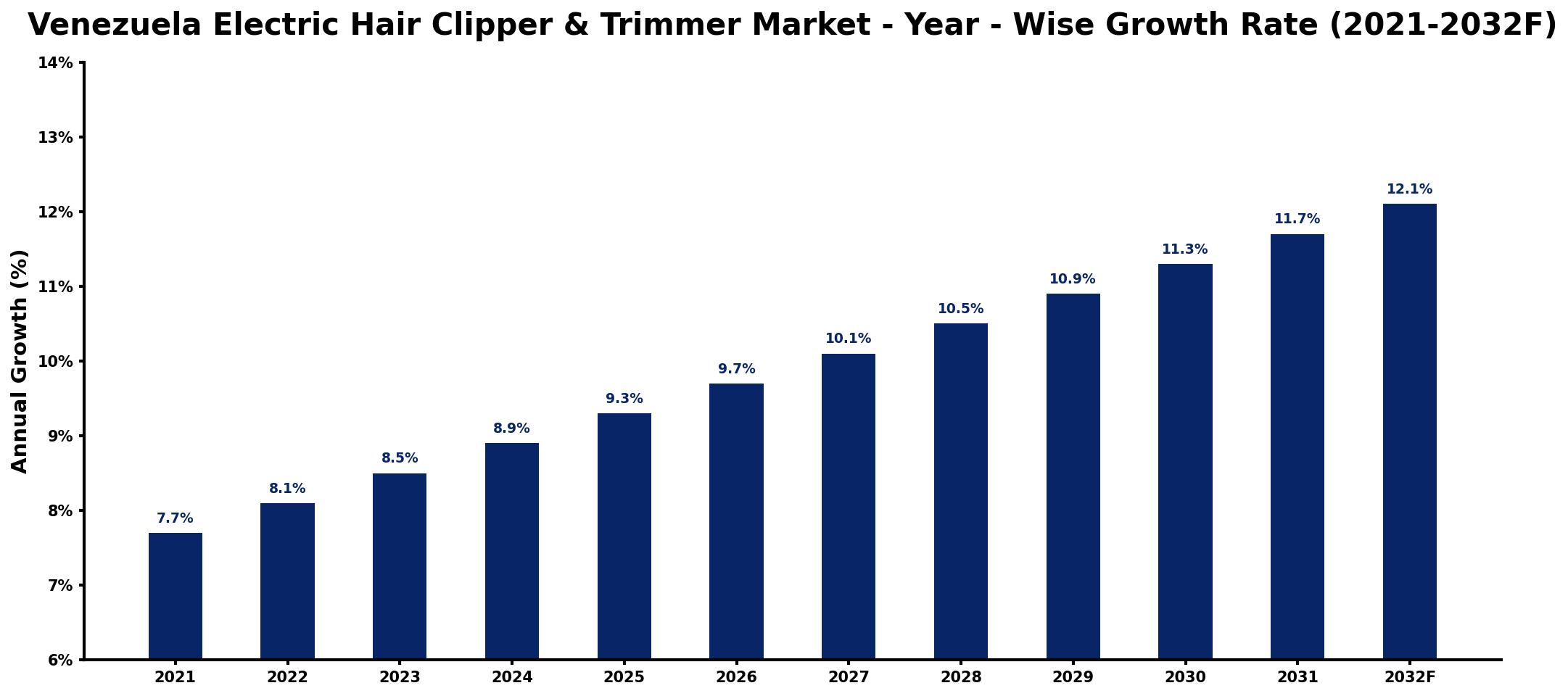
The table below presents the year‑wise growth rates along with the key drivers influencing the market
| Year | Growth Rate | Major Drivers |
| 2021 | 7.7% | Rising consumer grooming awareness |
| 2022 | 8.1% | Increased online retail penetration |
| 2023 | 8.5% | Expansion of personal care market |
| 2024 | 8.9% | Growth in male grooming segment |
| 2025 | 9.3% | Technological advancements in tools |
| 2026 | 9.7% | Surge in beauty salon investments |
| 2027 | 10.1% | Improved distribution channels efficiency |
| 2028 | 10.5% | Growing popularity of home grooming |
| 2029 | 10.9% | Rise in disposable income levels |
| 2030 | 11.3% | Increased focus on self-care routines |
| 2031 | 11.7% | Emergence of eco-friendly products |
| 2032 | 12.1% | Wider availability of premium brands |
Note: Market size estimations and growth projections presented in this report are based on 6Wresearch's proprietary forecasting methodology, utilizing the latest available industry data, government publications, and primary research inputs.
Venezuela Electric Hair Clipper & Trimmer Market Synopsis
The strongest force currently shaping the Venezuela Electric Hair Clipper & Trimmer Market is the heightened consumer focus on personal grooming and self-care. This trend is further amplified by the rise of home grooming solutions, particularly in response to limitations imposed during the pandemic, leading many consumers to seek out user-friendly devices for at-home use.
In this dynamic landscape, innovation remains key. Products featuring advanced technology—like cordless operation, adjustable cutting lengths, and ergonomic designs—are becoming increasingly popular. As consumers gravitate toward items that provide versatility and convenience, manufacturers are adapting their offerings to align with these preferences, ensuring competitiveness in this growing market.
- The market is projected to grow significantly, reaching USD 1770 Million by 2032.
- Increasing consumer emphasis on grooming and self-care is driving demand for electric clippers and trimmers.
- Technological advancements in grooming products are enhancing their functionality and appeal.
- Economic factors, including inflation and currency devaluation, pose challenges to market growth.
- The trend toward home grooming solutions is influencing consumer purchasing decisions.
The Venezuela Electric Hair Clipper & Trimmer Market faces significant challenges stemming from the country's ongoing economic instability. Currency devaluation has diminished consumer purchasing power, making it difficult for many to afford even essential grooming products. This situation is compounded by political uncertainty, which affects business operations and complicates the importation of high-quality items, typically preferred by consumers. These combined factors restrict both the accessibility and affordability of premium grooming products in the marketplace.
Current trends in the Venezuela Electric Hair Clipper & Trimmer Market indicate a strong consumer preference for multifunctional devices. As individuals seek more value, products offering diverse attachments for varying hair lengths and styles are becoming increasingly desirable. Additionally, there is a noticeable shift toward cordless designs, enhancing user convenience and making it easier for consumers to achieve professional results at home.
The pandemic has accelerated the trend of home grooming, prompting brands to innovate in the space. Products that are user-friendly and designed for home application are finding favor, as consumers navigate new norms in personal grooming. This shift is likely to persist, with an emphasis on quality and affordability driving consumer choices moving forward.
There are notable investment opportunities within the Venezuela Electric Hair Clipper & Trimmer Market, particularly for companies that prioritize quality and innovation. As consumer interest in personal grooming continues to rise, brands offering advanced technology and ergonomic designs stand to capture significant market share. The trend of DIY grooming solutions opens avenues for local manufacturers to develop competitive products that cater specifically to the needs of Venezuelan consumers, especially in light of economic constraints affecting imported goods. Furthermore, leveraging digital marketing strategies can effectively engage tech-savvy buyers, broadening market reach.
The Venezuelan government has instituted various policies aimed at regulating the electric hair clipper and trimmer market. These include stringent quality control measures designed to ensure consumer safety and product effectiveness. To bolster local production, there are restrictions on specific imported brands, coupled with pricing regulations to prevent excessive costs for consumers. Such initiatives aim to sustain fair competition while safeguarding public health and supporting local manufacturing endeavors.
Looking ahead to 2026-2032, the outlook for the Venezuela Electric Hair Clipper & Trimmer Market remains complex due to persistent economic and political challenges. While the market is projected to expand, potential declines in consumer purchasing power could limit growth as individuals prioritize essential goods over grooming products. Businesses will need to adopt adaptive strategies, focusing on affordable and locally manufactured solutions to maintain competitiveness in an unpredictable environment.
Recent trends in the Venezuela Electric Hair Clipper & Trimmer Market reveal a continued focus on product innovation and consumer engagement. Manufacturers are increasingly emphasizing advanced features and durability to attract a broader consumer base. Additionally, the local market has seen the emergence of more affordable alternatives, enabling greater accessibility for consumers grappling with economic pressures. As the market continues to evolve, companies are expected to adopt strategies that prioritize both quality and value to meet changing consumer demands.
- 10 Years of Market Numbers
- Historical Data Starting from 2022 to 2025
- Base Year: 2025
- Forecast Data until 2032
- Key Performance Indicators Impacting the Market
- Major Upcoming Developments and Projects
Key Highlights of the Report:
- Venezuela Electric Hair Clipper & Trimmer Market Outlook
- Market Size of Venezuela Electric Hair Clipper & Trimmer Market, 2025
- Forecast of Venezuela Electric Hair Clipper & Trimmer Market, 2032
- Historical Data and Forecast of Venezuela Electric Hair Clipper & Trimmer Revenues & Volume for the Period 2022-2032F
- Venezuela Electric Hair Clipper & Trimmer Market Trend Evolution
- Venezuela Electric Hair Clipper & Trimmer Market Drivers and Challenges
- Venezuela Electric Hair Clipper & Trimmer Price Trends
- Venezuela Electric Hair Clipper & Trimmer Porter's Five Forces
- Venezuela Electric Hair Clipper & Trimmer Industry Life Cycle
- Historical Data and Forecast of Venezuela Electric Hair Clipper & Trimmer Market Revenues & Volume By Product for the Period 2022-2032F
- Historical Data and Forecast of Venezuela Electric Hair Clipper & Trimmer Market Revenues & Volume By Corded for the Period 2022-2032F
- Historical Data and Forecast of Venezuela Electric Hair Clipper & Trimmer Market Revenues & Volume By Cordless for the Period 2022-2032F
- Historical Data and Forecast of Venezuela Electric Hair Clipper & Trimmer Market Revenues & Volume By Distribution Channel for the Period 2022-2032F
- Historical Data and Forecast of Venezuela Electric Hair Clipper & Trimmer Market Revenues & Volume By Offline for the Period 2022-2032F
- Historical Data and Forecast of Venezuela Electric Hair Clipper & Trimmer Market Revenues & Volume By Online for the Period 2022-2032F
- Venezuela Electric Hair Clipper & Trimmer Import Export Trade Statistics
- Market Opportunity Assessment By Product
- Market Opportunity Assessment By Distribution Channel
- Venezuela Electric Hair Clipper & Trimmer Top Companies Market Share
- Venezuela Electric Hair Clipper & Trimmer Competitive Benchmarking By Technical and Operational Parameters
- Venezuela Electric Hair Clipper & Trimmer Company Profiles
- Venezuela Electric Hair Clipper & Trimmer Key Strategic Recommendations






































