Venezuela Elevator and Escalator Market Summary
The venezuela elevator and escalator market was estimated at USD 559 Million in 2025 and is projected to reach USD 927 Million by 2032, growing at a CAGR of 8.6% from 2026 to 2032.
Venezuela Elevator and Escalator Market Year-wise Growth Rate and Key Drivers
This graph highlights how the Venezuela Elevator and Escalator Market has steadily grown over the past five years, supported by major growth factors.
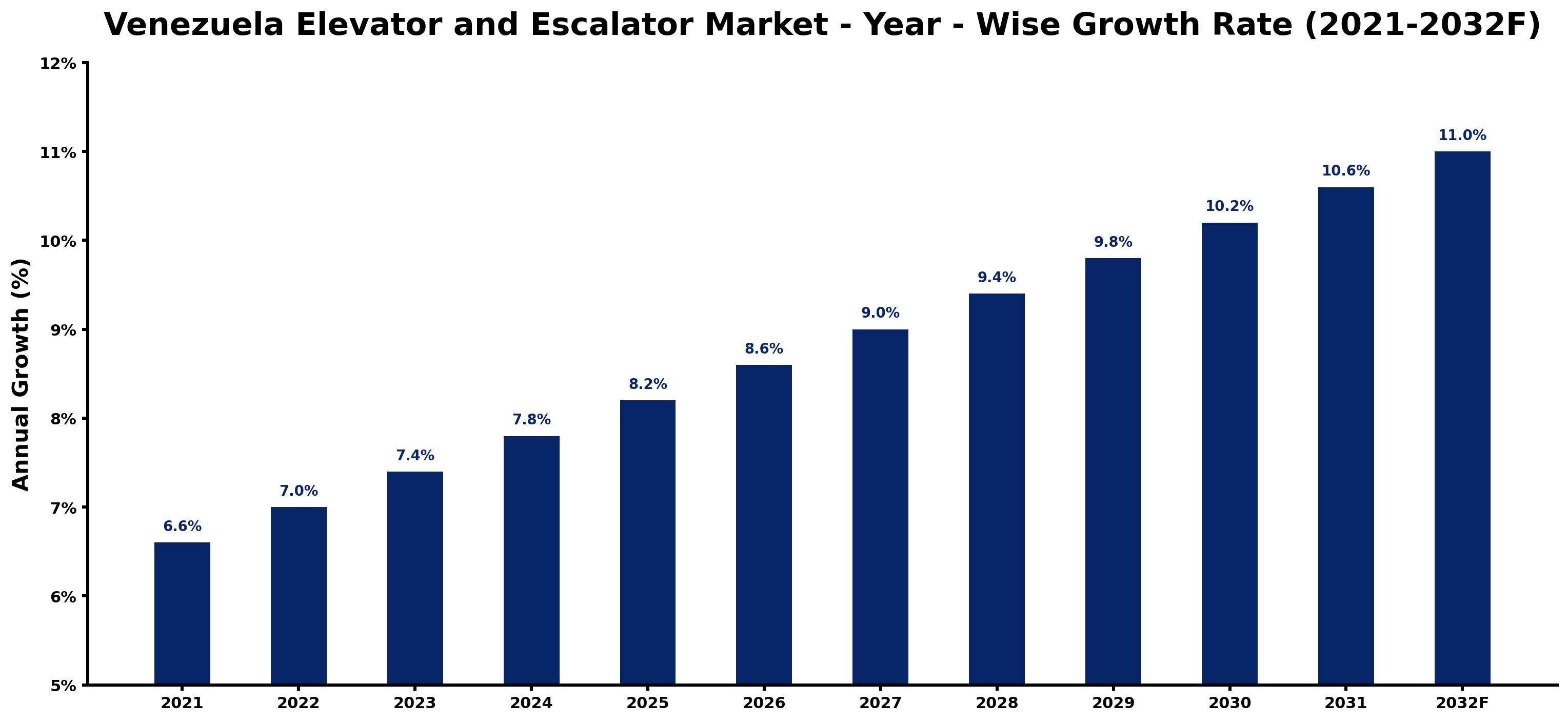
The table below presents the year wise growth rates along with the key drivers influencing the market
| Year | Growth Rate | Major Drivers |
| 2021 | 6.6% | Major urban developments in Caracas fueled infrastructure upgrades and elevator installations. |
| 2022 | 7.0% | Private sector investment targeted commercial real estate, boosting demand for modern escalators. |
| 2023 | 7.4% | Growing middle class in Venezuela increased expectations for high-quality vertical transport solutions. |
| 2024 | 7.8% | Government urban renewal projects prioritized public access with enhanced elevator systems. |
| 2025 | 8.2% | Technological improvements in energy efficiency caught the attention of residential developers. |
| 2026 | 8.6% | Luxury housing developments in coastal areas prompted higher demand for premium elevators. |
| 2027 | 9.0% | Increased tourism initiatives led to more hospitality venues requiring escalator installations. |
| 2028 | 9.4% | Significant public transportation expansion necessitated the integration of escalators at stations. |
| 2029 | 9.8% | Enhanced focus on accessibility prompted renovation of older buildings with modern elevators. |
| 2030 | 10.2% | Collaborations between local manufacturers and foreign firms encouraged innovation in elevator designs. |
| 2031 | 10.6% | Economic stabilization opened avenues for foreign investment in infrastructure projects. |
| 2032 | 11.0% | Sustainable building practices integrated advanced elevator technologies, appealing to eco-conscious developers. |
Note - Market size estimations and growth projections presented in this report are based on 6Wresearch's advanced forecasting approach, validated with industry datasets as of June 2026.
Venezuela Elevator and Escalator Market Synopsis
The Venezuela Elevator and Escalator Market is projected to reach 8.6% and witness significant growth during the forecast period (2026-2032). This anticipated expansion is driven by a combination of urbanization, infrastructure development, and increased investment in commercial and residential construction projects. The evolving landscape of urban living is leading to a rising demand for efficient vertical transportation solutions, which is expected to bolster the market considerably.
Venezuela Elevator and Escalator Market Growth Drivers
Several factors are contributing to the growth of the Venezuela Elevator and Escalator Market. Firstly, the surge in urban population is creating a pressing need for vertical mobility systems in high-rise buildings. As cities expand, the reliance on elevators and escalators becomes more imperative to facilitate the movement of people and goods. Secondly, the government's push towards modernizing existing infrastructure is fostering demand for advanced elevator and escalator systems that meet contemporary safety and efficiency standards.
- The increasing construction of skyscrapers and multi-story buildings is a significant driver, as these projects require robust vertical transport solutions.
- Technological advancements in elevator and escalator systems, such as smart technology features, contribute to enhanced user experience and efficiency, further solidifying market growth.
- Rising disposable income levels among the urban populace have led to increased demand for premium residential properties, which usually incorporate advanced vertical transport systems.
- Environmental concerns are influencing the market, with a growing preference for energy-efficient elevators and escalators that minimize energy consumption and carbon footprint.
- Public transportation systems and transit-oriented developments are becoming focal points in urban planning, creating new opportunities for the elevator and escalator market.
Venezuela Elevator and Escalator Market Challenges and Restraints
Despite the promising growth outlook for the market, certain challenges and restraints could hinder progress. Economic volatility remains a critical concern, as fluctuations in market stability may affect investment in construction and infrastructure projects. Furthermore, the high cost associated with advanced elevator and escalator technologies could pose a barrier to adoption, especially for smaller developers.
- Political instability can lead to delayed projects and uncertain regulatory environments, which may discourage foreign investment in the elevator and escalator market.
- Maintenance and service issues regarding existing systems may deter potential users from investing in new installations, leading to a cautious market approach.
- The skills gap in the workforce can limit the ability to service advanced technology systems, affecting the overall performance of the market.
- Supply chain disruptions can impede the timely delivery of critical components needed for installation and maintenance, posing risks to project timelines.
- Competition from alternative vertical transport solutions, such as inclined lifts and stairlifts, could complicate market dynamics, especially in niche applications.
Venezuela Elevator and Escalator Market Government Investment and Initiatives
The Venezuelan government has been focusing on several initiatives aimed at enhancing infrastructure, which have direct implications for the elevator and escalator market. Public spending on urban renewal projects has increased, targeting the modernization of existing transport infrastructure. This includes the replacement of outdated elevator systems in public buildings and residential complexes, promoting safety and efficiency.
- Government policies encouraging foreign direct investment are being implemented to attract global players to the market, enhancing the technological landscape.
- Incentives for green building projects have been introduced, promoting the installation of energy-efficient vertical transport solutions.
- Collaboration with international organizations for urban development projects has spurred investments in infrastructure improvements.
- Plans to upgrade public transit facilities include the integration of escalators and elevators, ensuring accessibility for all residents.
- Investment in workforce training programs is also a focus, aimed at developing skills necessary for the maintenance and operation of advanced elevator systems.
Venezuela Elevator and Escalator Market Latest Developments (May 2025 - June 2026)
Recent developments in the Venezuela Elevator and Escalator Market indicate a consistent trajectory towards modernization. Significant focus has been placed on integrating smart technologies into elevator systems, enhancing overall energy efficiency and user experience. During this period, various initiatives aimed at infrastructure enhancement have been launched, with a significant number of projects targeting the urban transit sector. This alignment with global trends favors the adoption of high-tech solutions to meet rising consumer expectations.
- Research and development activities focusing on the creation of sustainable elevator systems have gained momentum, responding to environmental concerns.
- A growing emphasis on safety compliance and regulatory standards is leading to more stringent requirements for new installations.
- Public-private partnerships have been instrumental in funding major projects, facilitating access to the latest technology and infrastructure upgrades.
- There has been a positive response to smart elevator features, such as touchless controls, driven by consumer preferences for hygiene and convenience.
- Increased collaboration between technology firms and construction companies is paving the way for innovative solutions tailored to local market needs.
Venezuela Elevator and Escalator Market - Key Attractiveness of the Report
- 10 Years of Market Numbers
- Historical Data Starting from 2022 to 2025
- Base Year: 2025
- Forecast Data until 2032
- Key Performance Indicators Impacting the Market
- Major Upcoming Developments and Projects
- What factors are driving growth in the Venezuela Elevator and Escalator Market?
- What challenges does the Venezuela Elevator and Escalator Market face?
- How is the government supporting the elevator and escalator sector?
- What are the latest trends in the Venezuela Elevator and Escalator Market?
Key Highlights of the Report:
- Venezuela Elevator and Escalator Market Outlook
- Market Size of Venezuela Elevator and Escalator Market, 2025
- Forecast of Venezuela Elevator and Escalator Market, 2032F
- Historical Data and Forecast of Venezuela Elevator and Escalator Revenues & Volume for the Period 2022-2032F
- Venezuela Elevator and Escalator Market Trend Evolution
- Venezuela Elevator and Escalator Market Drivers and Challenges
- Venezuela Elevator and Escalator Price Trends
- Venezuela Elevator and Escalator Porter's Five Forces
- Venezuela Elevator and Escalator Industry Life Cycle
- Historical Data and Forecast of Venezuela Elevator and Escalator Market Revenues & Volume By Types for the Period 2022-2032F
- Historical Data and Forecast of Venezuela Elevator and Escalator Market Revenues & Volume By Elevator for the Period 2022-2032F
- Historical Data and Forecast of Venezuela Elevator and Escalator Market Revenues & Volume By Escalator for the Period 2022-2032F
- Historical Data and Forecast of Venezuela Elevator and Escalator Market Revenues & Volume By Moving Walkways for the Period 2022-2032F
- Historical Data and Forecast of Venezuela Elevator and Escalator Market Revenues & Volume By Services for the Period 2022-2032F
- Historical Data and Forecast of Venezuela Elevator and Escalator Market Revenues & Volume By Maintenance & Repair for the Period 2022-2032F
- Historical Data and Forecast of Venezuela Elevator and Escalator Market Revenues & Volume By New Installation for the Period 2022-2032F
- Historical Data and Forecast of Venezuela Elevator and Escalator Market Revenues & Volume By Modernization for the Period 2022-2032F
- Historical Data and Forecast of Venezuela Elevator and Escalator Market Revenues & Volume By End-User for the Period 2022-2032F
- Historical Data and Forecast of Venezuela Elevator and Escalator Market Revenues & Volume By Residential for the Period 2022-2032F
- Historical Data and Forecast of Venezuela Elevator and Escalator Market Revenues & Volume By Commercial for the Period 2022-2032F
- Historical Data and Forecast of Venezuela Elevator and Escalator Market Revenues & Volume By Public for the Period 2022-2032F
- Venezuela Elevator and Escalator Import Export Trade Statistics
- Market Opportunity Assessment By Types
- Market Opportunity Assessment By Services
- Market Opportunity Assessment By End-User
- Venezuela Elevator and Escalator Top Companies Market Share
- Venezuela Elevator and Escalator Competitive Benchmarking By Technical and Operational Parameters
- Venezuela Elevator and Escalator Company Profiles
- Venezuela Elevator and Escalator Key Strategic Recommendations






































