Venezuela Fuel Oil Market Size, Share & Growth Rate
The Venezuela Fuel Oil Market was estimated at USD 367 Million in 2025 and is projected to reach USD 452 Million by 2032, growing at a CAGR of 3.0% from 2026 to 2032. This growth trajectory is primarily driven by Venezuela's extensive heavy crude oil reserves and the continued demand for fuel oil both domestically and internationally. Despite political and economic challenges, the market is expected to experience gradual stabilization, spurred by potential investments and innovations in production and distribution.
Venezuela Fuel Oil Market Year-wise Growth Rate and Key Drivers
This graph highlights how the Venezuela Fuel Oil Market has steadily grown over the years, supported by major growth factors.
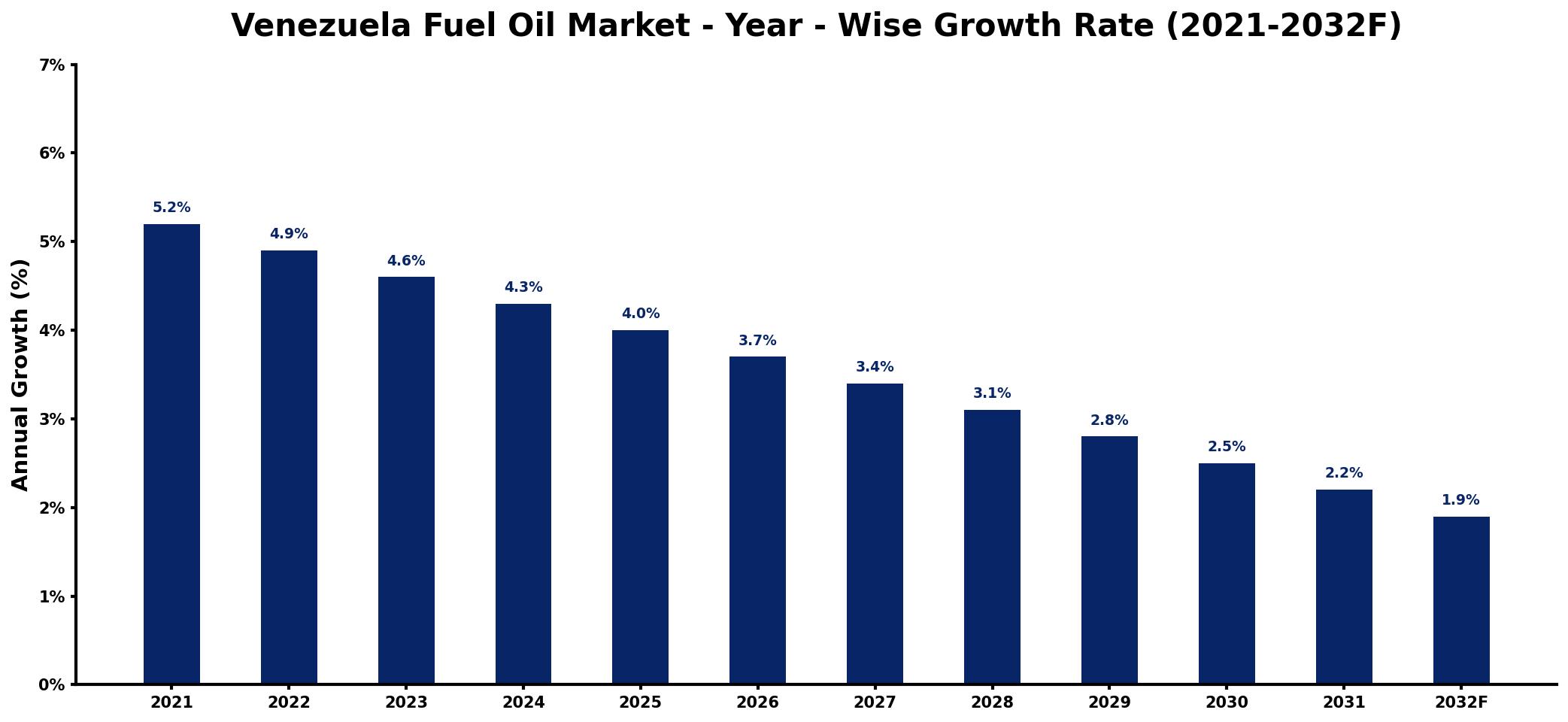
The table below presents the year‑wise growth rates along with the key drivers influencing the market
| Year | Growth Rate | Major Drivers |
| 2021 | 5.2% | Increased industrial energy consumption |
| 2022 | 4.9% | Rising demand for transportation services |
| 2023 | 4.6% | Expansion of power generation capacity |
| 2024 | 4.3% | Greater investment in infrastructure projects |
| 2025 | 4.0% | increased overall sector activity |
| 2026 | 3.7% | Higher residential energy needs |
| 2027 | 3.4% | Boost in manufacturing activities |
| 2028 | 3.1% | Increased agricultural production requirements |
| 2029 | 2.8% | Surge in mining sector operations |
| 2030 | 2.5% | Rising tourism and hospitality activities |
| 2031 | 2.2% | Growing urbanization and population density |
| 2032 | 1.9% | increased domestic production output |
Note: Market size estimations and growth projections presented in this report are based on 6Wresearch's proprietary forecasting methodology, utilizing the latest available industry data, government publications, and primary research inputs.
Venezuela Fuel Oil Market Synopsis
The most significant force currently shaping the Venezuela Fuel Oil Market is the national oil company PDVSA's influence over production and pricing mechanisms. As the state-controlled entity, PDVSA's operations are under immense scrutiny due to historical mismanagement and ongoing economic turbulence.
In addition, the global transition towards cleaner energy solutions adds a layer of complexity to the market dynamics. Stakeholders are compelled to adapt, exploring alternative energy sources and technologies while navigating the inherent challenges of the Venezuelan economy.
Venezuela Fuel Oil Market Key Takeaways
- Political and economic instability continues to disrupt the fuel oil supply chain.
- Venezuelas vast heavy crude oil reserves present significant investment opportunities.
- The market is gradually shifting towards alternative energy sources in response to global trends.
- PDVSAs control over production is both a strength and a point of contention.
- Investment strategies must consider both local and global market fluctuations.
Evaluation of Restraints in Venezuela Fuel Oil Market
The Venezuela Fuel Oil Market grapples with multiple constraints that hinder its potential growth. The ongoing political instability has engendered inconsistent policies, creating uncertainty for investors and operators alike. Coupled with an economic crisis, the production and distribution infrastructure has deteriorated, leading to reduced efficiency and output. Furthermore, international sanctions imposed on Venezuela have severely limited export opportunities, making it difficult for the country to leverage its substantial reserves effectively. These intertwined challenges contribute to a volatile market environment that complicates planning and execution within the sector.
Venezuela Fuel Oil Market Trends
Emerging trends in the Venezuela Fuel Oil Market reflect a conscious shift towards sustainability and diversification of energy sources. Stakeholders are increasingly exploring natural gas and renewable energy solutions as viable alternatives to traditional fuel oil. This trend aligns with global movements aimed at reducing carbon emissions and enhancing energy efficiency. Moreover, ongoing technological advancements are expected to improve the operational capabilities of existing facilities, fostering more reliable supply chains despite market volatility.
Venezuela Fuel Oil Market Opportunities
Investment opportunities in the Venezuela Fuel Oil Market are intrinsically linked to the nations significant oil reserves, which stand as one of the largest globally. Areas such as exploration and production, as well as refining and distribution infrastructure development, are ripe for investment. Moreover, technological innovations aimed at enhancing operational efficiency present avenues for stakeholders to capitalize on. However, potential investors must remain acutely aware of the political and economic landscape that influences these opportunities.
Government Initiatives in the Venezuela Fuel Oil Market
Government policies under President Nicolás Maduro heavily dictate the Venezuela Fuel Oil Market landscape. The administration maintains strict control over production, pricing, and distribution, primarily through PDVSA. Policies designed to subsidize fuel prices have led to challenges regarding sustainability and economic viability. There are also significant regulations restricting private sector participation, which stifles competition and innovation. The government's approach has drawn criticism for inefficiencies that contribute to the current economic crisis, posing serious implications for future market dynamics.
Future Insights of the Venezuela Fuel Oil Market
Looking ahead to the 2026-2032 period, the Venezuela Fuel Oil Market is likely to remain fraught with challenges stemming from ongoing political and economic instability. The countrys declining oil production and lack of investment in critical infrastructure threaten its ability to regain its former status in the global fuel oil market. Additionally, the international shift toward cleaner energy may further depress demand for traditional fuel oil. However, with comprehensive reforms and strategic investments, there lies potential for gradual recovery and adaptation within the market.
Venezuela Fuel Oil Market Latest Developments (2025 - 2026)
Recent developments in the Venezuela Fuel Oil Market illustrate a continued commitment to exploring alternative energy solutions. Initiatives focusing on improving distribution networks and refining technologies are underway, although substantial progress is tempered by the prevailing economic conditions. Stakeholders are evaluating the long-term feasibility of existing strategies, especially in light of international sanctions and fluctuating demand.
Venezuela Fuel Oil Market - Key Attractiveness of the Report
- 10 Years of Market Numbers
- Historical Data Starting from 2022 to 2025
- Base Year: 2025
- Forecast Data until 2032
- Key Performance Indicators Impacting the Market
- Major Upcoming Developments and Projects
Key Highlights of the Report:
- Venezuela Fuel Oil Market Outlook
- Market Size of Venezuela Fuel Oil Market, 2025
- Forecast of Venezuela Fuel Oil Market, 2032
- Historical Data and Forecast of Venezuela Fuel Oil Revenues & Volume for the Period 2022-2032F
- Venezuela Fuel Oil Market Trend Evolution
- Venezuela Fuel Oil Market Drivers and Challenges
- Venezuela Fuel Oil Price Trends
- Venezuela Fuel Oil Porter's Five Forces
- Venezuela Fuel Oil Industry Life Cycle
- Historical Data and Forecast of Venezuela Fuel Oil Market Revenues & Volume By Application for the Period 2022-2032F
- Historical Data and Forecast of Venezuela Fuel Oil Market Revenues & Volume By Marine for the Period 2022-2032F
- Historical Data and Forecast of Venezuela Fuel Oil Market Revenues & Volume By Industrial for the Period 2022-2032F
- Historical Data and Forecast of Venezuela Fuel Oil Market Revenues & Volume By Others for the Period 2022-2032F
- Venezuela Fuel Oil Import Export Trade Statistics
- Market Opportunity Assessment By Application
- Venezuela Fuel Oil Top Companies Market Share
- Venezuela Fuel Oil Competitive Benchmarking By Technical and Operational Parameters
- Venezuela Fuel Oil Company Profiles
- Venezuela Fuel Oil Key Strategic Recommendations






































