Venezuela Functional Apparel Market Size, Share & Growth Rate
The Venezuela Functional Apparel Market was estimated at USD 1255 Million in 2025 and is projected to reach USD 1842 Million by 2032, growing at a CAGR of 5.6% from 2026 to 2032. This trajectory is fueled by a heightened focus on fitness and outdoor activities, which has led to increased consumer interest in functional apparel that features performance-enhancing qualities. Additionally, the influx of international brands offering diverse options has further stimulated demand, aligning with the evolving lifestyle preferences of Venezuelans.
Venezuela Functional Apparel Market Year-wise Growth Rate and Key Drivers
This graph highlights how the Venezuela Functional Apparel Market has steadily grown over the years, supported by major growth factors.
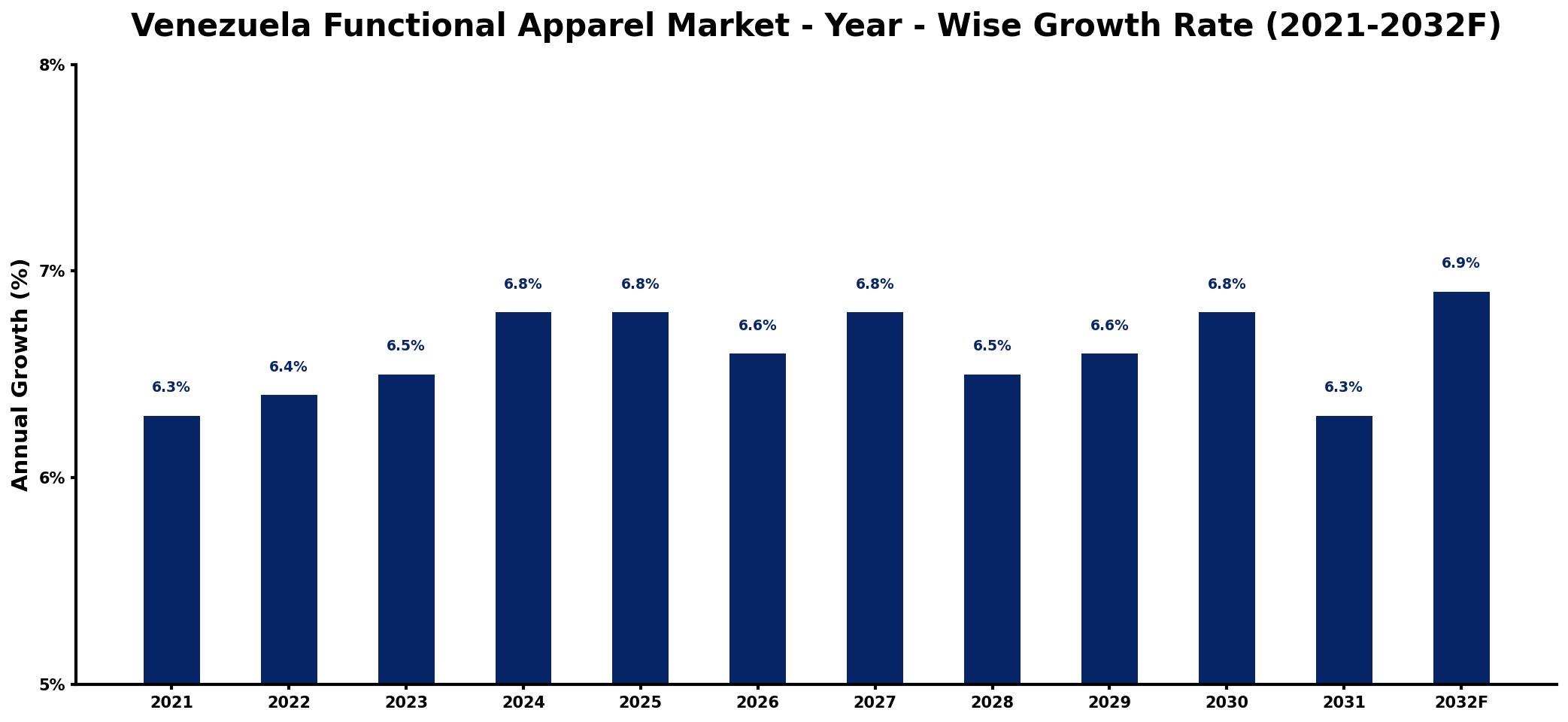
The table below presents the year‑wise growth rates along with the key drivers influencing the market
| Year | Growth Rate | Major Drivers |
| 2021 | 6.3% | Rising consumer health consciousness |
| 2022 | 6.4% | Increased investment in sustainability |
| 2023 | 6.5% | Growth in outdoor activities |
| 2024 | 6.8% | Expansion of e-commerce platforms |
| 2025 | 6.8% | Growing demand for performance gear |
| 2026 | 6.6% | Emergence of new retail channels |
| 2027 | 6.8% | Technological advancements in textiles |
| 2028 | 6.5% | Increase in fitness trends |
| 2029 | 6.6% | Surge in lifestyle brand collaborations |
| 2030 | 6.8% | Boost in urban athletic events |
| 2031 | 6.3% | strengthening underlying market demand |
| 2032 | 6.9% | increased domestic production output |
Note: Market size estimations and growth projections presented in this report are based on 6Wresearch's proprietary forecasting methodology, utilizing the latest available industry data, government publications, and primary research inputs.
Venezuela Functional Apparel Market Synopsis
Recent momentum in the Venezuela Functional Apparel Market underscores a shift towards activewear that seamlessly blends performance with style. However, despite this growing enthusiasm, the market faces challenges related to economic instability and fluctuating purchasing power, which threaten to temper growth in the near term.
Looking ahead, the market is poised for evolution, driven by an increasing demand for sustainable materials and technological advancements in fabric innovation. While the challenges are significant, they also create unique opportunities for brands that can adapt and resonate with the health-conscious consumers of Venezuela.
Venezuela Functional Apparel Market Key Takeaways
- The market is characterized by a rising demand for activewear that offers performance-enhancing features.
- Sustainable and eco-friendly materials are increasingly sought after by Venezuelan consumers.
- International brands are gaining market traction, offering diverse functional apparel options.
- The market is expected to grow despite the economic challenges, driven by health and wellness priorities.
- Investment opportunities exist in specialized segments, including outdoor and adventure sports apparel.
Evaluation of Restraints in Venezuela Functional Apparel Market
The Venezuela Functional Apparel Market grapples with significant restraints that hinder its growth potential. Economic instability remains a primary barrier, leading to inflation and currency devaluation, which drastically impacts consumer purchasing power. Political unrest and international sanctions complicate the operational landscape, creating uncertainties for businesses. As companies work to navigate these challenges, issues such as supply chain disruptions and limited access to innovative technology further exacerbate the situation, restricting market growth and competitiveness.
Venezuela Functional Apparel Market Trends
Currently, the Venezuela Functional Apparel Market is witnessing trends that emphasize the importance of multifunctional designs, particularly athleisure wear that transitions seamlessly from the gym to daily life. There is a clear shift towards comfort, durability, and innovative textiles, such as moisture-wicking and UV-resistant fabrics. Moreover, the growing awareness of environmental issues is prompting consumers to seek out sustainable apparel options, leading brands to integrate eco-friendly materials into their offerings.
Venezuela Functional Apparel Market Opportunities
Amidst the challenges, genuine growth opportunities exist in specialized apparel designed for outdoor activities and sports. As Venezuelans continue to embrace fitness and healthy lifestyles, there is a notable demand for high-performance clothing that features practical benefits. Additionally, the niche market for eco-friendly functional apparel presents an attractive avenue for investment, as consumers increasingly prioritize sustainability in their purchasing decisions.
Government Initiatives in the Venezuela Functional Apparel Market
Government policies in Venezuela significantly impact the functional apparel market, shaped by the economic climate and political framework. Import restrictions, currency controls, and price regulations present hurdles for businesses attempting to source materials and compete in the market. These policies often lead to supply chain disruptions and increased production costs, challenging companies to maintain competitiveness and operational efficiency in a volatile environment.
Future Insights of the Venezuela Functional Apparel Market
Looking towards 2026-2032, the Venezuela Functional Apparel Market is expected to face ongoing hurdles due to economic and political instability. Nevertheless, the increasing health and fitness consciousness among consumers will continue to drive demand for functional apparel that marries performance with style. Brands that can effectively leverage local manufacturing capabilities and digital marketing platforms will be better positioned to thrive in this challenging environment, meeting the evolving needs of health-oriented Venezuelan consumers.
Venezuela Functional Apparel Market Latest Developments (2025 - 2026)
Recent developments in the Venezuela Functional Apparel Market indicate a growing emphasis on innovation and quality. Brands are increasingly focusing on enhancing their product offerings through the integration of advanced textile technologies, while sustainable practices are becoming a cornerstone of many new collections. Retailers are also exploring new channels for reaching consumers, including e-commerce and digital marketing, to better connect with the health-conscious demographic in Venezuela.
Venezuela Functional Apparel Market - Key Attractiveness of the Report
- 10 Years of Market Numbers
- Historical Data Starting from 2022 to 2025
- Base Year: 2025
- Forecast Data until 2032
- Key Performance Indicators Impacting the Market
- Major Upcoming Developments and Projects
Key Highlights of the Report:
- Venezuela Functional Apparel Market Outlook
- Market Size of Venezuela Functional Apparel Market, 2025
- Forecast of Venezuela Functional Apparel Market, 2032
- Historical Data and Forecast of Venezuela Functional Apparel Revenues & Volume for the Period 2022-2032F
- Venezuela Functional Apparel Market Trend Evolution
- Venezuela Functional Apparel Market Drivers and Challenges
- Venezuela Functional Apparel Price Trends
- Venezuela Functional Apparel Porter's Five Forces
- Venezuela Functional Apparel Industry Life Cycle
- Historical Data and Forecast of Venezuela Functional Apparel Market Revenues & Volume By Product Type for the Period 2022-2032F
- Historical Data and Forecast of Venezuela Functional Apparel Market Revenues & Volume By Sportswear for the Period 2022-2032F
- Historical Data and Forecast of Venezuela Functional Apparel Market Revenues & Volume By Activewear for the Period 2022-2032F
- Historical Data and Forecast of Venezuela Functional Apparel Market Revenues & Volume By Protective Clothing for the Period 2022-2032F
- Historical Data and Forecast of Venezuela Functional Apparel Market Revenues & Volume By Others for the Period 2022-2032F
- Historical Data and Forecast of Venezuela Functional Apparel Market Revenues & Volume By Application for the Period 2022-2032F
- Historical Data and Forecast of Venezuela Functional Apparel Market Revenues & Volume By Sports Industry for the Period 2022-2032F
- Historical Data and Forecast of Venezuela Functional Apparel Market Revenues & Volume By Outdoor Clothing for the Period 2022-2032F
- Historical Data and Forecast of Venezuela Functional Apparel Market Revenues & Volume By Healthcare sector for the Period 2022-2032F
- Historical Data and Forecast of Venezuela Functional Apparel Market Revenues & Volume By Distribution Channel for the Period 2022-2032F
- Historical Data and Forecast of Venezuela Functional Apparel Market Revenues & Volume By Offline Store for the Period 2022-2032F
- Historical Data and Forecast of Venezuela Functional Apparel Market Revenues & Volume By Online Store for the Period 2022-2032F
- Venezuela Functional Apparel Import Export Trade Statistics
- Market Opportunity Assessment By Product Type
- Market Opportunity Assessment By Application
- Market Opportunity Assessment By Distribution Channel
- Venezuela Functional Apparel Top Companies Market Share
- Venezuela Functional Apparel Competitive Benchmarking By Technical and Operational Parameters
- Venezuela Functional Apparel Company Profiles
- Venezuela Functional Apparel Key Strategic Recommendations






































