Venezuela Halal Meat Market Size, Share & Growth Rate
The Venezuela Halal Meat Market was estimated at USD 428 Million in 2025 and is projected to reach USD 572 Million by 2032, growing at a CAGR of 4.2% from 2026 to 2032. This growth trajectory is primarily fueled by an expanding Muslim population seeking Halal-certified products that comply with Islamic dietary regulations. Additionally, a rising consumer consciousness regarding ethical sourcing and humane animal treatment is propelling demand for ethically produced Halal meat.
Venezuela Halal Meat Market Year-wise Growth Rate and Key Drivers
This graph highlights how the Venezuela Halal Meat Market has steadily grown over the years, supported by major growth factors.
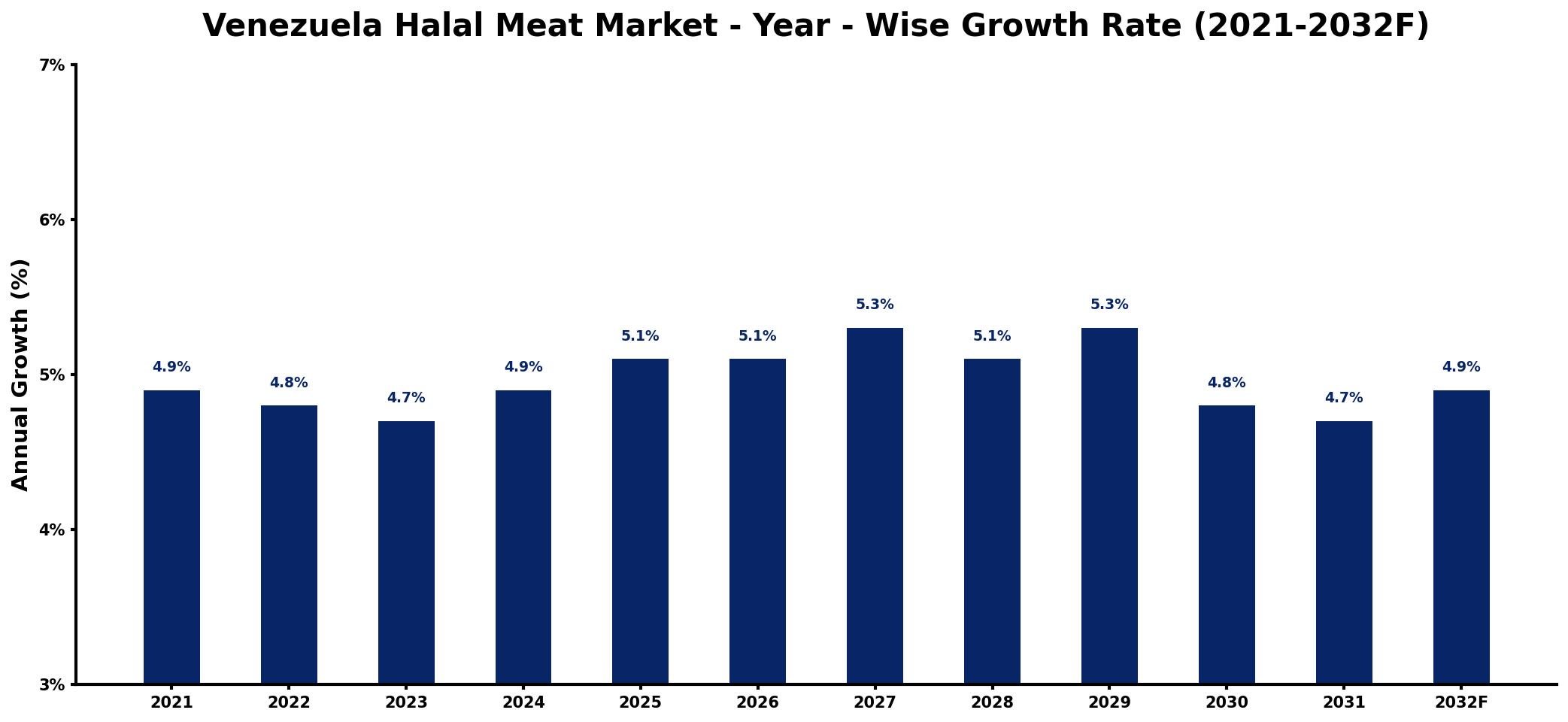
The table below presents the year‑wise growth rates along with the key drivers influencing the market
| Year | Growth Rate | Major Drivers |
| 2021 | 4.9% | Rising consumer awareness of quality |
| 2022 | 4.8% | Increasing demand for ethical sourcing |
| 2023 | 4.7% | Expanding retail distribution channels |
| 2024 | 4.9% | Growth in online purchasing platforms |
| 2025 | 5.1% | Surge in population dietary shifts |
| 2026 | 5.1% | Investment in local production facilities |
| 2027 | 5.3% | Enhancements in supply chain logistics |
| 2028 | 5.1% | Development of premium product lines |
| 2029 | 5.3% | Strengthening export market opportunities |
| 2030 | 4.8% | Diversification of food service offerings |
| 2031 | 4.7% | Emergence of health-conscious consumers |
| 2032 | 4.9% | Innovation in product packaging solutions |
Note: Market size estimations and growth projections presented in this report are based on 6Wresearch's proprietary forecasting methodology, utilizing the latest available industry data, government publications, and primary research inputs.
Venezuela Halal Meat Market Synopsis
Venezuela is witnessing a noticeable increase in its Muslim demographic, leading to a corresponding rise in demand for Halal meat products such as beef, lamb, and poultry. Local producers are increasingly obtaining Halal certifications, thereby expanding the variety of available products in supermarkets and specialty stores.
The market's unique dynamics stem from both cultural influences and a growing awareness of the health benefits associated with Halal meat. The integration of Halal standards into local meat production processes is gaining traction, driven by an urgency to meet the dietary needs of an expanding consumer base.
Venezuela Halal Meat Market Key Takeaways
- Significant growth driven by an increase in the Muslim population and demand for Halal-certified meat products.
- Local producers are obtaining certifications, enhancing product variety and availability.
- Government policies aim to promote domestic Halal production and ensure affordability for consumers.
- Economic challenges, including inflation and currency fluctuations, impact consumer purchasing power.
- Opportunities for investment exist, particularly in production and processing facilities catering to the Halal market.
Evaluation of Restraints in Venezuela Halal Meat Market
Despite the growing interest in the Halal meat sector, several restraints hinder its development. A significant shortage of certified Halal slaughterhouses and processing facilities limits product availability, complicating the supply chain. Moreover, the ongoing economic crisis, characterized by inflation and currency devaluation, poses challenges for both producers and consumers, affecting the affordability of Halal meat. The absence of standardized regulations further leads to issues such as mislabeling, undermining consumer trust. Political instability continues to affect import capabilities, making it difficult for businesses to secure essential resources and technologies.
Venezuela Halal Meat Market Trends
Current trends in the Venezuela Halal meat market highlight a growing consumer preference for transparency and traceability within the supply chain. Consumers are increasingly seeking detailed information regarding the sourcing and processing of Halal products. Additionally, supermarkets and specialty stores are expanding their offerings to include a wider range of Halal-certified meats, catering to both Muslim and non-Muslim consumers drawn by ethical and health-conscious eating habits.
Venezuela Halal Meat Market Opportunities
The Venezuela Halal Meat Market presents lucrative opportunities for investment, particularly for those interested in establishing production or processing facilities. Given the significant and growing Muslim community, there's an evident gap in the market that can be filled by certified suppliers. Furthermore, exporting Halal meat products to neighboring countries with Muslim populations could provide additional revenue streams, contributing to market expansion in the region.
Government Initiatives in the Venezuela Halal Meat Market
Government policies regarding the Halal meat market are largely influenced by the current economic and political climate. Efforts have been made to promote domestic production, reducing reliance on imports while ensuring that Halal meat remains affordable for consumers through price controls and subsidies. However, the ongoing economic crisis poses challenges in maintaining consistent quality and supply standards. There are indications of increasing support for local producers to enhance Halal meat availability in the market.
Future Insights of the Venezuela Halal Meat Market
Looking ahead, the Venezuela Halal Meat Market is anticipated to navigate a complex landscape shaped by ongoing economic instability and political unrest. While purchasing power among consumers may decline, there remains a substantial opportunity for growth driven by a larger Muslim population and increasing awareness about Halal practices among broader demographics. Success in this market will hinge on innovation, strategic marketing, and the establishment of robust distribution networks that cater to a niche yet expanding consumer base.
Venezuela Halal Meat Market Latest Developments (2025 - 2026)
Recent developments in the Venezuela Halal meat market indicate a trend toward increased collaboration among local producers to standardize Halal certification processes. Additionally, emerging partnerships with international suppliers are facilitating the introduction of diverse Halal meat products. Amid these efforts, consumers are becoming more engaged in the sourcing of their food, leading to greater demand for transparency in the supply chain.
Venezuela Halal Meat Market - Key Attractiveness of the Report
- 10 Years of Market Numbers
- Historical Data Starting from 2022 to 2025
- Base Year: 2025
- Forecast Data until 2032
- Key Performance Indicators Impacting the Market
- Major Upcoming Developments and Projects
Key Highlights of the Report:
- Venezuela Halal Meat Market Outlook
- Market Size of Venezuela Halal Meat Market, 2025
- Forecast of Venezuela Halal Meat Market, 2032
- Historical Data and Forecast of Venezuela Halal Meat Revenues & Volume for the Period 2022-2032F
- Venezuela Halal Meat Market Trend Evolution
- Venezuela Halal Meat Market Drivers and Challenges
- Venezuela Halal Meat Price Trends
- Venezuela Halal Meat Porter's Five Forces
- Venezuela Halal Meat Industry Life Cycle
- Historical Data and Forecast of Venezuela Halal Meat Market Revenues & Volume By Product Type for the Period 2022-2032F
- Historical Data and Forecast of Venezuela Halal Meat Market Revenues & Volume By Fresh Food for the Period 2022-2032F
- Historical Data and Forecast of Venezuela Halal Meat Market Revenues & Volume By Processed Food for the Period 2022-2032F
- Venezuela Halal Meat Import Export Trade Statistics
- Market Opportunity Assessment By Product Type
- Venezuela Halal Meat Top Companies Market Share
- Venezuela Halal Meat Competitive Benchmarking By Technical and Operational Parameters
- Venezuela Halal Meat Company Profiles
- Venezuela Halal Meat Key Strategic Recommendations






































