Venezuela Mass Spectrometry Market Size, Share & Growth Rate
The Venezuela Mass Spectrometry Market was estimated at USD 303 Million in 2025 and is projected to reach USD 418 Million by 2032, growing at a CAGR of 4.7% from 2026 to 2032. This growth is primarily fueled by the increasing application of mass spectrometry in pharmaceuticals, environmental testing, and food safety sectors. As investments in research and development surge, and healthcare infrastructure expands, the demand for precise analytical tools continues to escalate, driving the market forward.
Venezuela Mass Spectrometry Market Year-wise Growth Rate and Key Drivers
This graph highlights how the Venezuela Mass Spectrometry Market has steadily grown over the years, supported by major growth factors.
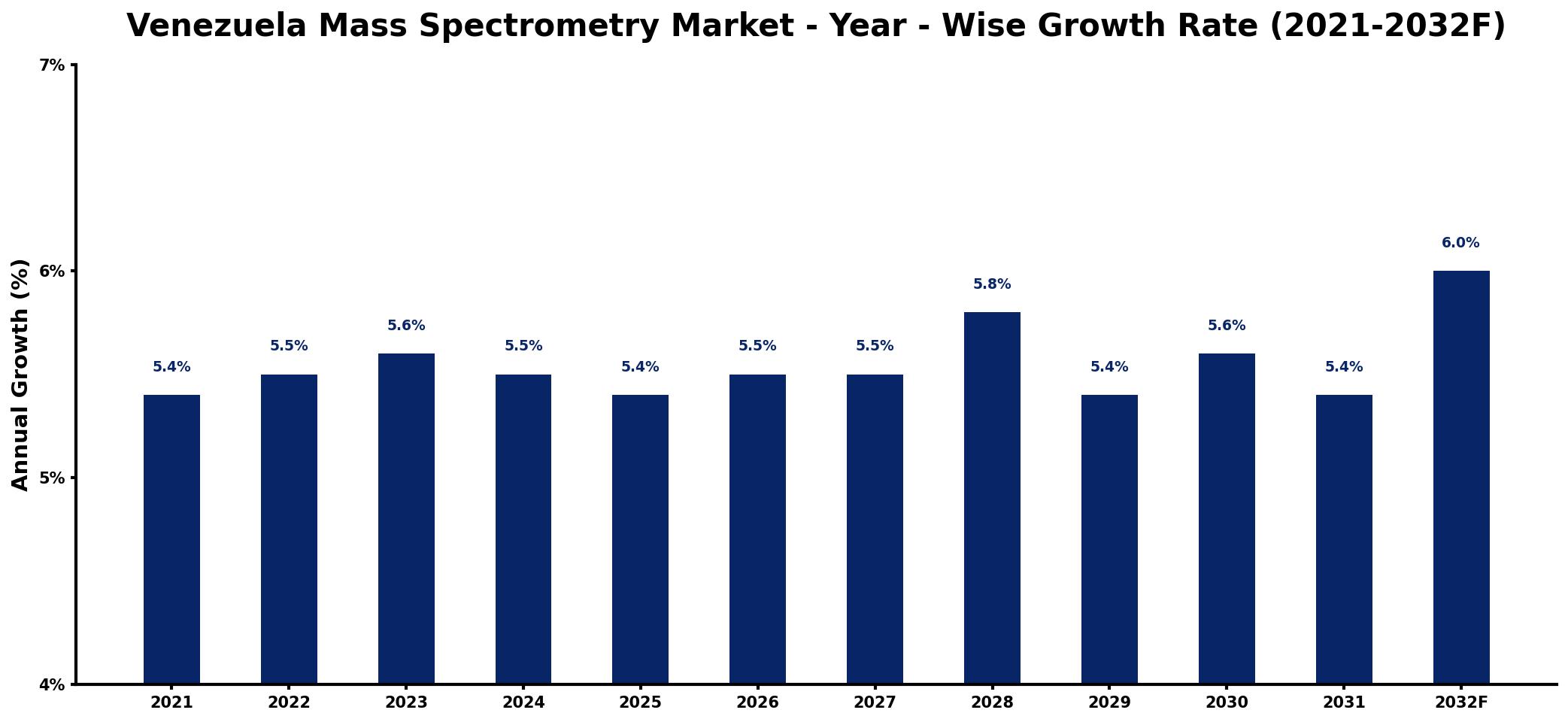
The table below presents the year‑wise growth rates along with the key drivers influencing the market
| Year | Growth Rate | Major Drivers |
| 2021 | 5.4% | Rising healthcare diagnostics demand |
| 2022 | 5.5% | Increased academic research funding |
| 2023 | 5.6% | Growing pharmaceutical development activities |
| 2024 | 5.5% | Expansion in food safety testing |
| 2025 | 5.4% | Boost in environmental monitoring initiatives |
| 2026 | 5.5% | Surge in biotechnology investments |
| 2027 | 5.5% | Higher government research grants |
| 2028 | 5.8% | Emergence of new applications |
| 2029 | 5.4% | Growth in industrial quality control |
| 2030 | 5.6% | Increased collaboration with universities |
| 2031 | 5.4% | Demand for personalized medicine solutions |
| 2032 | 6.0% | Technological advancements in analytics |
Note: Market size estimations and growth projections presented in this report are based on 6Wresearch's proprietary forecasting methodology, utilizing the latest available industry data, government publications, and primary research inputs.
Venezuela Mass Spectrometry Market Synopsis
The Venezuelan mass spectrometry market has experienced a phase of steady growth, underpinned by advancements in analytical technology and an increasing appreciation of its benefits. However, the journey ahead presents both opportunities and obstacles, particularly given the prevailing economic conditions in the country.
While the current momentum suggests promising developments, ongoing economic and political challenges may impact investment levels and technological access. Nevertheless, as industries increasingly require accurate and rapid analysis, the importance of mass spectrometry as an indispensable tool remains clear.
Venezuela Mass Spectrometry Market Key Takeaways
- The market is projected to grow from USD 303 Million in 2025 to USD 418 Million by 2032, at a CAGR of 4.7%.
- Increased investment in R&D and healthcare infrastructure drives demand for advanced analytical technologies.
- Partnerships between industry players and research institutions are enhancing innovation in mass spectrometry.
- Challenges from economic instability and international sanctions hinder access to cutting-edge technologies.
- Opportunities lie in developing cost-effective and user-friendly mass spectrometry solutions tailored to local needs.
Evaluation of Restraints in Venezuela Mass Spectrometry Market
The Venezuela Mass Spectrometry Market is significantly restrained by ongoing economic instability and political turmoil. These factors contribute to a volatile environment that deters investment and complicates access to necessary technology and equipment. Additionally, international sanctions restrict the importation of advanced mass spectrometry solutions, which hampers research capabilities and overall market growth. As businesses grapple with fluctuating currency exchange rates and rising inflation, the ability to invest in expensive analytical instruments becomes increasingly challenging.
Venezuela Mass Spectrometry Market Trends
A notable trend within the Venezuela Mass Spectrometry Market is the shift towards high-resolution and advanced mass spectrometry technologies. There is a rising demand for instruments that can accurately detect and identify complex molecules, particularly within the pharmaceutical and environmental sectors. Furthermore, the emphasis on user-friendly, cost-effective solutions indicates a responsiveness to the unique challenges faced by local laboratories and academic institutions. Collaborative efforts between industry and academia are becoming common as stakeholders aim to enhance research capabilities and address evolving analytical challenges.
Venezuela Mass Spectrometry Market Opportunities
Investment opportunities in the Venezuela Mass Spectrometry Market are particularly promising in the healthcare and pharmaceutical sectors, where mass spectrometry is vital for drug discovery and clinical diagnostics. The increasing need for precision medicine and biomarker discovery creates a demand for high-quality mass spectrometry instruments and associated services. Investing in innovative solutions that cater to local needs, such as portable instruments or budget-friendly options, presents a lucrative avenue. Moreover, forming partnerships with research institutions and healthcare providers can foster growth in the application of mass spectrometry for precision medicine.
Government Initiatives in the Venezuela Mass Spectrometry Market
Venezuelas government policies regarding the mass spectrometry market aim to bolster domestic production and lessen reliance on imports. Initiatives include tax incentives and subsidies designed to support local manufacturers. However, the overarching political and economic instability complicates these efforts, affecting access to funding and skilled labor essential for advancing the mass spectrometry sector. Regulatory challenges concerning imports further complicate the landscape, necessitating innovative approaches to strengthen the industry.
Future Insights of the Venezuela Mass Spectrometry Market
Looking forward to 2026-2032, the Venezuela Mass Spectrometry Market is set to navigate a complex environment shaped by economic and political factors. While significant hurdles remain, particularly in technology access, the potential for growth exists in sectors like healthcare and environmental testing where mass spectrometry is critical. Strategies that prioritize international collaborations and partnerships could facilitate advancements in technology and enhance market resilience. Overall, with the right approach, niche segments within the market could see substantial growth, ensuring the relevance of mass spectrometry in various applications.
Venezuela Mass Spectrometry Market Latest Developments (2025 - 2026)
Recent developments in the Venezuela Mass Spectrometry Market indicate a continued push towards innovation and collaboration. Industry stakeholders are increasingly engaging in partnerships with local research institutions to drive advancements in mass spectrometry technology. Efforts are also underway to enhance the accessibility of high-resolution instruments despite the prevailing economic challenges, as businesses adapt to the shifting landscape. The focus remains on expanding applications in pharmaceuticals and environmental testing, reflecting a commitment to meeting the evolving needs of these critical sectors.
Venezuela Mass Spectrometry Market - Key Attractiveness of the Report
- 10 Years of Market Numbers
- Historical Data Starting from 2022 to 2025
- Base Year: 2025
- Forecast Data until 2032
- Key Performance Indicators Impacting the Market
- Major Upcoming Developments and Projects
Key Highlights of the Report:
- Venezuela Mass Spectrometry Market Outlook
- Market Size of Venezuela Mass Spectrometry Market, 2025
- Forecast of Venezuela Mass Spectrometry Market, 2032
- Historical Data and Forecast of Venezuela Mass Spectrometry Revenues & Volume for the Period 2022-2032F
- Venezuela Mass Spectrometry Market Trend Evolution
- Venezuela Mass Spectrometry Market Drivers and Challenges
- Venezuela Mass Spectrometry Price Trends
- Venezuela Mass Spectrometry Porter's Five Forces
- Venezuela Mass Spectrometry Industry Life Cycle
- Historical Data and Forecast of Venezuela Mass Spectrometry Market Revenues & Volume By Technology for the Period 2022-2032F
- Historical Data and Forecast of Venezuela Mass Spectrometry Market Revenues & Volume By Hybrid Mass Spectrometry for the Period 2022-2032F
- Historical Data and Forecast of Venezuela Mass Spectrometry Market Revenues & Volume By Single Mass Spectrometry for the Period 2022-2032F
- Historical Data and Forecast of Venezuela Mass Spectrometry Market Revenues & Volume By Application for the Period 2022-2032F
- Historical Data and Forecast of Venezuela Mass Spectrometry Market Revenues & Volume By Pharmaceutical for the Period 2022-2032F
- Historical Data and Forecast of Venezuela Mass Spectrometry Market Revenues & Volume By Biotechnology for the Period 2022-2032F
- Historical Data and Forecast of Venezuela Mass Spectrometry Market Revenues & Volume By Security for the Period 2022-2032F
- Historical Data and Forecast of Venezuela Mass Spectrometry Market Revenues & Volume By Industrial chemistry for the Period 2022-2032F
- Historical Data and Forecast of Venezuela Mass Spectrometry Market Revenues & Volume By Environmental testing for the Period 2022-2032F
- Historical Data and Forecast of Venezuela Mass Spectrometry Market Revenues & Volume By Food & beverage testing for the Period 2022-2032F
- Historical Data and Forecast of Venezuela Mass Spectrometry Market Revenues & Volume By Forensic for the Period 2022-2032F
- Historical Data and Forecast of Venezuela Mass Spectrometry Market Revenues & Volume By Clinical for the Period 2022-2032F
- Venezuela Mass Spectrometry Import Export Trade Statistics
- Market Opportunity Assessment By Technology
- Market Opportunity Assessment By Application
- Venezuela Mass Spectrometry Top Companies Market Share
- Venezuela Mass Spectrometry Competitive Benchmarking By Technical and Operational Parameters
- Venezuela Mass Spectrometry Company Profiles
- Venezuela Mass Spectrometry Key Strategic Recommendations






































