Venezuela Metal Fabrication Market Size, Share & Growth Rate
The Venezuela Metal Fabrication Market was estimated at USD 225 Million in 2025 and is projected to reach USD 314 Million by 2032, growing at a CAGR of 4.9% from 2026 to 2032. This growth trajectory is largely fueled by the countrys rich natural resources and the necessity for infrastructure development to support its recovering oil and gas industry. Additionally, the rising demand for advanced metal components across various sectors, including automotive and construction, further propels market expansion.
Venezuela Metal Fabrication Market Year-wise Growth Rate and Key Drivers
This graph highlights how the Venezuela Metal Fabrication Market has steadily grown over the years, supported by major growth factors.
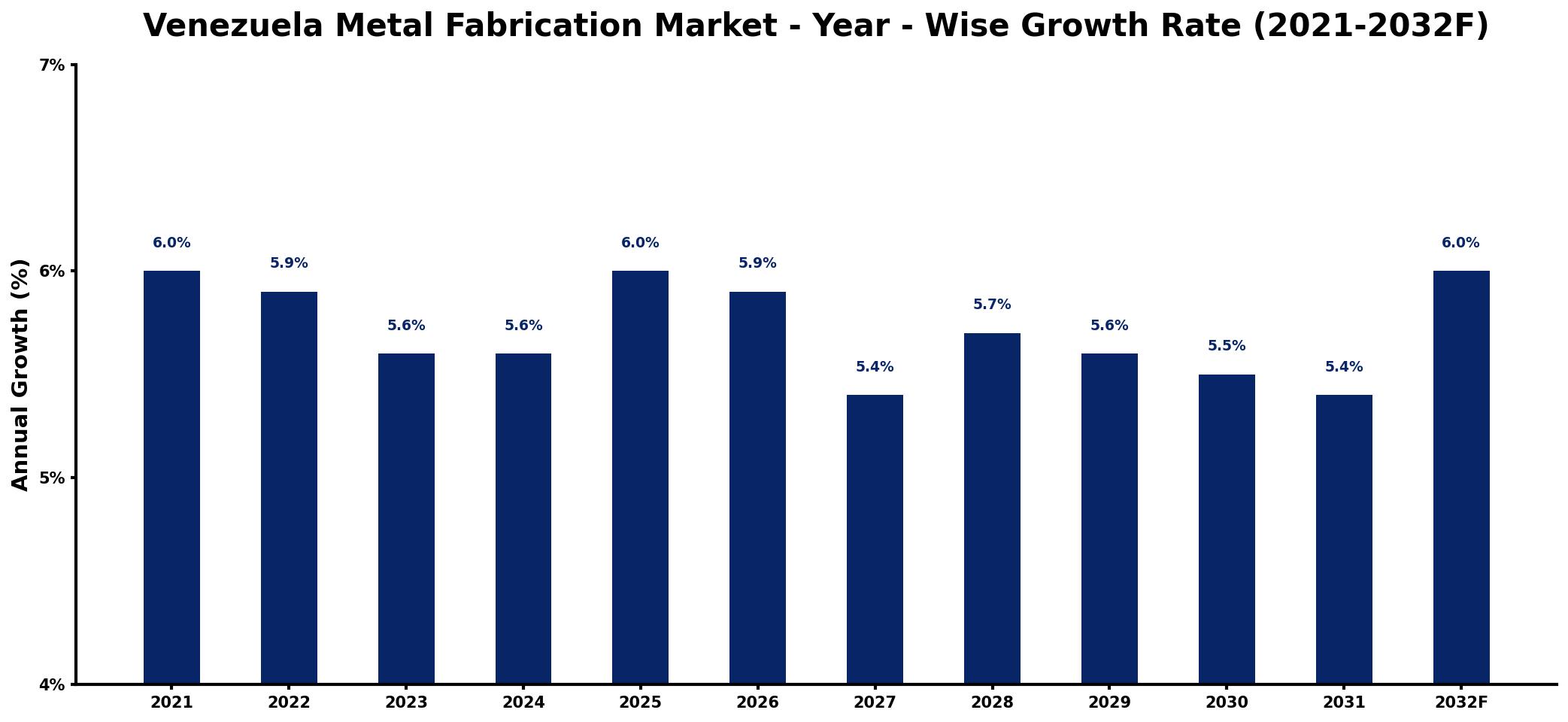
The table below presents the year‑wise growth rates along with the key drivers influencing the market
| Year | Growth Rate | Major Drivers |
| 2021 | 6.0% | Increased infrastructure development projects |
| 2022 | 5.9% | Growing demand from construction sector |
| 2023 | 5.6% | Rising investments in energy sector |
| 2024 | 5.6% | Expansion of automotive manufacturing capacity |
| 2025 | 6.0% | Strengthening of export markets presence |
| 2026 | 5.9% | Surge in residential construction activity |
| 2027 | 5.4% | Increased government infrastructure spending |
| 2028 | 5.7% | Growth in renewable energy initiatives |
| 2029 | 5.6% | Rising demand for consumer goods |
| 2030 | 5.5% | rising procurement volume requirements |
| 2031 | 5.4% | Increased focus on sustainability practices |
| 2032 | 6.0% | Strengthened regional trade partnerships |
Note: Market size estimations and growth projections presented in this report are based on 6Wresearch's proprietary forecasting methodology, utilizing the latest available industry data, government publications, and primary research inputs.
Venezuela Metal Fabrication Market Synopsis
The Venezuelan metal fabrication market has shown resilience amidst ongoing political and economic upheavals. Despite significant challenges, including hyperinflation and supply chain disruptions, the sector is adapting through innovation and technological advancements. Companies are gradually shifting towards automation to maintain competitiveness and improve operational efficiency.
The market comprises a wide array of players, from small workshops to larger manufacturers, all focused on meeting the growing demands from key industries. The emphasis on sustainable practices and the integration of advanced technologies signal a transformative phase, as companies aim to enhance their product offerings and align with global standards.
Venezuela Metal Fabrication Market Key Takeaways
- Shifts toward automation and advanced technologies are reshaping production capabilities.
- Growing demand for customized metal components is evident in multiple sectors.
- Political and economic instability continues to pose risks to market growth.
- Investment opportunities exist, particularly in infrastructure and resource extraction support.
- Innovation and diversification are critical strategies for companies operating in this market.
Evaluation of Restraints in Venezuela Metal Fabrication Market
The metal fabrication market in Venezuela is significantly restrained by a combination of economic volatility and political uncertainty. The rampant hyperinflation affects the costs of raw materials and machinery, forcing companies to operate under extreme financial pressure. Furthermore, the lack of investment in modern technology limits the industry's ability to innovate and remain competitive on the international stage. The unpredictable regulatory environment and corruption exacerbate these challenges, creating a landscape where strategic planning and long-term investments are fraught with risk.
Venezuela Metal Fabrication Market Trends
Emerging trends in the Venezuelan metal fabrication market include a pronounced shift towards automation and the adoption of advanced manufacturing technologies. Companies are increasingly investing in robotic welding, CNC machining, and laser cutting to enhance productivity and precision. Additionally, sustainability is becoming a key focus area, with firms exploring eco-friendly materials and processes to appeal to a growing consumer base concerned about environmental impact. The demand for complex and customized metal components, particularly within the automotive and aerospace sectors, is also on the rise, reflecting a shift in market dynamics.
Venezuela Metal Fabrication Market Opportunities
There are tangible opportunities for growth within the Venezuelan metal fabrication market, particularly in sectors like infrastructure development, oil & gas support, and specialized mining equipment manufacturing. Given Venezuela's wealth of natural resources, demand for metal fabrication services in extraction and processing is poised to increase. Companies that position themselves to provide essential metal components for construction projects or tailored fabrication services for the oil sector may find lucrative niches. Furthermore, targeting export markets can help mitigate domestic economic challenges, allowing businesses to diversify their revenue streams.
Government Initiatives in the Venezuela Metal Fabrication Market
Venezuelan government policies regarding the metal fabrication market are deeply intertwined with the countrys socialist principles and state-led economic model. The government maintains substantial control over industry operations through nationalization, stringent import regulations, and price controls. Current policies are geared towards encouraging domestic production and reducing reliance on foreign imports. However, the ongoing economic crisis complicates these initiatives, making it essential for businesses to navigate the complex regulatory landscape effectively.
Future Insights of the Venezuela Metal Fabrication Market
Looking ahead to 2026-2032, the outlook for the Venezuela Metal Fabrication Market remains complex. While there will be significant challenges, including limited access to raw materials and ongoing currency volatility, niche opportunities may emerge, especially in sectors focused on renewable energy and specialized metal services. Companies will need to be adaptable, leveraging innovation and technological advancements to carve out sustainable growth paths amidst an unpredictable economic environment.
Venezuela Metal Fabrication Market Latest Developments (2025 - 2026)
In recent months, the Venezuela Metal Fabrication Market has witnessed a cautious yet steady movement towards modernization, with some companies beginning to adopt advanced technologies such as robotic automation and digital fabrication techniques. This evolution reflects a broader trend of seeking efficiency and cost reduction amid economic challenges. Additionally, discussions around infrastructure projects have reignited interest in the sector, indicating potential future demand for fabricated metal products.
Venezuela Metal Fabrication Market - Key Attractiveness of the Report
- 10 Years of Market Numbers
- Historical Data Starting from 2022 to 2025
- Base Year: 2025
- Forecast Data until 2032
- Key Performance Indicators Impacting the Market
- Major Upcoming Developments and Projects
Key Highlights of the Report:
- Venezuela Metal Fabrication Market Outlook
- Market Size of Venezuela Metal Fabrication Market, 2025
- Forecast of Venezuela Metal Fabrication Market, 2032
- Historical Data and Forecast of Venezuela Metal Fabrication Revenues & Volume for the Period 2022-2032F
- Venezuela Metal Fabrication Market Trend Evolution
- Venezuela Metal Fabrication Market Drivers and Challenges
- Venezuela Metal Fabrication Price Trends
- Venezuela Metal Fabrication Porter's Five Forces
- Venezuela Metal Fabrication Industry Life Cycle
- Historical Data and Forecast of Venezuela Metal Fabrication Market Revenues & Volume By End-user Industry for the Period 2022-2032F
- Historical Data and Forecast of Venezuela Metal Fabrication Market Revenues & Volume By Manufacturing for the Period 2022-2032F
- Historical Data and Forecast of Venezuela Metal Fabrication Market Revenues & Volume By Power and Utilities for the Period 2022-2032F
- Historical Data and Forecast of Venezuela Metal Fabrication Market Revenues & Volume By Construction for the Period 2022-2032F
- Historical Data and Forecast of Venezuela Metal Fabrication Market Revenues & Volume By Oil and Gas for the Period 2022-2032F
- Historical Data and Forecast of Venezuela Metal Fabrication Market Revenues & Volume By Other End-user Industries for the Period 2022-2032F
- Historical Data and Forecast of Venezuela Metal Fabrication Market Revenues & Volume By Metal Folding for the Period 2022-2032F
- Historical Data and Forecast of Venezuela Metal Fabrication Market Revenues & Volume By Product category for the Period 2022-2032F
- Historical Data and Forecast of Venezuela Metal Fabrication Market Revenues & Volume By Structural steel fabrication for the Period 2022-2032F
- Historical Data and Forecast of Venezuela Metal Fabrication Market Revenues & Volume By Process Equipment Fabrication for the Period 2022-2032F
- Venezuela Metal Fabrication Import Export Trade Statistics
- Market Opportunity Assessment By End-user Industry
- Market Opportunity Assessment By Product category
- Venezuela Metal Fabrication Top Companies Market Share
- Venezuela Metal Fabrication Competitive Benchmarking By Technical and Operational Parameters
- Venezuela Metal Fabrication Company Profiles
- Venezuela Metal Fabrication Key Strategic Recommendations






































