Venezuela Musical Instrument Market Size, Share & Growth Rate
The Venezuela Musical Instrument Market was estimated at USD 195 Million in 2025 and is projected to reach USD 214 Million by 2032, growing at a CAGR of 1.3% from 2026 to 2032. This anticipated growth trajectory is primarily driven by the enduring cultural importance of music in Venezuela, alongside a gradual shift towards more affordable digital instruments as the economic landscape stabilizes. The increasing engagement of musicians in electronic music genres also enhances market demand, appealing to a younger demographic eager to explore innovative sound technologies.
Venezuela Musical Instrument Market Year-wise Growth Rate and Key Drivers
This graph highlights how the Venezuela Musical Instrument Market has steadily grown over the years, supported by major growth factors.
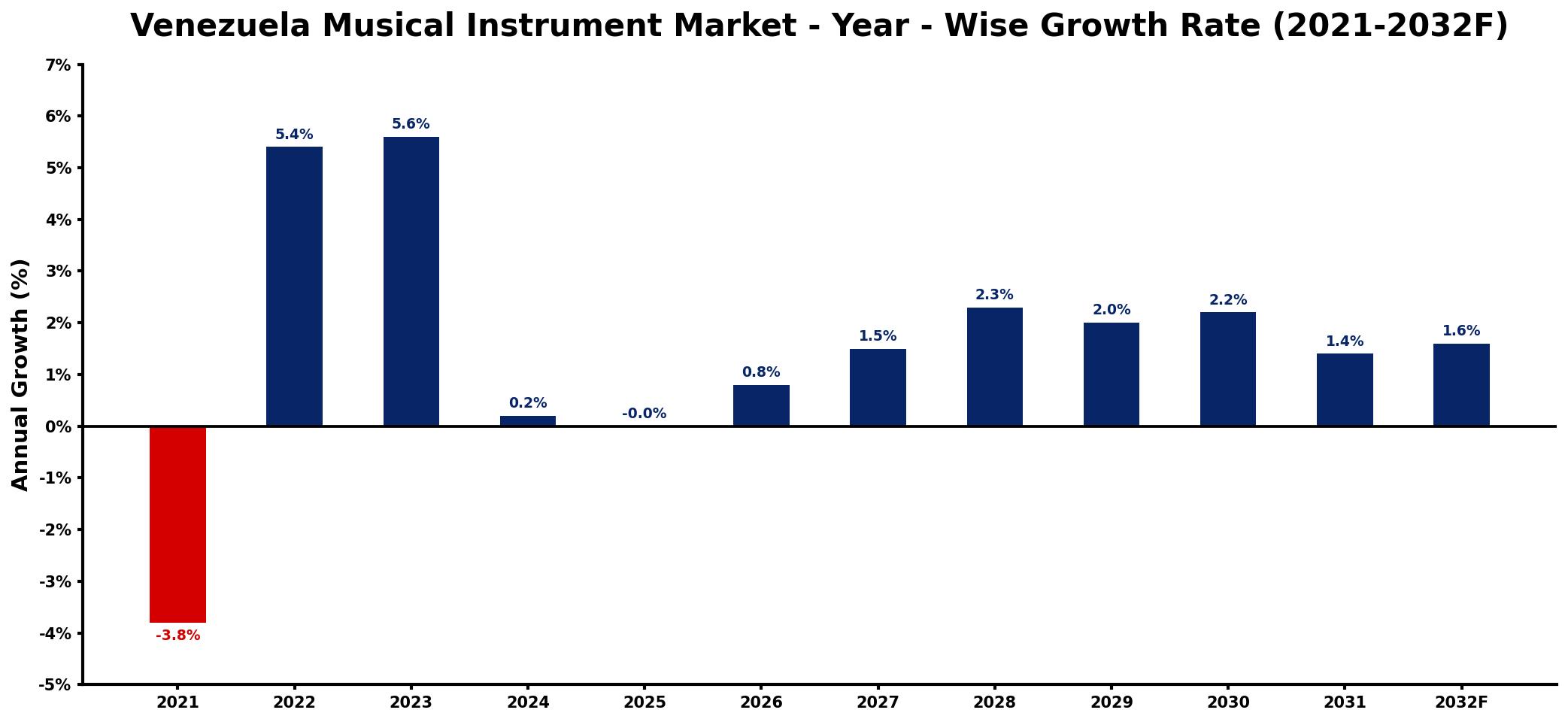
The table below presents the year‑wise growth rates along with the key drivers influencing the market
| Year | Growth Rate | Major Drivers |
| 2021 | -3.8% | reduced consumer spending on leisure |
| 2022 | 5.4% | increased demand for local performances |
| 2023 | 5.6% | growth in music education initiatives |
| 2024 | 0.2% | rise in cultural festivals participation |
| 2025 | -0.0% | stability in supply chain logistics |
| 2026 | 0.8% | expansion of online retail platforms |
| 2027 | 1.5% | increased investment in local artists |
| 2028 | 2.3% | growing popularity of music events |
| 2029 | 2.0% | enhanced collaboration with schools |
| 2030 | 2.2% | boost in community music programs |
| 2031 | 1.4% | development of regional music hubs |
| 2032 | 1.6% | strengthened partnerships with distributors |
Note: Market size estimations and growth projections presented in this report are based on 6Wresearch's proprietary forecasting methodology, utilizing the latest available industry data, government publications, and primary research inputs.
Venezuela Musical Instrument Market Synopsis
In recent years, the Venezuela Musical Instrument Market has seen a mix of traditional and modern influences, reflecting the countrys rich cultural tapestry. While traditional instruments like the cuatro and maracas maintain their allure, the market is progressively welcoming digital innovations that cater to contemporary musical tastes.
The increasing accessibility of online retail channels is reshaping purchasing behavior, enabling musicians to explore a wider variety of options. However, the ongoing economic challenges pose significant obstacles, influencing consumers to prioritize budget-friendly and second-hand instruments.
Venezuela Musical Instrument Market Key Takeaways
- The market showcases a blend of traditional and modern instruments, catering to diverse consumer preferences.
- Online retail channels are becoming increasingly popular for purchasing musical instruments.
- The shift towards digital and electronic instruments reflects changing musical trends among Venezuelan musicians.
- Economic instability continues to shape consumer purchasing power, driving demand for affordable options.
- Investment opportunities exist in niche markets focusing on quality, education, and local musical culture.
Evaluation of Restraints in Venezuela Musical Instrument Market
The Venezuela Musical Instrument Market is constrained by several significant factors stemming from the country's ongoing economic instability. High inflation rates and currency devaluation are eroding consumer purchasing power, making it increasingly difficult for aspiring musicians to invest in quality instruments. Additionally, political turmoil and social unrest have contributed to a cautious consumer sentiment, impacting overall spending in non-essential sectors, including musical instruments. Import restrictions further limit the availability of diverse products in the market, creating challenges for both consumers seeking variety and suppliers aiming to meet evolving demands.
Venezuela Musical Instrument Market Trends
A notable trend in the Venezuela Musical Instrument Market is the growing adoption of digital and electronic instruments, including synthesizers and digital audio workstations. This shift is reflective of the increasing popularity of electronic music genres, resonating particularly with younger musicians seeking innovative tools. Moreover, there is a rising demand for compact and portable instruments, aligning with the lifestyle of modern musicians who prioritize mobility and convenience. Traditional instruments continue to maintain their presence, but the expansion of digital options signals a significant modernization within the market.
Venezuela Musical Instrument Market Opportunities
Despite economic challenges, the Venezuela Musical Instrument Market offers several promising investment opportunities. There is a strong demand for high-quality instruments across various segments, including guitars, keyboards, and percussion instruments. Establishing specialized retail outlets or online platforms for instrument sales presents a viable avenue for growth. Collaborations with local musicians, educational institutions, and music festivals can foster community engagement while also driving instrument sales. Such partnerships not only create brand visibility but also contribute to the preservation and promotion of Venezuela's rich musical heritage.
Government Initiatives in the Venezuela Musical Instrument Market
Government policies impacting the Venezuela Musical Instrument Market are shaped by the country's complex economic climate. Efforts to stabilize the economy are reflected in measures that aim to support local manufacturing and discourage excessive reliance on imports. However, import restrictions and currency controls remain hurdles that complicate the availability and pricing of musical instruments. As the government works towards economic recovery, these policies are likely to evolve, potentially creating new opportunities for businesses operating within the musical instrument sector.
Future Insights of the Venezuela Musical Instrument Market
Looking ahead to the 2026-2032 period, the Venezuela Musical Instrument Market faces a complex landscape characterized by both challenges and potential growth avenues. Economic recovery could gradually enhance consumer purchasing power, leading to an increased willingness to invest in quality instruments. As the digital music landscape continues to flourish, companies that adapt to shifting consumer preferences and offer innovative products are more likely to thrive. A focus on building strong community ties and engaging with local musicians will be crucial for businesses aiming to navigate the uncertain economic terrain effectively.
Venezuela Musical Instrument Market Latest Developments (2025 - 2026)
In recent months, the Venezuela Musical Instrument Market has seen a gradual increase in the introduction of new product lines that cater to emerging digital trends. Several initiatives aimed at promoting music education and local talent have gained traction, further enriching the musical landscape. Moreover, the engagement of local musicians in collaborative projects has provided a platform for promoting both traditional and contemporary instruments. These developments are indicative of a resilient market adapting to changing consumer preferences amidst ongoing challenges.
Venezuela Musical Instrument Market - Key Attractiveness of the Report
- 10 Years of Market Numbers
- Historical Data Starting from 2022 to 2025
- Base Year: 2025
- Forecast Data until 2032
- Key Performance Indicators Impacting the Market
- Major Upcoming Developments and Projects
Key Highlights of the Report:
- Venezuela Musical Instrument Market Outlook
- Market Size of Venezuela Musical Instrument Market, 2025
- Forecast of Venezuela Musical Instrument Market, 2032
- Historical Data and Forecast of Venezuela Musical Instrument Revenues & Volume for the Period 2022-2032F
- Venezuela Musical Instrument Market Trend Evolution
- Venezuela Musical Instrument Market Drivers and Challenges
- Venezuela Musical Instrument Price Trends
- Venezuela Musical Instrument Porter's Five Forces
- Venezuela Musical Instrument Industry Life Cycle
- Historical Data and Forecast of Venezuela Musical Instrument Market Revenues & Volume By Product for the Period 2022-2032F
- Historical Data and Forecast of Venezuela Musical Instrument Market Revenues & Volume By String Instruments for the Period 2022-2032F
- Historical Data and Forecast of Venezuela Musical Instrument Market Revenues & Volume By Pianos And Keyboards for the Period 2022-2032F
- Historical Data and Forecast of Venezuela Musical Instrument Market Revenues & Volume By Drums And Percussion Instruments for the Period 2022-2032F
- Historical Data and Forecast of Venezuela Musical Instrument Market Revenues & Volume By Others for the Period 2022-2032F
- Venezuela Musical Instrument Import Export Trade Statistics
- Market Opportunity Assessment By Product
- Venezuela Musical Instrument Top Companies Market Share
- Venezuela Musical Instrument Competitive Benchmarking By Technical and Operational Parameters
- Venezuela Musical Instrument Company Profiles
- Venezuela Musical Instrument Key Strategic Recommendations






































