Venezuela Orchid Market Size, Share & Growth Rate
The Venezuela Orchid Market was estimated at USD 294 Million in 2025 and is projected to reach USD 412 Million by 2032, growing at a CAGR of 4.9% from 2026 to 2032. This growth trajectory is primarily driven by the increasing demand for rare and exotic orchid varieties among local collectors and enthusiasts. Additionally, the rise of eco-friendly cultivation practices is enhancing the sustainability of the market, appealing to a more environmentally conscious consumer base.
Venezuela Orchid Market Year-wise Growth Rate and Key Drivers
This graph highlights how the Venezuela Orchid Market has steadily grown over the years, supported by major growth factors.
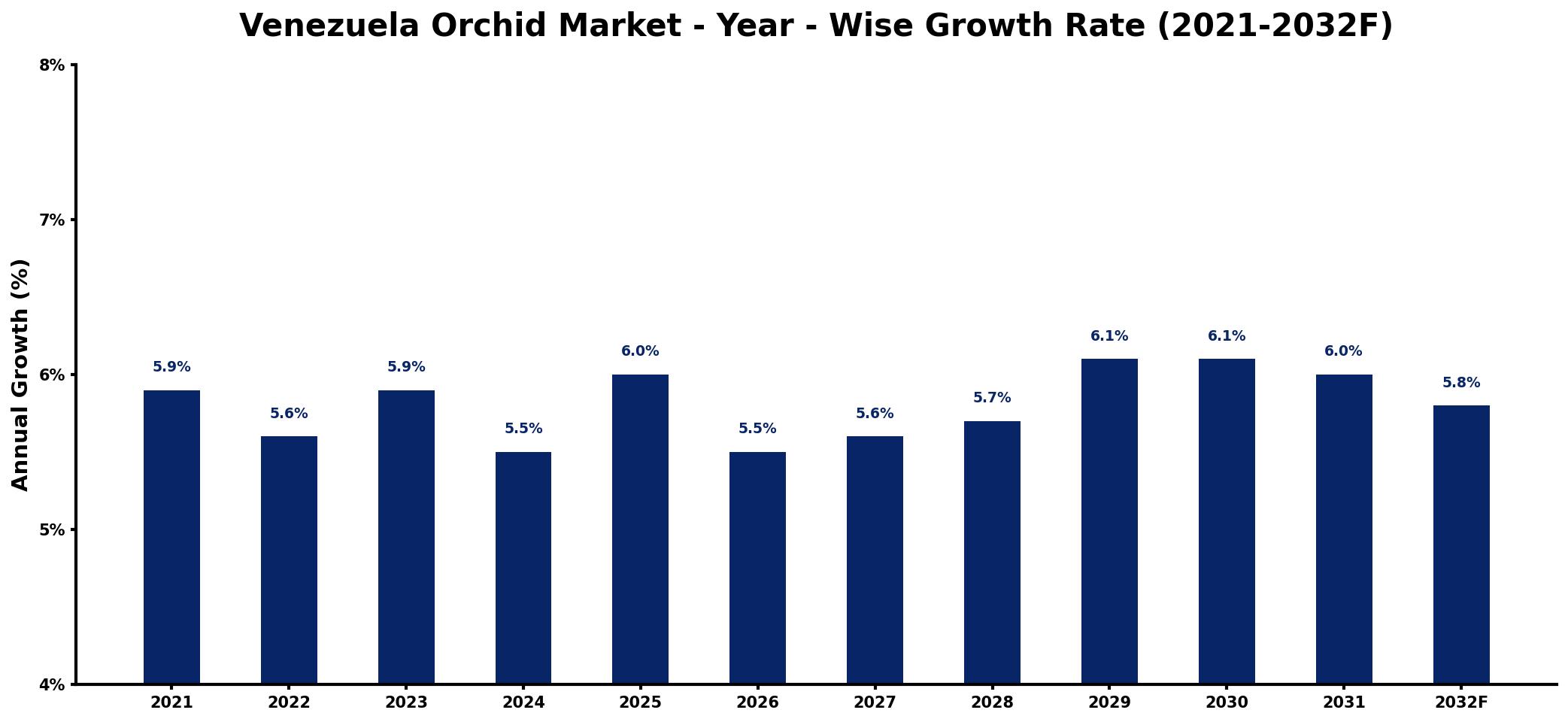
The table below presents the year‑wise growth rates along with the key drivers influencing the market
| Year | Growth Rate | Major Drivers |
| 2021 | 5.9% | Rising interest in gardening trends |
| 2022 | 5.6% | Increased consumer spending on plants |
| 2023 | 5.9% | Growth in floral tourism initiatives |
| 2024 | 5.5% | Emerging markets for exotic plants |
| 2025 | 6.0% | Expansion of online plant sales |
| 2026 | 5.5% | Investment in horticultural education programs |
| 2027 | 5.6% | Surge in home decoration trends |
| 2028 | 5.7% | Development of local nurseries |
| 2029 | 6.1% | Increase in botanical garden exhibitions |
| 2030 | 6.1% | increased capital investment inflows |
| 2031 | 6.0% | Rising popularity of indoor gardening |
| 2032 | 5.8% | Enhanced marketing for plant enthusiasts |
Note: Market size estimations and growth projections presented in this report are based on 6Wresearch's proprietary forecasting methodology, utilizing the latest available industry data, government publications, and primary research inputs.
Venezuela Orchid Market Synopsis
The strongest force shaping the Venezuela Orchid Market today is the rich biodiversity found within the country, which supports a plethora of native orchid species. The cultural significance of orchids in Venezuela, particularly in religious ceremonies and social events, further solidifies their demand, making them integral to local traditions.
Local growers play a pivotal role in this vibrant market, with many small-scale farms dedicated to the cultivation of these delicate blooms. Despite facing economic challenges, the enduring love for orchids among the Venezuelan populace and a supportive community of enthusiasts ensures that the market continues to flourish.
Venezuela Orchid Market Key Takeaways
- The market benefits from Venezuela's unique and diverse orchid species, fostering a strong cultural connection.
- Demand is increasing for rare and exotic varieties, driving innovation in cultivation techniques.
- Sustainable practices and eco-friendly approaches are becoming essential for market growth.
- Online platforms are facilitating broader connections between buyers and sellers, expanding market reach.
- Investment in orchid tourism presents a potential growth area for economic development.
Evaluation of Restraints in Venezuela Orchid Market
The Venezuela Orchid Market is hampered by a range of real restraints, the most significant being the ongoing political and economic instability. This instability has led to diminished production capabilities and disruptions in export channels. Moreover, the lack of access to essential resources—such as fertilizers and specialized equipment—poses substantial challenges for local growers, limiting their capacity to meet rising demand. The existence of illegal orchid trafficking also threatens the sustainability of orchid species, creating a dire need for stringent regulatory measures to protect this valuable natural heritage.
Venezuela Orchid Market Trends
The market is currently seeing an increase in the demand for rare and exotic orchid varieties, prompting growers to explore innovative cultivation methods. Collectors are particularly interested in unique cultivars boasting vibrant colors and patterns. Additionally, the emphasis on sustainable and ethically sourced orchids is leading to a surge in eco-friendly farming practices. Social media and online platforms are transforming how growers showcase their offerings, enabling a direct connection between producers and consumers. Furthermore, educational workshops focusing on orchid care are gaining traction, encouraging both new and seasoned growers to deepen their knowledge of orchid cultivation.
Venezuela Orchid Market Opportunities
The Venezuela Orchid Market presents several genuine growth and investment opportunities. Investors can capitalize on the increasing demand for unique orchid varieties by establishing local farms or forming partnerships with existing growers. Furthermore, the rise of orchid tourism offers a promising avenue for development, as there is potential for creating orchid-themed attractions that draw both local and international visitors. Investing in conservation efforts can also provide long-term benefits, as protecting native species ensures a sustainable future for the market.
Government Initiatives in the Venezuela Orchid Market
The Venezuelan government has recognized the importance of the orchid market and is actively implementing policies to promote its growth. Regulations are in place to prevent illegal harvesting and trafficking, while permits are required for collection and export activities. Additionally, the government is encouraging sustainable practices among local growers, fostering initiatives that support the cultivation and conservation of native orchid species. These policies aim to balance economic development with environmental protection, ensuring the future viability of the orchid industry.
Future Insights of the Venezuela Orchid Market
Looking ahead to 2026-2032, the future of the Venezuela Orchid Market is poised for both challenges and opportunities. Economic recovery, along with an emphasis on sustainable cultivation practices, will be crucial for revitalizing the industry. If measures are taken to stabilize the political landscape and improve the regulatory environment, the market could see a resurgence in both production and export potential. Continued consumer interest in exotic and rare orchids, coupled with the growth of conservation initiatives, may ultimately lead to a more robust and resilient orchid sector.
Venezuela Orchid Market Latest Developments (2025 - 2026)
In recent months, there has been a noticeable increase in community events celebrating orchids, including shows and auctions that have attracted both local participants and international collectors. Additionally, educational programs on orchid care and sustainable practices have gained popularity, drawing more individuals into the cultivation space. These developments reflect a growing interest in both preserving and expanding the Venezuelan orchid heritage, showcasing the resilience of this unique market.
Venezuela Orchid Market - Key Attractiveness of the Report
- 10 Years of Market Numbers
- Historical Data Starting from 2022 to 2025
- Base Year: 2025
- Forecast Data until 2032
- Key Performance Indicators Impacting the Market
- Major Upcoming Developments and Projects
Key Highlights of the Report:
- Venezuela Orchid Market Outlook
- Market Size of Venezuela Orchid Market, 2025
- Forecast of Venezuela Orchid Market, 2032
- Historical Data and Forecast of Venezuela Orchid Revenues & Volume for the Period 2022-2032F
- Venezuela Orchid Market Trend Evolution
- Venezuela Orchid Market Drivers and Challenges
- Venezuela Orchid Price Trends
- Venezuela Orchid Porter's Five Forces
- Venezuela Orchid Industry Life Cycle
- Historical Data and Forecast of Venezuela Orchid Market Revenues & Volume By Product Type for the Period 2022-2032F
- Historical Data and Forecast of Venezuela Orchid Market Revenues & Volume By Phalaenopsis Orchid for the Period 2022-2032F
- Historical Data and Forecast of Venezuela Orchid Market Revenues & Volume By Cattleya Orchid for the Period 2022-2032F
- Historical Data and Forecast of Venezuela Orchid Market Revenues & Volume By Vanda Orchid for the Period 2022-2032F
- Historical Data and Forecast of Venezuela Orchid Market Revenues & Volume By Paphiopedilum Orchid for the Period 2022-2032F
- Historical Data and Forecast of Venezuela Orchid Market Revenues & Volume By Miltonia Orchid for the Period 2022-2032F
- Historical Data and Forecast of Venezuela Orchid Market Revenues & Volume By Others for the Period 2022-2032F
- Historical Data and Forecast of Venezuela Orchid Market Revenues & Volume By Application for the Period 2022-2032F
- Historical Data and Forecast of Venezuela Orchid Market Revenues & Volume By Garden for the Period 2022-2032F
- Historical Data and Forecast of Venezuela Orchid Market Revenues & Volume By Cosmetic for the Period 2022-2032F
- Historical Data and Forecast of Venezuela Orchid Market Revenues & Volume By Herbal Medicine for the Period 2022-2032F
- Venezuela Orchid Import Export Trade Statistics
- Market Opportunity Assessment By Product Type
- Market Opportunity Assessment By Application
- Venezuela Orchid Top Companies Market Share
- Venezuela Orchid Competitive Benchmarking By Technical and Operational Parameters
- Venezuela Orchid Company Profiles
- Venezuela Orchid Key Strategic Recommendations






































