Venezuela Phenol Market Size, Share & Growth Rate
The Venezuela Phenol Market was estimated at USD 1158 Million in 2025 and is projected to reach USD 1696 Million by 2032, growing at a CAGR of 5.6% from 2026 to 2032. This growth trajectory is primarily fueled by the increased demand for phenolic compounds in critical sectors such as automotive, construction, and electronics. Furthermore, the ongoing shift towards sustainable practices, including the development of bio-based phenol, is expected to bolster market expansion in the coming years.
Venezuela Phenol Market Year-wise Growth Rate and Key Drivers
This graph highlights how the Venezuela Phenol Market has steadily grown over the years, supported by major growth factors.
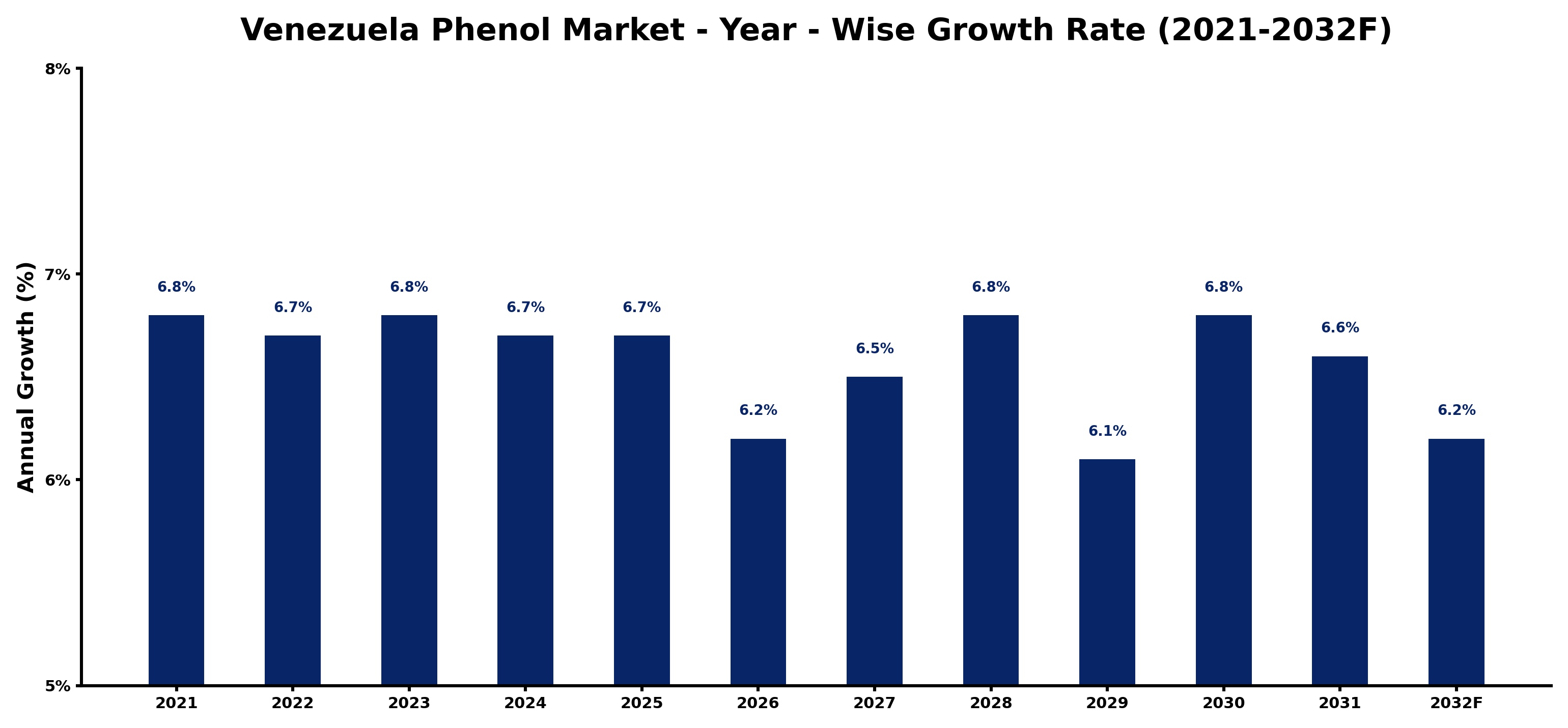
The table below presents the year‑wise growth rates along with the key drivers influencing the market
| Year | Growth Rate | Major Drivers |
| 2021 | 6.8% | Increasing adoption of advanced technologies |
| 2022 | 6.7% | Expansion of transportation and logistics networks |
| 2023 | 6.8% | Growing urbanization and commercial development |
| 2024 | 6.7% | Increasing industrial infrastructure investments |
| 2025 | 6.7% | Increasing smart city development projects |
| 2026 | 6.2% | Rising electricity demand across industries |
| 2027 | 6.5% | Rising electricity demand across industries |
| 2028 | 6.8% | Expansion of commercial construction activities |
| 2029 | 6.1% | Rapid growth in telecom and data center sectors |
| 2030 | 6.8% | Increasing industrial automation investments |
| 2031 | 6.6% | Increasing industrial automation investments |
| 2032 | 6.2% | Growing renewable energy integration projects |
Note - Market size estimations and growth projections presented in this report are based on 6Wresearch's advanced forecasting approach, validated with industry datasets as of June 2026.
Venezuela Phenol Market Synopsis
Currently, the Venezuela Phenol Market stands at a pivotal crossroads, influenced by both global demand and local challenges. The reliance on petrochemical production and the diverse applications of phenol derivatives are driving a complex market environment.
Despite ongoing political and economic challenges, industries across Venezuela continue to tap into phenol's versatility. Applications range from pharmaceuticals to personal care, highlighting the compound's vital role in the country's industrial landscape.
Venezuela Phenol Market Key Takeaways
- The market is projected to reach USD 1696 Million by 2032, indicating robust growth potential.
- Political and economic instability continues to pose significant challenges for market participants.
- Sustainable production methods are increasingly becoming a focal point for manufacturers.
- There is a growing interest in bio-based phenol derived from renewable sources.
- Investment in local production facilities may yield strategic advantages despite the prevailing uncertainties.
Evaluation of Restraints in Venezuela Phenol Market
The Venezuela Phenol Market grapples with significant restraints primarily stemming from ongoing political turmoil and economic instability. Hyperinflation and currency devaluation have led to uncertainty among businesses, complicating supply chains and investment opportunities. Furthermore, strict government regulations and the prioritization of state-owned enterprises can limit the operational scope for private companies. These factors collectively hinder the market's growth and demand potential, forcing companies to continuously adapt their strategies in an unpredictable landscape.
Venezuela Phenol Market Trends
In recent years, there has been a noticeable trend towards sustainability within the Venezuela Phenol Market. Companies are increasingly adopting eco-friendly production processes, driven by consumer demand for greener products. Additionally, the development and commercialization of bio-based phenol are gaining traction, reflecting a broader shift towards renewable resources in industrial production.
Moreover, as industries expand their application of phenolic compounds—from resins to adhesives—there is a sustained upward pressure on demand. The intersection of these trends positions the Venezuelan phenol sector for potential growth, provided that manufacturers can navigate the associated challenges effectively.
Venezuela Phenol Market Opportunities
Significant investment opportunities exist within the Venezuela Phenol Market, particularly in the production of high-demand phenol derivatives such as phenolic resins and bisphenol-A. While the market faces economic challenges, the steadfast demand in construction, automotive, and electronics indicates a resilient appetite for phenolic products. Establishing local production facilities or fostering partnerships with existing manufacturers could strategically position investors to capture a share of this market. Furthermore, aligning with sustainability trends and producing eco-friendly products can provide a competitive edge in an increasingly conscientious marketplace.
Government Initiatives in the Venezuela Phenol Market
Government policies in Venezuela significantly shape the phenol market landscape, particularly through price controls and support for state-owned enterprises. These measures aim to regulate affordability for consumers and stabilize the market amidst economic turmoil. While state-sponsored subsidies bolster production from companies like Pequiven, the effects of political instability complicate operational efficiency and production capacity. Therefore, understanding these governmental dynamics is crucial for businesses looking to navigate the Venezuela Phenol Market successfully.
Future Insights of the Venezuela Phenol Market
Looking ahead to 2026-2032, the Venezuela Phenol Market's trajectory remains uncertain but promising, contingent upon resolving key political and economic obstacles. As crude oil production stabilizes and investment in infrastructure improves, the market could see a resurgence. The increasing adoption of sustainable practices and the potential for bio-based phenol could catalyze growth, provided manufacturers remain agile and responsive to evolving conditions. By closely monitoring the political landscape, businesses can position themselves to capitalize on emerging opportunities in this complex market.
Venezuela Phenol Market Latest Developments (May 2025 - June 2026)
Recent developments in the Venezuela Phenol Market reflect a cautious optimism among stakeholders. A renewed focus on infrastructure investment and the potential for international collaborations may pave the way for improved production capabilities. Furthermore, industry participants are actively exploring innovative solutions to enhance sustainability in production processes. These shifts suggest a gradual adaptation to both local and global market dynamics, which could influence the competitive landscape moving forward.
Venezuela Phenol Market - Key Attractiveness of the Report
- 10 Years of Market Numbers
- Historical Data Starting from 2022 to 2025
- Base Year: 2025
- Forecast Data until 2032
- Key Performance Indicators Impacting the Market
- Major Upcoming Developments and Projects
Key Highlights of the Report:
- Venezuela Phenol Market Outlook
- Market Size of Venezuela Phenol Market, 2025
- Forecast of Venezuela Phenol Market, 2032
- Historical Data and Forecast of Venezuela Phenol Revenues & Volume for the Period 2022-2032F
- Venezuela Phenol Market Trend Evolution
- Venezuela Phenol Market Drivers and Challenges
- Venezuela Phenol Price Trends
- Venezuela Phenol Porter's Five Forces
- Venezuela Phenol Industry Life Cycle
- Historical Data and Forecast of Venezuela Phenol Market Revenues & Volume By End-users for the Period 2022-2032F
- Historical Data and Forecast of Venezuela Phenol Market Revenues & Volume By Bisphenol A for the Period 2022-2032F
- Historical Data and Forecast of Venezuela Phenol Market Revenues & Volume By Phenolic Resins for the Period 2022-2032F
- Historical Data and Forecast of Venezuela Phenol Market Revenues & Volume By Caprolactam for the Period 2022-2032F
- Historical Data and Forecast of Venezuela Phenol Market Revenues & Volume By Alkyl Phenyls for the Period 2022-2032F
- Historical Data and Forecast of Venezuela Phenol Market Revenues & Volume By Others for the Period 2022-2032F
- Venezuela Phenol Import Export Trade Statistics
- Market Opportunity Assessment By End-users
- Venezuela Phenol Top Companies Market Share
- Venezuela Phenol Competitive Benchmarking By Technical and Operational Parameters
- Venezuela Phenol Company Profiles
- Venezuela Phenol Key Strategic Recommendations






































