Venezuela Propane Market Size, Share & Growth Rate
The Venezuela Propane Market was estimated at USD 506 Million in 2025 and is projected to reach USD 728 Million by 2032, growing at a CAGR of 5.3% from 2026 to 2032. This growth trajectory is fueled by a combination of factors, including increasing domestic production and consumption, as the country endeavors to reduce its reliance on imported energy sources. Moreover, the rising awareness of propane as a cleaner fuel alternative and government initiatives supporting energy self-sufficiency further bolster demand.
Venezuela Propane Market Year-wise Growth Rate and Key Drivers
This graph highlights how the Venezuela Propane Market has steadily grown over the years, supported by major growth factors.
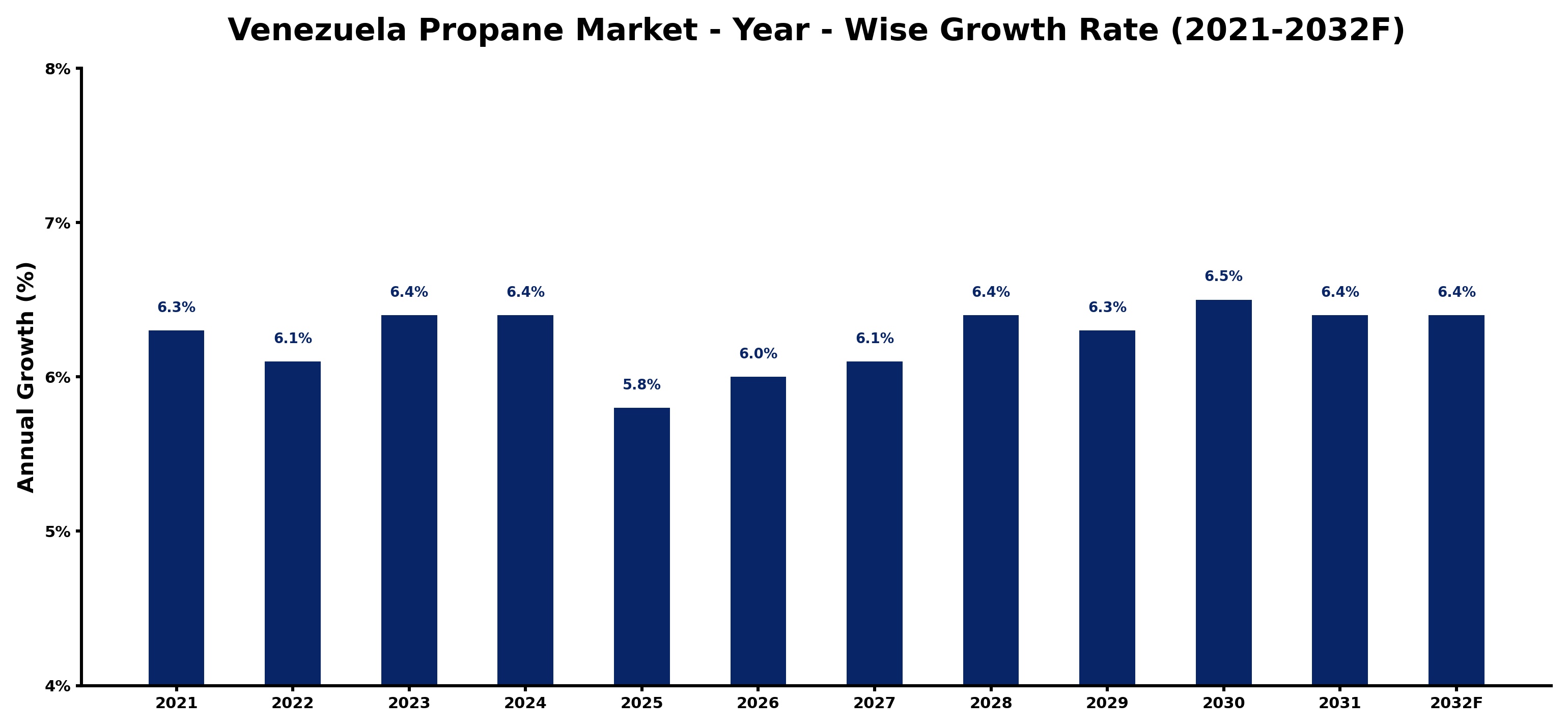
The table below presents the year‑wise growth rates along with the key drivers influencing the market
| Year | Growth Rate | Major Drivers |
| 2021 | 6.3% | Export driven propane demand spurred investment in storage facility construction |
| 2022 | 6.1% | Pipeline upgrades boost propane distribution efficiency and reliability |
| 2023 | 6.4% | New processing plants boost Venezuela's propane export capabilities |
| 2024 | 6.4% | Technological upgrades in gas extraction enhance propane production efficiency |
| 2025 | 5.8% | Export driven pipeline expansions boosted propane distribution network reliability |
| 2026 | 6.0% | Domestic propane distribution network upgrades boosted logistics efficiency and availability |
| 2027 | 6.1% | Manufacturing investments in propane infrastructure bolstered local production capabilities |
| 2028 | 6.4% | Export driven investments in propane processing facilities boost production capacity |
| 2029 | 6.3% | Domestic demand recovery boosts propane production facility investments |
| 2030 | 6.5% | Improved infrastructure development boosts propane distribution network efficiency |
| 2031 | 6.4% | Propane storage technology upgrades improved supply chain efficiency |
| 2032 | 6.4% | Propane storage facility expansions boost regional distribution network capacity |
Note - Market size estimations and growth projections presented in this report are based on 6Wresearch’s advanced forecasting approach, validated with industry datasets as of June 2026.
Venezuela Propane Market Synopsis
Currently, the most significant force shaping the Venezuela Propane Market is the government's push towards energy self-sufficiency. This initiative is driving investments in propane production and distribution infrastructure, as the nation seeks to leverage its abundant natural gas resources to meet growing domestic needs.
In addition, the burgeoning residential and commercial sectors are beginning to realize the advantages of propane as a versatile and efficient energy source. However, existing infrastructural challenges remain a pressing concern that stakeholders must navigate to fully exploit market potential.
Venezuela Propane Market Key Takeaways
- Strong growth trajectory projected due to domestic production initiatives.
- Rising demand in residential and commercial sectors, driven by cleaner energy trends.
- Government interventions both bolster affordability and complicate market dynamics.
- Opportunities for infrastructure investments amidst limited current capabilities.
- Political and economic instability continues to pose risks to market stability.
Evaluation of Restraints in Venezuela Propane Market
Despite the growth potential, the Venezuela Propane Market is fundamentally constrained by persistent economic instability and political unrest. These factors foster a volatile business environment marked by fluctuating prices and supply shortages. Furthermore, outdated infrastructure, including inadequate transportation systems, hampers efficient distribution. The sanctions imposed by foreign governments limit access to foreign investment and advanced technologies, stifling opportunities for modernization and growth in the sector.
Venezuela Propane Market Trends
A notable trend in the Venezuela Propane Market is the increasing focus on using propane as a cleaner alternative fuel in both industrial and residential applications. This shift aligns with global energy trends promoting sustainability and efficiency. Additionally, there is growing investment in developing distribution and storage facilities, a necessary step to support expanding domestic consumption of propane.
Venezuela Propane Market Opportunities
Opportunities abound within the Venezuela Propane Market, particularly in the residential and commercial sectors. The growing recognition of propane's efficiency and lower environmental impact offers an avenue for expansion. Strategic investments aimed at modernizing infrastructure could enable enhanced distribution capabilities. Furthermore, the government's continued endorsement of propane as a viable energy solution can attract both domestic and foreign investments in innovative technologies.
Government Initiatives in the Venezuela Propane Market
Government policies in Venezuela significantly influence the propane market, primarily through price subsidies that make propane accessible to the general population. These policies aim to ensure the availability and affordability of energy sources amidst economic challenges. While state ownership of the oil company PDVSA governs the market, the government has also implemented measures to stabilize supply chains and promote infrastructure enhancements, although the effectiveness of these initiatives can vary.
Future Insights of the Venezuela Propane Market
Looking ahead to 2026-2032, the future of the Venezuela Propane Market appears fraught with uncertainty. While the potential for growth remains robust due to the nation's substantial propane reserves, external political and economic pressures could inhibit development. Ongoing efforts to modernize infrastructure and improve operational capacity will be critical. If the government successfully addresses challenges, the market could witness significant transformations, positioning propane as a central component of Venezuela's energy strategy.
Venezuela Propane Market Latest Developments (May 2025 - June 2026)
Recent developments in the Venezuela Propane Market indicate a concerted effort towards enhancing domestic production capabilities. Infrastructure investments aimed at improving distribution networks have gained momentum, reflecting a broader commitment to reduce dependency on imports. Additionally, government policies are evolving to better regulate pricing and ensure a more stable supply, though challenges persist amidst economic fluctuations.
Venezuela Propane Market - Key Attractiveness of the Report
- 10 Years of Market Numbers
- Historical Data Starting from 2022 to 2025
- Base Year: 2025
- Forecast Data until 2032
- Key Performance Indicators Impacting the Market
- Major Upcoming Developments and Projects
Key Highlights of the Report:
- Venezuela Propane Market Outlook
- Market Size of Venezuela Propane Market, 2025
- Forecast of Venezuela Propane Market, 2032
- Historical Data and Forecast of Venezuela Propane Revenues & Volume for the Period 2022-2032F
- Venezuela Propane Market Trend Evolution
- Venezuela Propane Market Drivers and Challenges
- Venezuela Propane Price Trends
- Venezuela Propane Porter's Five Forces
- Venezuela Propane Industry Life Cycle
- Historical Data and Forecast of Venezuela Propane Market Revenues & Volume By Applications for the Period 2022-2032F
- Historical Data and Forecast of Venezuela Propane Market Revenues & Volume By Industrial for the Period 2022-2032F
- Historical Data and Forecast of Venezuela Propane Market Revenues & Volume By Commercial for the Period 2022-2032F
- Historical Data and Forecast of Venezuela Propane Market Revenues & Volume By Residential for the Period 2022-2032F
- Historical Data and Forecast of Venezuela Propane Market Revenues & Volume By Transportation for the Period 2022-2032F
- Historical Data and Forecast of Venezuela Propane Market Revenues & Volume By Agriculture for the Period 2022-2032F
- Historical Data and Forecast of Venezuela Propane Market Revenues & Volume By Chemicals and Refineries for the Period 2022-2032F
- Venezuela Propane Import Export Trade Statistics
- Market Opportunity Assessment By Applications
- Venezuela Propane Top Companies Market Share
- Venezuela Propane Competitive Benchmarking By Technical and Operational Parameters
- Venezuela Propane Company Profiles
- Venezuela Propane Key Strategic Recommendations






































