Venezuela Tobacco Market Size, Share & Growth Rate
The Venezuela Tobacco Market was estimated at USD 152 Million in 2025 and is projected to reach USD 214 Million by 2032, growing at a CAGR of 5.0% from 2026 to 2032. This growth is propelled by a complex interplay of factors, including a resilient consumer base and a shift towards premium tobacco products. While economic challenges persist, the steady demand for traditional and emerging tobacco products suggests that the market remains a viable area for investment.
Venezuela Tobacco Market Year-wise Growth Rate and Key Drivers
This graph highlights how the Venezuela Tobacco Market has steadily grown over the years, supported by major growth factors.
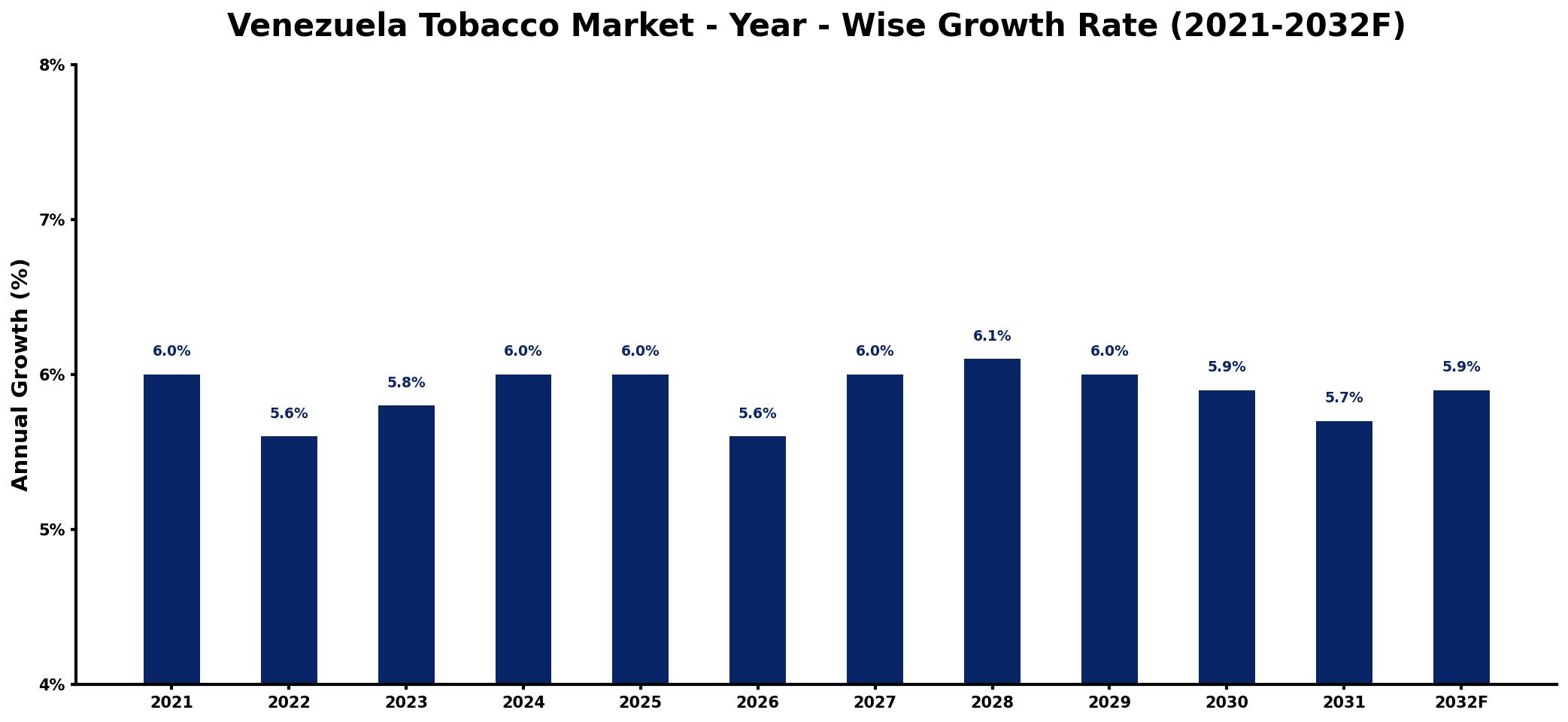
The table below presents the year‑wise growth rates along with the key drivers influencing the market
| Year | Growth Rate | Major Drivers |
| 2021 | 6.0% | Rising consumer disposable income |
| 2022 | 5.6% | Increased urban population growth |
| 2023 | 5.8% | Expansion of retail distribution channels |
| 2024 | 6.0% | Growing popularity of premium products |
| 2025 | 6.0% | Strengthening local manufacturing capabilities |
| 2026 | 5.6% | Enhanced marketing and advertising strategies |
| 2027 | 6.0% | Surge in international investments |
| 2028 | 6.1% | Innovations in product offerings |
| 2029 | 6.0% | Rising awareness of lifestyle trends |
| 2030 | 5.9% | Diversification of product categories |
| 2031 | 5.7% | Growth in social consumption venues |
| 2032 | 5.9% | Increased presence of online sales |
Note: Market size estimations and growth projections presented in this report are based on 6Wresearch's proprietary forecasting methodology, utilizing the latest available industry data, government publications, and primary research inputs.
Venezuela Tobacco Market Synopsis
Cigarettes remain the predominant choice among Venezuelan consumers, illustrating the enduring cultural affinity for tobacco products. With a significant percentage of the adult population still identifying as smokers, the market benefits from a solid, albeit pressured, demand landscape.
Additionally, the local production of cigars and other tobacco products complements imports, creating a diverse offering that caters to varied consumer preferences. This blend of domestic and imported goods enriches the market and allows for a range of pricing strategies to be employed.
Venezuela Tobacco Market Key Takeaways
- The market is driven by a consistent demand for traditional tobacco products despite global consumption declines.
- Economic instability continues to challenge consumer purchasing power, impacting overall market growth.
- A trend towards premium and flavored tobacco products is emerging, reflecting changing consumer tastes.
- Government regulations and high taxation have inadvertently fostered a black market for tobacco products.
- Investment opportunities exist, particularly in the premium segment and alternative tobacco products.
Evaluation of Restraints in Venezuela Tobacco Market
The Venezuela Tobacco Market is significantly constrained by the nation's ongoing economic crisis and political instability. These factors have diminished consumer purchasing power, making it increasingly difficult for companies to sustain sales. Furthermore, the governments stringent regulations, which include high taxes on tobacco products and severe restrictions on advertising, have prompted a rise in smuggling and counterfeit products. This creates an environment where legitimate businesses struggle against illegal competition, limiting their growth potential. Additionally, challenges surrounding access to raw materials impact the capacity of local producers to scale effectively.
Venezuela Tobacco Market Trends
The market is witnessing a distinct shift towards premium and flavored tobacco products. As consumer incomes fluctuate, there is a growing demand for high-quality options that offer unique flavors and packaging. Moreover, the rise of electronic cigarettes and vaping products is indicative of a broader trend towards reduced-risk alternatives, as health awareness among consumers increases. These trends not only reflect a changing landscape within Venezuela but also resonate with global movements toward healthier choices.
Venezuela Tobacco Market Opportunities
Given the cultural significance of tobacco in Venezuela, there remains a strong foundation for growth within the tobacco industry. Companies that focus on niche segments, such as premium cigars or artisanal tobacco products, are well-positioned to tap into an emerging consumer base willing to spend on quality. Additionally, opportunities abound for businesses that can innovate within the e-cigarette and vaping product categories. Strategic partnerships and market research are essential for navigating the regulatory landscape and maximizing investment potential.
Government Initiatives in the Venezuela Tobacco Market
The Venezuelan governments policies towards tobacco are largely influenced by its socialist regime, characterized by stringent regulations aimed at reducing smoking prevalence. High taxes on tobacco products, smoking bans in public spaces, and significant restrictions on advertising are prevalent. While these measures are designed to promote public health, they have simultaneously led to the growth of a black market. Additionally, the state-owned monopoly on tobacco production further complicates the competitive landscape, limiting opportunities for private enterprise.
Future Insights of the Venezuela Tobacco Market
Looking ahead, the Venezuela Tobacco Market is likely to continue grappling with challenges posed by economic instability and regulatory pressures. However, the anticipated growth in premium segments and alternative tobacco products may provide avenues for resilience and expansion. As consumer preferences evolve and brand loyalty shifts, companies that can innovate while navigating the difficult political and economic landscape will be best positioned for success. Ultimately, the market will require agility and foresight to adapt to both challenges and opportunities over the coming years.
Venezuela Tobacco Market Latest Developments (2025 - 2026)
Recent developments in the Venezuela Tobacco Market have seen a pronounced focus on premium offerings, with companies exploring new flavor profiles and packaging techniques to attract discerning consumers. Concurrently, industry players are increasingly engaging in market research to better understand shifting consumer behaviors. The rise of the black market continues to pose significant challenges, compelling legitimate businesses to innovate their marketing strategies and explore partnerships to enhance brand visibility amidst strict regulations.
Venezuela Tobacco Market - Key Attractiveness of the Report
- 10 Years of Market Numbers
- Historical Data Starting from 2022 to 2025
- Base Year: 2025
- Forecast Data until 2032
- Key Performance Indicators Impacting the Market
- Major Upcoming Developments and Projects
Key Highlights of the Report:
- Venezuela Tobacco Market Outlook
- Market Size of Venezuela Tobacco Market, 2025
- Forecast of Venezuela Tobacco Market, 2032
- Historical Data and Forecast of Venezuela Tobacco Revenues & Volume for the Period 2022-2032F
- Venezuela Tobacco Market Trend Evolution
- Venezuela Tobacco Market Drivers and Challenges
- Venezuela Tobacco Price Trends
- Venezuela Tobacco Porter's Five Forces
- Venezuela Tobacco Industry Life Cycle
- Historical Data and Forecast of Venezuela Tobacco Market Revenues & Volume By Product for the Period 2022-2032F
- Historical Data and Forecast of Venezuela Tobacco Market Revenues & Volume By Smokeless for the Period 2022-2032F
- Historical Data and Forecast of Venezuela Tobacco Market Revenues & Volume By Cigarettes for the Period 2022-2032F
- Historical Data and Forecast of Venezuela Tobacco Market Revenues & Volume By Cigar & Cigarillos for the Period 2022-2032F
- Historical Data and Forecast of Venezuela Tobacco Market Revenues & Volume By Next Generation Products for the Period 2022-2032F
- Historical Data and Forecast of Venezuela Tobacco Market Revenues & Volume By Waterpipes for the Period 2022-2032F
- Historical Data and Forecast of Venezuela Tobacco Market Revenues & Volume By Distribution Channel for the Period 2022-2032F
- Historical Data and Forecast of Venezuela Tobacco Market Revenues & Volume By Offline for the Period 2022-2032F
- Historical Data and Forecast of Venezuela Tobacco Market Revenues & Volume By Online for the Period 2022-2032F
- Venezuela Tobacco Import Export Trade Statistics
- Market Opportunity Assessment By Product
- Market Opportunity Assessment By Distribution Channel
- Venezuela Tobacco Top Companies Market Share
- Venezuela Tobacco Competitive Benchmarking By Technical and Operational Parameters
- Venezuela Tobacco Company Profiles
- Venezuela Tobacco Key Strategic Recommendations






































