Vietnam Absorbent Mats Market (2026-2032) | Segmentation, Value, Outlook, Share, Growth, Analysis, Companies, Forecast, Competitive Landscape, Industry, Trends, Size & Revenue
Market Forecast By Material (Polypropylene, PVC, Nitrile, Rubber, Others), By Category (Grease & Oil Absorbing Mats, Chemical Absorbent Mats, Universal Absorbent Mats), By End-user (Food & Beverages, Automotive, Chemicals, Oil & Gas, Pharmaceuticals, Others), By Price (Low, Medium, High), By Distribution Channel (Direct Sales, Indirect Sales) And Competitive Landscape
| Product Code: ETC10066555 | Publication Date: Sep 2024 | Updated Date: Jun 2026 | Product Type: Market Research Report | |
| Publisher: 6Wresearch | Author: Sumit Sagar | No. of Pages: 75 | No. of Figures: 35 | No. of Tables: 20 |
Vietnam Absorbent Mats Market Growth Rate
According to 6Wresearch internal database and industry insights, the Vietnam Absorbent Mats Market is projected to grow at a compound annual growth rate (CAGR) of 6.2% during the forecast period (2026–2032).
Vietnam Absorbent Mats Market Year-wise Growth Rate and Key Drivers
This graph highlights how the Vietnam Absorbent Mats Market has steadily grown over the past five years, supported by major growth factors.
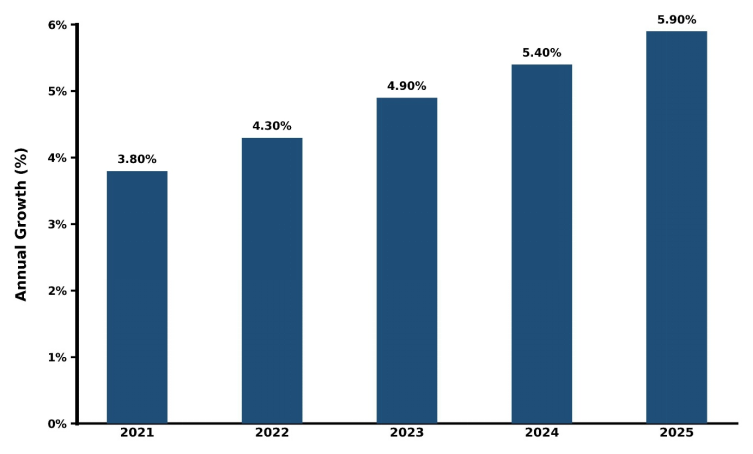
Below is an evaluation of year-wise growth rate along with growth drivers:
| Year | Est. Annual Growth (%) | Growth Drivers |
| 2021 | 3.8% | Enhancing adherence to industrial safety rules within newly formed industrial areas to minimize risks of falls due to slippery surfaces. |
| 2022 | 4.3% | Rise in setting up manufacturing plants that require continuous oil containment and grease removal. |
| 2023 | 4.9% | Increased awareness about the importance of cleanliness of the workplace environment in terms of contamination in electronic and automotive assembly units. |
| 2024 | 5.4% | The increasing establishment of food processing lines and industrial chemical complexes using advanced sorbent structures. |
| 2025 | 5.9% | Accelerating integration of premium eco-friendly materials and localized sourcing networks across multinational production facilities. |
Topics Covered in the Vietnam Absorbent Mats Market Report
The Vietnam Absorbent Mats Market report covers the market by material, category, end-user, price, and distribution channel. The market report provides an unbiased and detailed analysis of ongoing market trends, opportunities, and drivers, which help stakeholders devise and align their market strategies according to the current and future market dynamics.
Vietnam Absorbent Mats Market Highlights
| Report Name | Vietnam Absorbent Mats Market |
| Forecast period | 2026-2032 |
| CAGR | 6.2% |
| Growing Sector | Food and Beverages |
Vietnam Absorbent Mats Market Synopsis
Vietnam Absorbent Mats Market is an emerging industrial safety segment focused on controlling and managing liquid spills across manufacturing, automotive, chemical, and oil & gas sectors Absorbent mats are designed using specialized fibers and polymer-based materials that rapidly absorb oils, chemicals, and water-based liquids, reducing workplace hazards and environmental contamination. Apart from this, increasing industrialization, strict occupational safety regulations, and growing environmental awareness are key factors proliferating Vietnam absorbent mats market growth.
Evaluation of Growth Drivers in the Vietnam Absorbent Mats Market
Below are some major drivers and their influence on the market dynamics:
| Drivers | Primary Segments Affected | Why It Matters (evidence) |
| Supportive Safety Initiatives | Industrial Manufacturing Hubs, Warehousing | National framework mandates enforcing strict occupational safety standards encourage facilities to buy mass containment mats to reduce work hazards. |
| Eco-conscious & Zero Leakage | Chemical Storage, Oil & Gas Processing | Increasing strictness in environmental tracking regarding surface run-offs encourages plants to deploy zero-leakage preventative sorbent systems. |
| Rise in Industrial Output | Food & Beverages, Automotive Production | As international electronics and vehicle plants expand across northern and southern corridors, capital spending on workplace floor maintenance tools escalates. |
| Digital Fulfillment Integration | Automated Logistics Centers, Smart Hubs | Proliferation of vast specialized e-commerce logistics centers drives continuous rolling traffic, boosting demand for continuous-length walkway runner mats. |
| Rationalized Logistics Networks | Global Heavy Goods Shipping, Export Yards | The optimized logistic network enables seamless bulk transport of rolls of industrial sorbents from local distributors directly to high-demand production areas. |
Vietnam Absorbent Mats Market is expected to grow at a considerable rate, registering a compound annual growth rate (CAGR) of 6.2% during the forecast period (2026-2032), due to rising industrial safety awareness, stricter environmental regulations, and increasing demand for spill control solutions across diverse industries. Manufacturers are increasingly adopting high-performance absorbent mats to ensure workplace safety, minimize contamination risks, and comply with international environmental standards. Along with this, expansion of manufacturing clusters and logistics hubs further strengthens long-term demand.
Evaluation of Restraints in the Vietnam Absorbent Mats Market
Below are some major restraints and their influence on the market dynamics:
| Restraints | Primary Segments Affected | What This Means (evidence) |
| Infrastructure Bottlenecks | Polypropylene Fiber Extrusion, Melt-blown Synthesis | Inadequate regional capacity for ultra-fine melt-blown chemical fiber synthesis forces a heavy reliance on imported base mediums, limiting fast scale-ups. |
| Environmental Disposal Realities | Spent Sorbent Burning, Hazardous Incineration | High carbon requirements and emissions surrounding the incineration of saturated toxic chemical mats clash with strict new provincial green footprint laws. |
| Regulatory Compliance Friction | Liquid Contact Certifications, Standard Ratings | Bureaucratic delays in defining standard performance parameters for heavy-duty chemical mats slow down the introduction of newly formulated variants. |
| Seasonal Operational Halts | Construction Sites, Open Assembly Yards | Seasonal monsoon variations heavy enough to flood work environments limit the use and performance lifecycles of standard industrial fabric mat lines. |
| Cost Management Pressures | Factory Safety Capital, Plant Maintenance Budgets | High capital costs for flame-retardant and anti-static technical mats require mid-sized local entities to limit their procurement volumes. |
Vietnam Absorbent Mats Market Challenges
Despite strong growth potential, the Vietnam Absorbent Mats Industry faces challenges such as insufficient infrastructure to recycle contaminated mats, heavy reliance on foreign raw materials, and competition from cheaper, but lower quality, products. Moreover, the fact that many small and medium businesses do not know about this type of product hinders its adoption.
Vietnam Absorbent Mats Market Trends
Some pivotal trends reshaping the landscape of Vietnam Absorbent Mats Market are:
- Melt-blown Polypropylene Multi-layer Sheets: Processing lines are abandoning basic thin single-layer products to produce complex multi-layer sonic-bonded pads that offer higher oil absorption and rip resistance.
- Color-Coded Spill Identification Systems: Utilizing standard bright safety colors (like high-visibility yellow for toxic chemical leaks and slate gray for water leaks) inside processing bays to allow fast emergency crew responses.
- Recycled Synthetic Composites: The use of recycled consumer post-industrial plastics within heavy-duty mat backings is becoming popular owing to green supply requirements.
- Anti-microbial Infused Fiber Matrix Structures: Incorporating special silver-ion or organic-based biocides into the sorbent lines used in food preparation environments for microbial inhibition.
Investment Opportunities in the Vietnam Absorbent Mats Market
Some strategic potential investment opportunities lie in the Vietnam Absorbent Mats Industry includes:
- Creation of Open Sorbent Customization Service Hubs: Building dedicated shaping and rolling plants inside high-capacity industrial hubs to supply medium-sized factories with custom dimensions while skipping high tool costs.
- Localized Production of Polypropylene Fiber Hubs: Significant opportunities lie in the creation of localized centers that will process specialized fine denier polypropylene fibers that are retardants against oil.
- Specialized Supply Chain of B2B Lab Spill: The creation of a direct digital connection between high tech laboratories and mat manufacturers to meet the increasing demands for anti-corrosion chemical suits.
Top 5 Leading Players in the Vietnam Absorbent Mats Market
Below is a comprehensive list of prominent players operating in the Vietnam Absorbent Mats Market:
1. BHL (Bao Ho Lao Dong Vietnam)
| Company Name | BHL (Bao Ho Lao Dong Vietnam) |
| Headquarters | Hanoi, Vietnam |
| Established | 2012 |
| Website | - |
BHL delivers an extensive assortment of industrial safety gear, including high-capacity polypropylene chemical absorbent mats and oil-selective pads tailored specifically for heavy engineering zones located across Northern Vietnam.
2. Achison Joint Stock Company
| Company Name | Achison Joint Stock Company |
| Headquarters | Ho Chi Minh City, Vietnam |
| Established | 2002 |
| Website | Click Here |
Achison assists major manufacturing operations in sourcing and integrating specialized cleanroom mats, adhesive contamination boards, and high-durability industrial spill mats to elevate global electronic cleanroom floor metrics.
3. ECO Vietnam Sorbent Solutions
| Company Name | ECO Vietnam Sorbent Solutions |
| Headquarters | Da Nang, Vietnam |
| Established | 2017 |
| Website | - |
ECO Vietnam functions as a key technical supplier for marine and coastal operations, providing advanced oil-only sorbent booms, custom industrial universal floor runners, and high-capacity roll mats for oil-and-gas complexes.
4. Sotaville Company Limited
| Company Name | Sotaville Company Limited |
| Headquarters | Hanoi, Vietnam |
| Established | 2015 |
| Website | Click Here |
Serving both precision chemical research laboratories and large international automotive factories, this entity offers rapid supply networks for specialty chemical-resistant mats, workplace entry carpets, and flexible anti-slip runners.
5. Garan Safety
| Company Name | Garan Safety |
| Headquarters | Ho Chi Minh City, Vietnam |
| Established | 2003 |
| Website | Click Here |
Garan Safety specializes in advanced environmental protection products, supplying durable oil-absorbent floor mats, universal spill kits, and specialized anti-fatigue drainage mats to international manufacturing lines nationwide.
Government Initiatives Being Implemented in the Vietnam Absorbent Mats Market
According to Vietnamese Government Data, key initiatives include:
- Eco-Industrial Park Framework (Decree No. 35/2022/ND-CP): Financial initiatives and tax cuts provided to processing plants that shift toward closed-loop water management systems and zero-leak environmental safety profiles via smart containment setups.
- Technical Human Resource Training Subsidies: Public funding programs matching industrial colleges with technical schools to turn out safety inspectors fluent in global hazardous chemical handling procedures.
- National Industrial Safety Strategy (Decree No. 39/2016/ND-CP): This regulatory architecture sets strict guidelines, corporate health auditing standards, and severe operational penalties to force factories to implement proper industrial fluid containment and anti-slip walking pathways.
Future Insights of the Vietnam Absorbent Mats Market
The future of the Vietnam Absorbent Mats Market indicates a strong transition toward smart-embedded, bio-sourced, and specialized task-specific floor sorbent lines over the forecast period. With the rapid evolution of modern production spaces, leading operators are anticipated to utilize bio-based polymer alternatives like modified cellulose or specialized natural hemp fibers to achieve sustainable manufacturing goals. Furthermore, the adoption of new multilayer polymer backings will contribute towards increased longevity of absorbent mats by enabling them to withstand material-handling vehicle traffic.
Market Segmentation Analysis
This report offers a comprehensive study of the following market segments and their leading categories:
By Material
By material, polypropylene secured 46.12% of the Vietnam absorbent mats market share in 2025, while rubber is projected to advance at a 6.84% CAGR during 2026–2032 fueled by expanding chemical processing clusters and rising demand for rugged oil-resistant floor surfaces.
By End-user
By end-user, food & beverages captured 38.63% of the Vietnam absorbent mats market size in 2025, whereas the automotive sector is forecast to witness the fastest growth at a 7.42% CAGR during 2026–2032 supported by growing investments in modern vehicle assembly plants.
By Price
According to Rashi, Senior Research Analyst, 6Wresearch, the medium-range products secured 52.18% of the Vietnam absorbent mats market value in 2025, while high-price technical variations are projected to advance at a 6.91% CAGR during 2026–2032 driven by increasing demand for specialty static-dissipative and fire-retardant mats.
By Distribution Channel
By distribution channel, direct sales captured 64.27% of the Vietnam absorbent mats market volume in 2025, whereas indirect sales are forecast to expand at a 6.53% CAGR during 2026–2032 due to the widening footprint of regional industrial supply retailers.
Note: Market size and growth projections are calculated using 6Wresearch’s advanced research and forecasting methodology.
Key Attractiveness of the Report
- 10 Years of Market Numbers
- Historical Data Starting from 2022 to 2025
- Base Year: 2025
- Forecast Data until 2032
- Key Performance Indicators Impacting the Market
- Major Upcoming Developments and Projects
Key Highlights of the Report:
- Vietnam Absorbent Mats Market Outlook
- Market Size of Vietnam Absorbent Mats Market, 2025
- Forecast of Vietnam Absorbent Mats Market, 2032
- Historical Data and Forecast of Vietnam Absorbent Mats Revenues & Volume for the Period 2022- 2032
- Vietnam Absorbent Mats Market Trend Evolution
- Vietnam Absorbent Mats Market Drivers and Challenges
- Vietnam Absorbent Mats Price Trends
- Vietnam Absorbent Mats Porter's Five Forces
- Vietnam Absorbent Mats Industry Life Cycle
- Historical Data and Forecast of Vietnam Absorbent Mats Market Revenues & Volume By Material for the Period 2022- 2032
- Historical Data and Forecast of Vietnam Absorbent Mats Market Revenues & Volume By Polypropylene for the Period 2022- 2032
- Historical Data and Forecast of Vietnam Absorbent Mats Market Revenues & Volume By PVC for the Period 2022- 2032
- Historical Data and Forecast of Vietnam Absorbent Mats Market Revenues & Volume By Nitrile for the Period 2022- 2032
- Historical Data and Forecast of Vietnam Absorbent Mats Market Revenues & Volume By Rubber for the Period 2022- 2032
- Historical Data and Forecast of Vietnam Absorbent Mats Market Revenues & Volume By Others for the Period 2022- 2032
- Historical Data and Forecast of Vietnam Absorbent Mats Market Revenues & Volume By Category for the Period 2022- 2032
- Historical Data and Forecast of Vietnam Absorbent Mats Market Revenues & Volume By Grease & Oil Absorbing Mats for the Period 2022- 2032
- Historical Data and Forecast of Vietnam Absorbent Mats Market Revenues & Volume By Chemical Absorbent Mats for the Period 2022- 2032
- Historical Data and Forecast of Vietnam Absorbent Mats Market Revenues & Volume By Universal Absorbent Mats for the Period 2022- 2032
- Historical Data and Forecast of Vietnam Absorbent Mats Market Revenues & Volume By End-user for the Period 2022- 2032
- Historical Data and Forecast of Vietnam Absorbent Mats Market Revenues & Volume By Food & Beverages for the Period 2022- 2032
- Historical Data and Forecast of Vietnam Absorbent Mats Market Revenues & Volume By Automotive for the Period 2022- 2032
- Historical Data and Forecast of Vietnam Absorbent Mats Market Revenues & Volume By Chemicals for the Period 2022- 2032
- Historical Data and Forecast of Vietnam Absorbent Mats Market Revenues & Volume By Oil & Gas for the Period 2022- 2032
- Historical Data and Forecast of Vietnam Absorbent Mats Market Revenues & Volume By Pharmaceuticals for the Period 2022- 2032
- Historical Data and Forecast of Vietnam Absorbent Mats Market Revenues & Volume By Others for the Period 2022- 2032
- Historical Data and Forecast of Vietnam Absorbent Mats Market Revenues & Volume By Price for the Period 2022- 2032
- Historical Data and Forecast of Vietnam Absorbent Mats Market Revenues & Volume By Low for the Period 2022- 2032
- Historical Data and Forecast of Vietnam Absorbent Mats Market Revenues & Volume By Medium for the Period 2022- 2032
- Historical Data and Forecast of Vietnam Absorbent Mats Market Revenues & Volume By High for the Period 2022- 2032
- Historical Data and Forecast of Vietnam Absorbent Mats Market Revenues & Volume By Distribution Channel for the Period 2022- 2032
- Historical Data and Forecast of Vietnam Absorbent Mats Market Revenues & Volume By Direct Sales for the Period 2022- 2032
- Historical Data and Forecast of Vietnam Absorbent Mats Market Revenues & Volume By Indirect Sales for the Period 2022- 2032
- Vietnam Absorbent Mats Import Export Trade Statistics
- Market Opportunity Assessment By Material
- Market Opportunity Assessment By Category
- Market Opportunity Assessment By End-user
- Market Opportunity Assessment By Price
- Market Opportunity Assessment By Distribution Channel
- Vietnam Absorbent Mats Top Companies Market Share
- Vietnam Absorbent Mats Competitive Benchmarking By Technical and Operational Parameters
- Vietnam Absorbent Mats Company Profiles
- Vietnam Absorbent Mats Key Strategic Recommendations
Market Covered
The report offers an extensive study of the following market segments:
By Material
- Polypropylene
- PVC
- Nitrile
- Rubber
- Others
By Category
- Grease & Oil Absorbing Mats
- Chemical Absorbent Mats
- Universal Absorbent Mats
By End-user
- Food & Beverages
- Automotive
- Chemicals
- Oil & Gas
- Pharmaceuticals
- Others
By Price
- Low
- Medium
- High
By Distribution Channel
- Direct Sales
- Indirect Sales
Vietnam Absorbent Mats Market (2026-2032): FAQs
Vietnam Absorbent Mats Market is projected to grow at a CAGR of 6.2% from 2026 to 2032, driven by rising adoption of absorbent solutions in automotive, chemical, and industrial applications.
High replacement costs, limited awareness among SMEs, and disposal challenges for contaminated mats are key constraints affecting adoption rates.
Primarily, rising implementation of safety standards on factory floors and the swift evolution of large logistics networks are some of the main factors.
A major trend is the shift toward eco-friendly and reusable absorbent mats, driven by sustainability and waste reduction policies.
6Wresearch actively monitors the Vietnam Absorbent Mats Market and publishes its comprehensive annual report, highlighting emerging trends, growth drivers, revenue analysis, and forecast outlook. Our insights help businesses to make data-backed strategic decisions with ongoing market dynamics. Our analysts track relevent industries related to the Vietnam Absorbent Mats Market, allowing our clients with actionable intelligence and reliable forecasts tailored to emerging regional needs.
Yes, we provide customisation as per your requirements. To learn more, feel free to contact us on sales@6wresearch.com
|
1 Executive Summary |
|
2 Introduction |
|
2.1 Key Highlights of the Report |
|
2.2 Report Description |
|
2.3 Market Scope & Segmentation |
|
2.4 Research Methodology |
|
2.5 Assumptions |
|
3 Vietnam Absorbent Mats Market Overview |
|
3.1 Vietnam Country Macro Economic Indicators |
|
3.2 Vietnam Absorbent Mats Market Revenues & Volume, 2022 & 2032F |
|
3.3 Vietnam Absorbent Mats Market - Industry Life Cycle |
|
3.4 Vietnam Absorbent Mats Market - Porter's Five Forces |
|
3.5 Vietnam Absorbent Mats Market Revenues & Volume Share, By Material, 2022 & 2032F |
|
3.6 Vietnam Absorbent Mats Market Revenues & Volume Share, By Category, 2022 & 2032F |
|
3.7 Vietnam Absorbent Mats Market Revenues & Volume Share, By End-user, 2022 & 2032F |
|
3.8 Vietnam Absorbent Mats Market Revenues & Volume Share, By Price, 2022 & 2032F |
|
3.9 Vietnam Absorbent Mats Market Revenues & Volume Share, By Distribution Channel, 2022 & 2032F |
|
4 Vietnam Absorbent Mats Market Dynamics |
|
4.1 Impact Analysis |
|
4.2 Market Drivers |
|
4.2.1 Increasing awareness about environmental concerns and the importance of using eco-friendly products. |
|
4.2.2 Growing industrial activities leading to higher demand for absorbent mats in factories and workshops. |
|
4.2.3 Stringent regulations regarding workplace safety and environmental protection driving the adoption of absorbent mats. |
|
4.3 Market Restraints |
|
4.3.1 Fluctuating raw material prices impacting production costs. |
|
4.3.2 Competition from alternative products like spill kits and reusable absorbent materials. |
|
4.3.3 Limited awareness and adoption among small and medium enterprises. |
|
5 Vietnam Absorbent Mats Market Trends |
|
6 Vietnam Absorbent Mats Market, By Types |
|
6.1 Vietnam Absorbent Mats Market, By Material |
|
6.1.1 Overview and Analysis |
|
6.1.2 Vietnam Absorbent Mats Market Revenues & Volume, By Material, 2022- 2032F |
|
6.1.3 Vietnam Absorbent Mats Market Revenues & Volume, By Polypropylene, 2022- 2032F |
|
6.1.4 Vietnam Absorbent Mats Market Revenues & Volume, By PVC, 2022- 2032F |
|
6.1.5 Vietnam Absorbent Mats Market Revenues & Volume, By Nitrile, 2022- 2032F |
|
6.1.6 Vietnam Absorbent Mats Market Revenues & Volume, By Rubber, 2022- 2032F |
|
6.1.7 Vietnam Absorbent Mats Market Revenues & Volume, By Others, 2022- 2032F |
|
6.2 Vietnam Absorbent Mats Market, By Category |
|
6.2.1 Overview and Analysis |
|
6.2.2 Vietnam Absorbent Mats Market Revenues & Volume, By Grease & Oil Absorbing Mats, 2022- 2032F |
|
6.2.3 Vietnam Absorbent Mats Market Revenues & Volume, By Chemical Absorbent Mats, 2022- 2032F |
|
6.2.4 Vietnam Absorbent Mats Market Revenues & Volume, By Universal Absorbent Mats, 2022- 2032F |
|
6.3 Vietnam Absorbent Mats Market, By End-user |
|
6.3.1 Overview and Analysis |
|
6.3.2 Vietnam Absorbent Mats Market Revenues & Volume, By Food & Beverages, 2022- 2032F |
|
6.3.3 Vietnam Absorbent Mats Market Revenues & Volume, By Automotive, 2022- 2032F |
|
6.3.4 Vietnam Absorbent Mats Market Revenues & Volume, By Chemicals, 2022- 2032F |
|
6.3.5 Vietnam Absorbent Mats Market Revenues & Volume, By Oil & Gas, 2022- 2032F |
|
6.3.6 Vietnam Absorbent Mats Market Revenues & Volume, By Pharmaceuticals, 2022- 2032F |
|
6.3.7 Vietnam Absorbent Mats Market Revenues & Volume, By Others, 2022- 2032F |
|
6.4 Vietnam Absorbent Mats Market, By Price |
|
6.4.1 Overview and Analysis |
|
6.4.2 Vietnam Absorbent Mats Market Revenues & Volume, By Low, 2022- 2032F |
|
6.4.3 Vietnam Absorbent Mats Market Revenues & Volume, By Medium, 2022- 2032F |
|
6.4.4 Vietnam Absorbent Mats Market Revenues & Volume, By High, 2022- 2032F |
|
6.5 Vietnam Absorbent Mats Market, By Distribution Channel |
|
6.5.1 Overview and Analysis |
|
6.5.2 Vietnam Absorbent Mats Market Revenues & Volume, By Direct Sales, 2022- 2032F |
|
6.5.3 Vietnam Absorbent Mats Market Revenues & Volume, By Indirect Sales, 2022- 2032F |
|
7 Vietnam Absorbent Mats Market Import-Export Trade Statistics |
|
7.1 Vietnam Absorbent Mats Market Export to Major Countries |
|
7.2 Vietnam Absorbent Mats Market Imports from Major Countries |
|
8 Vietnam Absorbent Mats Market Key Performance Indicators |
|
8.1 Number of industrial accidents reported in workplaces. |
|
8.2 Percentage increase in the adoption of eco-friendly absorbent mats. |
|
8.3 Growth in the number of manufacturing facilities in Vietnam using absorbent mats. |
|
9 Vietnam Absorbent Mats Market - Opportunity Assessment |
|
9.1 Vietnam Absorbent Mats Market Opportunity Assessment, By Material, 2022 & 2032F |
|
9.2 Vietnam Absorbent Mats Market Opportunity Assessment, By Category, 2022 & 2032F |
|
9.3 Vietnam Absorbent Mats Market Opportunity Assessment, By End-user, 2022 & 2032F |
|
9.4 Vietnam Absorbent Mats Market Opportunity Assessment, By Price, 2022 & 2032F |
|
9.5 Vietnam Absorbent Mats Market Opportunity Assessment, By Distribution Channel, 2022 & 2032F |
|
10 Vietnam Absorbent Mats Market - Competitive Landscape |
|
10.1 Vietnam Absorbent Mats Market Revenue Share, By Companies, 2025 |
|
10.2 Vietnam Absorbent Mats Market Competitive Benchmarking, By Operating and Technical Parameters |
|
11 Company Profiles |
|
12 Recommendations |
|
13 Disclaimer |
Global Go To Market Strategy - 2030
Export potential enables firms to identify high-growth global markets with greater confidence by combining advanced trade intelligence with a structured quantitative methodology. The framework analyzes emerging demand trends and country-level import patterns while integrating macroeconomic and trade datasets such as GDP and population forecasts, bilateral import–export flows, tariff structures, elasticity differentials between developed and developing economies, geographic distance, and import demand projections. Using weighted trade values from 2020–2024 as the base period to project country-to-country export potential for 2030, these inputs are operationalized through calculated drivers such as gravity model parameters, tariff impact factors, and projected GDP per-capita growth. Through an analysis of hidden potentials, demand hotspots, and market conditions that are most favorable to success, this method enables firms to focus on target countries, maximize returns, and global expansion with data, backed by accuracy.
By factoring in the projected importer demand gap that is currently unmet and could be potential opportunity, it identifies the potential for the Exporter (Country) among 190 countries, against the general trade analysis, which identifies the biggest importer or exporter.
To discover high-growth global markets and optimize your business strategy:
Click Here
Pricing
- Single User License$ 1,995
- Department License$ 2,400
- Site License$ 3,120
- Global License$ 3,795

Leadership Perspectives from Industry Events
Search
Thought Leadership and Analyst Meet





Our Clients








6WResearch In News
- India Export Attractiveness Tracker 2026
- India Air Conditioner Market Set for Strong Rebound in 2026 After Weather-Led Correction and GST-Driven Recovery: 6Wresearch
- ADAS in India: How Automatic Emergency Braking, Blind Spot Detection & Driver Monitoring are Transforming Road Safety
- Doha a strategic location for EV manufacturing hub: IPA Qatar
- Demand for luxury TVs surging in the GCC, says Samsung
- Empowering Growth: The Thriving Journey of Bangladesh’s Cable Industry
Latest Reports
- Nicaragua RPG Gaming Market (2026-2032)
- New Zealand RPG Gaming Market (2026-2032)
- Netherlands RPG Gaming Market (2026-2032)
- Nauru RPG Gaming Market (2026-2032)
- Namibia RPG Gaming Market (2026-2032)
- Mozambique RPG Gaming Market (2026-2032)
- Montenegro RPG Gaming Market (2026-2032)
- Mongolia RPG Gaming Market (2026-2032)
- Monaco RPG Gaming Market (2026-2032)
- Micronesia RPG Gaming Market (2026-2032)
Industry Events and Analyst Meet

EV India Expo 2026

HIMTEX 2026

India Refining Summit 2026

India EV Show 2026

EV tech India Expo 2026
Whitepaper
- Middle East & Africa Commercial Security Market Click here to view more.
- Middle East & Africa Fire Safety Systems & Equipment Market Click here to view more.
- GCC Drone Market Click here to view more.
- Middle East Lighting Fixture Market Click here to view more.
- GCC Physical & Perimeter Security Market Click here to view more.


