Vietnam AC Electric Motor Market (2026-2032) | Industry, Competitive Landscape, Trends, Companies, Share, Value, Segmentation, Forecast, Outlook, Size & Revenue, Analysis, Growth
Market Forecast By Voltage (Low, Medium, High), By Typeof Motor (AC Induction/Asynchronous, AC Synchronous), By End User Industry (Oil & Gas, Power Generation, Water & Wastewater, Food & Beverage) And Competitive Landscape
| Product Code: ETC10066457 | Publication Date: Sep 2024 | Updated Date: Jul 2026 | Product Type: Market Research Report | |
| Publisher: 6Wresearch | Author: Sumit Sagar | No. of Pages: 70 | No. of Figures: 35 | No. of Tables: 5 |
Vietnam AC Electric Motor Market Growth Rate
According to 6Wresearch internal databases and industry insights, the Vietnam AC Electric Motor Market is projected to grow at a compound annual growth rate (CAGR) of 6.31% during the forecast period 2026–2032.
Vietnam AC Electric Motor Market Year-wise Growth Rate and Key Drivers (2022-2032)
This graph illustrates the annual growth rates of the Vietnam AC Electric Motor Market from 2022 to 2032, highlighting a steady upward trajectory and projected market expansion over the forecast period.
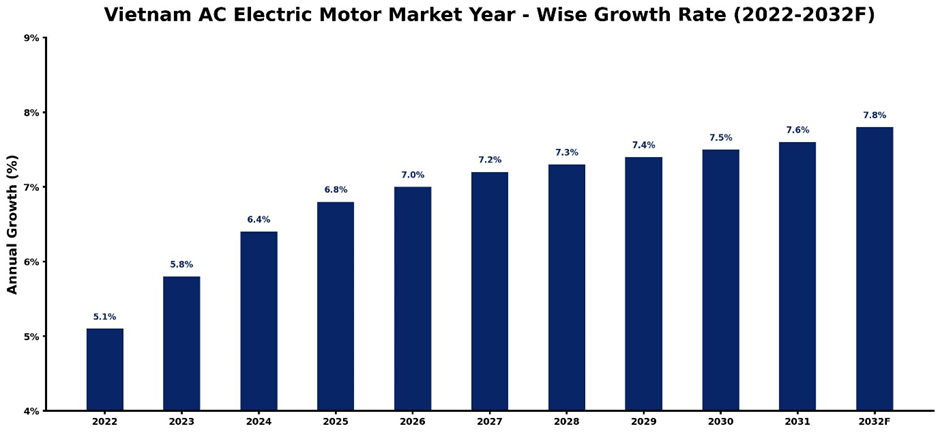
The following table summarizes the historical and forecasted growth rates of the Vietnam AC Electric Motor Market, along with the rationale behind each year’s performance.
| Year | Estimated Growth (%) | Market Rationale |
| 2022 | 5.1% | Recovery in industrial production and manufacturing output following pandemic disruptions. |
| 2023 | 5.8% | Increased foreign direct investments in electronics and industrial manufacturing sectors. |
| 2024 | 6.4% | Growing installation of motors in factory automation and process industries. |
| 2025 | 6.8% | Expansion of industrial parks and modernization of production facilities. |
| 2026 | 7% | Rising adoption of premium-efficiency motors to meet energy-saving targets. |
| 2027 | 7.2% | Growth in water treatment and wastewater management projects nationwide. |
| 2028 | 7.3% | Increasing investment in renewable power and industrial infrastructure. |
| 2029 | 7.4% | Strong demand from food processing and export-oriented manufacturing sectors. |
| 2030 | 7.5% | Wider implementation of Industry 4.0 technologies and automated systems. |
| 2031 | 7.6% | Expansion of smart factories and energy-efficient industrial equipment. |
| 2032 | 7.8% | Continued industrial development and replacement of aging motor systems. |
Topics Covered in the Vietnam AC Electric Motor Market Report
The Vietnam AC Electric Motor Industry report covers the market by voltage, type of motor, and end user industry. The report provides a detailed analysis of ongoing market trends, opportunities/high-growth areas, and market drivers that will help stakeholders align strategies based on current and future market dynamics.
Vietnam AC Electric Motor Market Highlights
| Report Name | Vietnam AC Electric Motor Market |
| Forecast period | 2026-2032 |
| CAGR | 6.31% |
| Growing Sector | Food and Beverage |
Vietnam AC Electric Motor Market Synopsis
The Vietnam AC Electric Motor Market is one of the most critical building blocks of the growing industrial infrastructure of the country. An AC (Alternating Current) electric motor can be defined as an electromechanical equipment used for converting alternating current electrical energy into mechanical energy rotation and widely used in industrial machines, pumps, fans, compressors, and conveyor systems. As a result of foreign direct investments in technologically advanced manufacturing facilities, widespread urbanization, and government initiatives for greener manufacturing processes, the market has evolved from conventional systems to highly efficient and intelligent powertrains.
Evaluation of Growth Drivers in Vietnam AC Electric Motor Market (2026–2032)
Below are some major drivers and their influence on the market dynamics:
| Drivers | Primary Segment Affected | Why It Matters (Evidence) |
| Expansion of Industrial Manufacturing | Low Voltage Motors | Growing factory installations require efficient motor-driven systems. |
| Rising Water & Wastewater Infrastructure Investments | Water & Wastewater | Pumps and treatment equipment rely heavily on AC motors. |
| Increasing Factory Automation Adoption | AC Induction Motors | Automated production lines require reliable motor systems. |
| Energy Efficiency Regulations | AC Synchronous Motors | Industries are replacing older motors with efficient alternatives. |
| Growth of Renewable and Conventional Power Projects | Power Generation | Power plants require motors for auxiliary and operational equipment. |
Vietnam AC Electric Motor Market is expected to witness growth, registering a CAGR of 6.31% during 2026–2032. This sustained upward progression is directly linked to the structural optimization of local Vietnamese factories. In an era where power grids are facing heavy utilization strains, local manufacturers are shifting completely toward smart-monitored variable speed AC units. The structural pivot ensures that the market moves far beyond a simple commodity replacement cycle into a high-value technological modernization ecosystem.
Evaluation of Restraints in Vietnam AC Electric Motor Market
Below are some major restraints and their influence on the market dynamics:
| Restraints | Primary Segment Affected | What This Means (Evidence) |
| High Initial Cost of Premium Motors | AC Synchronous Motors | Higher upfront investments may delay replacement cycles. |
| Dependence on Imported Components | Manufacturers | Supply chain disruptions can impact production costs. |
| Skilled Workforce Shortage | Industrial End Users | Limited technical expertise may hinder advanced motor deployment. |
| Fluctuating Raw Material Prices | Motor Producers | Volatility affects manufacturing profitability. |
| Maintenance Challenges in Remote Areas | Water & Wastewater | Reduced availability of specialized servicing increases downtime risks. |
Vietnam AC Electric Motor Market Challenges
The predominant challenge confronting the Vietnam AC Electric Motor Industry exist in the steep operational knowledge gap combined with the current components landscape. The next generation of variable frequency AC systems depends on sophisticated software and electronic control configurations. Local industries generally do not have dedicated in-house technician teams that are required to optimize the system. Furthermore, supply chain vulnerabilities for specialized core components mean that any geopolitical friction can disrupt the delivery timelines of vital equipment parts, leaving heavy manufacturing enterprises exposed to unexpected assembly downtimes.
Vietnam AC Electric Motor Market Trends
Some of the most influential trends reshaping the Vietnam AC electric motor market growth:
- IoT and Smart Sensors Integration: Contemporary industries are using more of AC electric motors fitted with advanced vibration, heat and acoustic sensors in order to develop predictive maintenance solutions.
- Variable Speed Drives (VSD) Integration: In order to conserve energy, the industry is witnessing a tremendous shift towards the use of integrated speed drive motors along with AC motors.
- Tremendous Shifting towards IE3 and IE4 Standard Motors: Regulations penalizing pollution through manufacturing processes are compelling manufacturers to shift from their conventional IE1 and IE2 models towards super-efficient models.
- Increasing Domestic Component Assembly: In order to hedge themselves against any logistical shocks, leading foreign companies have set up their domestic assembly facilities in Vietnam.
Investment Opportunities in the Vietnam AC Electric Motor Market
Some of the potential investment prospects include:
- Specialized Testing and Rewinding Services: The increasing availability of technologically advanced industrial motors offers a wonderful window for offering certified after-sale services.
- Development of Smart Motor Control Systems: Development of smart micro-controllers of variable frequency domestically owing to current import dependency offers a very promising opportunity.
- Strategic Supply Agreements with Expanding Industrial Parks: Direct partnerships to supply uniform high-efficiency motor fleets to upcoming eco-industrial zones across northern Vietnam offer robust long-term returns.
Top 5 Leading Players in Vietnam AC Electric Motor Market
Below is a list of players operating in the Vietnam AC Electric Motor Market:
1. Teco Motor Vietnam
| Company Name | Teco Motor Vietnam |
|---|---|
| Established Year | 2006 |
| Headquarters | Binh Duong Province, Vietnam |
| Official Website | Click Here |
Teco Motor Vietnam operates a major domestic manufacturing footprint specializing in high-durability low-to-high voltage industrial AC induction motors, serving heavy industrial pumping, ventilation, and manufacturing sectors across Southeast Asia.
2. ABB Vietnam
| Company Name | ABB Vietnam |
|---|---|
| Established Year | 1993 |
| Headquarters | Hanoi, Vietnam |
| Official Website | Click Here |
ABB Vietnam delivers globally renowned high-efficiency AC motors, smart drive systems, and digital powertrain monitoring architectures tailored extensively for the power generation, water management, and heavy processing fields.
3. Siemens Vietnam
| Company Name | Siemens Vietnam |
|---|---|
| Established Year | 1993 |
| Headquarters | Ho Chi Minh City, Vietnam |
| Official Website | Click Here |
Siemens provides high-performance synchronous and asynchronous AC motors paired with sophisticated automation integrations, making them a primary technology partner for advanced factory setups and logistics centers.
4. Toshiba Industrial Products Asia
| Company Name | Toshiba Industrial Products Asia |
|---|---|
| Established Year | 2008 |
| Headquarters | Dong Nai Province, Vietnam |
| Official Website | Click Here |
Operating a state-of-the-art production hub in Vietnam, Toshiba manufactures premium-efficiency three-phase AC induction motors for regional and international distribution, optimizing power consumption ratios across heavy manufacturing.
5. HEM (Hanoi Electro-Mechanical Manufacturing)
| Company Name | HEM (Hanoi Electro-Mechanical Manufacturing) |
|---|---|
| Established Year | 1961 |
| Headquarters | Hanoi, Vietnam |
| Official Website | Click Here |
As a historic cornerstone manufacturer of electro-mechanical equipment in Vietnam, HEM produces versatile, locally adapted AC electric motors widely utilized across the country's municipal infrastructure, agricultural grids, and light industrial networks.
Government Initiatives being implemented in the Vietnam AC Electric Motor Market
The Government of Vietnam has rolled out aggressive regulatory frameworks designed to phase out highly polluting, low-efficiency industrial assets. Under the National Energy Efficiency Program (VNEEP3), industrial manufacturing facilities operating within the territory are required to log and audit energy footprints, with state subsidies directed toward entities that convert their old configurations to modern, high-efficiency IE3-grade powertrains. Concurrently, the Ministry of Science and Technology has strictly applied updated TCVN national standards, which restrict the importation and commercial sale of electric motor equipment that fails to cross stringent minimum energy performance thresholds, forcing an organic market shift toward premium AC technology.
Future Insights of the Vietnam AC Electric Motor Market
The Vietnam AC Electric Motor Market is positioned to move into a hyper-connected era over the next decade. As industrial parks continue to integrate into broader cloud-based asset tracking systems, standalone AC motors will increasingly be treated as smart grid components. The evolution will drive massive growth across high-end synchronous motor platforms that integrate seamless automation feedback loops. Consequently, while standard mechanical component prices may stabilize, the software-enabled control and drive integration architecture within the Vietnamese motor landscape will command an expanding portion of total industrial system investments.
Market Segmentation Analysis
This report offers a comprehensive study of the following market segments and their leading categories:
By Voltage - Market Dominated by Low Voltage Motors, High Voltage Set for Rapid Expansion
According to Sumit Sagar, Senior Research Analyst, 6Wresearch, Low voltage AC electric motors (operating up to 690V) firmly secured the dominant share of 63.40% of the Vietnam AC electric motor market share in 2025. Conversely, high voltage AC motors (operating above 3300V) are projected to advance at an aggressive CAGR of 7.15% during 2026–2032, propelled by massive capital outlays for new water purification infrastructures, heavy mineral mining installations, and complex maritime processing facilities requiring enormous mechanical torque outputs.
By Type of Motor - AC Induction/Asynchronous Leads, Synchronous Shows Rapid Growth
By type, AC Induction/Asynchronous motors accounted for 68.20% of the total Vietnam market revenue in 2025, supported by their legendary mechanical simplicity, and extreme resilience in rugged, dust-heavy manufacturing plant conditions. On the contrary, AC Synchronous solutions are anticipated to expand at an impressive CAGR of 8.42% through 2032, owing to their peerless operational efficiency ratios.
Note: Market size estimations and growth projections presented in this report are based on 6Wresearch’s advanced forecasting approach, validated with industry datasets as of June 2026.
Key Attractiveness of the Report:
- 10 Years of Market Numbers
- Historical Data Starting from 2022 to 2025
- Base Year: 2025
- Forecast Data until 2032
- Key Performance Indicators Impacting the Market
- Major Upcoming Developments and Projects
Key Highlights of the Report:
- Vietnam AC Electric Motor Market Outlook
- Market Size of Vietnam AC Electric Motor Market, 2025
- Forecast of Vietnam AC Electric Motor Market, 2032
- Historical Data and Forecast of Vietnam AC Electric Motor Revenues & Volume for the Period 2022- 2032
- Vietnam AC Electric Motor Market Trend Evolution
- Vietnam AC Electric Motor Market Drivers and Challenges
- Vietnam AC Electric Motor Price Trends
- Vietnam AC Electric Motor Porter's Five Forces
- Vietnam AC Electric Motor Industry Life Cycle
- Historical Data and Forecast of Vietnam AC Electric Motor Market Revenues & Volume By Voltage for the Period 2022- 2032
- Historical Data and Forecast of Vietnam AC Electric Motor Market Revenues & Volume By Low for the Period 2022- 2032
- Historical Data and Forecast of Vietnam AC Electric Motor Market Revenues & Volume By Medium for the Period 2022- 2032
- Historical Data and Forecast of Vietnam AC Electric Motor Market Revenues & Volume By High for the Period 2022- 2032
- Historical Data and Forecast of Vietnam AC Electric Motor Market Revenues & Volume By Type of Motor for the Period 2022- 2032
- Historical Data and Forecast of Vietnam AC Electric Motor Market Revenues & Volume By AC Induction/Asynchronous for the Period 2022- 2032
- Historical Data and Forecast of Vietnam AC Electric Motor Market Revenues & Volume By AC Synchronous for the Period 2022- 2032
- Historical Data and Forecast of Vietnam AC Electric Motor Market Revenues & Volume By End User Industry for the Period 2022- 2032
- Historical Data and Forecast of Vietnam AC Electric Motor Market Revenues & Volume By Oil & Gas for the Period 2022- 2032
- Historical Data and Forecast of Vietnam AC Electric Motor Market Revenues & Volume By Power Generation for the Period 2022- 2032
- Historical Data and Forecast of Vietnam AC Electric Motor Market Revenues & Volume By Water & Wastewater for the Period 2022- 2032
- Historical Data and Forecast of Vietnam AC Electric Motor Market Revenues & Volume By Food & Beverage for the Period 2022- 2032
- Vietnam AC Electric Motor Import Export Trade Statistics
- Market Opportunity Assessment By Voltage
- Market Opportunity Assessment By Type of Motor
- Market Opportunity Assessment By End User Industry
- Vietnam AC Electric Motor Top Companies Market Share
- Vietnam AC Electric Motor Competitive Benchmarking By Technical and Operational Parameters
- Vietnam AC Electric Motor Company Profiles
- Vietnam AC Electric Motor Key Strategic Recommendations
Market Covered
The report offers an extensive study of the following market segments:
By Voltage
- Low Voltage
- Medium Voltage
- High Voltage
By Type of Motor
- AC Induction (Asynchronous)
- AC Synchronous
By End User Industry
- Oil & Gas
- Power Generation
- Water & Wastewater
- Food & Beverage
Vietnam AC Electric Motor Market (2026-2032): FAQs
Rapid industrialization, expansion of manufacturing facilities, and increasing automation adoption are key growth drivers.
The AC Induction/Asynchronous motor segment remains the dominant configuration, capturing 68.20% of total revenue in 2025 due to its operational upkeep costs across factory floor networks.
Vietnam AC Electric Motor Market is growing at a robust CAGR of 6.31% during the 2026–2032 forecast period. low
Vietnam AC electric motor market is expected to grow steadily through 2032, supported by industrial expansion and infrastructure development.
6Wresearch actively monitors the Vietnam AC Electric Motor Market and publishes its comprehensive annual report, highlighting emerging trends, growth drivers, revenue analysis, and forecast outlook. Our insights help businesses to make data-backed strategic decisions with ongoing market dynamics. Our analysts track relevent industries related to the Vietnam AC Electric Motor Market, allowing our clients with actionable intelligence and reliable forecasts tailored to emerging regional needs.
Yes, we provide customisation as per your requirements. To learn more, feel free to contact us on sales@6wresearch.com
| 1 Executive Summary |
| 2 Introduction |
| 2.1 Key Highlights of the Report |
| 2.2 Report Description |
| 2.3 Market Scope & Segmentation |
| 2.4 Research Methodology |
| 2.5 Assumptions |
| 3 Vietnam AC Electric Motor Market Overview |
| 3.1 Vietnam Country Macro Economic Indicators |
| 3.2 Vietnam AC Electric Motor Market Revenues & Volume, 2022 & 2032F |
| 3.3 Vietnam AC Electric Motor Market - Industry Life Cycle |
| 3.4 Vietnam AC Electric Motor Market - Porter's Five Forces |
| 3.5 Vietnam AC Electric Motor Market Revenues & Volume Share, By Voltage, 2022 & 2032F |
| 3.6 Vietnam AC Electric Motor Market Revenues & Volume Share, By Typeof Motor, 2022 & 2032F |
| 3.7 Vietnam AC Electric Motor Market Revenues & Volume Share, By End User Industry, 2022 & 2032F |
| 4 Vietnam AC Electric Motor Market Dynamics |
| 4.1 Impact Analysis |
| 4.2 Market Drivers |
| 4.2.1 Increasing industrialization and infrastructure development in Vietnam |
| 4.2.2 Rising demand for energy-efficient electric motors |
| 4.2.3 Government initiatives promoting the use of AC electric motors in various sectors |
| 4.3 Market Restraints |
| 4.3.1 Competition from foreign manufacturers |
| 4.3.2 Fluctuating raw material prices |
| 4.3.3 Technological advancements leading to the adoption of alternative energy sources |
| 5 Vietnam AC Electric Motor Market Trends |
| 6 Vietnam AC Electric Motor Market, By Types |
| 6.1 Vietnam AC Electric Motor Market, By Voltage |
| 6.1.1 Overview and Analysis |
| 6.1.2 Vietnam AC Electric Motor Market Revenues & Volume, By Voltage, 2022-2032F |
| 6.1.3 Vietnam AC Electric Motor Market Revenues & Volume, By Low, 2022-2032F |
| 6.1.4 Vietnam AC Electric Motor Market Revenues & Volume, By Medium, 2022-2032F |
| 6.1.5 Vietnam AC Electric Motor Market Revenues & Volume, By High, 2022-2032F |
| 6.2 Vietnam AC Electric Motor Market, By Typeof Motor |
| 6.2.1 Overview and Analysis |
| 6.2.2 Vietnam AC Electric Motor Market Revenues & Volume, By AC Induction/Asynchronous, 2022-2032F |
| 6.2.3 Vietnam AC Electric Motor Market Revenues & Volume, By AC Synchronous, 2022-2032F |
| 6.3 Vietnam AC Electric Motor Market, By End User Industry |
| 6.3.1 Overview and Analysis |
| 6.3.2 Vietnam AC Electric Motor Market Revenues & Volume, By Oil & Gas, 2022-2032F |
| 6.3.3 Vietnam AC Electric Motor Market Revenues & Volume, By Power Generation, 2022-2032F |
| 6.3.4 Vietnam AC Electric Motor Market Revenues & Volume, By Water & Wastewater, 2022-2032F |
| 6.3.5 Vietnam AC Electric Motor Market Revenues & Volume, By Food & Beverage, 2022-2032F |
| 7 Vietnam AC Electric Motor Market Import-Export Trade Statistics |
| 7.1 Vietnam AC Electric Motor Market Export to Major Countries |
| 7.2 Vietnam AC Electric Motor Market Imports from Major Countries |
| 8 Vietnam AC Electric Motor Market Key Performance Indicators |
| 8.1 Energy efficiency ratings of AC electric motors |
| 8.2 Adoption rate of AC electric motors in key industries |
| 8.3 Number of government projects utilizing AC electric motors |
| 8.4 Investment in research and development for improving AC electric motor technology |
| 8.5 Growth rate of the manufacturing sector in Vietnam |
| 9 Vietnam AC Electric Motor Market - Opportunity Assessment |
| 9.1 Vietnam AC Electric Motor Market Opportunity Assessment, By Voltage, 2022 & 2032F |
| 9.2 Vietnam AC Electric Motor Market Opportunity Assessment, By Typeof Motor, 2022 & 2032F |
| 9.3 Vietnam AC Electric Motor Market Opportunity Assessment, By End User Industry, 2022 & 2032F |
| 10 Vietnam AC Electric Motor Market - Competitive Landscape |
| 10.1 Vietnam AC Electric Motor Market Revenue Share, By Companies, 2025 |
| 10.2 Vietnam AC Electric Motor Market Competitive Benchmarking, By Operating and Technical Parameters |
| 11 Company Profiles |
| 12 Recommendations |
| 13 Disclaimer |
Global Go To Market Strategy - 2030
Export potential enables firms to identify high-growth global markets with greater confidence by combining advanced trade intelligence with a structured quantitative methodology. The framework analyzes emerging demand trends and country-level import patterns while integrating macroeconomic and trade datasets such as GDP and population forecasts, bilateral import–export flows, tariff structures, elasticity differentials between developed and developing economies, geographic distance, and import demand projections. Using weighted trade values from 2020–2024 as the base period to project country-to-country export potential for 2030, these inputs are operationalized through calculated drivers such as gravity model parameters, tariff impact factors, and projected GDP per-capita growth. Through an analysis of hidden potentials, demand hotspots, and market conditions that are most favorable to success, this method enables firms to focus on target countries, maximize returns, and global expansion with data, backed by accuracy.
By factoring in the projected importer demand gap that is currently unmet and could be potential opportunity, it identifies the potential for the Exporter (Country) among 190 countries, against the general trade analysis, which identifies the biggest importer or exporter.
To discover high-growth global markets and optimize your business strategy:
Click Here
Pricing
- Single User License$ 1,995
- Department License$ 2,400
- Site License$ 3,120
- Global License$ 3,795

Leadership Perspectives from Industry Events
Search
Thought Leadership and Analyst Meet





Our Clients








6WResearch In News
- India Export Attractiveness Tracker 2026
- India Air Conditioner Market Set for Strong Rebound in 2026 After Weather-Led Correction and GST-Driven Recovery: 6Wresearch
- ADAS in India: How Automatic Emergency Braking, Blind Spot Detection & Driver Monitoring are Transforming Road Safety
- Doha a strategic location for EV manufacturing hub: IPA Qatar
- Demand for luxury TVs surging in the GCC, says Samsung
- Empowering Growth: The Thriving Journey of Bangladesh’s Cable Industry
Latest Reports
- Nicaragua RPG Gaming Market (2026-2032)
- New Zealand RPG Gaming Market (2026-2032)
- Netherlands RPG Gaming Market (2026-2032)
- Nauru RPG Gaming Market (2026-2032)
- Namibia RPG Gaming Market (2026-2032)
- Mozambique RPG Gaming Market (2026-2032)
- Montenegro RPG Gaming Market (2026-2032)
- Mongolia RPG Gaming Market (2026-2032)
- Monaco RPG Gaming Market (2026-2032)
- Micronesia RPG Gaming Market (2026-2032)
Industry Events and Analyst Meet

EV India Expo 2026

HIMTEX 2026

India Refining Summit 2026

India EV Show 2026

EV tech India Expo 2026
Whitepaper
- Middle East & Africa Commercial Security Market Click here to view more.
- Middle East & Africa Fire Safety Systems & Equipment Market Click here to view more.
- GCC Drone Market Click here to view more.
- Middle East Lighting Fixture Market Click here to view more.
- GCC Physical & Perimeter Security Market Click here to view more.


