Vietnam Acai Berry Extract Market (2026-2032) | Competitive Landscape, Companies, Growth, Share, Industry, Analysis, Outlook, Value, Forecast, Segmentation, Size & Revenue, Trends
Market Forecast By Product Form (Pulp, Dry), By End-use Industry (Food & Beverages, Pharmaceuticals, Cosmetics, Others), By Distribution Channel (Hypermarkets/Supermarkets, Speciality Stores, Convenience Stores, Online, Others) And Competitive Landscape
| Product Code: ETC10066558 | Publication Date: Sep 2024 | Updated Date: Jun 2026 | Product Type: Market Research Report | |
| Publisher: 6Wresearch | Author: Sumit Sagar | No. of Pages: 70 | No. of Figures: 35 | No. of Tables: 5 |
Vietnam Acai Berry Extract Market Growth Rate
According to 6Wresearch internal databases and industry insights, the Vietnam Acai Berry Extract Market is projected to grow at a steady compound annual growth rate (CAGR) of 8.34% during the forecast period 2026–2032.
Vietnam Acai Berry Extract Market Year-wise Growth Rate and Key Drivers
This graph illustrates the annual growth rates of the Vietnam Acai Berry Extract Market from 2021 to 2032, highlighting a steady upward trajectory and projected market expansion over the forecast period.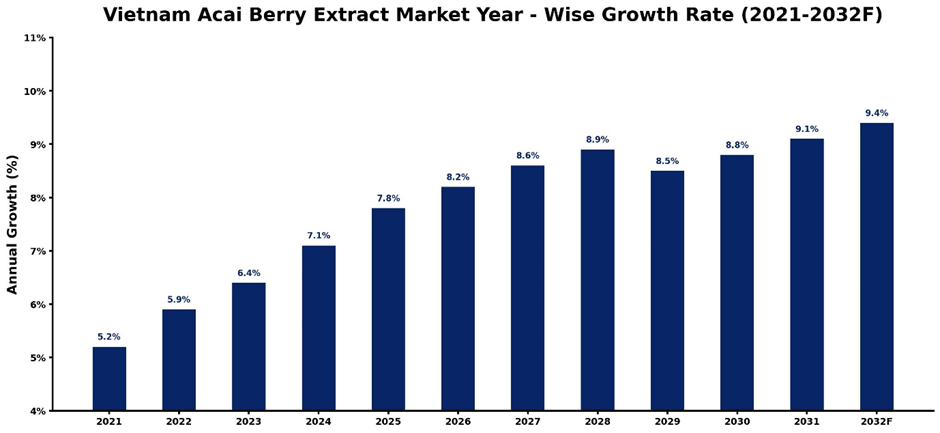
The following table summarizes the historical and forecasted growth rates of the Vietnam Acai Berry Extract Market, along with the rationale behind each year’s performance.
| Year | Estimated Growth (%) | Market Rationale |
| 2021 | 5.2% | Initial post-pandemic recovery and a sharp baseline spike in baseline consumer interest regarding plant-derived health supplements. |
| 2022 | 5.9% | Expanding urban smoothie and juice bar networks across Ho Chi Minh City and Hanoi introducing açaí bowls to mass consumers. |
| 2023 | 6.4% | The rise in disposable wealth of the middle class is changing the pattern of domestic food consumption towards imported, functional superfoods. |
| 2024 | 7.1% | Increasingly, local cosmetic brands are turning to berry extracts rich in anthocyanins to develop their line of anti-aging facial cream. |
| 2025 | 7.8% | Heightened retail penetration via high-end hypermarkets and cross-border e-commerce networks optimizing frozen chain supply routes. |
| 2026 | 8.2% | More domestic nutraceutical capsules are being made by using standardized freeze-dried custom formulas. |
| 2027 | 8.6% | Installation of state-of-the-art cold-chain infrastructure at the major transit corridors to reduce raw material spoiling rate. |
| 2028 | 8.9% | Local mid-tier beverage producing enterprises are now widely using natural colorant alternatives and clean-label verification for their products. |
| 2029 | 8.5% | Market consolidation phase following a temporary global price stabilization of premium wild-harvested raw inputs from Brazil. |
| 2030 | 8.8% | Accelerated direct-to-consumer digital subscription frameworks delivering frozen single-serve purees straight to urban households. |
| 2031 | 9.1% | Growing use in functional dairy products, especially high-end yogurts and meal-replacement drinks aimed at exercise groups. |
| 2032 | 9.4% | Maturity of regional distribution nodes making functional wellness botanical extracts universally accessible outside primary metropolises. |
Topics Covered in the Vietnam Acai Berry Extract Market Report
The Vietnam Acai Berry Extract Industry report covers the market by product form, end-use industry, and distribution channel. The report provides a detailed analysis of ongoing market trends, opportunities/high-growth areas, and market drivers that will help stakeholders align strategies based on current and future market dynamics.
Vietnam Acai Berry Extract Market Highlights
| Report Name | Vietnam Acai Berry Extract Market |
| Forecast period | 2026-2032 |
| CAGR | 8.34% |
| Growing Sector | Food & Beverages |
Vietnam Acai Berry Extract Market Synopsis
Vietnam acai berry extract market is a niche but growing segment within the country’s health and nutraceutical industry, driven by increasing consumer awareness of superfoods and natural dietary supplements. Acai berry extract, derived from the Amazonian acai fruit, is valued for its high antioxidant content, vitamins, and potential health benefits, including immune support, anti-aging, and weight management. The market primarily caters to dietary supplements, functional foods and beverages, and personal care products.
Evaluation of Growth Drivers in Vietnam Acai Berry Extract Market (2026–2032)
Below are some major drivers and their influence on the market dynamics:
| Drivers | Primary Segment Affected | Why It Matters (Evidence) |
| Antioxidant-Driven Skincare Trends | Cosmetics | Rising domestic consumer preferences for botanical ingredients have prompted local personal care manufacturers to substitute chemical bases with polyphenol-rich berry extracts. |
| Expansion of High-End Smoothie Cultures | Food & Beverages | Proliferation of lifestyle-oriented fitness hubs establishes a high-volume, recurring demand for bulk processed bases. |
| Nutraceutical Clean-Label Movements | Pharmaceuticals | Pharmaceutical firms are actively engineering natural wellness capsules to capture a growing demographic segment prioritizing preventive self-care. |
| Cross-Border Digital Procurement Channels | Online & Community | The integration of specialized e-commerce logistics lowers historical entry barriers for niche imported functional ingredients. |
| Westernized Dietary Premiumization |
Hypermarkets/ Supermarkets |
Increased real consumer spending capabilities within Tier 1 urban zones directly translate to higher shelf allocations for luxury organic foods. |
Vietnam Acai Berry Extract Market is projected to grow at a CAGR of 8.34% during 2026–2032, driven by the structural transformation of the country's retail ecosystem and an expanding middle class willing to pay a premium for verified botanical imports. The compounding integration of superfood ingredients across everyday functional consumables ensures sustained institutional market volume. In Vietnam, the market is undergoing structural expansion driven by a structural shift in consumer purchasing behavior.
As domestic health literacy increases, urban populations are moving away from synthetic additive products in favor of organic, nutrient-dense superfoods. The product's deep violet hue and robust antioxidant capacity make it highly versatile, allowing multi-industry implementation spanning functional food manufacturing, wellness beverages, preventative nutra-pharmaceuticals, and natural dermatological cosmetics.
Evaluation of Restraints in Vietnam Acai Berry Extract Market
Below are some major restraints and their influence on the market dynamics:
| Restraints | Primary Segment Affected | What This Means (Evidence) |
| Strict Import Dependence Vulnerabilities | Logistics & Supply Chain | As commercial cultivation remains confined to South American ecosystems, downstream processors face frequent freight fluctuations and complex customs clearance bottlenecks. |
| Cold-Chain Operational Disparities | Food & Beverages | Inconsistent specialized sub-zero transportation networks outside primary urban centers restrict the regional expansion of volatile frozen pulp forms. |
| Premium Consumer Price Sensitivity | Specialty Stores | These items are positioned at luxury price limits due to high extraction and international transportation costs, which restricts their quick penetration in rural districts. |
| Proliferation of Adulterated Products | Online & Community | The influx of unverified substitute berry powders undermines overall consumer confidence. |
| Complex Regulatory Compliance Norms | Pharmaceuticals | Rigorous safety verification parameters mandated by local food safety board regarding imported biological goods slow down cross-border commercial product rollouts. |
Vietnam Acai Berry Extract Market Challenges
The primary challenge constraining the Vietnam acai berry extract market growth centers on microbiological stability and raw material fragility. The chemical integrity of acai's key functional compounds—specifically its sensitive anthocyanin molecules—is highly susceptible to thermal degradation and oxidation during shipping, clearing, and manufacturing.
If the temperature fluctuates during maritime or air transit from Latin American trade routes, the active antioxidant capacity can decline rapidly, compromising product efficacy. Furthermore, local manufacturing facilities frequently lack specialized high-throughput machinery required to process raw extracts without exposing them to extreme heat, resulting in high production wastage and inconsistent end-product quality control across local brands.
Vietnam Acai Berry Extract Market Trends
Some of the prevalent trends shaping the Vietnam Acai Berry Extract Market include:
- Nano-encapsulation technology penetration: Locally pharmaceutical and cosmetic product developers are using nano-encapsulated acai extract powder to protect the active components from metabolic oxidation and dramatically increase their bioavailability at the cellular level.
- Visual marketing that is guided by aesthetics: Food service operators and functional beverage manufacturers are exploiting heavily the natural vibrant purple color of the extract to attract visually oriented, younger demographics on social platforms.
- Blend of superfoods with synergistic effects: The manufacturers have moved away from single-ingredient formulations and have combined acai with local Vietnamese natural ingredients like red dragon fruit or green tea extracts to provide holistic, wellness benefits that are tailored.
- Rise of Single-Serve Ready-To-Drink (RTD) Packs: With an increasingly fast-paced urban lifestyle, people are changing to grab-and-go lifestyle items. It has led to a rise in pre-blended aa wellness shots and ambient shelf-stable nutrition pouches.
Investment Opportunities in the Vietnam Acai Berry Extract Industry
Potential investment prospects include:
- Localized Dehydration Processing Facilities: Making use of raw pulp imports to perform local freeze-drying and spray-drying procedures inside the industrial zones of Vietnam may Much reduce the costs of international transportation and also lower tariffs.
- Organic Certified Skincare Lines: Introducing clean, toxin-free dermaceutical lines that are First and foremost based on 100% natural high concentration acai extracts, is a good opportunity as there is a big change among the consumers towards natural products, and away from the synthetic skin lightening products.
- B2B Supply Agreements with National Gym Chains: Obtaining exclusive large-scale supply contracts to integrate functional superfood extract mixes directly into the institutional cafs of rapidly expanding fitness franchise chains is a largely untapped institutional channel.
- High-Tech Smart Cold-Chain Logistics: Going for specialized, temperature-controlled transport systems More exactly designed for high-value, perishable imported botanical ingredients in secondary cities of the developing world.
Top 5 Leading Players in Vietnam Acai Berry Extract Market
Below is a primary list of top players operating in the Vietnam Acai Berry Extract Market:
1. Son Ha Group Import Export JSC
| Company Name | Son Ha Group Import Export JSC |
|---|---|
| Established Year | 1998 |
| Headquarters | Hanoi, Vietnam |
| Official Website | Click Here |
Son Ha Group operates a diversified supply network that features a dedicated import-distribution wing handling premium botanical raw ingredients.
2. UPVN Trading Company Limited
| Company Name | UPVN Trading Company Limited |
|---|---|
| Established Year | 2016 |
| Headquarters | Ho Chi Minh City, Vietnam |
| Official Website | - |
UPVN specializes in the strategic sourcing and import of premium functional food bases and health beverage raw ingredients.
3. Kimen Company Limited
| Company Name | Kimen Company Limited |
|---|---|
| Established Year | 2011 |
| Headquarters | Ho Chi Minh City, Vietnam |
| Official Website | Click Here |
Kimen acts as a specialized B2B supplier of industrial cosmetic ingredients and raw manufacturing inputs.
4. Asia Light Services & Trading Company Limited
| Company Name | Asia Light Services & Trading Company Limited |
|---|---|
| Established Year | 2019 |
| Headquarters | Da Nang, Vietnam |
| Official Website | - |
Asia Light operates an expansive logistics and trade framework focusing on advanced raw materials for the personal care and nutraceutical sectors.
5. Classic Food Company Limited (Classic Fine Foods Vietnam)
| Company Name | Classic Food Company Limited (Classic Fine Foods Vietnam) |
|---|---|
| Established Year | 2005 |
| Headquarters | Ho Chi Minh City, Vietnam |
| Official Website | Click Here |
Classic Fine Foods is a major importer and distributor of premium culinary and beverage components across the hospitality sector.
Government Initiatives being implemented in the Vietnam Acai Berry Extract Market
The Vietnamese government has implemented several strategic policies that indirectly facilitate the expansion of the imported botanical extract sector. Under Decision No. 1294/QD-BYT, the Ministry of Health has unified and clarified food safety inspection standards for imported functional biological ingredients, ensuring faster customs throughput for verified organic products.
Furthermore, the Vietnam National Trade Repository (VNTR) framework, launched to improve transparency in line with free trade agreements, has reduced import tariffs on agricultural extracts originating from favored trading partners. The government’s ongoing National Nutrition Strategy, which actively promotes clean-label eating habits and mandates the reduction of artificial synthetic colorants in children's foodstuffs, has driven commercial food processors to adopt natural visual alternatives like dense acai berry extracts.
Future Insights of the Vietnam Acai Berry Extract Market
Vietnam Acai Berry Extract Market is set to evolve from a niche premium health product into a standardized mainstream industrial ingredient. The market will likely witness substantial technological progression as processing centers transition toward vacuum freeze-drying to optimize the preservation of volatile natural active compounds. As structural cold-chain infrastructure expands into secondary and tertiary regional hubs, the availability of frozen pulp formats will rise sharply, balancing the current market skew toward urban zones. Additionally, strategic corporate alignments between global ingredient suppliers and dominant domestic beverage conglomerates will likely yield cost-optimized local product lines, bringing retail price tags within reach of broader consumer demographics.
Market Segmentation Analysis
The report offers a comprehensive study of the following market segments and their leading categories:
By Product Form
By product form, pulp secured 78.25% of the Vietnam acai berry extract market share in 2025, dominated due to its foundational integration across high-volume quick-service juice networks and frozen retail pack lines; conversely, dry (powdered and freeze-dried) forms are projected to advance at a faster CAGR of 9.84% during 2026–2032, fueled by its extended ambient shelf life and flexible, low-weight applicability in both pharmaceutical tableting and anhydrous cosmetic manufacturing lines.
By End-use Industry
the food & beverages sector accounted for 54.60% of the Vietnam acai berry extract market in 2025, driven by a mainstream consumer demand for lifestyle smoothie bowls and functional antioxidant beverages; meanwhile, the cosmetics category is anticipated to expand at the highest CAGR of 10.15% through 2032, owing to rising demand for precision clean-label formulations and natural botanical ingredients inside premium anti-aging topical skincare systems.
By Distribution Channel
By distribution channel, hypermarkets/supermarkets captured 48.12% of the Vietnam acai berry extract market in 2025, supported by structured cold-storage shelf space and mass consumer grocery trust; in contrast, the online channel is forecast to witness the fastest growth rate, marking a CAGR of 11.30% during the 2026–2032 period, driven by an expanding smartphone-dependent urban population and direct-to-consumer health supplement subscription models.
Note: Market size estimations and growth projections presented in this report are based on 6Wresearch’s advanced forecasting approach, validated with industry datasets as of June 2026.
Key Attractiveness of the Report:
- 10 Years of Market Numbers
- Historical Data Starting from 2022 to 2025
- Base Year: 2025
- Forecast Data until 2032
- Key Performance Indicators Impacting the Market
- Major Upcoming Developments and Projects
Key Highlights of the Report:
- Vietnam Acai Berry Extract Market Outlook
- Market Size of Vietnam Acai Berry Extract Market, 2025
- Forecast of Vietnam Acai Berry Extract Market, 2032
- Historical Data and Forecast of Vietnam Acai Berry Extract Revenues & Volume for the Period 2022-2032
- Vietnam Acai Berry Extract Market Trend Evolution
- Vietnam Acai Berry Extract Market Drivers and Challenges
- Vietnam Acai Berry Extract Price Trends
- Vietnam Acai Berry Extract Porter's Five Forces
- Vietnam Acai Berry Extract Industry Life Cycle
- Historical Data and Forecast of Vietnam Acai Berry Extract Market Revenues & Volume By Product Form for the Period 2022-2032
- Historical Data and Forecast of Vietnam Acai Berry Extract Market Revenues & Volume By Pulp for the Period 2022-2032
- Historical Data and Forecast of Vietnam Acai Berry Extract Market Revenues & Volume By Dry for the Period 2022-2032
- Historical Data and Forecast of Vietnam Acai Berry Extract Market Revenues & Volume By End-use Industry for the Period 2022-2032
- Historical Data and Forecast of Vietnam Acai Berry Extract Market Revenues & Volume By Food & Beverages for the Period 2022-2032
- Historical Data and Forecast of Vietnam Acai Berry Extract Market Revenues & Volume By Pharmaceuticals for the Period 2022-2032
- Historical Data and Forecast of Vietnam Acai Berry Extract Market Revenues & Volume By Cosmetics for the Period 2022-2032
- Historical Data and Forecast of Vietnam Acai Berry Extract Market Revenues & Volume By Others for the Period 2022-2032
- Historical Data and Forecast of Vietnam Acai Berry Extract Market Revenues & Volume By Distribution Channel for the Period 2022-2032
- Historical Data and Forecast of Vietnam Acai Berry Extract Market Revenues & Volume By Hypermarkets/Supermarkets for the Period 2022-2032
- Historical Data and Forecast of Vietnam Acai Berry Extract Market Revenues & Volume By Speciality Stores for the Period 2022-2032
- Historical Data and Forecast of Vietnam Acai Berry Extract Market Revenues & Volume By Convenience Stores for the Period 2022-2032
- Historical Data and Forecast of Vietnam Acai Berry Extract Market Revenues & Volume By Online for the Period 2022-2032
- Historical Data and Forecast of Vietnam Acai Berry Extract Market Revenues & Volume By Others for the Period 2022-2032
- Vietnam Acai Berry Extract Import Export Trade Statistics
- Market Opportunity Assessment By Product Form
- Market Opportunity Assessment By End-use Industry
- Market Opportunity Assessment By Distribution Channel
- Vietnam Acai Berry Extract Top Companies Market Share
- Vietnam Acai Berry Extract Competitive Benchmarking By Technical and Operational Parameters
- Vietnam Acai Berry Extract Company Profiles
- Vietnam Acai Berry Extract Key Strategic Recommendations
Market Covered
The report offers an extensive study of the following market segments:
By Product Form
- Pulp
- Dry
By End-use Industry
- Food & Beverages
- Pharmaceuticals
- Cosmetics
- Others
By Distribution Channel
- Hypermarkets/Supermarkets
- Speciality Stores
- Convenience Stores
- Online
- Others
Vietnam Acai Berry Extract Market (2026-2032): FAQs
Vietnam Acai Berry Extract Market is projected to expand at a steady compound annual growth rate (CAGR) of 8.34% during the forecast period from 2026 to 2032.
The dry (powdered/freeze-dried) segment is experiencing the fastest growth, projected to expand at a CAGR of 9.84% due to its long shelf-life and manufacturing versatility.
The cosmetics segment is growing rapidly due to an intensive industrial shift toward plant-based active ingredients, using acai's natural antioxidant properties to formulate anti-aging skincare products.
The online channel is projected to experience the fastest growth, posting a CAGR of 11.30%, supported by direct-to-consumer health brands and localized digital delivery networks.
6Wresearch actively monitors the Vietnam Acai Berry Extract Market and publishes its comprehensive annual report, highlighting emerging trends, growth drivers, revenue analysis, and forecast outlook. Our insights help businesses to make data-backed strategic decisions with ongoing market dynamics. Our analysts track relevent industries related to the Vietnam Acai Berry Extract Market, allowing our clients with actionable intelligence and reliable forecasts tailored to emerging regional needs.
Yes, we provide customisation as per your requirements. To learn more, feel free to contact us on sales@6wresearch.com
| 1 Executive Summary |
| 2 Introduction |
| 2.1 Key Highlights of the Report |
| 2.2 Report Description |
| 2.3 Market Scope & Segmentation |
| 2.4 Research Methodology |
| 2.5 Assumptions |
| 3 Vietnam Acai Berry Extract Market Overview |
| 3.1 Vietnam Country Macro Economic Indicators |
| 3.2 Vietnam Acai Berry Extract Market Revenues & Volume, 2022 & 2032F |
| 3.3 Vietnam Acai Berry Extract Market - Industry Life Cycle |
| 3.4 Vietnam Acai Berry Extract Market - Porter's Five Forces |
| 3.5 Vietnam Acai Berry Extract Market Revenues & Volume Share, By Product Form, 2022 & 2032F |
| 3.6 Vietnam Acai Berry Extract Market Revenues & Volume Share, By End-use Industry, 2022 & 2032F |
| 3.7 Vietnam Acai Berry Extract Market Revenues & Volume Share, By Distribution Channel, 2022 & 2032F |
| 4 Vietnam Acai Berry Extract Market Dynamics |
| 4.1 Impact Analysis |
| 4.2 Market Drivers |
| 4.2.1 Increasing awareness about health benefits of acai berry extract |
| 4.2.2 Growing demand for natural and organic products in Vietnam |
| 4.2.3 Rising disposable income leading to higher spending on health and wellness products |
| 4.3 Market Restraints |
| 4.3.1 Limited availability of acai berries in Vietnam leading to high import costs |
| 4.3.2 Regulatory challenges and strict import regulations for acai berry extract |
| 4.3.3 Price sensitivity among consumers in Vietnam |
| 5 Vietnam Acai Berry Extract Market Trends |
| 6 Vietnam Acai Berry Extract Market, By Types |
| 6.1 Vietnam Acai Berry Extract Market, By Product Form |
| 6.1.1 Overview and Analysis |
| 6.1.2 Vietnam Acai Berry Extract Market Revenues & Volume, By Product Form, 2022-2032F |
| 6.1.3 Vietnam Acai Berry Extract Market Revenues & Volume, By Pulp, 2022-2032F |
| 6.1.4 Vietnam Acai Berry Extract Market Revenues & Volume, By Dry, 2022-2032F |
| 6.2 Vietnam Acai Berry Extract Market, By End-use Industry |
| 6.2.1 Overview and Analysis |
| 6.2.2 Vietnam Acai Berry Extract Market Revenues & Volume, By Food & Beverages, 2022-2032F |
| 6.2.3 Vietnam Acai Berry Extract Market Revenues & Volume, By Pharmaceuticals, 2022-2032F |
| 6.2.4 Vietnam Acai Berry Extract Market Revenues & Volume, By Cosmetics, 2022-2032F |
| 6.2.5 Vietnam Acai Berry Extract Market Revenues & Volume, By Others, 2022-2032F |
| 6.3 Vietnam Acai Berry Extract Market, By Distribution Channel |
| 6.3.1 Overview and Analysis |
| 6.3.2 Vietnam Acai Berry Extract Market Revenues & Volume, By Hypermarkets/Supermarkets, 2022-2032F |
| 6.3.3 Vietnam Acai Berry Extract Market Revenues & Volume, By Speciality Stores, 2022-2032F |
| 6.3.4 Vietnam Acai Berry Extract Market Revenues & Volume, By Convenience Stores, 2022-2032F |
| 6.3.5 Vietnam Acai Berry Extract Market Revenues & Volume, By Online, 2022-2032F |
| 6.3.6 Vietnam Acai Berry Extract Market Revenues & Volume, By Others, 2022-2032F |
| 7 Vietnam Acai Berry Extract Market Import-Export Trade Statistics |
| 7.1 Vietnam Acai Berry Extract Market Export to Major Countries |
| 7.2 Vietnam Acai Berry Extract Market Imports from Major Countries |
| 8 Vietnam Acai Berry Extract Market Key Performance Indicators |
| 8.1 Number of health and wellness stores stocking acai berry extract products |
| 8.2 Consumer interest and engagement on social media platforms related to acai berry extract |
| 8.3 Number of new product launches and innovations in the acai berry extract market |
| 8.4 Adoption rate of acai berry extract in various food and beverage products in Vietnam |
| 8.5 Trend analysis of online searches and discussions related to acai berry extract in Vietnam |
| 9 Vietnam Acai Berry Extract Market - Opportunity Assessment |
| 9.1 Vietnam Acai Berry Extract Market Opportunity Assessment, By Product Form, 2022 & 2032F |
| 9.2 Vietnam Acai Berry Extract Market Opportunity Assessment, By End-use Industry, 2022 & 2032F |
| 9.3 Vietnam Acai Berry Extract Market Opportunity Assessment, By Distribution Channel, 2022 & 2032F |
| 10 Vietnam Acai Berry Extract Market - Competitive Landscape |
| 10.1 Vietnam Acai Berry Extract Market Revenue Share, By Companies, 2025 |
| 10.2 Vietnam Acai Berry Extract Market Competitive Benchmarking, By Operating and Technical Parameters |
| 11 Company Profiles |
| 12 Recommendations |
| 13 Disclaimer |
Global Go To Market Strategy - 2030
Export potential enables firms to identify high-growth global markets with greater confidence by combining advanced trade intelligence with a structured quantitative methodology. The framework analyzes emerging demand trends and country-level import patterns while integrating macroeconomic and trade datasets such as GDP and population forecasts, bilateral import–export flows, tariff structures, elasticity differentials between developed and developing economies, geographic distance, and import demand projections. Using weighted trade values from 2020–2024 as the base period to project country-to-country export potential for 2030, these inputs are operationalized through calculated drivers such as gravity model parameters, tariff impact factors, and projected GDP per-capita growth. Through an analysis of hidden potentials, demand hotspots, and market conditions that are most favorable to success, this method enables firms to focus on target countries, maximize returns, and global expansion with data, backed by accuracy.
By factoring in the projected importer demand gap that is currently unmet and could be potential opportunity, it identifies the potential for the Exporter (Country) among 190 countries, against the general trade analysis, which identifies the biggest importer or exporter.
To discover high-growth global markets and optimize your business strategy:
Click Here
Pricing
- Single User License$ 1,995
- Department License$ 2,400
- Site License$ 3,120
- Global License$ 3,795

Leadership Perspectives from Industry Events
Search
Thought Leadership and Analyst Meet





Our Clients








6WResearch In News
- India Export Attractiveness Tracker 2026
- India Air Conditioner Market Set for Strong Rebound in 2026 After Weather-Led Correction and GST-Driven Recovery: 6Wresearch
- ADAS in India: How Automatic Emergency Braking, Blind Spot Detection & Driver Monitoring are Transforming Road Safety
- Doha a strategic location for EV manufacturing hub: IPA Qatar
- Demand for luxury TVs surging in the GCC, says Samsung
- Empowering Growth: The Thriving Journey of Bangladesh’s Cable Industry
Latest Reports
- Nicaragua RPG Gaming Market (2026-2032)
- New Zealand RPG Gaming Market (2026-2032)
- Netherlands RPG Gaming Market (2026-2032)
- Nauru RPG Gaming Market (2026-2032)
- Namibia RPG Gaming Market (2026-2032)
- Mozambique RPG Gaming Market (2026-2032)
- Montenegro RPG Gaming Market (2026-2032)
- Mongolia RPG Gaming Market (2026-2032)
- Monaco RPG Gaming Market (2026-2032)
- Micronesia RPG Gaming Market (2026-2032)
Industry Events and Analyst Meet

EV India Expo 2026

HIMTEX 2026

India Refining Summit 2026

India EV Show 2026

EV tech India Expo 2026
Whitepaper
- Middle East & Africa Commercial Security Market Click here to view more.
- Middle East & Africa Fire Safety Systems & Equipment Market Click here to view more.
- GCC Drone Market Click here to view more.
- Middle East Lighting Fixture Market Click here to view more.
- GCC Physical & Perimeter Security Market Click here to view more.


