Vietnam Accelerator Card Market (2026-2032) | Outlook, Growth, Forecast, Value, Trends, Size & Revenue, Competitive Landscape, Share, Industry, Companies, Segmentation, Analysis
Market Forecast By Processor Type (Central Processing Units, Graphics Processing Units, Field Programmable Gate Arrays, Application-Specific Integrated Circuit), By Accelerator Type (High-Performance Computing Accelerator, Cloud Accelerator), By Application (Video and Image Processing, Machine Learning, Financial Computing, Data Analytics, Mobile Phones) And Competitive Landscape
| Product Code: ETC10066564 | Publication Date: Sep 2024 | Updated Date: Jun 2026 | Product Type: Market Research Report | |
| Publisher: 6Wresearch | Author: Sumit Sagar | No. of Pages: 75 | No. of Figures: 35 | No. of Tables: 20 |
Vietnam Accelerator Card Market Growth Rate
According to 6Wresearch internal databases and industry insights, the Vietnam Accelerator Card Market is projected to grow at a compound annual growth rate (CAGR) of 16.85% during the forecast period 2026–2032.
Vietnam Accelerator Card Market Year-wise Growth Rate and Key Drivers
This graph illustrates the annual growth rates of the Vietnam Accelerator Card Market from 2021 to 2032, highlighting a steady upward trajectory and projected market expansion over the forecast period.
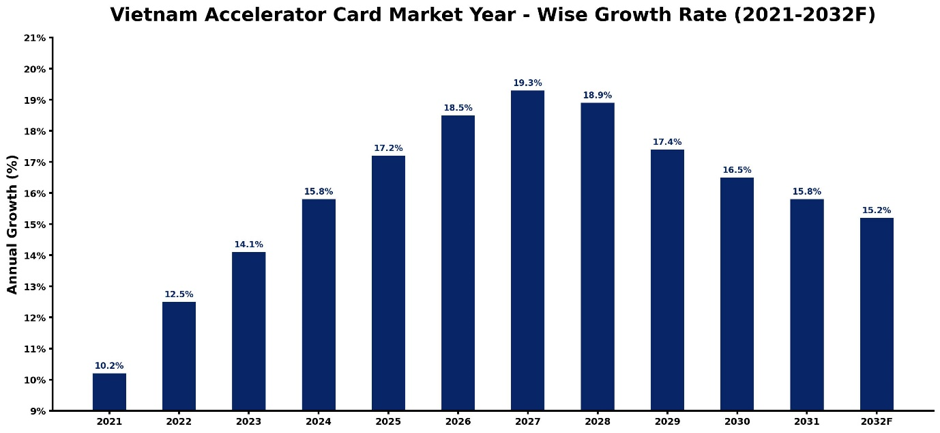
The following table summarizes the historical and forecasted growth rates of the Vietnam Accelerator Card Market, along with the rationale behind each year’s performance.
| Year | Estimated Growth (%) | Market Rationale |
| 2021 | 10.2% | First wave of regional data center growth along with first implementations of enterprise-local cloud environments. |
| 2022 | 12.5% | Faster pace of digital transformation following the pandemic, driving up demands for eCommerce operations and basic server upgrade. |
| 2023 | 14.1% | Emergence of early Machine Learning solutions and increased network demands that require hardware acceleration. |
| 2024 | 15.8% | Vast inflows of foreign direct investment in local cloud infrastructure and digital economy facilities. |
| 2025 | 17.2% | Boom in localized Generative AI experiments and development of future telecom processors. |
| 2026 | 18.5% | Full-scale buildout of multi-tenant hyperscale data centers in key metropolitan regions including Hanoi and Ho Chi Minh City. |
| 2027 | 19.3% | Edge computing architecture used in automation in manufacturing is commercially adopted. |
| 2028 | 18.9% | Stabilization of procurement cycles of enterprise hardware due to high initial cost involved. |
| 2029 | 17.4% | Adaption to specialized hardware technology that is efficient in operation and not general-purpose parallel processing technologies. |
| 3030 | 16.5% | Trend towards efficient software environments, reducing the need for regular replacements of structural hardware components. |
| 2031 | 15.8% | High market saturation of conventional hardware chips results in a concentration on specialized hardware acceleration solutions. |
| 2032 | 15.2% | Final stage market forecast stabilization due to the adoption of edge nodes over infrastructural building blocks. |
Topics Covered in the Vietnam Accelerator Card Market Report
Vietnam Accelerator Card Industry report covers the market by processor type, accelerator type, and application. The report provides a detailed analysis of ongoing market trends, opportunities/high-growth areas, and market drivers that will help stakeholders align strategies based on current and future market dynamics.
Vietnam Accelerator Card Market Highlights
| Report Name | Vietnam Accelerator Card Market |
| Forecast period | 2026-2032 |
| CAGR | 16.85% |
| Growing Sector | Machine Learning |
Vietnam Accelerator Card Market Synopsis
Vietnam Accelerator Card Market refers to the specialized hardware sector focused on co-processing components—such as GPUs, ASICs, and FPGAs—designed to offload and accelerate data-heavy computation from traditional Central Processing Units (CPUs). These plug-in cards are vital for handling high-throughput, low-latency demands of advanced artificial intelligence frameworks, deep learning algorithms, and massive data analytics pipelines. Driven by a booming national digital economy and a state-supported rush toward Industry 4.0 infrastructure, the domestic market is transforming rapidly.
Evaluation of Growth Drivers in Vietnam Accelerator Card Market (2026–2032)
Below are some major drivers and their influence on the market dynamics:
| Drivers | Primary Segment Affected | Why It Matters (Evidence) |
| Hyperscale Data Center Expansion | Cloud Accelerator | Global and domestic providers are constructing massive multi-megawatt facilities locally to comply with data residency regulations, directly fueling bulk accelerator hardware deployments. |
| Generative AI & LLM Proliferation | Graphics Processing Units (GPUs) | Local startups and tech conglomerates are developing native Vietnamese language models, requiring dense parallel-processing infrastructure to handle training and real-time inference workloads. |
| Telecommunications & 5G Rollouts | Field Programmable Gate Arrays (FPGAs) | Major telecom providers require reconfigurable, low-latency cards at the network edge to manage massive beamforming data rates and dynamic traffic routing across urban centers. |
| Industrial Automation Initiatives | High-Performance Computing Accelerator | The domestic smart-manufacturing sector is integrating computer vision systems on manufacturing floors, creating a direct demand for high-capacity local compute units. |
| Fintech and Digital Banking Surge | Video and Image Processing / Analytics | Rapid adoption of biometric verification (eKYC) and real-time fraud-detection algorithms forces banking architectures to deploy high-throughput hardware to process millions of daily transactions. |
Vietnam Accelerator Card Market is anticipated to grow, registering a CAGR of 16.85% during 2026–2032, propelled by a national push toward total economic digitization and large-scale enterprise adoption of cloud computing frameworks. As regional data hubs transition from basic text processing to compute-intensive tasks like deep learning and high-definition streaming, the structural integration of acceleration hardware within data centers has become an operational necessity rather than a secondary luxury.
Evaluation of Restraints in Vietnam Accelerator Card Market
Below are some major restraints and their influence on the Vietnam accelerator card market growth dynamics:
| Restraints | Primary Segment Affected | What This Means (Evidence) |
| Import Dependence & Supply Chains | All Segments | A lack of domestic advanced chip manufacturing leaves local enterprises completely exposed to global component shortages, price volatility, and shipping delays. |
| High Initial Capital Expenditure | Mobile Phones / Edge Apps | High initial costs for the best accelerators prevent SMEs from implementing comprehensive upgrades and using older equipment instead. |
| Severe Specialized Talent Gaps | Machine Learning | Lack of engineers who are capable of tuning particular compilers such as CUDA and OpenCL limits companies' ability to fully utilize the computing capacity of the card. |
| Power and Thermal Constraints | High-Performance Computing Accelerator | Low power consumption and cooling needs of dense clusters require extensive investment in a high-quality cooling system for older facilities. |
| Rapid Technology Obsolescence | Application-Specific Integrated Circuits (ASICs) | Small steps in design improvement may quickly make locally developed hardware obsolescent within several iterations. |
Vietnam Accelerator Card Market Challenges
Vietnam Accelerator Card Market faces several significant challenges that could impact its growth trajectory. First, the industry is dependent on imported cutting-edge chips, making it susceptible to disruption from international supply chains and political events. Besides, the power consumption needed to run servers is quite high, creating certain operational and cost problems in areas with poor power infrastructure. Finally, the structural obstacles in domestic manufacturing, alongside specific technical requirements, may hamper the implementation process.
Vietnam Accelerator Card Market Trends
Key trends shaping the Vietnam Accelerator Card Industry includes:
- Ecosystem Shift to Liquid Cooling: The emergence of denser accelerator card configurations leading to intense heat conditions means that the new data centers being constructed in Vietnam will be abandoning their current reliance on air conditioners and moving towards liquid cooling to keep processes running efficiently.
- Shift Towards Customized ASICs for Inference: Even though GPUs are used for training larger models, businesses in Vietnam have started using Application-Specific Integrated Circuit chips designed specifically for the deployment of pre-trained models (inference) as a way to cut down costs on operations.
- Integrating Edge AI Hardware Components: With a number of smart city developments taking place in major cities, accelerator cards are becoming compact enough to fit onto city-based IoT devices and base stations instead of having them in centralized server locations.
- Hardware-as-a-Service (HaaS): In order to avoid massive initial investments in such systems, Vietnam's businesses are subscribing to cloud services offering HaaS as a cost-efficient solution.
Investment Opportunities in the Vietnam Accelerator Card Market
Some potential investment opportunities present in the Vietnam Accelerator Card Market
- Hyperscale Data Centers for AI Processing: There is a great opportunity for large investments in the development of hyperscale facilities that are custom-made from scratch in order to sustain the weight, dense energy consumption, and liquid cooling requirements of contemporary accelerator chips.
- Creation of Advanced Packaging & Testing Sites: While fabricating semiconductor wafers may not be in our immediate interest, the development of localized facilities responsible for assembling and testing such chips is highly consistent with national tech policy priorities.
- Development of Specialized Edge Hardware: It makes great sense to invest in developing specific applications of accelerators, such as specialized vision processors used in quality control lines for manufacturing plants in our region.
- Local High-End GPU/ASIC Compute Cluster Hosting: It also makes good sense to invest in hosting services for GPUs and ASIC clusters that will exclusively service our local financial and telecommunications corporations requiring regional data sovereignty.
Top 5 Leading Players in Vietnam Accelerator Card Market
Given below is a list of leading companies operating in the Vietnam Accelerator Card Market:
FPT Smart Cloud
| Company Name | FPT Smart Cloud |
| Established Year | 2020 |
| Headquarters | Hanoi, Vietnam |
| Official Website | Click Here |
FPT Smart Cloud stands as a cornerstone of Vietnam's cloud computing infrastructure, offering robust AI and cloud services built on localized data centers.
Viettel IDC
| Company Name | Viettel IDC |
| Established Year | 2008 |
| Headquarters | Ho Chi Minh City, Vietnam |
| Official Website | Click Here |
As the data center arm of Vietnam's largest telecommunications group, Viettel IDC operates a vast network of Tier III certified data facilities.
CMC Telecom
| Company Name | CMC Telecom |
| Established Year | 2008 |
| Headquarters | Hanoi, Vietnam |
| Official Website | Click Here |
CMC Telecom provides premium digital infrastructure services, focusing heavily on multi-cloud environments and high-security data centers.
Company Name: VNG Cloud
| Company Name | Company Name: VNG Cloud |
| Established Year | 2007 (As part of VNG Corporation) |
| Headquarters | Ho Chi Minh City, Vietnam |
| Official Website | Click Here |
VNG Cloud delivers tailored digital transformation solutions for Vietnam's massive digital content, gaming, and media sectors.
VNPT (Vietnam Posts and Telecommunications Group)
| Company Name | VNPT (Vietnam Posts and Telecommunications Group) |
| Established Year | 2006 (Modern corporate structure) |
| Headquarters | Hanoi, Vietnam |
| Official Website | Click Here |
VNPT heavily implements specialized accelerator cards, particularly programmable FPGAs and custom network ASICs, across its massive national routing infrastructure and cloud centers to handle heavy data loads stemming from e-government platforms and IoT networks.
Government Initiatives being implemented in the Vietnam Accelerator Card Market
In recognition of this fact, the Vietnamese government is offering ample support through the development of the country’s National Strategy on Research, Development, and Application of Artificial Intelligence through 2030, which seeks to establish Vietnam as a leading technological hub in Southeast Asia through substantial investments in data centers and high-performance computing.
In addition, Decision No. 749/QD-TTg, which approved the National Digital Transformation Program, is providing significant corporate tax exemptions, exemptions from import duties for high-tech electronic components, and simplified land-use access for companies constructing local cloud facilities. The purpose of these regulatory incentives is to attract global semiconductor companies to Vietnam and to persuade local telecommunications companies to install dense, accelerator-based infrastructure that will reduce dependency on overseas computing nodes.
Future Insights of the Vietnam Accelerator Card Market
Vietnam Accelerator Card Market is set to transition from generalized computing clusters to highly specialized, decentralized topologies. As local edge nodes become more intelligent, the demand for compact, ultra-low-power acceleration modules will explode across smart factories and municipal grids, shifting spending away from purely centralized data hubs.
By 2032, custom application chips designed for specific language processing and industrial vision tasks are expected to capture a massive portion of new market hardware additions. This transition will be supported by a maturing domestic cloud framework capable of dynamically allocating specialized hardware processing power based on real-time application needs, solidifying Vietnam’s position as a digital powerhouse in the region.
Market Segmentation Analysis
The report offers a comprehensive study of the following market segments and their leading categories:
By Processor Type
By processor type, Graphics Processing Units (GPUs) led the sector by capturing a dominant 46.80% value share of the Vietnam accelerator card market in 2025, a position maintained due to their unmatched versatility in handling massive parallel processing workloads for general AI training; conversely, Application-Specific Integrated Circuits (ASICs) are projected to chart the fastest growth trajectory, advancing at a CAGR of 19.45% from 2026 to 2032 as domestic enterprises prioritize cost-efficient, high-throughput dedicated hardware for specialized inference applications.
By Accelerator Type
In terms of accelerator types, Cloud Accelerators commanded a leading 61.25% revenue share of the domestic market in 2025, driven heavily by centralized hyper-scale center investments and localized data residency mandates; on the other hand, High-Performance Computing (HPC) Accelerators are anticipated to expand at a steady CAGR of 14.90% through the forecast window, fueled by escalating public sector investments in meteorological modeling, national defense grids, and advanced university research networks.
By Application
According to Punit, Senior Research Analyst, 6Wresearch, Machine Learning segment asserted its dominance by claiming 42.10% of the market size in 2025, propelled by the urgent corporate need to integrate predictive analytics and automated customer service algorithms across fast-growing consumer sectors; meanwhile, Video and Image Processing applications are set to achieve the fastest expansion rate, marking a CAGR of 18.15% during the 2026–2032 period, heavily spurred by the rapid digitization of local media platforms, high-definition streaming demands, and urban smart camera surveillance rollouts.
Note: Market size estimations and growth projections presented in this report are based on 6Wresearch’s advanced forecasting approach, validated with industry datasets as of June 2026.
Key Attractiveness of the Report:
- 10 Years of Market Numbers
- Historical Data Starting from 2022 to 2025
- Base Year: 2025
- Forecast Data until 2032
- Key Performance Indicators Impacting the Market
- Major Upcoming Developments and Projects
Key Highlights of the Report:
- Vietnam Accelerator Card Market Outlook
- Market Size of Vietnam Accelerator Card Market, 2025
- Forecast of Vietnam Accelerator Card Market, 2032
- Historical Data and Forecast of Vietnam Accelerator Card Revenues & Volume for the Period 2022 - 2032
- Vietnam Accelerator Card Market Trend Evolution
- Vietnam Accelerator Card Market Drivers and Challenges
- Vietnam Accelerator Card Price Trends
- Vietnam Accelerator Card Porter's Five Forces
- Vietnam Accelerator Card Industry Life Cycle
- Historical Data and Forecast of Vietnam Accelerator Card Market Revenues & Volume By Processor Type for the Period 2022 - 2032
- Historical Data and Forecast of Vietnam Accelerator Card Market Revenues & Volume By Central Processing Units for the Period 2022 - 2032
- Historical Data and Forecast of Vietnam Accelerator Card Market Revenues & Volume By Graphics Processing Units for the Period 2022 - 2032
- Historical Data and Forecast of Vietnam Accelerator Card Market Revenues & Volume By Field Programmable Gate Arrays for the Period 2022 - 2032
- Historical Data and Forecast of Vietnam Accelerator Card Market Revenues & Volume By Application-Specific Integrated Circuit for the Period 2022 - 2032
- Historical Data and Forecast of Vietnam Accelerator Card Market Revenues & Volume By Accelerator Type for the Period 2022 - 2032
- Historical Data and Forecast of Vietnam Accelerator Card Market Revenues & Volume By High-Performance Computing Accelerator for the Period 2022 - 2032
- Historical Data and Forecast of Vietnam Accelerator Card Market Revenues & Volume By Cloud Accelerator for the Period 2022 - 2032
- Historical Data and Forecast of Vietnam Accelerator Card Market Revenues & Volume By Application for the Period 2022 - 2032
- Historical Data and Forecast of Vietnam Accelerator Card Market Revenues & Volume By Video and Image Processing for the Period 2022 - 2032
- Historical Data and Forecast of Vietnam Accelerator Card Market Revenues & Volume By Machine Learning for the Period 2022 - 2032
- Historical Data and Forecast of Vietnam Accelerator Card Market Revenues & Volume By Financial Computing for the Period 2022 - 2032
- Historical Data and Forecast of Vietnam Accelerator Card Market Revenues & Volume By Data Analytics for the Period 2022 - 2032
- Historical Data and Forecast of Vietnam Accelerator Card Market Revenues & Volume By Mobile Phones for the Period 2022 - 2032
- Vietnam Accelerator Card Import Export Trade Statistics
- Market Opportunity Assessment By Processor Type
- Market Opportunity Assessment By Accelerator Type
- Market Opportunity Assessment By Application
- Vietnam Accelerator Card Top Companies Market Share
- Vietnam Accelerator Card Competitive Benchmarking By Technical and Operational Parameters
- Vietnam Accelerator Card Company Profiles
- Vietnam Accelerator Card Key Strategic Recommendations
Market Covered
The report offers an extensive study of the following market segments:
By Processor Type
- Central Processing Units (CPUs)
- Graphics Processing Units (GPUs)
- Field Programmable Gate Arrays (FPGAs)
- Application-Specific Integrated Circuits (ASICs)
By Accelerator Type
- High-Performance Computing (HPC) Accelerator
- Cloud Accelerator
By Application
- Video and Image Processing
- Machine Learning
- Financial Computing
- Data Analytics
- Mobile Phones
Vietnam Accelerator Card Market (2026-2032) : FAQs
Vietnam Accelerator Card Market is projected to grow at a compound annual growth rate (CAGR) of 16.85% during the forecast period from 2026 to 2032.
Some of the prominent factors fueling growth include the emergence of region-wide hyperscale data centers and digitization initiatives in domestic banking and manufacturing industries.
The market faces structural challenges including a complete dependence on imported advanced chips, and substantial power requirements for running dense server setups.
Vietnam Accelerator Card Market is expected to continue its robust growth beyond 2032, driven by increased adoption of artificial intelligence (AI) and machine learning applications.
6Wresearch actively monitors the Vietnam Accelerator Card Market and publishes its comprehensive annual report, highlighting emerging trends, growth drivers, revenue analysis, and forecast outlook. Our insights help businesses to make data-backed strategic decisions with ongoing market dynamics. Our analysts track relevent industries related to the Vietnam Accelerator Card Market, allowing our clients with actionable intelligence and reliable forecasts tailored to emerging regional needs.
Yes, we provide customisation as per your requirements. To learn more, feel free to contact us on sales@6wresearch.com
| 1 Executive Summary |
| 2 Introduction |
| 2.1 Key Highlights of the Report |
| 2.2 Report Description |
| 2.3 Market Scope & Segmentation |
| 2.4 Research Methodology |
| 2.5 Assumptions |
| 3 Vietnam Accelerator Card Market Overview |
| 3.1 Vietnam Country Macro Economic Indicators |
| 3.2 Vietnam Accelerator Card Market Revenues & Volume, 2022 & 2032F |
| 3.3 Vietnam Accelerator Card Market - Industry Life Cycle |
| 3.4 Vietnam Accelerator Card Market - Porter's Five Forces |
| 3.5 Vietnam Accelerator Card Market Revenues & Volume Share, By Processor Type, 2022 & 2032F |
| 3.6 Vietnam Accelerator Card Market Revenues & Volume Share, By Accelerator Type, 2022 & 2032F |
| 3.7 Vietnam Accelerator Card Market Revenues & Volume Share, By Application, 2022 & 2032F |
| 4 Vietnam Accelerator Card Market Dynamics |
| 4.1 Impact Analysis |
| 4.2 Market Drivers |
| 4.2.1 Increasing demand for high-performance computing solutions in various industries. |
| 4.2.2 Technological advancements in the field of artificial intelligence and machine learning. |
| 4.2.3 Growing adoption of cloud computing services in Vietnam. |
| 4.3 Market Restraints |
| 4.3.1 High initial investment required for implementing accelerator card solutions. |
| 4.3.2 Lack of skilled professionals in the field of high-performance computing. |
| 4.3.3 Concerns regarding data security and privacy issues associated with accelerator card usage. |
| 5 Vietnam Accelerator Card Market Trends |
| 6 Vietnam Accelerator Card Market, By Types |
| 6.1 Vietnam Accelerator Card Market, By Processor Type |
| 6.1.1 Overview and Analysis |
| 6.1.2 Vietnam Accelerator Card Market Revenues & Volume, By Processor Type, 2022- 2032F |
| 6.1.3 Vietnam Accelerator Card Market Revenues & Volume, By Central Processing Units, 2022- 2032F |
| 6.1.4 Vietnam Accelerator Card Market Revenues & Volume, By Graphics Processing Units, 2022- 2032F |
| 6.1.5 Vietnam Accelerator Card Market Revenues & Volume, By Field Programmable Gate Arrays, 2022- 2032F |
| 6.1.6 Vietnam Accelerator Card Market Revenues & Volume, By Application-Specific Integrated Circuit, 2022- 2032F |
| 6.2 Vietnam Accelerator Card Market, By Accelerator Type |
| 6.2.1 Overview and Analysis |
| 6.2.2 Vietnam Accelerator Card Market Revenues & Volume, By High-Performance Computing Accelerator, 2022- 2032F |
| 6.2.3 Vietnam Accelerator Card Market Revenues & Volume, By Cloud Accelerator, 2022- 2032F |
| 6.3 Vietnam Accelerator Card Market, By Application |
| 6.3.1 Overview and Analysis |
| 6.3.2 Vietnam Accelerator Card Market Revenues & Volume, By Video and Image Processing, 2022- 2032F |
| 6.3.3 Vietnam Accelerator Card Market Revenues & Volume, By Machine Learning, 2022- 2032F |
| 6.3.4 Vietnam Accelerator Card Market Revenues & Volume, By Financial Computing, 2022- 2032F |
| 6.3.5 Vietnam Accelerator Card Market Revenues & Volume, By Data Analytics, 2022- 2032F |
| 6.3.6 Vietnam Accelerator Card Market Revenues & Volume, By Mobile Phones, 2022- 2032F |
| 7 Vietnam Accelerator Card Market Import-Export Trade Statistics |
| 7.1 Vietnam Accelerator Card Market Export to Major Countries |
| 7.2 Vietnam Accelerator Card Market Imports from Major Countries |
| 8 Vietnam Accelerator Card Market Key Performance Indicators |
| 8.1 Average time to deploy accelerator card solutions. |
| 8.2 Rate of adoption of accelerator card technology in different industries. |
| 8.3 Number of partnerships and collaborations between accelerator card manufacturers and technology companies. |
| 9 Vietnam Accelerator Card Market - Opportunity Assessment |
| 9.1 Vietnam Accelerator Card Market Opportunity Assessment, By Processor Type, 2022 & 2032F |
| 9.2 Vietnam Accelerator Card Market Opportunity Assessment, By Accelerator Type, 2022 & 2032F |
| 9.3 Vietnam Accelerator Card Market Opportunity Assessment, By Application, 2022 & 2032F |
| 10 Vietnam Accelerator Card Market - Competitive Landscape |
| 10.1 Vietnam Accelerator Card Market Revenue Share, By Companies, 2025 |
| 10.2 Vietnam Accelerator Card Market Competitive Benchmarking, By Operating and Technical Parameters |
| 11 Company Profiles |
| 12 Recommendations |
| 13 Disclaimer |
Global Go To Market Strategy - 2030
Export potential enables firms to identify high-growth global markets with greater confidence by combining advanced trade intelligence with a structured quantitative methodology. The framework analyzes emerging demand trends and country-level import patterns while integrating macroeconomic and trade datasets such as GDP and population forecasts, bilateral import–export flows, tariff structures, elasticity differentials between developed and developing economies, geographic distance, and import demand projections. Using weighted trade values from 2020–2024 as the base period to project country-to-country export potential for 2030, these inputs are operationalized through calculated drivers such as gravity model parameters, tariff impact factors, and projected GDP per-capita growth. Through an analysis of hidden potentials, demand hotspots, and market conditions that are most favorable to success, this method enables firms to focus on target countries, maximize returns, and global expansion with data, backed by accuracy.
By factoring in the projected importer demand gap that is currently unmet and could be potential opportunity, it identifies the potential for the Exporter (Country) among 190 countries, against the general trade analysis, which identifies the biggest importer or exporter.
To discover high-growth global markets and optimize your business strategy:
Click Here
Pricing
- Single User License$ 1,995
- Department License$ 2,400
- Site License$ 3,120
- Global License$ 3,795

Leadership Perspectives from Industry Events
Search
Thought Leadership and Analyst Meet





Our Clients








6WResearch In News
- India Export Attractiveness Tracker 2026
- India Air Conditioner Market Set for Strong Rebound in 2026 After Weather-Led Correction and GST-Driven Recovery: 6Wresearch
- ADAS in India: How Automatic Emergency Braking, Blind Spot Detection & Driver Monitoring are Transforming Road Safety
- Doha a strategic location for EV manufacturing hub: IPA Qatar
- Demand for luxury TVs surging in the GCC, says Samsung
- Empowering Growth: The Thriving Journey of Bangladesh’s Cable Industry
Latest Reports
- Nicaragua RPG Gaming Market (2026-2032)
- New Zealand RPG Gaming Market (2026-2032)
- Netherlands RPG Gaming Market (2026-2032)
- Nauru RPG Gaming Market (2026-2032)
- Namibia RPG Gaming Market (2026-2032)
- Mozambique RPG Gaming Market (2026-2032)
- Montenegro RPG Gaming Market (2026-2032)
- Mongolia RPG Gaming Market (2026-2032)
- Monaco RPG Gaming Market (2026-2032)
- Micronesia RPG Gaming Market (2026-2032)
Industry Events and Analyst Meet

EV India Expo 2026

HIMTEX 2026

India Refining Summit 2026

India EV Show 2026

EV tech India Expo 2026
Whitepaper
- Middle East & Africa Commercial Security Market Click here to view more.
- Middle East & Africa Fire Safety Systems & Equipment Market Click here to view more.
- GCC Drone Market Click here to view more.
- Middle East Lighting Fixture Market Click here to view more.
- GCC Physical & Perimeter Security Market Click here to view more.


