Vietnam Accounting Software Market Size, Share & Growth Rate
The Vietnam Accounting Software Market was estimated at USD 277 Million in 2025 and is projected to reach USD 392 Million by 2032, growing at a CAGR of 5.1% from 2026 to 2032. This growth is underpinned by the increasing digitalization of financial processes among SMEs, coupled with a rising demand for efficient tax compliance solutions. As businesses recognize the value of automating their accounting practices, the market is set to expand significantly over the forecast period.
Vietnam Accounting Software Market Year-wise Growth Rate and Key Drivers
This graph highlights how the Vietnam Accounting Software Market has steadily grown over the years, supported by major growth factors.
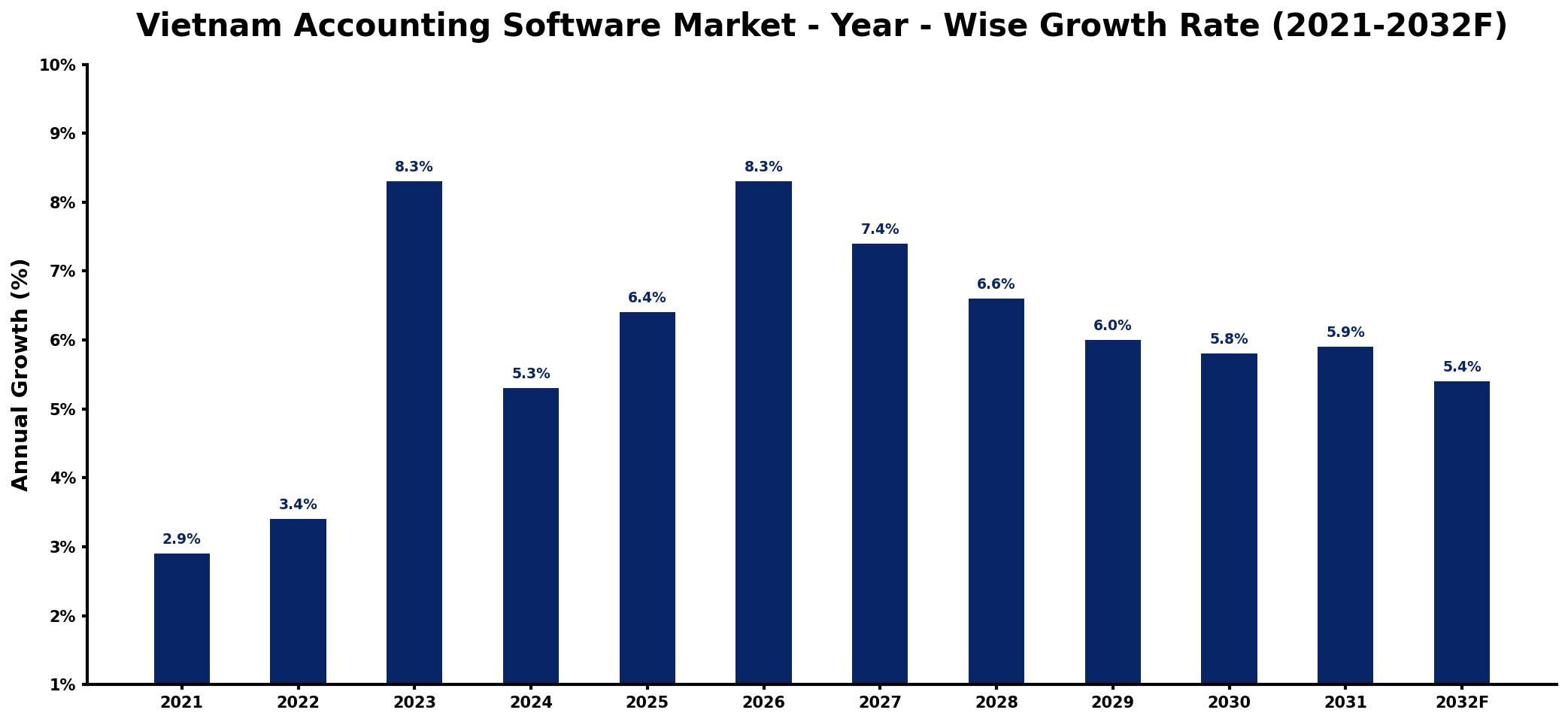
The table below presents the year‑wise growth rates along with the key drivers influencing the market
| Year | Growth Rate | Major Drivers |
| 2021 | 2.9% | Increased digital transformation initiatives |
| 2022 | 3.4% | Rising demand for automation solutions |
| 2023 | 8.3% | Expansion of SMEs in region |
| 2024 | 5.3% | Growing focus on compliance standards |
| 2025 | 6.4% | Investment in cloud technology adoption |
| 2026 | 8.3% | Enhanced financial literacy programs |
| 2027 | 7.4% | Emergence of remote work trends |
| 2028 | 6.6% | Strengthening of regulatory frameworks |
| 2029 | 6.0% | Growing need for data analytics |
| 2030 | 5.8% | Increased focus on sustainability practices |
| 2031 | 5.9% | Adoption of integrated business solutions |
| 2032 | 5.4% | Diversification of industry verticals |
Note: Market size estimations and growth projections presented in this report are based on 6Wresearch's proprietary forecasting methodology, utilizing the latest available industry data, government publications, and primary research inputs.
Vietnam Accounting Software Market Synopsis
A notable trend in the Vietnam accounting software market is the surge in cloud-based solutions. With remote work becoming commonplace, businesses are gravitating towards flexible, cloud-accessible software that allows for real-time financial management. This transition is particularly appealing to SMEs, who often require budget-friendly yet robust solutions to meet their financial reporting obligations.
The competitive landscape is shaped by an influx of both local innovators and international players, each bringing diverse functionalities tailored to various business sizes. This diversity enables a broad spectrum of options for enterprises, ranging from basic bookkeeping features to advanced analytics and compliance tools.
Vietnam Accounting Software Market Key Takeaways
- The market is witnessing a significant transformation driven by digitalization and automation.
- There is a growing emphasis on cloud-based solutions for remote financial management.
- SMEs are becoming key adopters, acknowledging the importance of efficient financial systems.
- Competitive pricing and tailored functionalities are critical for market players.
- Data privacy and regulatory compliance remain top priorities for businesses leveraging accounting software.
Evaluation of Restraints in Vietnam Accounting Software Market
Despite its growth potential, the Vietnam accounting software market faces notable restraints. One significant challenge is the rapid pace of technological evolution, which requires ongoing innovation to meet changing business needs. As companies demand more sophisticated features like automation and enhanced security, software providers must consistently invest in development. Additionally, the pressure to comply with both local and international regulations demands that firms remain vigilant and adaptable. Finally, a segment of the market still adheres to traditional accounting methods, which can slow down the adoption of modern software solutions. As such, effective education and engagement strategies are essential for bridging this gap.
Vietnam Accounting Software Market Trends
Several trends are currently shaping the Vietnam accounting software market. The shift toward cloud computing stands out as businesses seek more flexible, scalable solutions. Furthermore, there is a significant push for automation in accounting processes, aimed at reducing manual errors and enhancing efficiency. Additionally, the rise of mobile applications is enabling on-the-go financial management, further driving user engagement. As cybersecurity concerns mount, software providers are also prioritizing enhanced security features to protect sensitive financial data.
Vietnam Accounting Software Market Opportunities
The Vietnam accounting software market holds substantial growth opportunities, particularly in developing tailored solutions for SMEs. The increasing emphasis on compliance and financial transparency presents avenues for software innovations that address these demands. Moreover, as more businesses transition to digital operations, there is potential for expanding services that integrate accounting software with other business management tools. Educational initiatives aimed at improving understanding and adoption of accounting technology will also play a critical role in capturing this burgeoning market.
Government Initiatives in the Vietnam Accounting Software Market
Government efforts to enhance the business environment in Vietnam have indirectly benefited the accounting software sector. Policies encouraging digital transformation and regulatory compliance have set the stage for widespread adoption of accounting solutions. Initiatives aimed at supporting SMEs through grants and training programs further facilitate the growth of the market. Additionally, the government's commitment to enhancing data security and privacy laws helps build trust in software solutions, fostering greater adoption among businesses.
Future Insights of the Vietnam Accounting Software Market
Looking ahead to 2026-2032, the Vietnam accounting software market is poised for dynamic expansion. As businesses increasingly recognize the value of integrated financial solutions, the demand for comprehensive and user-friendly software will continue to rise. Innovations in artificial intelligence and machine learning are expected to play a crucial role in developing smarter accounting systems, further enhancing efficiency and accuracy. The ongoing shift towards remote work will also sustain the demand for cloud-based solutions, positioning this market for sustained growth and development in the years to come.
Vietnam Accounting Software Market Latest Developments (2025 - 2026)
Recent trends in the Vietnam accounting software market indicate a clear move towards enhanced automation features and improved user interfaces. Many software providers are focusing on expanding their cloud offerings to support remote work, emphasizing accessibility and ease of use. Additionally, there have been notable collaborations between tech firms and educational institutions aimed at fostering a greater understanding of accounting software among business professionals. As the market evolves, flexibility in pricing and features will remain central to attracting a diverse customer base.
Vietnam Accounting Software Market - Key Attractiveness of the Report
- 10 Years of Market Numbers
- Historical Data Starting from 2022 to 2025
- Base Year: 2025
- Forecast Data until 2032
- Key Performance Indicators Impacting the Market
- Major Upcoming Developments and Projects
Key Highlights of the Report:
- Vietnam Accounting Software Market Outlook
- Market Size of Vietnam Accounting Software Market, 2025
- Forecast of Vietnam Accounting Software Market, 2032
- Historical Data and Forecast of Vietnam Accounting Software Revenues & Volume for the Period 2022-2032F
- Vietnam Accounting Software Market Trend Evolution
- Vietnam Accounting Software Market Drivers and Challenges
- Vietnam Accounting Software Price Trends
- Vietnam Accounting Software Porter's Five Forces
- Vietnam Accounting Software Industry Life Cycle
- Historical Data and Forecast of Vietnam Accounting Software Market Revenues & Volume By Component for the Period 2022-2032F
- Historical Data and Forecast of Vietnam Accounting Software Market Revenues & Volume By Software for the Period 2022-2032F
- Historical Data and Forecast of Vietnam Accounting Software Market Revenues & Volume By Services for the Period 2022-2032F
- Historical Data and Forecast of Vietnam Accounting Software Market Revenues & Volume By Enterprise Size for the Period 2022-2032F
- Historical Data and Forecast of Vietnam Accounting Software Market Revenues & Volume By Large for the Period 2022-2032F
- Historical Data and Forecast of Vietnam Accounting Software Market Revenues & Volume By Small & Medium for the Period 2022-2032F
- Historical Data and Forecast of Vietnam Accounting Software Market Revenues & Volume By Type for the Period 2022-2032F
- Historical Data and Forecast of Vietnam Accounting Software Market Revenues & Volume By Spreadsheets for the Period 2022-2032F
- Historical Data and Forecast of Vietnam Accounting Software Market Revenues & Volume By ERP for the Period 2022-2032F
- Historical Data and Forecast of Vietnam Accounting Software Market Revenues & Volume By Custom Accounting Software for the Period 2022-2032F
- Historical Data and Forecast of Vietnam Accounting Software Market Revenues & Volume By Tax Management Software for the Period 2022-2032F
- Historical Data and Forecast of Vietnam Accounting Software Market Revenues & Volume By End-use Industry for the Period 2022-2032F
- Historical Data and Forecast of Vietnam Accounting Software Market Revenues & Volume By BFSI for the Period 2022-2032F
- Historical Data and Forecast of Vietnam Accounting Software Market Revenues & Volume By IT & Telecommunication for the Period 2022-2032F
- Historical Data and Forecast of Vietnam Accounting Software Market Revenues & Volume By Government & Public Sector for the Period 2022-2032F
- Historical Data and Forecast of Vietnam Accounting Software Market Revenues & Volume By Automotive for the Period 2022-2032F
- Historical Data and Forecast of Vietnam Accounting Software Market Revenues & Volume By Retail & Consumer Goods for the Period 2022-2032F
- Historical Data and Forecast of Vietnam Accounting Software Market Revenues & Volume By Oil & Gas for the Period 2022-2032F
- Historical Data and Forecast of Vietnam Accounting Software Market Revenues & Volume By Manufacturing for the Period 2022-2032F
- Historical Data and Forecast of Vietnam Accounting Software Market Revenues & Volume By Others for the Period 2022-2032F
- Vietnam Accounting Software Import Export Trade Statistics
- Market Opportunity Assessment By Component
- Market Opportunity Assessment By Enterprise Size
- Market Opportunity Assessment By Type
- Market Opportunity Assessment By End-use Industry
- Vietnam Accounting Software Top Companies Market Share
- Vietnam Accounting Software Competitive Benchmarking By Technical and Operational Parameters
- Vietnam Accounting Software Company Profiles
- Vietnam Accounting Software Key Strategic Recommendations






































