Vietnam Agricultural Sprayers Market Size & Growth Rate
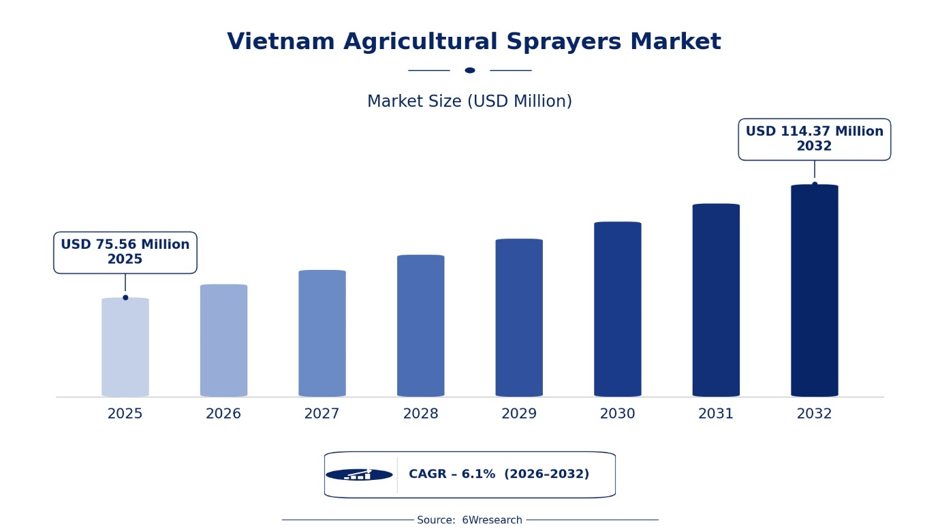
According to 6Wresearch internal database and industry insights, the Vietnam Agricultural Sprayers Market was valued at USD 75.56 Million in 2025 and is projected to reach USD 114.37 Million by 2032, growing at a CAGR of approximately 6.1% during 2026–2032.
Vietnam Agricultural Sprayers Market Highlights
| Report Metric | Details |
| Report Name | Vietnam Agricultural Sprayers Market (2026-2032) |
| Market Size 2025 | USD 75.56 Million |
| Market Size 2032 | USD 114.37 Million |
| Absolute Growth 2025–2032 | USD 38.81 Million |
| CAGR 2026–2032 | 6.1% |
| Peak Annual Growth | 7.5% in 2028 |
| Forecast Period | 2026–2032 |
| Historical Data | 2022–2025 |
| Base Year | 2025 |
| Leading Type, 2025 | Handheld (58% share) |
| Leading Capacity, 2025 | Crop Type (31% share) |
| Leading Power Source, 2025 | Fuel-based (49% share) |
| Fastest-Growing Type | Aerial (14.5% CAGR) |
| Fastest-Growing Capacity | Farm Size (6.9% CAGR) |
| Fastest-Growing Power Source | Solar (16% CAGR) |
| Growing Sector | Drone-based contract spraying services |
| Key End Users | Smallholder farmers, agricultural cooperatives, commercial plantation operators, contract spraying service providers, agro-enterprises and equipment rental operators |
Vietnam Agricultural Sprayers Market Year-wise Growth Rate and Key Drivers (2022–2032)
This graph illustrates the annual growth rates of the market from 2022 to 2032, highlighting a steady upward trajectory and projected market expansion over the forecast period.
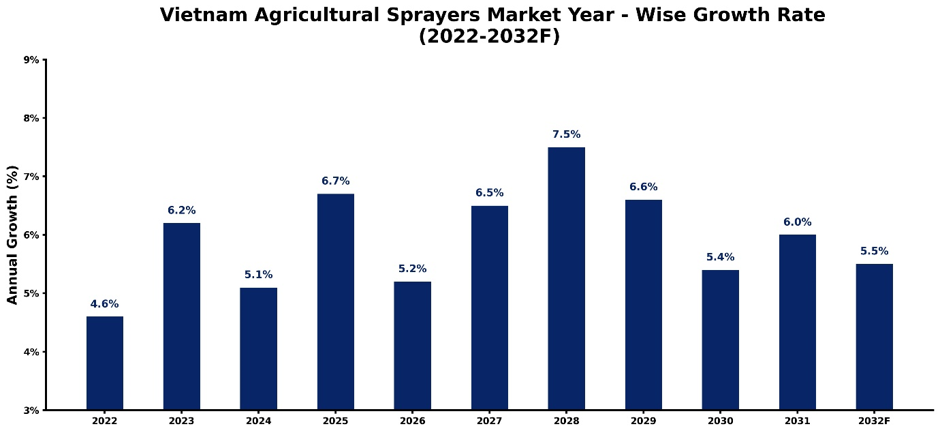
The following table presents the estimated annual growth rate for each year together with the principal factor influencing market performance. The values are intended to highlight year-specific drivers rather than to provide a direct comparison between individual years.
| Year | Estimated Annual Growth (%) | Market Rationale |
| 2022 | 4.6% | Post-pandemic reopening restored farm activity, yet higher fuel prices and imported component costs after the Ukraine war restrained equipment purchases. |
| 2023 | 6.2% | Record rice exports of about 8.1 million tonnes raised farm cash flow and encouraged equipment upgrades in the Mekong Delta. |
| 2024 | 5.1% | Typhoon Yagi and saltwater intrusion damaged crops and farm incomes, which delayed sprayer replacement in affected provinces. |
| 2025 | 6.7% | Record durian and coffee export earnings and wider drone service use for rice spraying lifted equipment demand. |
| 2026 | 5.2% | Normalising farm margins after a record export year are expected to slow upgrade cycles for conventional power sprayers. |
| 2027 | 6.5% | Launch of Mekong Delta low-emission rice programme activities is expected to increase demand for efficient, accurate application equipment. |
| 2028 | 7.5% | Falling battery prices and wider dealer credit are expected to accelerate adoption of cordless sprayers and service-based drones. |
| 2029 | 6.6% | Early adoption waves are expected to fade as the first fleets of battery and drone sprayers become widely owned. |
| 2030 | 5.4% | Land consolidation and slower expansion of rice and orchard area are expected to cap additions to the installed sprayer base. |
| 2031 | 6% | Renewal of orchard planting and ageing power sprayers is expected to revive replacement demand in higher-value crop areas. |
| 2032 | 5.5% | Equipment ownership is expected to approach saturation in core rice regions, moderating growth into the end of the forecast period. |
Note: Market size estimations and growth projections presented in this report are based on 6Wresearch’s proprietary forecasting methodology, utilizing the latest available industry data, government publications, and primary research inputs.
Vietnam Agricultural Sprayers Market Synopsis
The Vietnam Agricultural Sprayers Market is projected to transform in the coming years as demand is shaped by rural labour scarcity, intensive rice cultivation in the Mekong Delta, export orchards in the Central Highlands and Southeast region, and rising acceptance of battery-powered and drone-based application. The industry covers self-propelled, tractor-mounted, trailed, handheld and aerial equipment used to apply pesticides, herbicides and foliar nutrients across Vietnamese farms. Government support for mechanisation and climate-smart rice production is further widening the buyer base.
Market Dynamics Impact Analysis (2026–2032)
| Factor | Type | Impact | Primary Segment Affected |
| Agricultural labour shortage encouraging mechanised spraying | Driver | High | Aerial |
| Export orchard expansion requiring precise canopy coverage | Driver | High | Tractor-mounted |
| Local assembly of cordless knapsack sprayers | Opportunity | Medium | Electric & Battery-driven |
| Off-grid solar charging for remote farms | Opportunity | Medium | Solar |
| Fragmented small landholdings | Restraint | High | Trailed |
| Import dependence on engines, batteries and components | Restraint | Medium | Fuel-based |
| Limited trained operators and after-sales coverage | Challenge | High | Self-propelled |
| Competition from unbranded low-cost imports | Challenge | Medium | Manual |
Evaluation of Drivers in the Vietnam Agricultural Sprayers Market (2026–2032)
Below mentioned are some major drivers and their influence on the market dynamics:
| Drivers | Primary Segment Affected | Why It Matters (Evidence) |
| Shrinking agricultural labour pool | Aerial | Spraying is labour-intensive and hazardous, so growers pay contractors to treat fields faster with fewer workers. Agriculture now employs below 30 per cent of the national workforce. |
| Intensive rice cultivation in the Mekong Delta | Fuel-based | Double and triple cropping multiplies spray rounds each year, which raises usage hours and replacement frequency of engine-driven units. The delta produces over half of national rice output on roughly 7 million hectares nationwide. |
| Falling lithium battery costs and rural electricity access | Electric & Battery-driven | Cheaper battery packs make cordless sprayers competitive on running cost, and near-universal household electricity makes charging practical. More than 99 per cent of households have grid access. |
| Importer residue compliance | Nozzle Type | Importers apply maximum residue limits, so growers invest in calibrated, low-drift nozzles to control dose and drift. The EU-Vietnam Free Trade Agreement has been in force since August 2020. |
Rising farm incomes from record agri-food export earnings, which topped USD 62 billion in 2024, are increasing the capacity of growers and cooperatives to invest in spraying equipment. Expanding dealer and after-sales networks across the Mekong Delta and Central Highlands bring machines closer to farmers and shorten repair times. Instalment sales and rural lending by dealers and banks make purchases easier to finance. Furthermore, growing private investment in equipment assembly and distribution widens product choice, and smartphone-based advisory on pest outbreaks raises the frequency of timely spraying.
Evaluation of Restraints in the Vietnam Agricultural Sprayers Market
Below mentioned are some major restraints and their influence on the market dynamics:
| Market Restraint | Primary Segment Affected | Why It Matters (Evidence) |
| Fragmented small landholdings | Self-propelled | Farms below one hectare on average cannot justify high-capacity machines, so buyers favour low-cost portable units. Parcels are often split into several plots, which complicates machine movement. |
| Import dependence on engines, batteries and components | Fuel-based | Most engines, lithium cells and electronics come from China, Japan and Thailand, so currency swings and shipping delays raise dealer prices and extend delivery times. |
| Cost-led reliance on manual knapsack units | Manual | Basic manual sprayers retail for a few hundred thousand dong, and household labour is treated as free, so many smallholders postpone moving to powered equipment. |
| Weather and disaster income shocks | Trailed | Typhoon Yagi in September 2024 and saltwater intrusion earlier that year reduced farm income, which postponed purchases of higher-value equipment in affected provinces. |
Vietnam Agricultural Sprayers Market Challenges
The Vietnam Agricultural Sprayers Industry faces several structural challenges. A thin base of trained operators and technicians across the country’s 34 provinces and cities means service coverage is uneven, so breakdowns during peak spraying weeks leave farmers idle. Lithium battery packs degrade quickly in hot, humid conditions and often need replacement within about three years, which raises lifetime costs for electric units. Low-priced unbranded imports undercut established brands with limited warranty support, eroding dealer margins. Cooperative buyers and dealers also operate on credit cycles of about six months, tying up working capital and slowing replenishment of inventory ahead of crop seasons.
Trends in the Vietnam Agricultural Sprayers Market
Below mentioned are some of the trends shaping the Vietnam agricultural sprayers market growth:
- Shift from Knapsack Spraying to Drone Service Models: Rice growers in the Mekong Delta are increasingly hiring drone operators who charge per hectare rather than buying equipment themselves. This removes upfront cost and cuts spraying time on large paddies. Suppliers of agricultural drones, batteries and spray tanks benefit most, while operators and dealers offering training and quick repairs gain customer loyalty.
- Transition from Petrol Engines to Lithium Battery Sprayers: Farmers near towns and across southern provinces are moving to cordless knapsack sprayers that are quieter, easier to start and cheaper to run than two-stroke engines. Lower-cost lithium packs imported from China have accelerated this change. Suppliers that bundle batteries, chargers and warranty cover are best placed to convert petrol users.
- Shift from Paper Spray Diaries to App-Based Application Records: Exporters and cooperatives certified under VietGAP and GlobalGAP must document each spraying event, and growers are moving to phone-based logs. Some drone platforms record flight and volume data automatically. Suppliers whose machines offer flow metering and data export reinforce buyer compliance and gain preference.
Investment Opportunities in the Vietnam Agricultural Sprayers Market
Some of the investment opportunities in the Vietnam Agricultural Sprayers Market are mentioned below:
- Dronespraying fleets and service centres: per-hectare contract spraying is growing in rice provinces while most growers cannot afford drones outright. investors can finance spraying drone fleets, battery rotation systems and repair workshops in an giang, dong thap and can tho. entry works best through distribution agreements with drone manufacturers and partnerships with cooperatives that guarantee field volumes.
- orchard air-blast and tractor-mounted sprayers: expanding durian and coffee plantations in dak lak, lam dong and dong nai need canopy-matched equipment that is rarely stocked locally. suppliers can import or assemble air-blast units and offer calibration, spare parts and financing. partnering with regional tractor dealers and plantation cooperatives provides ready distribution and service points.
- precision nozzles and retrofit kits: export residue rules are encouraging growers to fit low-drift, air-induction nozzles and flow controllers to existing sprayers. investors can supply retrofit kits, calibration tools and training through agricultural input retailers across the mekong delta and central highlands. local blending with a nozzle manufacturer and field demonstrations with cooperatives build early credibility.
Leading Players in Vietnam Agricultural Sprayers Market
Below is a comprehensive list of companies contributing to the growth of Vietnam Agricultural Sprayers Market:
1. DJI
|
Company Name |
DJI |
|
Established Year |
2006 |
|
Headquarters |
Shenzhen, China |
|
Official Website |
DJI is a global drone manufacturer that supplies agricultural spraying drones through authorised distributors. It is a prominent technology provider for contract spraying services in Vietnam.
2. XAG
|
Company Name |
XAG |
|
Established Year |
2007 |
|
Headquarters |
Guangzhou, China |
|
Official Website |
XAG develops agricultural drones, unmanned vehicles and precision farming systems. It serves Vietnamese growers and service operators through local distribution partners.
3. Kubota Corporation
|
Company Name |
Kubota Corporation |
|
Established Year |
1890 |
|
Headquarters |
Osaka, Japan |
|
Official Website |
Kubota Corporation is a Japanese agricultural machinery manufacturer known for tractors, rice machinery and implements. It maintains an established dealer network in Vietnam and supports tractor-mounted implement demand.
4. Honda Motor
|
Company Name |
Honda Motor |
|
Established Year |
1948 |
|
Headquarters |
Tokyo, Japan |
|
Official Website |
Honda Motor is a Japanese engine and equipment manufacturer whose general-purpose engines power many fuel-based sprayers sold in Vietnam. Its engines are widely used by domestic assemblers and equipment importers.
Government Initiatives in the Vietnam Agricultural Sprayers Market
Vietnam’s Agriculture and Rural Development Strategy for 2021–2030, issued under Decision 150/QĐ-TTg in 2022, targets agricultural growth of 2.5–3% a year through modernised, mechanised production. Decision 749/QĐ-TTg of 2020 sets a national digital transformation programme aiming at a digital economy equal to 30% of GDP by 2030, including precision farming, while the Law on Crop Production (2018) and the Law on Plant Protection and Quarantine (2013) regulate pesticide application.
The Ministry of Agriculture and Environment, formed in 2025, coordinates mechanisation and plant protection programmes, including the Mekong Delta programme approved in 2023 to develop one million hectares of high-quality, low-emission rice by 2030. Resolution 120/NQ-CP of 2017 on sustainable Mekong Delta development supports climate-resilient farming, while the Law on Cooperatives (2023) encourages cooperative investment in shared machinery.
Future Insights of the Vietnam Agricultural Sprayers Market
In terms of future, continued rural mechanisation will broaden demand for efficient crop protection equipment as holdings modernise. Improving rural road and port logistics will connect distributors with more remote growing areas, expanding after-sales reach and shortening delivery times. Wider satellite and sensor-based crop monitoring will encourage precise, timing-based application. Vietnam’s pledge to reach net-zero emissions by 2050 and its aim of high-income status by 2045 will steer investment towards lower-emission, higher-value farm operations. Rising adoption of integrated pest management practices will favour equipment that applies inputs in smaller, better-timed doses.
Market Segmentation Analysis
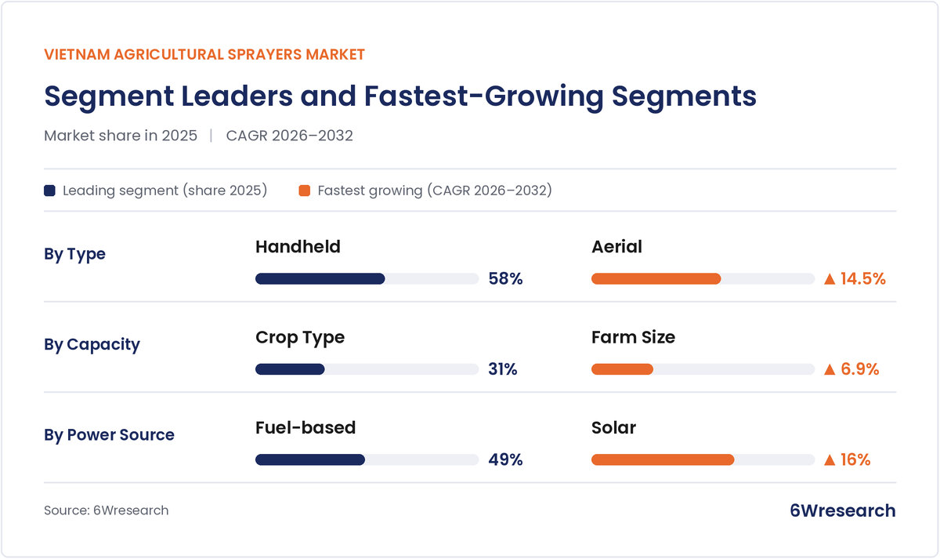
The report offers a comprehensive study of the market across its key segments. The chart below highlights the leading segment by market share in 2025 and the fastest-growing segment by CAGR over 2026–2032, followed by a detailed analysis of each segment.
By Type – Handheld Leads, Aerial Expected to Grow Fastest
According to Sumit Sagar, Senior Research Analyst at 6Wresearch, Handheld sprayers lead with a 58% share in 2025, as holdings averaging below one-hectare, low purchase cost and suitability for terraced and orchard plots keep knapsack units the default tool for most Vietnamese farmers. On the other hand, aerial sprayers are projected to expand at a 14.5% CAGR over 2026–2032, as service providers offer per-hectare drone spraying across the Mekong Delta’s large rice fields.
By Capacity – Crop Type Leads, Farm Size Expected to Grow Fastest
Crop Type configurations accounted for 31% of the market share in 2025, as rice paddies, durian and coffee plantations and vegetable plots each require different tank sizes, boom or air-blast designs and spray pressures. Apart from this, farm Size categories are forecast to grow fastest at a 6.9% CAGR through 2026–2032, as cooperative land pooling and larger commercial holdings in the Mekong Delta and Central Highlands move buyers towards higher-capacity machines.
By Power Source – Fuel-based Leads, Solar Expected to Grow Fastest
Fuel-based sprayers held 49% of the Vietnam agricultural sprayers market share in 2025, owing to the wide availability of petrol knapsack and engine-driven units and the reach of rural fuel retail where field-side grid power is limited. However, solar-powered units are expected to record the fastest growth at a 16.0% CAGR from a small base, supported by strong solar irradiation in southern and Central Highlands provinces and demand for off-grid charging.
Key Attractiveness of the Report
- 10 Years of Market Numbers
- Historical Data Starting from 2022 to 2025
- Base Year 2025
- Forecast Data until 2032
- Key Performance Indicators Impacting the Market
- Major Upcoming Developments and Projects
Key Highlights of the Report:
- Vietnam Agricultural Sprayers Market Outlook
- Market Size of Vietnam Agricultural Sprayers Market, 2025
- Forecast of Vietnam Agricultural Sprayers Market, 2032
- Historical Data and Forecast of Vietnam Agricultural Sprayers Revenues & Volume for the Period 2022-2032
- Vietnam Agricultural Sprayers Market Trend Evolution
- Vietnam Agricultural Sprayers Market Drivers and Challenges
- Vietnam Agricultural Sprayers Price Trends
- Vietnam Agricultural Sprayers Porter's Five Forces
- Vietnam Agricultural Sprayers Industry Life Cycle
- Historical Data and Forecast of Vietnam Agricultural Sprayers Market Revenues & Volume By Type for the Period 2022-2032
- Historical Data and Forecast of Vietnam Agricultural Sprayers Market Revenues & Volume By Self-propelled for the Period 2022-2032
- Historical Data and Forecast of Vietnam Agricultural Sprayers Market Revenues & Volume By Tractor-mounted for the Period 2022-2032
- Historical Data and Forecast of Vietnam Agricultural Sprayers Market Revenues & Volume By Trailed for the Period 2022-2032
- Historical Data and Forecast of Vietnam Agricultural Sprayers Market Revenues & Volume By Handheld for the Period 2022-2032
- Historical Data and Forecast of Vietnam Agricultural Sprayers Market Revenues & Volume By Aerial for the Period 2022-2032
- Historical Data and Forecast of Vietnam Agricultural Sprayers Market Revenues & Volume By Capacity for the Period 2022-2032
- Historical Data and Forecast of Vietnam Agricultural Sprayers Market Revenues & Volume By Farm Size for the Period 2022-2032
- Historical Data and Forecast of Vietnam Agricultural Sprayers Market Revenues & Volume By Crop Type for the Period 2022-2032
- Historical Data and Forecast of Vietnam Agricultural Sprayers Market Revenues & Volume By Nozzle Type for the Period 2022-2032
- Historical Data and Forecast of Vietnam Agricultural Sprayers Market Revenues & Volume By Usage for the Period 2022-2032
- Historical Data and Forecast of Vietnam Agricultural Sprayers Market Revenues & Volume By Power Source for the Period 2022-2032
- Historical Data and Forecast of Vietnam Agricultural Sprayers Market Revenues & Volume By Fuel-based for the Period 2022-2032
- Historical Data and Forecast of Vietnam Agricultural Sprayers Market Revenues & Volume By Electric & Battery-driven for the Period 2022-2032
- Historical Data and Forecast of Vietnam Agricultural Sprayers Market Revenues & Volume By Manual for the Period 2022-2032
- Historical Data and Forecast of Vietnam Agricultural Sprayers Market Revenues & Volume By Solar for the Period 2022-2032
- Vietnam Agricultural Sprayers Import Export Trade Statistics
- Market Opportunity Assessment By Type
- Market Opportunity Assessment By Capacity
- Market Opportunity Assessment By Power Source
- Vietnam Agricultural Sprayers Top Companies Market Share
- Vietnam Agricultural Sprayers Competitive Benchmarking By Technical and Operational Parameters
- Vietnam Agricultural Sprayers Company Profiles
- Vietnam Agricultural Sprayers Key Strategic Recommendations
Market Covered
The report offers an extensive study of the following market segments:
By Type
- Self-propelled
- Tractor-mounted
- Trailed
- Handheld
- Aerial
By Capacity
- Farm Size
- Crop Type
- Nozzle Type
- Usage
By Power Source
- Fuel-based
- Electric & Battery-driven
- Manual
- Solar






































