Vietnam Alcoholic Spirits Market Summary
The vietnam alcoholic spirits market was estimated at USD 250 Million in 2025 and is projected to reach USD 354 Million by 2032, growing at a CAGR of 7.9% from 2026 to 2032.
Vietnam Alcoholic Spirits Market Year-wise Growth Rate and Key Drivers
This graph highlights how the Vietnam Alcoholic Spirits Market has steadily grown over the past five years, supported by major growth factors.
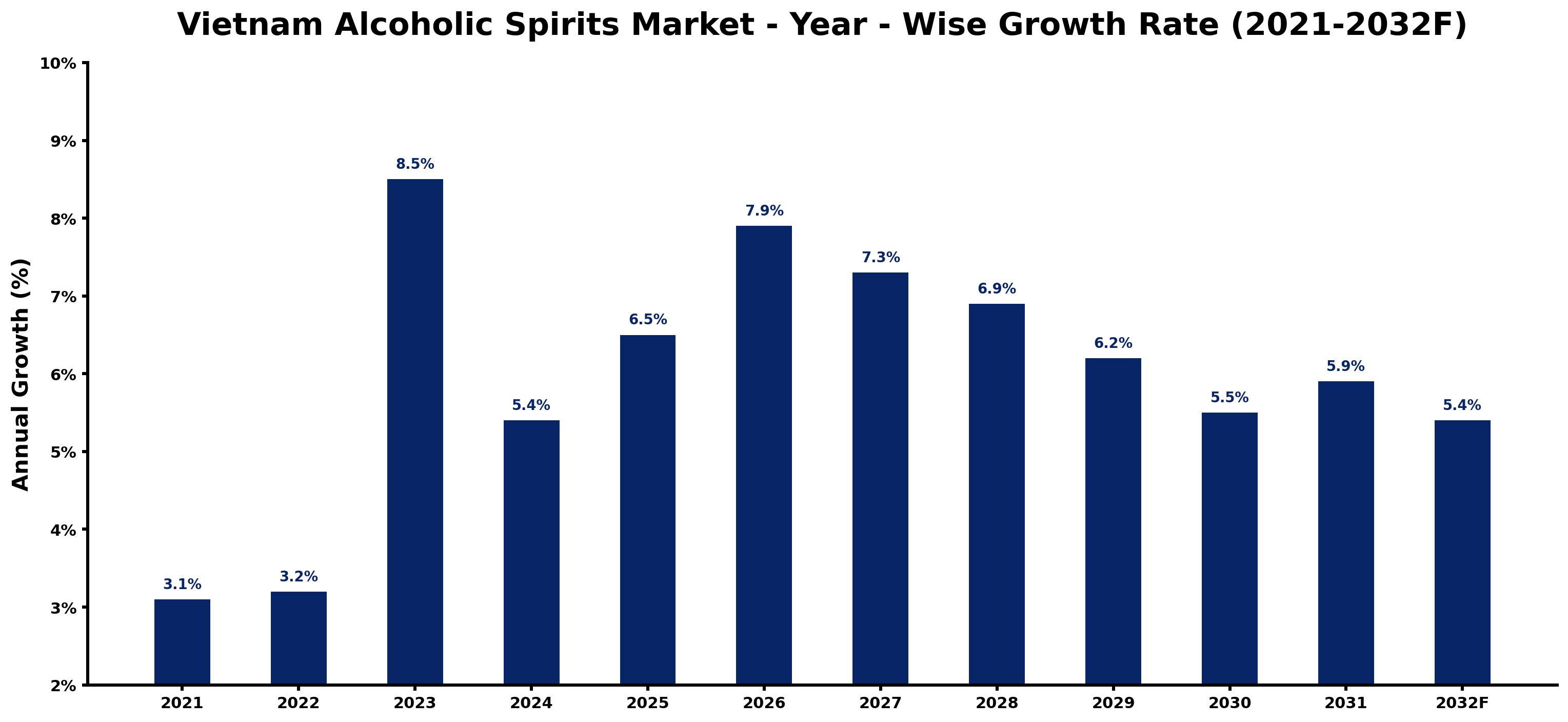
The table below presents the year wise growth rates along with the key drivers influencing the market
| Year | Growth Rate | Major Drivers |
| 2021 | 3.1% | The pandemic reshaped drinking habits, with home-based consumption gaining popularity. |
| 2022 | 3.2% | Urbanization accelerates, increasing access to diverse alcoholic beverage options. |
| 2023 | 8.5% | Younger consumers embrace premium offerings, shifting brand loyalty toward artisanal spirits. |
| 2024 | 5.4% | E-commerce platforms expand, making products accessible to rural and urban consumers. |
| 2025 | 6.5% | Tourism rebounds, revitalizing demand for local premium and international spirits. |
| 2026 | 7.9% | Health-conscious trends lead to a rise in low-alcohol and non-alcoholic spirits. |
| 2027 | 7.3% | Social media influencers propel craft distilleries into mainstream consumer awareness. |
| 2028 | 6.9% | Investment in local distilleries fosters a culture of innovation and flavor exploration. |
| 2029 | 6.2% | Vietnamese spirits gain traction globally, opening new markets for export opportunities. |
| 2030 | 5.5% | Sustainability becomes central, with brands focusing on eco-friendly production practices. |
| 2031 | 5.9% | Cultural festivals showcase local spirits, enhancing their visibility and market penetration. |
| 2032 | 5.4% | Changing lifestyles foster a thriving cocktail culture, driving innovation in mixology. |
Note - Market size estimations and growth projections presented in this report are based on 6Wresearch's advanced forecasting approach, validated with industry datasets as of June 2026.
Vietnam Alcoholic Spirits Market Synopsis
The Vietnam Alcoholic Spirits Market is projected to reach 7.9% and witness significant growth during the forecast period (2026-2032). This expansion is driven by a series of factors, including an increase in disposable income, evolving consumer behavior, and urbanization. The alcoholic beverage sector in Vietnam has seen remarkable development, with alcoholic spirits emerging as a substantial component of the overall market landscape.
Vietnam Alcoholic Spirits Market Growth Drivers
The growth of the Vietnam alcoholic spirits market is underpinned by several key drivers:
- Increased disposable income has empowered consumers to spend more on premium options, leading to heightened demand for high-quality spirits such as whiskey, vodka, and rum.
- The young and affluent demographic in Vietnam seeks unique experiences; this demographic shift influences consumption patterns towards craft spirits and premium liquor.
- Urbanization plays a pivotal role, as urban consumers tend to favor sophisticated and diverse drinking experiences, fueling the market for alcoholic spirits.
- Western cultural influences contribute to the growing cocktail culture, enhancing the popularity of various alcoholic spirits among younger consumers.
- The burgeoning middle-class segment is increasingly willing to explore international brands and premium offerings, further driving market growth.
Vietnam Alcoholic Spirits Market Challenges and Restraints
Despite the promising growth prospects, the Vietnam alcoholic spirits market faces numerous challenges that could hinder its expansion:
- Government regulations on advertising and promotion pose significant constraints on marketing efforts, limiting the ability of brands to effectively reach potential consumers.
- The prevalence of counterfeit and illegal alcoholic products undermines consumer confidence, posing a threat to legitimate players in terms of safety and revenue.
- Economic fluctuations and uncertainty may drive consumers towards more affordable options, negatively impacting the sales of premium and high-end spirits.
- Cultural attitudes towards alcohol consumption can also vary geographically, influencing the acceptance and popularity of certain types of spirits.
- Increased competition from non-alcoholic beverage alternatives might divert consumer attention, particularly among health-conscious younger demographics.
Vietnam Alcoholic Spirits Market COVID-19 Impact
The COVID-19 pandemic, particularly in 2025, had a profound impact on the Vietnam alcoholic spirits market. Lockdowns and restrictions on social gatherings led to a marked decline in on-premise consumption in bars and restaurants. However, this decline was somewhat mitigated by a surge in off-premise sales, as consumers converted to home consumption. The economic slowdown due to the pandemic resulted in a shift in buying behavior, with many consumers opting for more budget-friendly spirits, thereby impacting the premium product segment. Furthermore, the tourism and hospitality sectors, critical to the spirits market, faced significant challenges, further straining demand for high-end alcoholic beverages.
Vietnam Alcoholic Spirits Market Government Investment and Initiatives
The Vietnamese government has initiated several measures to support the growth of the alcoholic spirits market. These initiatives include policy frameworks aimed at fostering a regulated and competitive market environment. By encouraging responsible alcohol consumption and promoting safety standards, the government seeks to enhance consumer confidence. Additionally, public spending on infrastructure related to the alcohol industry has increased, facilitating better distribution channels for alcoholic products. The government has also been working on the legalization and regulation of certain alcoholic beverages to combat illegal trade, thereby protecting legitimate businesses and ensuring quality control.
Vietnam Alcoholic Spirits Market Latest Developments (May 2025 - June 2026)
During the period from May 2025 to June 2026, the Vietnam alcoholic spirits market saw several key developments reflecting emerging trends. There was a marked increase in the launch of craft distilleries focused on producing locally inspired spirits that cater to the growing demand for unique flavors and experiences. This shift has been supported by an increase in consumer interest in authenticity and artisanal production methods. Additionally, the market began to see a greater emphasis on sustainable practices, with several brands innovating in environmentally friendly packaging and production processes. The ongoing evolution of the cocktail culture in urban areas has driven bars and restaurants to experiment with creative drink offerings, further embedding alcoholic spirits into social experiences.
Vietnam Alcoholic Spirits Market - Key Attractiveness of the Report
- 10 Years of Market Numbers
- Historical Data Starting from 2022 to 2025
- Base Year: 2025
- Forecast Data until 2032
- Key Performance Indicators Impacting the Market
- Major Upcoming Developments and Projects
Key Highlights of the Report:
- Vietnam Alcoholic Spirits Market Outlook
- Market Size of Vietnam Alcoholic Spirits Market, 2025
- Forecast of Vietnam Alcoholic Spirits Market, 2032
- Historical Data and Forecast of Vietnam Alcoholic Spirits Revenues & Volume for the Period 2022-2032F
- Vietnam Alcoholic Spirits Market Trend Evolution
- Vietnam Alcoholic Spirits Market Drivers and Challenges
- Vietnam Alcoholic Spirits Price Trends
- Vietnam Alcoholic Spirits Porter's Five Forces
- Vietnam Alcoholic Spirits Industry Life Cycle
- Historical Data and Forecast of Vietnam Alcoholic Spirits Market Revenues & Volume By ?Product Type for the Period 2022-2032F
- Historical Data and Forecast of Vietnam Alcoholic Spirits Market Revenues & Volume By Brandy & Cognac for the Period 2022-2032F
- Historical Data and Forecast of Vietnam Alcoholic Spirits Market Revenues & Volume By Rum for the Period 2022-2032F
- Historical Data and Forecast of Vietnam Alcoholic Spirits Market Revenues & Volume By Tequila for the Period 2022-2032F
- Historical Data and Forecast of Vietnam Alcoholic Spirits Market Revenues & Volume By White Spirits for the Period 2022-2032F
- Historical Data and Forecast of Vietnam Alcoholic Spirits Market Revenues & Volume By Whiskey for the Period 2022-2032F
- Historical Data and Forecast of Vietnam Alcoholic Spirits Market Revenues & Volume By Liqueurs for the Period 2022-2032F
- Historical Data and Forecast of Vietnam Alcoholic Spirits Market Revenues & Volume By Others for the Period 2022-2032F
- Historical Data and Forecast of Vietnam Alcoholic Spirits Market Revenues & Volume By Distribution Channels for the Period 2022-2032F
- Historical Data and Forecast of Vietnam Alcoholic Spirits Market Revenues & Volume By Supermarkets & Hypermarkets for the Period 2022-2032F
- Historical Data and Forecast of Vietnam Alcoholic Spirits Market Revenues & Volume By Liquor Specialist Stores for the Period 2022-2032F
- Historical Data and Forecast of Vietnam Alcoholic Spirits Market Revenues & Volume By Grocery Retailers for the Period 2022-2032F
- Historical Data and Forecast of Vietnam Alcoholic Spirits Market Revenues & Volume By Online Retailing for the Period 2022-2032F
- Historical Data and Forecast of Vietnam Alcoholic Spirits Market Revenues & Volume By Other for the Period 2022-2032F
- Vietnam Alcoholic Spirits Import Export Trade Statistics
- Market Opportunity Assessment By ?Product Type
- Market Opportunity Assessment By Distribution Channels
- Vietnam Alcoholic Spirits Top Companies Market Share
- Vietnam Alcoholic Spirits Competitive Benchmarking By Technical and Operational Parameters
- Vietnam Alcoholic Spirits Company Profiles
- Vietnam Alcoholic Spirits Key Strategic Recommendations






































