Vietnam API Management Market Size & Growth Rate (2026-2032)
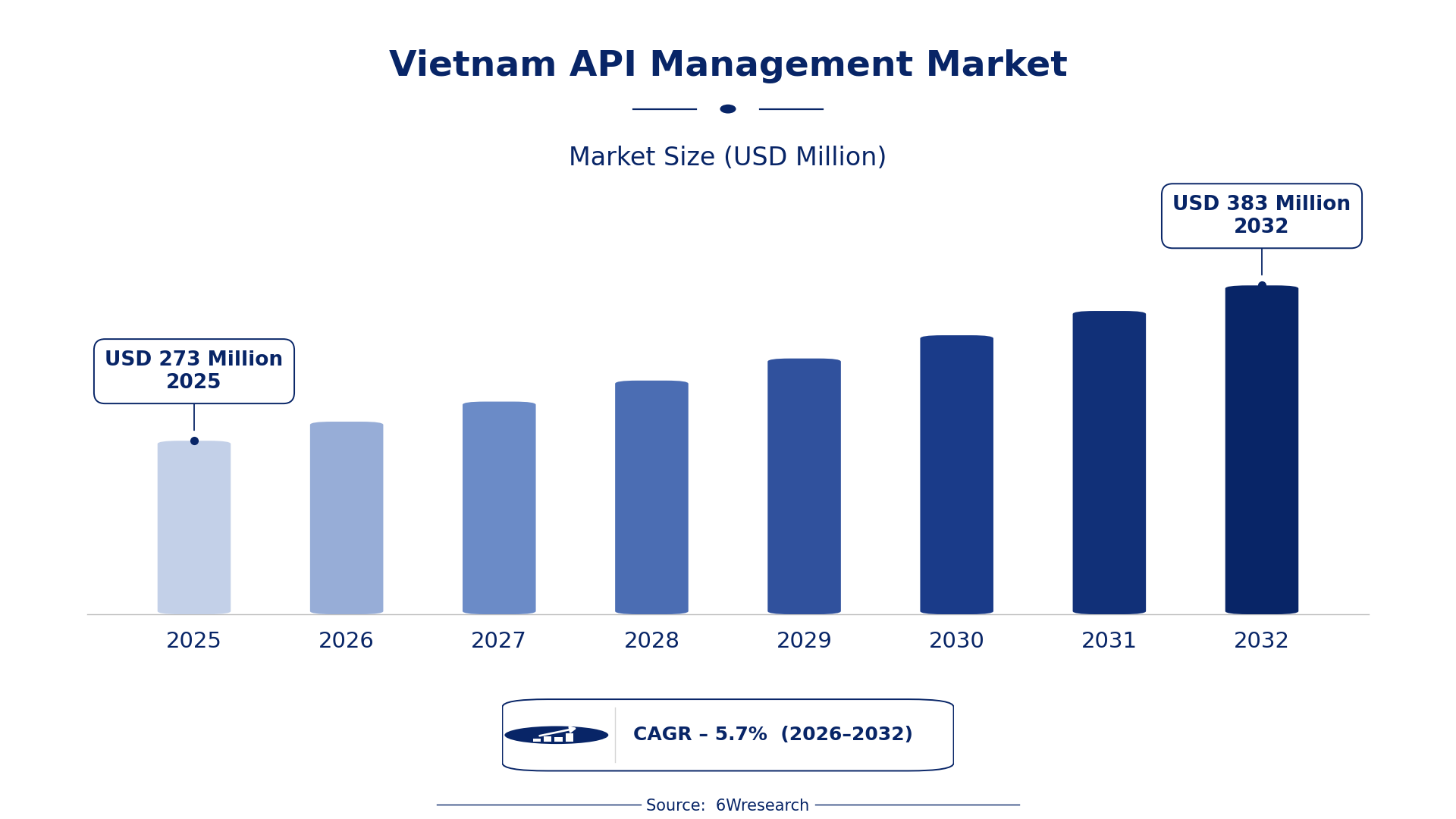
The Vietnam API Management Market was estimated at USD 273 Million in 2025 and is projected to reach USD 383 Million by 2032, growing at a CAGR of 5.7% from 2026 to 2032.
Vietnam API Management Market Synopsis
The driving force behind the Vietnam API Management Market is the urgent need for businesses to enhance their digital capabilities. Organizations across various sectors are increasingly recognizing the value of APIs in fostering connectivity and facilitating smooth data exchange. This demand is prompting a surge in the adoption of API management solutions tailored to meet specific industry requirements.
As businesses aim to streamline operations and drive innovation, API management has become essential. The market is responding with a diverse range of platforms and solutions, ensuring that organizations can optimize their API strategies. This trend is pivotal in shaping Vietnam's digital ecosystem, ultimately supporting the country's broader goals for economic growth and technological advancement.
Vietnam API Management Market Year-wise Growth Rate and Key Drivers
This graph illustrates the annual growth rates of the Vietnam API Management Market from 2021 to 2032, highlighting a steady upward trajectory and projected expansion over the forecast period.
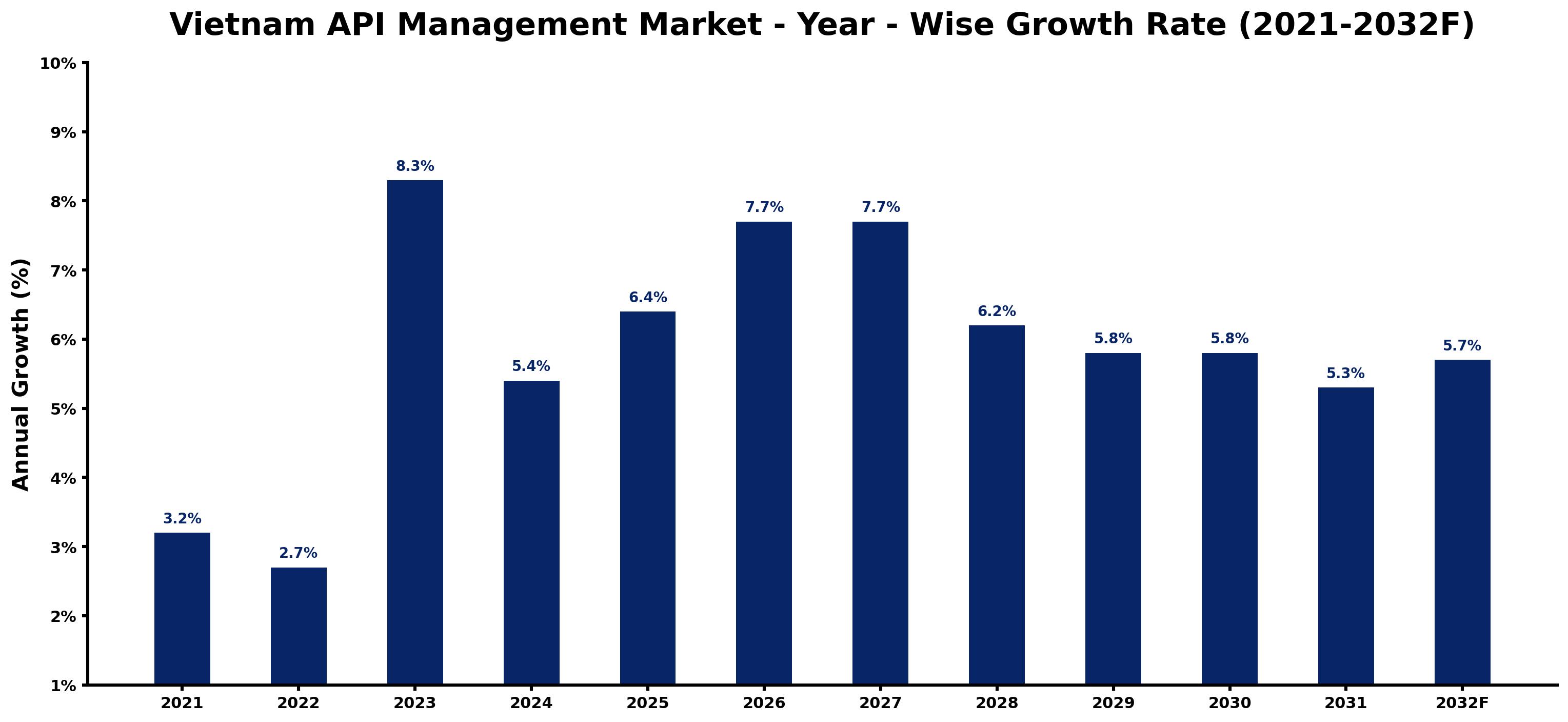
The table below presents the year‑wise growth rates along with the key drivers influencing the market
| Year | Growth Rate | Major Drivers |
| 2021 | 3.2% | Vietnam's digital transformation initiatives expand API usage. |
| 2022 | 2.7% | Growing fintech adoption drives demand for API management. |
| 2023 | 8.3% | Government support for digital economy enhances API integration. |
| 2024 | 5.4% | Increased cloud services adoption fuels API demand growth. |
| 2025 | 6.4% | E-commerce boom in Vietnam pushes API infrastructure needs. |
| 2026 | 7.7% | Local startups leveraging APIs for innovative services rise. |
| 2027 | 7.7% | Rising mobile app development requires robust API management. |
| 2028 | 6.2% | Strengthened data privacy regulations prioritize API security measures. |
| 2029 | 5.8% | Increased partnerships among tech firms boost API collaboration. |
| 2030 | 5.8% | Rising IoT implementations necessitate efficient API architectures. |
| 2031 | 5.3% | Vietnam's growing developer community enhances API innovation. |
| 2032 | 5.7% | Local government promotes API ecosystems for public services. |
Note: Market size estimations and growth projections presented in this report are based on 6Wresearch's proprietary forecasting methodology, utilizing the latest available industry data, government publications, and primary research inputs.
Vietnam API Management Market Key Takeaways
Below are some of the specific key takeaways from the market, including:
- The market is witnessing increased investment in API management solutions driven by the push for digital transformation.
- Security remains a primary concern, with organizations prioritizing secure API strategies to protect data integrity.
- Integration complexity is a notable challenge, as businesses must navigate diverse systems and standards.
- The COVID-19 pandemic has accelerated the need for efficient data exchange and connectivity, boosting market growth.
- Emerging players are entering the market, offering innovative solutions that cater to specific industry needs.
Evaluation of Restraints in Vietnam API Management Market
Several factors are constraining the growth of the Vietnam API Management Market. One significant challenge is ensuring the security of APIs amid increasing cyber threats. Organizations often struggle to implement robust security measures while maintaining efficiency. Additionally, the integration of APIs across various sectors can be complicated due to the diversity of existing systems and the lack of standardization. Another hurdle is the shortage of skilled professionals adept at designing and managing APIs, which can hinder effective implementation. Lastly, the fast-paced evolution of technology requires businesses to continuously adapt, adding another layer of complexity to their API strategies.
Vietnam API Management Market Trends
A few trends are emerging in the Vietnam API Management Market that are worth noting. First, the focus on API security has intensified, leading to the development of advanced security protocols and tools. Organizations are investing in solutions that offer comprehensive security features to protect sensitive data. Second, there is a growing emphasis on API analytics, allowing businesses to monitor usage patterns and optimize performance. Third, low-code and no-code API management platforms are gaining traction, enabling organizations to create and manage APIs without extensive coding knowledge, thus democratizing API management.
Vietnam API Management Market Opportunities
The Vietnam API Management Market is ripe with opportunities for growth and investment. One of the most promising areas is the development of industry-specific API solutions. As sectors like healthcare and finance undergo digital transformation, tailored API strategies can enhance operational efficiency and customer experiences. on top of that, the integration of artificial intelligence in API management can facilitate smarter decision-making and predictive analytics. Collaborations between public and private sectors to enhance digital infrastructure also present avenues for growth, especially in rural and underserved areas.
Government Initiatives in the Vietnam API Management Market
Government initiatives are crucial in shaping the Vietnam API Management Market. The Vietnamese government has placed a strong emphasis on digital transformation as part of its national strategy. Policies encouraging the adoption of advanced technologies are promoting API management solutions, which are integral to enhancing connectivity and operational efficiency across industries.
- A national digital infrastructure upgrade programme was recently completed, aimed at improving connectivity and supporting the adoption of API management solutions.
- Ongoing initiatives focus on establishing regulatory frameworks that ensure data security and interoperability among different sectors.
- Plans are underway for a public-private partnership expected to expand digital service access, enhancing the ecosystem for API management by 2027.
- The government is currently promoting an innovation hub initiative that encourages startups to develop API-based solutions in various sectors.
Future Insights of the Vietnam API Management Market
Looking ahead to 2026-2032, the Vietnam API Management Market is set to grow considerably. As organizations continue to embrace digital transformation, the demand for effective API management solutions will increase. Businesses will focus on enhancing interoperability and security, paving the way for more innovative applications of APIs across sectors. The rise of cloud-based solutions and the integration of AI technologies are also expected to redefine how APIs are utilized, creating a more agile and responsive digital environment in Vietnam.
Vietnam API Management Market Latest Developments
In recent months, the Vietnam API Management Market has seen a flurry of activity, indicating a growing commitment to digital transformation. Companies are increasingly adopting advanced API solutions to enhance their operational efficiencies and meet evolving customer expectations.
- A major technology vendor launched a new API management platform in early 2025, designed to streamline data integration across various business applications.
- An initiative that began in mid-2025 focuses on developing training programs for professionals in API management, addressing the skills gap in the sector.
- In Q4 2025, a leading regional operator announced a partnership with a cloud service provider to enhance API security measures for its clients.
- Plans for an API management technology rollout are expected to begin in the second half of 2026, targeting small to medium-sized enterprises.
Vietnam API Management Market - Key Attractiveness of the Report
- 10 Years of Market Numbers
- Historical Data Starting from 2022 to 2025
- Base Year: 2025
- Forecast Data until 2032
- Key Performance Indicators Impacting the Market
- Major Upcoming Developments and Projects
Key Highlights of the Report:
- Vietnam API Management Market Outlook
- Market Size of Vietnam API Management Market, 2025
- Forecast of Vietnam API Management Market, 2032
- Historical Data and Forecast of Vietnam API Management Revenues & Volume for the Period 2022-2032F
- Vietnam API Management Market Trend Evolution
- Vietnam API Management Market Drivers and Challenges
- Vietnam API Management Price Trends
- Vietnam API Management Porter's Five Forces
- Vietnam API Management Industry Life Cycle
- Historical Data and Forecast of Vietnam API Management Market Revenues & Volume By Component for the Period 2022-2032F
- Historical Data and Forecast of Vietnam API Management Market Revenues & Volume By Solutions for the Period 2022-2032F
- Historical Data and Forecast of Vietnam API Management Market Revenues & Volume By Services for the Period 2022-2032F
- Historical Data and Forecast of Vietnam API Management Market Revenues & Volume By Organization Size for the Period 2022-2032F
- Historical Data and Forecast of Vietnam API Management Market Revenues & Volume By Large Enterprise for the Period 2022-2032F
- Historical Data and Forecast of Vietnam API Management Market Revenues & Volume By Small & Medium Enterprise for the Period 2022-2032F
- Historical Data and Forecast of Vietnam API Management Market Revenues & Volume By Deployment Type for the Period 2022-2032F
- Historical Data and Forecast of Vietnam API Management Market Revenues & Volume By On-premises for the Period 2022-2032F
- Historical Data and Forecast of Vietnam API Management Market Revenues & Volume By Cloud for the Period 2022-2032F
- Historical Data and Forecast of Vietnam API Management Market Revenues & Volume By Vertical for the Period 2022-2032F
- Historical Data and Forecast of Vietnam API Management Market Revenues & Volume By BFSI for the Period 2022-2032F
- Historical Data and Forecast of Vietnam API Management Market Revenues & Volume By Healthcare for the Period 2022-2032F
- Historical Data and Forecast of Vietnam API Management Market Revenues & Volume By Government for the Period 2022-2032F
- Historical Data and Forecast of Vietnam API Management Market Revenues & Volume By Energy & Utilities for the Period 2022-2032F
- Historical Data and Forecast of Vietnam API Management Market Revenues & Volume By Manufacturing for the Period 2022-2032F
- Historical Data and Forecast of Vietnam API Management Market Revenues & Volume By Retail & Consumer Goods for the Period 2022-2032F
- Historical Data and Forecast of Vietnam API Management Market Revenues & Volume By Telecom & IT for the Period 2022-2032F
- Historical Data and Forecast of Vietnam API Management Market Revenues & Volume By Others for the Period 2022-2032F
- Vietnam API Management Import Export Trade Statistics
- Market Opportunity Assessment By Component
- Market Opportunity Assessment By Organization Size
- Market Opportunity Assessment By Deployment Type
- Market Opportunity Assessment By Vertical
- Vietnam API Management Top Companies Market Share
- Vietnam API Management Competitive Benchmarking By Technical and Operational Parameters
- Vietnam API Management Company Profiles
- Vietnam API Management Key Strategic Recommendations






































