Vietnam Aquaculture & Marine Products Market Size, Share & Growth Rate
The Vietnam Aquaculture & Marine Products Market was estimated at USD 450 Million in 2025 and is projected to reach USD 635 Million by 2032, growing at a CAGR of 5.0% from 2026 to 2032. This impressive trajectory is largely fueled by Vietnams rich aquatic resource base, coupled with a burgeoning global demand for high-quality seafood products. Additionally, government initiatives aimed at promoting sustainable practices and technology adoption are further enhancing production capabilities, positioning the country as a significant player on the international seafood stage.
Vietnam Aquaculture & Marine Products Market Year-wise Growth Rate and Key Drivers
This graph highlights how the Vietnam Aquaculture & Marine Products Market has steadily grown over the years, supported by major growth factors.
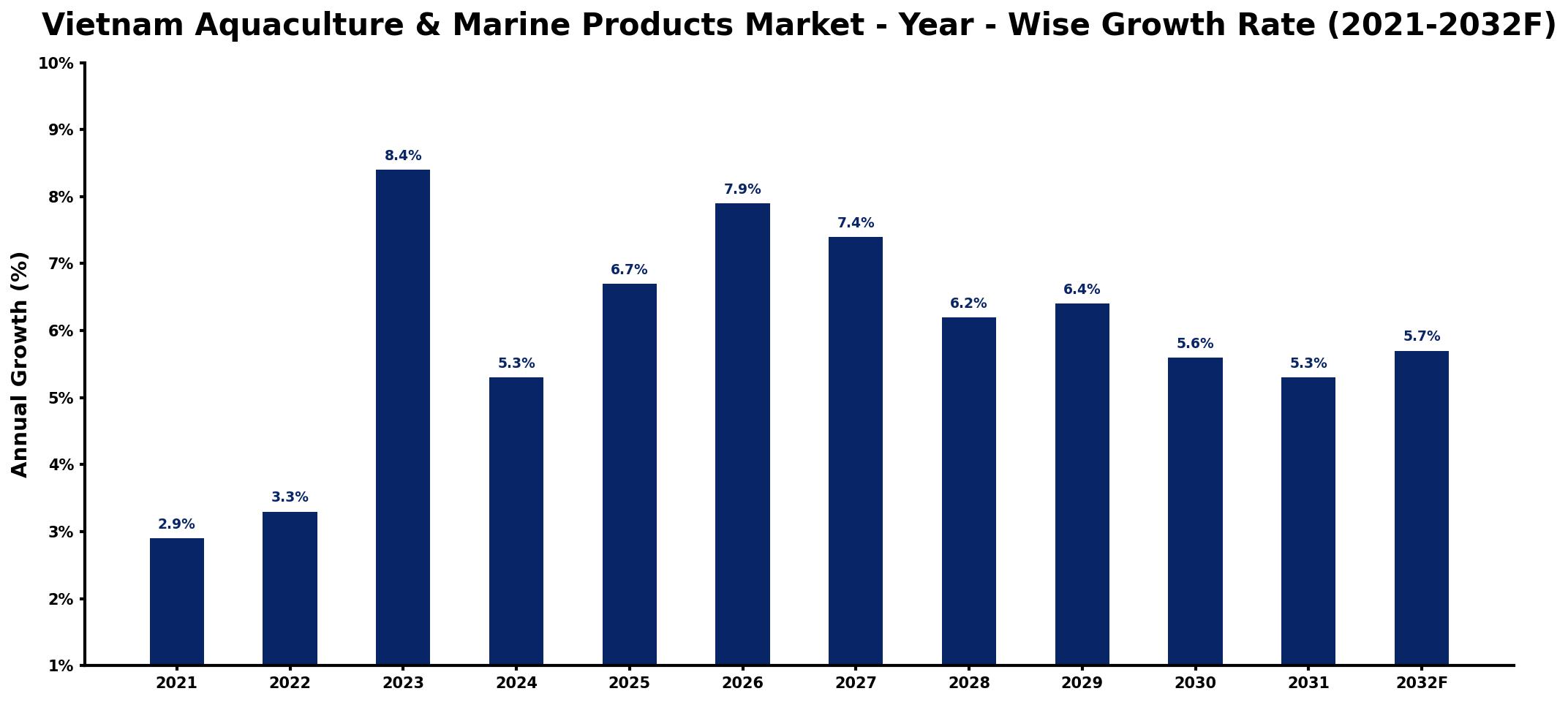
The table below presents the year‑wise growth rates along with the key drivers influencing the market
| Year | Growth Rate | Major Drivers |
| 2021 | 2.9% | Rising consumer health awareness |
| 2022 | 3.3% | Growing export market opportunities |
| 2023 | 8.4% | Increased investment in technology |
| 2024 | 5.3% | Expansion of sustainable practices |
| 2025 | 6.7% | Higher demand for seafood alternatives |
| 2026 | 7.9% | Strengthening global supply chains |
| 2027 | 7.4% | Enhanced regulatory support initiatives |
| 2028 | 6.2% | Emerging markets demand surge |
| 2029 | 6.4% | Advancements in breeding techniques |
| 2030 | 5.6% | Focus on environmental sustainability |
| 2031 | 5.3% | Innovative processing methods development |
| 2032 | 5.7% | Strengthened partnerships in trade |
Note: Market size estimations and growth projections presented in this report are based on 6Wresearch's proprietary forecasting methodology, utilizing the latest available industry data, government publications, and primary research inputs.
Vietnam Aquaculture & Marine Products Market Synopsis
The driving force behind the Vietnam Aquaculture & Marine Products Market is the increasing global appetite for seafood, particularly from developing economies. With a long-standing tradition of aquaculture and access to abundant marine resources, Vietnam is well-poised to meet this rising demand while maximizing its export potential.
However, this growth comes with the responsibility of implementing sustainable practices to safeguard the ecological balance. Environmental sustainability, alongside effective disease management, remains pivotal to maintaining the market's health and longevity, necessitating rigorous monitoring and innovative solutions.
- The market is experiencing a steady growth trajectory due to robust global seafood demand.
- Sustainable aquaculture practices are critical for continued market access and growth.
- Technological advancements are playing a significant role in increasing production efficiency.
- Consumer awareness regarding the health benefits of seafood is propelling demand for premium marine products.
- Government support through policies and incentives is essential for market resilience.
Despite the positive growth outlook, the Vietnam Aquaculture & Marine Products Market faces substantial restraints. Issues surrounding sustainability remain a critical challenge; overfishing and poor aquaculture practices could jeopardize the future health of marine ecosystems. Furthermore, the industry is vulnerable to fluctuations in water quality and outbreaks of disease, necessitating continuous investment in monitoring systems and preventive measures. Meeting the rigorous international sustainability certifications is essential for Vietnamese products to remain competitive in the global market.
Current trends in the Vietnam Aquaculture & Marine Products Market indicate a strong shift toward organic and sustainably sourced seafood. Consumers are increasingly prioritizing health and environmental impact in their purchasing decisions. Additionally, technological innovations such as aquaponics and advanced monitoring systems are gaining traction, enhancing productivity and sustainability in farming practices. Theres also a notable trend toward value-added products, which can significantly boost profitability.
Significant growth and investment opportunities exist in the Vietnam Aquaculture & Marine Products Market, particularly in sustainable aquaculture practices and technology integration. Investments in eco-friendly aquaculture systems, disease management technologies, and advanced logistics can yield high returns. Additionally, the expansion of the organic seafood segment offers a promising avenue for both producers and exporters, catering to the evolving consumer demand for health-focused, premium products.
The Vietnamese government is actively involved in supporting the aquaculture sector through various policies aimed at promoting sustainable practices and enhancing production capabilities. Initiatives include funding for research and development, training programs for local farmers on best practices, and subsidies for environmentally friendly technologies. These efforts are designed to bolster the industrys competitiveness on a global scale while ensuring the long-term sustainability of marine resources.
Looking ahead to the period from 2026 to 2032, the Vietnam Aquaculture & Marine Products Market is expected to continue its upward trajectory, driven by increasing global demand and enhanced production technologies. A greater focus on sustainability will influence operational strategies, leading to more environmentally friendly practices. As international markets evolve, Vietnams ability to adapt to new consumer preferences and regulatory requirements will be essential for maintaining its position as a leading seafood exporter.
Recent developments in the Vietnam Aquaculture & Marine Products Market reflect a shift toward sustainability and innovation. Many producers are adopting more rigorous environmental standards and investing in research to enhance disease management. There is also an increase in partnerships between government bodies and private sectors aimed at boosting the competitiveness of Vietnam's seafood products on the global stage. These trends indicate a collective effort to respond to market challenges and consumer expectations.
- 10 Years of Market Numbers
- Historical Data Starting from 2022 to 2025
- Base Year: 2025
- Forecast Data until 2032
- Key Performance Indicators Impacting the Market
- Major Upcoming Developments and Projects
Key Highlights of the Report:
- Vietnam Aquaculture & Marine Products Market Outlook
- Market Size of Vietnam Aquaculture & Marine Products Market, 2025
- Forecast of Vietnam Aquaculture & Marine Products Market, 2032
- Historical Data and Forecast of Vietnam Aquaculture & Marine Products Revenues & Volume for the Period 2022-2032F
- Vietnam Aquaculture & Marine Products Market Trend Evolution
- Vietnam Aquaculture & Marine Products Market Drivers and Challenges
- Vietnam Aquaculture & Marine Products Price Trends
- Vietnam Aquaculture & Marine Products Porter's Five Forces
- Vietnam Aquaculture & Marine Products Industry Life Cycle
- Historical Data and Forecast of Vietnam Aquaculture & Marine Products Market Revenues & Volume By Rearing Product Type for the Period 2022-2032F
- Historical Data and Forecast of Vietnam Aquaculture & Marine Products Market Revenues & Volume By Equipment for the Period 2022-2032F
- Historical Data and Forecast of Vietnam Aquaculture & Marine Products Market Revenues & Volume By Chemicals for the Period 2022-2032F
- Historical Data and Forecast of Vietnam Aquaculture & Marine Products Market Revenues & Volume By Pharmaceuticals for the Period 2022-2032F
- Historical Data and Forecast of Vietnam Aquaculture & Marine Products Market Revenues & Volume By Fertilizers for the Period 2022-2032F
- Historical Data and Forecast of Vietnam Aquaculture & Marine Products Market Revenues & Volume By Others for the Period 2022-2032F
- Historical Data and Forecast of Vietnam Aquaculture & Marine Products Market Revenues & Volume By Type for the Period 2022-2032F
- Historical Data and Forecast of Vietnam Aquaculture & Marine Products Market Revenues & Volume By Fisheries for the Period 2022-2032F
- Historical Data and Forecast of Vietnam Aquaculture & Marine Products Market Revenues & Volume By Seaweeds for the Period 2022-2032F
- Historical Data and Forecast of Vietnam Aquaculture & Marine Products Market Revenues & Volume By Microalgae for the Period 2022-2032F
- Historical Data and Forecast of Vietnam Aquaculture & Marine Products Market Revenues & Volume By Crustaceans for the Period 2022-2032F
- Historical Data and Forecast of Vietnam Aquaculture & Marine Products Market Revenues & Volume By Molluscs for the Period 2022-2032F
- Historical Data and Forecast of Vietnam Aquaculture & Marine Products Market Revenues & Volume By Others for the Period 2022-2032F
- Historical Data and Forecast of Vietnam Aquaculture & Marine Products Market Revenues & Volume By Production Type for the Period 2022-2032F
- Historical Data and Forecast of Vietnam Aquaculture & Marine Products Market Revenues & Volume By Small-Scale for the Period 2022-2032F
- Historical Data and Forecast of Vietnam Aquaculture & Marine Products Market Revenues & Volume By Medium & Large Scale for the Period 2022-2032F
- Historical Data and Forecast of Vietnam Aquaculture & Marine Products Market Revenues & Volume By Culture for the Period 2022-2032F
- Historical Data and Forecast of Vietnam Aquaculture & Marine Products Market Revenues & Volume By Freshwater for the Period 2022-2032F
- Historical Data and Forecast of Vietnam Aquaculture & Marine Products Market Revenues & Volume By Brackish Water for the Period 2022-2032F
- Historical Data and Forecast of Vietnam Aquaculture & Marine Products Market Revenues & Volume By Marine for the Period 2022-2032F
- Vietnam Aquaculture & Marine Products Import Export Trade Statistics
- Market Opportunity Assessment By Rearing Product Type
- Market Opportunity Assessment By Type
- Market Opportunity Assessment By Production Type
- Market Opportunity Assessment By Culture
- Vietnam Aquaculture & Marine Products Top Companies Market Share
- Vietnam Aquaculture & Marine Products Competitive Benchmarking By Technical and Operational Parameters
- Vietnam Aquaculture & Marine Products Company Profiles
- Vietnam Aquaculture & Marine Products Key Strategic Recommendations






































