Vietnam Autonomous Trucks Market Size, Share & Growth Rate
The Vietnam Autonomous Trucks Market was estimated at USD 1021 Million in 2025 and is projected to reach USD 1448 Million by 2032, growing at a CAGR of 5.1% from 2026 to 2032. This robust growth trajectory is largely driven by the escalating demand for efficient logistics solutions amidst a rapidly expanding economy. Additionally, advancements in artificial intelligence and sensor technologies are enhancing the operational capabilities of autonomous trucks, making them an attractive option for transport companies aiming to optimize their delivery processes.
Vietnam Autonomous Trucks Market Growth Rate Analysis (2021-2032)
The Vietnam Autonomous Trucks Market is witnessing notable growth, marked by an upward trend with an increase from 2.9% in 2022 to 8.4% in 2023. This surge can be attributed to rising consumer demand for efficient logistics solutions, driven by expanding e-commerce and industrial sectors. Continued investments in infrastructure and advancements in technology are facilitating the integration of autonomous vehicles into the transport network. As the market stabilizes, growth is projected to remain above 6% through 2032, with key developments such as government policies promoting digitalization and energy transition playing crucial roles. Despite slight fluctuations, including a dip to 5.4% in 2024, the outlook remains strong for the sector.
Vietnam Autonomous Trucks Market Year-wise Growth Rate and Key Drivers
This graph highlights how the Vietnam Autonomous Trucks Market has steadily grown over the past five years, supported by major growth factors.
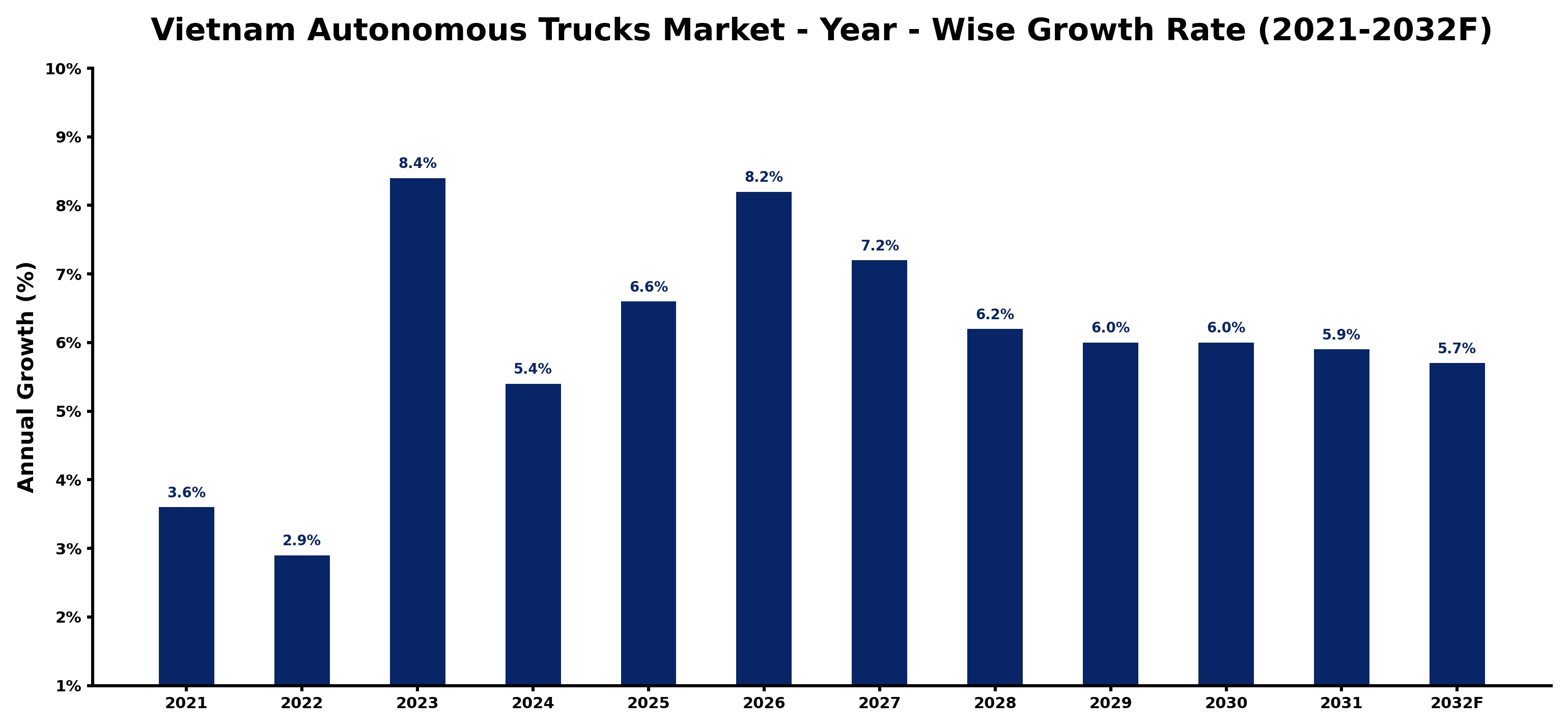
The table below presents the year‑wise growth rates along with the key drivers influencing the market
| Year | Growth Rate | Major Drivers |
| 2021 | 3.6% | Government incentives for automation |
| 2022 | 2.9% | Increased logistics efficiency demands |
| 2023 | 8.4% | Technological advancements in AI |
| 2024 | 5.4% | Rising fuel costs drive adoption |
| 2025 | 6.6% | Infrastructure improvements support deployment |
| 2026 | 8.2% | Growing e-commerce logistics needs |
| 2027 | 7.2% | Sustainability initiatives promote automation |
| 2028 | 6.2% | Urbanization increases freight demands |
| 2029 | 6.0% | Safety regulations encourage innovation |
| 2030 | 6.0% | Consumer preference for efficiency |
| 2031 | 5.9% | Partnerships with tech companies expand |
| 2032 | 5.7% | Global market trends influence growth |
Note - Market size estimations and growth projections presented in this report are based on 6Wresearch’s advanced forecasting approach, validated with industry datasets as of June 2026.
Vietnam Autonomous Trucks Market Synopsis
As the logistics sector in Vietnam continues to grow, there is an evident shift towards automation. Companies are actively seeking solutions to improve efficiency and reduce costs, positioning autonomous trucks as a viable alternative to traditional transport methods. This shift is further accelerated by the increasing complexities of supply chain management.
Moreover, the Vietnamese government's commitment to investing in smart transportation infrastructure supports the adoption of autonomous technologies. With a focus on enhancing road safety and addressing the shortage of skilled drivers, stakeholders are increasingly prioritizing innovations in autonomous trucking.
Vietnam Autonomous Trucks Market Key Takeaways
- The market is poised for significant growth due to rising demand for cost-effective transportation solutions.
- Technological advancements in AI and sensor integration are critical to autonomous truck development.
- Government initiatives aim to foster a conducive environment for autonomous vehicle deployment.
- Safety enhancements and efficiency improvements are primary motivators for businesses exploring automation.
- Public perception and regulatory frameworks will play essential roles in market adoption.
Evaluation of Restraints in Vietnam Autonomous Trucks Market
Despite the promising growth, several restraints persist in the Vietnam Autonomous Trucks Market. The absence of a solid technological infrastructure poses a significant barrier; reliable connectivity and advanced sensor capabilities are vital for the seamless operation of autonomous vehicles. Furthermore, regulatory frameworks governing the use of such vehicles are still evolving, presenting challenges for firms looking to innovate. Lastly, gaining public trust in autonomous technology is crucial, as skepticism can hinder widespread acceptance and usage.
Vietnam Autonomous Trucks Market Trends
The current trends in the Vietnam Autonomous Trucks Market indicate a strong shift towards hybrid technologies, combining both autonomous and manual operations. This transitional approach allows for smoother integration and gradual acceptance by stakeholders. Additionally, ongoing pilot projects are helping to demonstrate the feasibility and benefits of autonomous trucks, fostering greater confidence among potential users. The focus on sustainable practices is also evident, with companies looking to reduce their carbon footprints through the adoption of electric autonomous trucks.
Vietnam Autonomous Trucks Market Opportunities
As the market matures, significant opportunities for growth and investment arise. The ongoing urbanization in Vietnam necessitates efficient transportation systems, which can be addressed by scaling up autonomous truck operations. Additionally, collaboration between technology providers and logistics companies can enhance the development of customized solutions tailored to specific industry needs. As the regulatory landscape becomes clearer, early adopters of autonomous technologies are likely to gain a competitive edge in the evolving transport sector.
Government Initiatives in the Vietnam Autonomous Trucks Market
The Vietnamese government is actively promoting smart transportation initiatives aimed at embracing advanced technologies, including autonomous vehicles. Investments in infrastructure to support intelligent transportation systems are increasing, which bodes well for the future of autonomous trucking. Furthermore, public funding and incentives are being introduced to encourage companies to innovate within this space, ensuring a progressive approach towards modernizing the logistics industry.
Future Insights of the Vietnam Autonomous Trucks Market
Looking ahead to the period from 2026 to 2032, the Vietnam Autonomous Trucks Market is expected to evolve significantly. A combination of technological advancements, regulatory support, and increasing public acceptance will likely drive widespread adoption. The competitive landscape will shift as new entrants emerge and existing players enhance their offerings, leading to innovative solutions tailored to the unique challenges of the Vietnamese market. As demand for efficient logistics solutions intensifies, autonomous trucks are poised to play a pivotal role in the transportation ecosystem.
Vietnam Autonomous Trucks Market Latest Developments (May 2025 - June 2026)
Recent developments within the Vietnam Autonomous Trucks Market indicate a surge in pilot projects designed to test the viability of autonomous technologies in real-world scenarios. Collaborative efforts between tech firms and logistics companies are becoming more commonplace, aimed at refining operational models and enhancing safety protocols. Additionally, regulatory bodies are beginning to establish clearer guidelines for the operation of autonomous trucks, paving the way for broader market acceptance.
Vietnam Autonomous Trucks Market - Key Attractiveness of the Report
- 10 Years of Market Numbers
- Historical Data Starting from 2022 to 2025
- Base Year: 2025
- Forecast Data until 2032
- Key Performance Indicators Impacting the Market
- Major Upcoming Developments and Projects
Key Highlights of the Report:
- Vietnam Autonomous Trucks Market Outlook
- Market Size of Vietnam Autonomous Trucks Market, 2025
- Forecast of Vietnam Autonomous Trucks Market, 2032F
- Historical Data and Forecast of Vietnam Autonomous Trucks Revenues & Volume for the Period 2022-2032F
- Vietnam Autonomous Trucks Market Trend Evolution
- Vietnam Autonomous Trucks Market Drivers and Challenges
- Vietnam Autonomous Trucks Price Trends
- Vietnam Autonomous Trucks Porter's Five Forces
- Vietnam Autonomous Trucks Industry Life Cycle
- Historical Data and Forecast of Vietnam Autonomous Trucks Market Revenues & Volume By Level of Autonomy for the Period 2022-2032F
- Historical Data and Forecast of Vietnam Autonomous Trucks Market Revenues & Volume By Level 1 for the Period 2022-2032F
- Historical Data and Forecast of Vietnam Autonomous Trucks Market Revenues & Volume By Level 2 for the Period 2022-2032F
- Historical Data and Forecast of Vietnam Autonomous Trucks Market Revenues & Volume By Level 3 for the Period 2022-2032F
- Historical Data and Forecast of Vietnam Autonomous Trucks Market Revenues & Volume By Level 4 for the Period 2022-2032F
- Historical Data and Forecast of Vietnam Autonomous Trucks Market Revenues & Volume By Sensor Type for the Period 2022-2032F
- Historical Data and Forecast of Vietnam Autonomous Trucks Market Revenues & Volume By Ultrasonic for the Period 2022-2032F
- Historical Data and Forecast of Vietnam Autonomous Trucks Market Revenues & Volume By Radar for the Period 2022-2032F
- Historical Data and Forecast of Vietnam Autonomous Trucks Market Revenues & Volume By Camera for the Period 2022-2032F
- Historical Data and Forecast of Vietnam Autonomous Trucks Market Revenues & Volume By LiDAR for the Period 2022-2032F
- Historical Data and Forecast of Vietnam Autonomous Trucks Market Revenues & Volume By Propulsion for the Period 2022-2032F
- Historical Data and Forecast of Vietnam Autonomous Trucks Market Revenues & Volume By Diesel for the Period 2022-2032F
- Historical Data and Forecast of Vietnam Autonomous Trucks Market Revenues & Volume By Electric for the Period 2022-2032F
- Historical Data and Forecast of Vietnam Autonomous Trucks Market Revenues & Volume By Others for the Period 2022-2032F
- Historical Data and Forecast of Vietnam Autonomous Trucks Market Revenues & Volume By Truck Type for the Period 2022-2032F
- Historical Data and Forecast of Vietnam Autonomous Trucks Market Revenues & Volume By Light Duty Truck for the Period 2022-2032F
- Historical Data and Forecast of Vietnam Autonomous Trucks Market Revenues & Volume By Medium Duty Truck for the Period 2022-2032F
- Historical Data and Forecast of Vietnam Autonomous Trucks Market Revenues & Volume By Heavy Duty Truck for the Period 2022-2032F
- Vietnam Autonomous Trucks Import Export Trade Statistics
- Market Opportunity Assessment By Level of Autonomy
- Market Opportunity Assessment By Sensor Type
- Market Opportunity Assessment By Propulsion
- Market Opportunity Assessment By Truck Type
- Vietnam Autonomous Trucks Top Companies Market Share
- Vietnam Autonomous Trucks Competitive Benchmarking By Technical and Operational Parameters
- Vietnam Autonomous Trucks Company Profiles
- Vietnam Autonomous Trucks Key Strategic Recommendations






































