Vietnam Decorative Film Market Summary
The vietnam decorative film market was estimated at USD 328 Million in 2025 and is projected to reach USD 462 Million by 2032, growing at a CAGR of 8.2% from 2026 to 2032.
Vietnam Decorative Film Market Year-wise Growth Rate and Key Drivers
This graph highlights how the Vietnam Decorative Film Market has steadily grown over the past five years, supported by major growth factors.
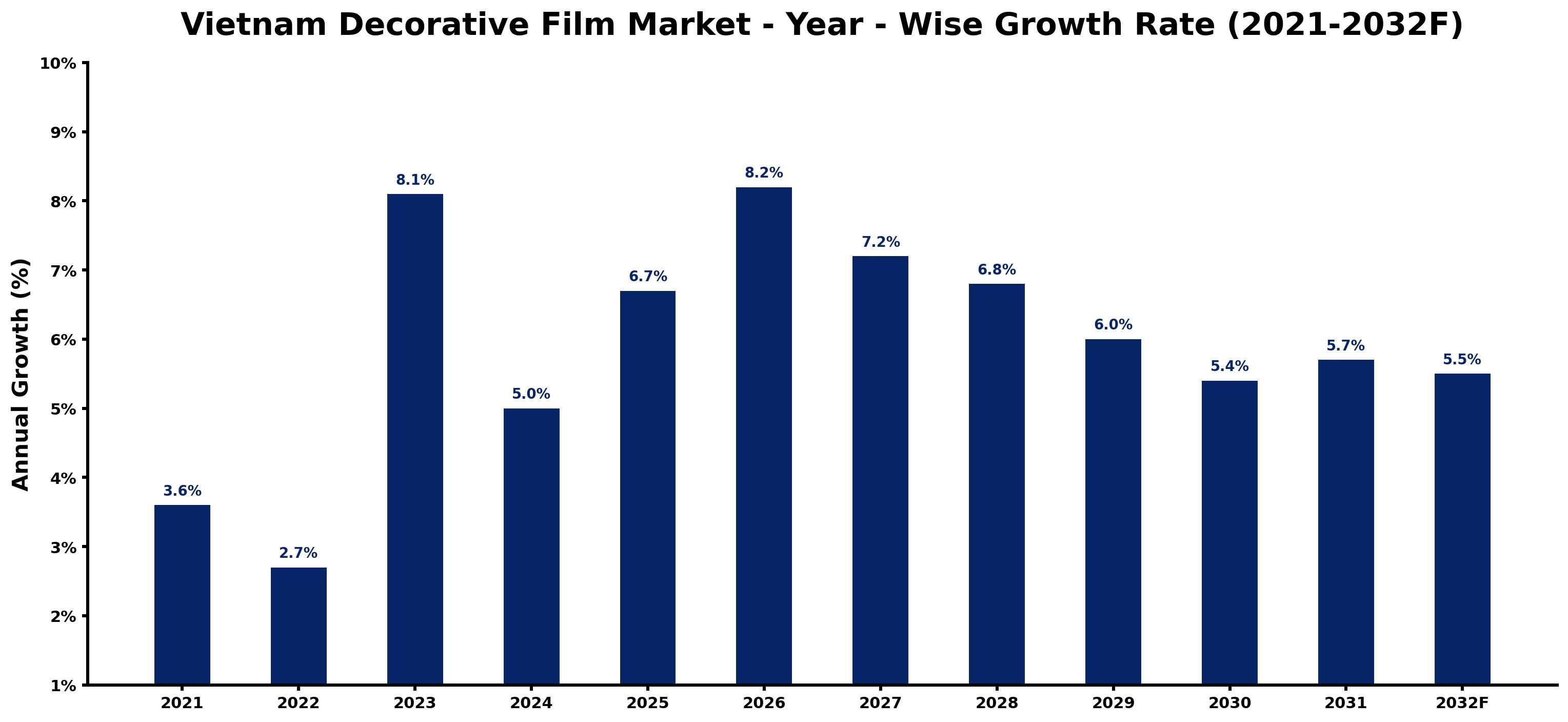
The table below presents the year wise growth rates along with the key drivers influencing the market
| Year | Growth Rate | Major Drivers |
| 2021 | 3.6% | Vietnam's construction sector rebounds, enhancing demand for decorative film applications. |
| 2022 | 2.7% | Increased urbanization leads to higher property development and film usage in interiors. |
| 2023 | 8.1% | E-commerce expansion fuels online sales of decorative films among younger consumers. |
| 2024 | 5.0% | Local manufacturers enhance production capabilities, improving cost competitiveness of decorative films. |
| 2025 | 6.7% | Sustainability trends encourage eco-friendly film options, appealing to environmentally conscious buyers. |
| 2026 | 8.2% | Technological innovations in film production boost quality and variety available in the market. |
| 2027 | 7.2% | Rising middle-class income levels encourage investment in home aesthetics and renovations. |
| 2028 | 6.8% | Architectural design trends favor decorative films for aesthetics and functional enhancements. |
| 2029 | 6.0% | Regional partnerships strengthen supply chains, reducing costs and lead times significantly. |
| 2030 | 5.4% | Demand for energy-efficient solutions increases interest in solar control decorative films. |
| 2031 | 5.7% | Cultural preferences for unique aesthetics promote customization options in decorative films. |
| 2032 | 5.5% | Integration of smart technologies creates new opportunities for innovative decorative film products. |
Note - Market size estimations and growth projections presented in this report are based on 6Wresearch's advanced forecasting approach, validated with industry datasets as of June 2026.
Vietnam Decorative Film Market Synopsis
The Vietnam Decorative Film Market is projected to reach 8.2% and witness significant growth during the forecast period (2026-2032). This growth is largely fueled by the increasing demand for decorative solutions within both residential and commercial sectors, driven by rising disposable incomes among consumers. As urbanization accelerates in Vietnam, the surge in construction activities is also propelling the need for decorative films, which are increasingly being recognized for their aesthetic contributions to various environments. Furthermore, government initiatives aimed at promoting sustainable living and smart housing have gained traction, enhancing product awareness and acceptance among end users. Technological advancements focused on the development of eco-friendly materials are likely to further stimulate demand throughout the forecast period. However, it is crucial to note that high installation costs and fluctuating raw material prices, along with a shortage of skilled labor, present challenges to the market's expansion.
Vietnam Decorative Film Market Growth Drivers
The growth of the Vietnam Decorative Film Market is primarily driven by several key factors:
- The rising disposable income of consumers is enabling more households and businesses to invest in decorative films as a means of enhancing interior aesthetics.
- Increased construction activities across urban areas are creating a heightened demand for decorative solutions, as developers and homeowners seek to differentiate their spaces.
- The strong emphasis on sustainability is pushing manufacturers to innovate eco-friendly decorative film products, capturing the interest of environmentally-conscious consumers.
- Growing awareness of the benefits and versatility of decorative films in both functional and aesthetic applications is driving consumer interest and market penetration.
- A trend towards smart housing solutions is leading to increased integration of decorative films within modern living spaces, enhancing their appeal amidst tech-savvy consumers.
Vietnam Decorative Film Market Challenges and Restraints
Despite its promising growth trajectory, the Vietnam Decorative Film Market faces several challenges that could hinder its expansion:
- High installation costs associated with decorative films may deter some potential customers, particularly in a price-sensitive market.
- Volatile prices of raw materials used in the production of decorative films can impact pricing and profitability, creating uncertainty for manufacturers and suppliers.
- A lack of skilled labor in the installation and application of decorative films can limit market growth, as quality and expertise play significant roles in customer satisfaction.
- Economic fluctuations and regulatory changes in Vietnam could impact real estate and construction growth, subsequently affecting the demand for decorative films.
- Competition from alternative interior decoration solutions, such as paint and traditional wall coverings, may pose a challenge to the decorative film market.
Vietnam Decorative Film Market Government Investment and Initiatives
The Vietnamese government has been actively promoting various initiatives that indirectly support the growth of the decorative film market. Policies aimed at enhancing the real estate and construction sectors often create an environment conducive to market expansion. Investments in infrastructure and smart city projects are among the key government strategies that stimulate demand for interior décor solutions, including decorative films.
Moreover, initiatives to promote sustainable building practices have led to increased focus on eco-friendly materials, which is a vital aspect of decorative films. Government incentives for green building certifications can encourage developers to incorporate decorative films in their projects, thus positively impacting market growth. Additionally, public spending on housing and urban development is projected to increase, creating further opportunities for decorative film applications across various forms of construction.
Vietnam Decorative Film Market Latest Developments (May 2025 - June 2026)
In the period from May 2025 to June 2026, the Vietnam Decorative Film Market has observed several noteworthy developments. The ongoing urbanization trend significantly influences market dynamics, with a marked increase in the number of residential and commercial construction projects. Many manufacturers have begun to invest in research and development to innovate advanced decorative films that are both aesthetically pleasing and eco-friendly.
Furthermore, partnerships and collaborations between technology providers and decorative film manufacturers have emerged, leading to the introduction of smart decorative films that can adapt to various environmental conditions. Awareness campaigns targeting construction professionals and end users have also expanded, focusing on the benefits and applications of decorative films in modern spaces.
Vietnam Decorative Film Market - Key Attractiveness of the Report
- 10 Years of Market Numbers
- Historical Data Starting from 2022 to 2025
- Base Year: 2025
- Forecast Data until 2032
- Key Performance Indicators Impacting the Market
- Major Upcoming Developments and Projects
Key Highlights of the Report:
- Vietnam Decorative Film Market Outlook
- Market Size of Vietnam Decorative Film Market, 2025
- Forecast of Vietnam Decorative Film Market, 2032F
- Historical Data and Forecast of Vietnam Decorative Film Revenues & Volume for the Period 2022-2032F
- Vietnam Decorative Film Market Trend Evolution
- Vietnam Decorative Film Market Drivers and Challenges
- Vietnam Decorative Film Price Trends
- Vietnam Decorative Film Porter's Five Forces
- Vietnam Decorative Film Industry Life Cycle
- Historical Data and Forecast of Vietnam Decorative Film Market Revenues & Volume By Product Type for the Period 2022-2032F
- Historical Data and Forecast of Vietnam Decorative Film Market Revenues & Volume By Stained Window Film for the Period 2022-2032F
- Historical Data and Forecast of Vietnam Decorative Film Market Revenues & Volume By Frosted Window Film for the Period 2022-2032F
- Historical Data and Forecast of Vietnam Decorative Film Market Revenues & Volume By Applications for the Period 2022-2032F
- Historical Data and Forecast of Vietnam Decorative Film Market Revenues & Volume By Residential for the Period 2022-2032F
- Historical Data and Forecast of Vietnam Decorative Film Market Revenues & Volume By Commercial for the Period 2022-2032F
- Vietnam Decorative Film Import Export Trade Statistics
- Market Opportunity Assessment By Product Type
- Market Opportunity Assessment By Applications
- Vietnam Decorative Film Top Companies Market Share
- Vietnam Decorative Film Competitive Benchmarking By Technical and Operational Parameters
- Vietnam Decorative Film Company Profiles
- Vietnam Decorative Film Key Strategic Recommendations






































