Vietnam Facade Market Size, Share & Growth Rate
The Vietnam Facade Market was estimated at USD 311 Million in 2025 and is projected to reach USD 443 Million by 2032, growing at a CAGR of 5.2% from 2026 to 2032. This upward trajectory is primarily fueled by rapid urbanization and the escalating demand for aesthetically pleasing and energy-efficient building solutions. As Vietnam's middle-class population expands, there is a notable shift towards modern architectural designs that combine both functionality and visual appeal.
Vietnam Facade Market Year-wise Growth Rate and Key Drivers
This graph highlights how the Vietnam Facade Market has steadily grown over the years, supported by major growth factors.
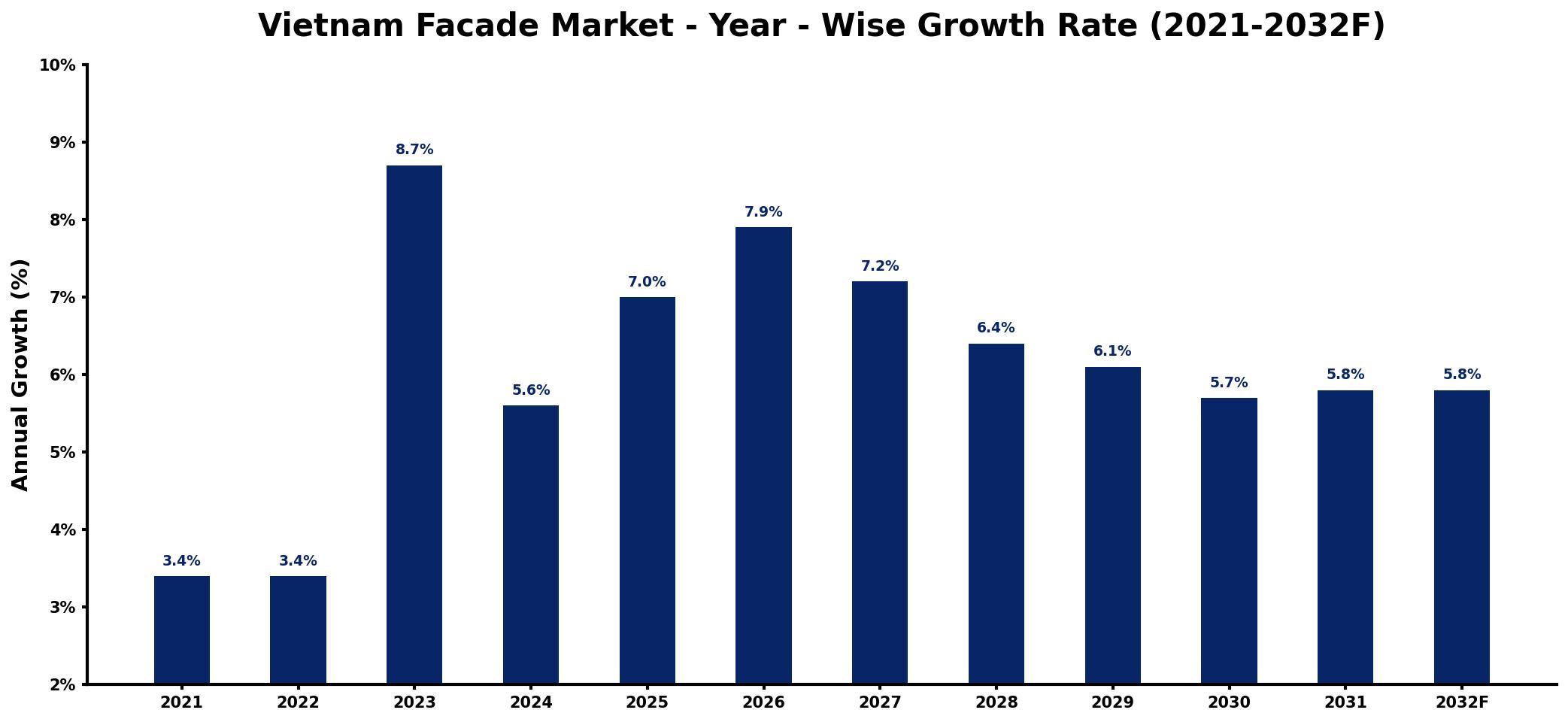
The table below presents the year‑wise growth rates along with the key drivers influencing the market
| Year | Growth Rate | Major Drivers |
| 2021 | 3.4% | Rising urban construction projects |
| 2022 | 3.4% | Increased government infrastructure investments |
| 2023 | 8.7% | Growing green building initiatives |
| 2024 | 5.6% | Surge in commercial property development |
| 2025 | 7.0% | Expansion of residential housing market |
| 2026 | 7.9% | Technological advancements in materials |
| 2027 | 7.2% | Strengthened regulations for energy efficiency |
| 2028 | 6.4% | Heightened demand for aesthetic designs |
| 2029 | 6.1% | Increased focus on sustainable architecture |
| 2030 | 5.7% | Growth in renovation and remodeling |
| 2031 | 5.8% | Boost in international investments |
| 2032 | 5.8% | Rising consumer awareness on design |
Note: Market size estimations and growth projections presented in this report are based on 6Wresearch's proprietary forecasting methodology, utilizing the latest available industry data, government publications, and primary research inputs.
Vietnam Facade Market Synopsis
Urbanization is the most powerful force shaping the Vietnam facade market today. The country's construction boom, combined with rising consumer expectations for innovative designs, has led to an increased focus on facade aesthetics and energy efficiency in buildings.
Additionally, stringent building regulations are compelling developers to integrate sustainable practices into their projects. This demand for eco-friendly facade solutions not only meets regulatory requirements but also caters to a growing demographic that values sustainability in architectural design.
Vietnam Facade Market Key Takeaways
- The market is experiencing robust growth driven by urbanization and increased disposable income.
- Innovative materials and designs are becoming critical to meet evolving consumer preferences.
- Stricter building codes are propelling the adoption of sustainable facade solutions.
- The impact of COVID-19 has reshaped design considerations, emphasizing health and safety.
- There are significant opportunities for both local and international players in this expanding market.
Evaluation of Restraints in Vietnam Facade Market
Despite the growth, several restraints hinder the Vietnam facade market. One primary limitation is the lack of awareness and acceptance of advanced facade technologies among smaller developers. Often, traditional construction practices prevail due to budget constraints, impeding the adoption of innovative materials. Additionally, the requirement for continuous adaptation to emerging architectural trends can pose a challenge, necessitating ongoing investment in research and development to keep pace with consumer expectations.
Vietnam Facade Market Trends
Currently, there is a noticeable trend towards modular and prefabricated facade systems that streamline the construction process. These approaches not only reduce time and labor costs but also minimize waste, aligning with sustainability goals. Furthermore, the integration of smart technologies, such as automated shading and energy-efficient glazing, is increasingly popular as buildings aim to enhance energy performance and user comfort. These trends underscore a significant shift towards modern, functional design in the Vietnam facade market.
Vietnam Facade Market Opportunities
The Vietnam facade market presents several promising opportunities for growth and investment. With the ongoing urbanization and infrastructural development, there is a pressing need for high-quality, sustainable building facades. Companies focusing on innovative materials that offer durability, aesthetic appeal, and energy efficiency stand to gain a significant market share. Additionally, partnerships with local construction firms can facilitate entry into the market, allowing international players to tap into the burgeoning demand for modern architectural solutions.
Government Initiatives in the Vietnam Facade Market
The Vietnamese government has introduced various policies aimed at promoting sustainable construction practices. Public spending on infrastructure projects has increased, providing a fertile ground for investments in advanced facade solutions. Additionally, initiatives to enhance energy efficiency in buildings are encouraging developers to explore innovative facade technologies that comply with new regulations. These government measures are vital in fostering an environment conducive to growth in the facade market.
Future Insights of the Vietnam Facade Market
Looking ahead to 2026-2032, the Vietnam facade market is expected to continue its upward trajectory, bolstered by continuous urban development and a shift towards sustainable building practices. As the economy stabilizes post-pandemic, there will be renewed interest in construction projects, allowing for innovative facade designs that prioritize health, safety, and environmental considerations. The market's evolution will be characterized by the incorporation of advanced materials and technology, making it increasingly competitive and dynamic.
Vietnam Facade Market Latest Developments (2025 - 2026)
Recent developments in the Vietnam facade market indicate a strong shift towards incorporating advanced technologies and sustainable practices. Many companies are investing in R&D to create environmentally friendly facade systems that resonate with changing consumer demands. Additionally, collaboration among industry stakeholders is intensifying to enhance knowledge sharing regarding innovative materials and construction techniques. This collective effort is expected to drive market growth and foster new opportunities.
Vietnam Facade Market - Key Attractiveness of the Report
- 10 Years of Market Numbers
- Historical Data Starting from 2022 to 2025
- Base Year: 2025
- Forecast Data until 2032
- Key Performance Indicators Impacting the Market
- Major Upcoming Developments and Projects
Key Highlights of the Report:
- Vietnam Facade Market Outlook
- Market Size of Vietnam Facade Market, 2025
- Forecast of Vietnam Facade Market, 2032
- Historical Data and Forecast of Vietnam Facade Revenues & Volume for the Period 2022-2032F
- Vietnam Facade Market Trend Evolution
- Vietnam Facade Market Drivers and Challenges
- Vietnam Facade Price Trends
- Vietnam Facade Porter's Five Forces
- Vietnam Facade Industry Life Cycle
- Historical Data and Forecast of Vietnam Facade Market Revenues & Volume By Product for the Period 2022-2032F
- Historical Data and Forecast of Vietnam Facade Market Revenues & Volume By Ventilated Facades for the Period 2022-2032F
- Historical Data and Forecast of Vietnam Facade Market Revenues & Volume By Non-ventilated Facades for the Period 2022-2032F
- Historical Data and Forecast of Vietnam Facade Market Revenues & Volume By Others for the Period 2022-2032F
- Historical Data and Forecast of Vietnam Facade Market Revenues & Volume By End-use for the Period 2022-2032F
- Historical Data and Forecast of Vietnam Facade Market Revenues & Volume By Commercial for the Period 2022-2032F
- Historical Data and Forecast of Vietnam Facade Market Revenues & Volume By Residential for the Period 2022-2032F
- Historical Data and Forecast of Vietnam Facade Market Revenues & Volume By Industrial for the Period 2022-2032F
- Vietnam Facade Import Export Trade Statistics
- Market Opportunity Assessment By Product
- Market Opportunity Assessment By End-use
- Vietnam Facade Top Companies Market Share
- Vietnam Facade Competitive Benchmarking By Technical and Operational Parameters
- Vietnam Facade Company Profiles
- Vietnam Facade Key Strategic Recommendations






































