Vietnam Filament Led Bulb Market Size, Share & Growth Rate
The Vietnam Filament Led Bulb Market was estimated at USD 447 Million in 2025 and is projected to reach USD 630 Million by 2032, growing at a CAGR of 5.0% from 2026 to 2032. This growth trajectory is driven primarily by the rising demand for energy-efficient lighting solutions and a growing preference for sustainable products. With the ongoing phase-out of incandescent bulbs and a shift toward more eco-friendly lighting technologies, the market is poised for significant expansion.
Vietnam Filament Led Bulb Market Year-wise Growth Rate and Key Drivers
This graph highlights how the Vietnam Filament Led Bulb Market has steadily grown over the years, supported by major growth factors.
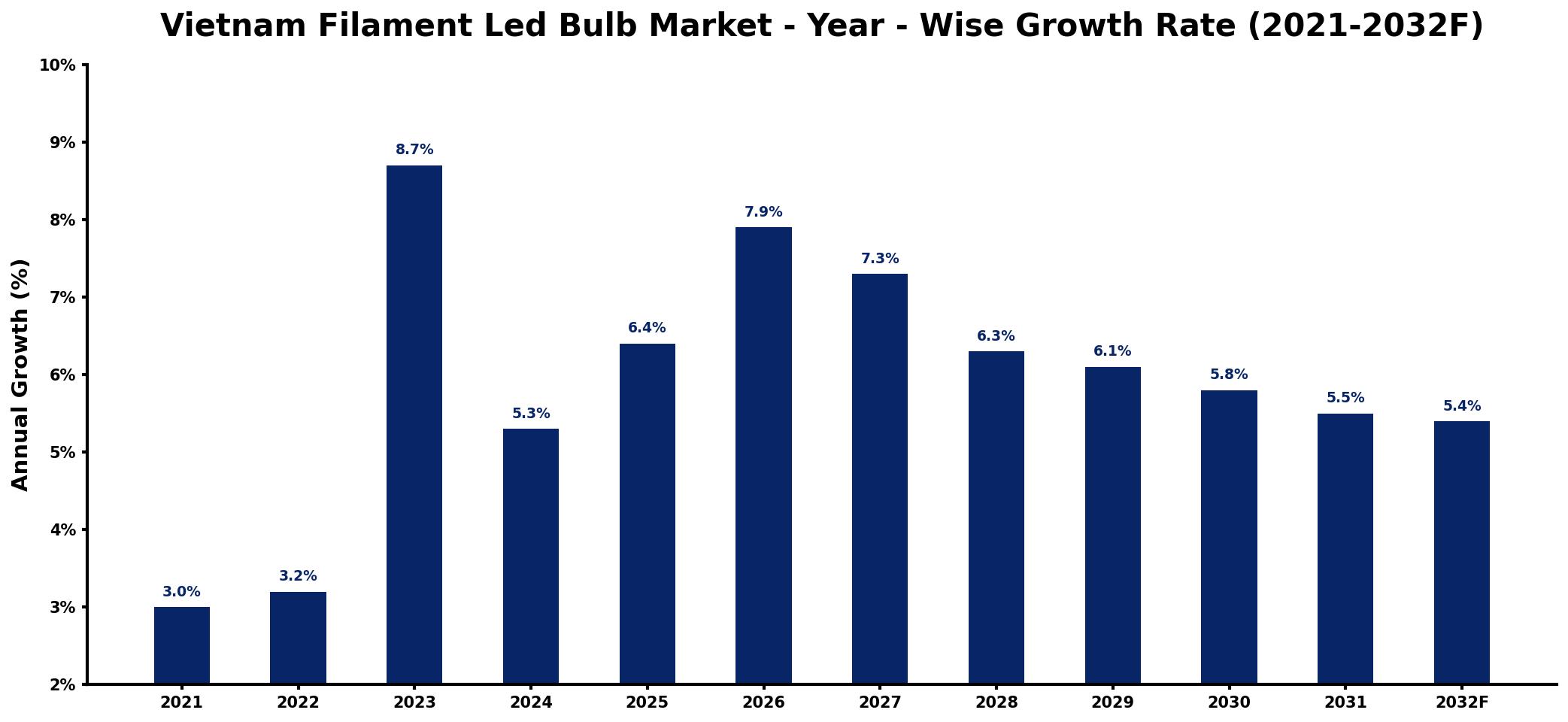
The table below presents the year‑wise growth rates along with the key drivers influencing the market
| Year | Growth Rate | Major Drivers |
| 2021 | 3.0% | Rising consumer awareness sustainability |
| 2022 | 3.2% | Increased residential renovation activities |
| 2023 | 8.7% | Government incentives energy efficiency |
| 2024 | 5.3% | Growing commercial sector investments |
| 2025 | 6.4% | Expanding smart home technologies |
| 2026 | 7.9% | Enhanced distribution network accessibility |
| 2027 | 7.3% | Boost in construction activities nationwide |
| 2028 | 6.3% | Surge in eco-friendly initiatives |
| 2029 | 6.1% | Adoption of energy-saving regulations |
| 2030 | 5.8% | Increased demand green technologies |
| 2031 | 5.5% | Expansion of urban infrastructure projects |
| 2032 | 5.4% | Focus on renewable energy solutions |
Note: Market size estimations and growth projections presented in this report are based on 6Wresearch's proprietary forecasting methodology, utilizing the latest available industry data, government publications, and primary research inputs.
Vietnam Filament Led Bulb Market Synopsis
The strongest force shaping the Vietnam filament LED bulb market today is the demand for energy-efficient lighting solutions that also provide aesthetic appeal. As consumers increasingly favor products that combine vintage design with modern efficiency, filament LED bulbs have emerged as a favorite for home and commercial applications alike.
Additionally, sustainability initiatives and government regulations aimed at reducing energy consumption are further driving the adoption of these bulbs. Manufacturers are responding by creating diverse product offerings in various designs and color temperatures to meet the evolving consumer preferences.
Vietnam Filament Led Bulb Market Key Takeaways
- The Vietnam filament LED bulb market is set for robust growth, with an estimated market value of USD 630 Million by 2032.
- Energy efficiency and sustainability are the main drivers of consumer choice in the lighting sector.
- Manufacturers are focusing on innovative designs to cater to changing aesthetic preferences in lighting.
- Increasing public awareness around eco-friendly products supports market penetration.
- Online retail channels are becoming increasingly popular for accessing filament LED bulbs.
Evaluation of Restraints in Vietnam Filament Led Bulb Market
While the Vietnam filament LED bulb market shows promise, it faces real restraints that could impede its growth. One primary challenge is the ongoing need for greater consumer awareness regarding the benefits of filament LED bulbs over traditional incandescent options. Many potential buyers remain unaware of the energy savings and environmental impact these products offer. Additionally, the price point of filament LED bulbs can be a barrier for some consumers, making affordability a key focus area for manufacturers. To overcome these obstacles, educating the market about the long-term savings and sustainability benefits of filament LED technology will be essential.
Vietnam Filament Led Bulb Market Trends
Several trends are shaping the demand for filament LED bulbs in Vietnam. One significant trend is the increasing popularity of smart lighting solutions, where filament LED bulbs can be integrated into smart home systems, allowing users to control their lighting via apps and voice commands. Furthermore, there is a noticeable shift toward decorative and aesthetic lighting, with consumers seeking filament LED bulbs that enhance the visual ambiance of their spaces. These bulbs are becoming a staple in hospitality and retail environments, where ambiance is paramount.
Vietnam Filament Led Bulb Market Opportunities
The Vietnam filament LED bulb market presents various opportunities for growth and investment. Innovations in technology, such as the development of dimmable and color-changing filament LED bulbs, are opening new avenues for consumer engagement. Additionally, as urbanization continues to rise, there is potential for substantial sales growth in both residential and commercial sectors. Furthermore, collaborations with interior designers and architects could position manufacturers favorably within niche markets, targeting high-end clients seeking unique lighting solutions.
Government Initiatives in the Vietnam Filament Led Bulb Market
Government initiatives in Vietnam increasingly support the transition to energy-efficient lighting solutions, promoting the adoption of LED technology through various incentives and regulations. There are ongoing programs aimed at phasing out inefficient incandescent bulbs and encouraging the use of energy-saving products. Public spending on infrastructure that incorporates LED lighting is also on the rise, further bolstering the filament LED bulb market's prospects.
Future Insights of the Vietnam Filament Led Bulb Market
Looking ahead to 2026-2032, the Vietnam filament LED bulb market is expected to experience dynamic growth driven by ongoing trends toward sustainability and energy efficiency. As consumer preferences continue to shift, manufacturers are likely to invest in research and development to create innovative lighting solutions. The incorporation of advanced technology in filament LED bulbs, including smart features, will likely appeal to a broader audience, paving the way for higher adoption rates across diverse sectors.
Vietnam Filament Led Bulb Market Latest Developments (2025 - 2026)
Recent developments in the Vietnam filament LED bulb market indicate a shift towards more eco-friendly production practices and enhanced product offerings. Manufacturers are expanding their portfolios with new designs tailored for specific markets, such as hospitality and residential applications. Additionally, there has been a noticeable increase in online retail activity as consumers seek convenience and a wider selection of products. Collaborations between manufacturers and local retailers are also becoming more common, enhancing market reach and consumer access.
Vietnam Filament Led Bulb Market - Key Attractiveness of the Report
- 10 Years of Market Numbers
- Historical Data Starting from 2022 to 2025
- Base Year: 2025
- Forecast Data until 2032
- Key Performance Indicators Impacting the Market
- Major Upcoming Developments and Projects
Key Highlights of the Report:
- Vietnam Filament Led Bulb Market Outlook
- Market Size of Vietnam Filament Led Bulb Market, 2025
- Forecast of Vietnam Filament Led Bulb Market, 2032
- Historical Data and Forecast of Vietnam Filament Led Bulb Revenues & Volume for the Period 2022-2032F
- Vietnam Filament Led Bulb Market Trend Evolution
- Vietnam Filament Led Bulb Market Drivers and Challenges
- Vietnam Filament Led Bulb Price Trends
- Vietnam Filament Led Bulb Porter's Five Forces
- Vietnam Filament Led Bulb Industry Life Cycle
- Historical Data and Forecast of Vietnam Filament Led Bulb Market Revenues & Volume By Product for the Period 2022-2032F
- Historical Data and Forecast of Vietnam Filament Led Bulb Market Revenues & Volume By 25-Watt Type for the Period 2022-2032F
- Historical Data and Forecast of Vietnam Filament Led Bulb Market Revenues & Volume By 40-Watt Type for the Period 2022-2032F
- Historical Data and Forecast of Vietnam Filament Led Bulb Market Revenues & Volume By 60-Watt Type for the Period 2022-2032F
- Historical Data and Forecast of Vietnam Filament Led Bulb Market Revenues & Volume By Others for the Period 2022-2032F
- Historical Data and Forecast of Vietnam Filament Led Bulb Market Revenues & Volume By Application for the Period 2022-2032F
- Historical Data and Forecast of Vietnam Filament Led Bulb Market Revenues & Volume By Restaurants for the Period 2022-2032F
- Historical Data and Forecast of Vietnam Filament Led Bulb Market Revenues & Volume By Bars for the Period 2022-2032F
- Historical Data and Forecast of Vietnam Filament Led Bulb Market Revenues & Volume By Hotels for the Period 2022-2032F
- Historical Data and Forecast of Vietnam Filament Led Bulb Market Revenues & Volume By Cafes & Homes for the Period 2022-2032F
- Historical Data and Forecast of Vietnam Filament Led Bulb Market Revenues & Volume By Others for the Period 2022-2032F
- Vietnam Filament Led Bulb Import Export Trade Statistics
- Market Opportunity Assessment By Product
- Market Opportunity Assessment By Application
- Vietnam Filament Led Bulb Top Companies Market Share
- Vietnam Filament Led Bulb Competitive Benchmarking By Technical and Operational Parameters
- Vietnam Filament Led Bulb Company Profiles
- Vietnam Filament Led Bulb Key Strategic Recommendations






































