Vietnam Flooring, roofing and wall coverings Market Summary
The vietnam flooring, roofing and wall coverings market was estimated at USD 192 Million in 2025 and is projected to reach USD 268 Million by 2032, growing at a CAGR of 8.0% from 2026 to 2032.
Vietnam Flooring, roofing and wall coverings Market Year-wise Growth Rate and Key Drivers
This graph highlights how the Vietnam Flooring, roofing and wall coverings Market has steadily grown over the past five years, supported by major growth factors.
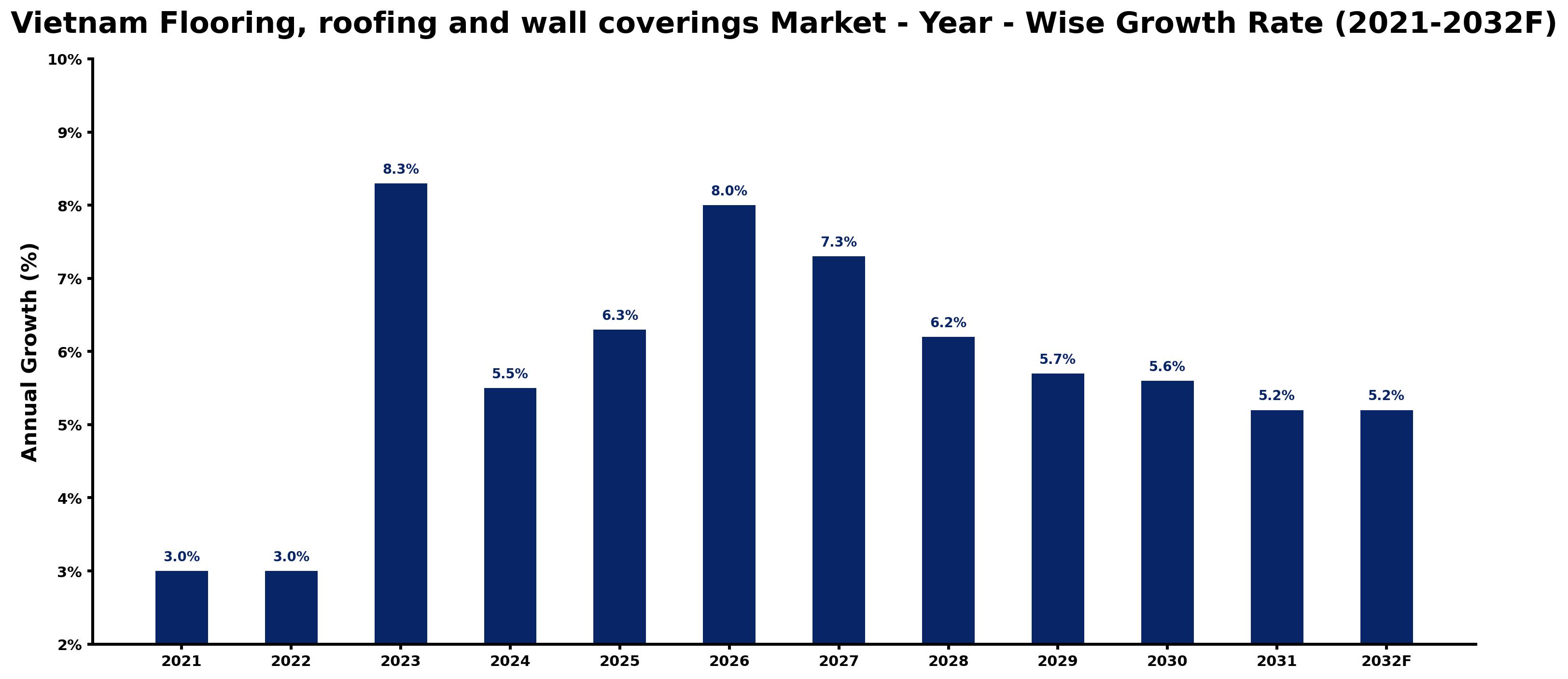
The table below presents the year wise growth rates along with the key drivers influencing the market
| Year | Growth Rate | Major Drivers |
| 2021 | 3.0% | Post-lockdown retail projects spark increased interest in sustainable building materials. |
| 2022 | 3.0% | Manufacturing relocation trends elevate local production capabilities for flooring and wall coverings. |
| 2023 | 8.3% | Investments in infrastructure projects fuel demand for durable roofing solutions across urban areas. |
| 2024 | 5.5% | Emerging consumer preferences shift towards eco-friendly and innovative wall covering options. |
| 2025 | 6.3% | Rural power grid expansions necessitate robust materials for both residential and commercial buildings. |
| 2026 | 8.0% | Integration of smart home technology influences flooring design trends throughout urban centers. |
| 2027 | 7.3% | International partnerships enhance access to advanced materials, boosting product offerings significantly. |
| 2028 | 6.2% | An increase in disposable income leads to higher spending on premium home upgrades. |
| 2029 | 5.7% | Local artisans gain popularity, promoting unique and culturally relevant wall coverings. |
| 2030 | 5.6% | E-commerce platforms provide greater accessibility to diverse flooring and roofing products. |
| 2031 | 5.2% | Sustainable architecture trends drive innovation in materials, emphasizing energy efficiency. |
| 2032 | 5.2% | Competitive pricing strategies emerge as manufacturers respond to shifting market expectations. |
Note - Market size estimations and growth projections presented in this report are based on 6Wresearch's advanced forecasting approach, validated with industry datasets as of June 2026.
Vietnam Flooring, roofing and wall coverings Market Synopsis
The Vietnam Flooring, roofing and wall coverings Market is projected to reach 8.0% and witness significant growth during the forecast period (2026-2032). This dynamic market encompasses a wide array of products utilized for both interior and exterior applications in various types of buildings, including residential, commercial, and industrial sectors. Key products within this market include flooring materials such as tiles, wood, and vinyl, roofing materials consisting of tiles and metal sheets, and wall coverings like paint, wallpaper, and decorative panels. These components are essential for enhancing the aesthetic appeal and functional efficiency of properties.
Vietnam Flooring, roofing and wall coverings Market Growth Drivers
The growth of the Vietnam flooring, roofing and wall coverings market is significantly propelled by several interrelated factors. Urbanization in Vietnam is proceeding at an unprecedented rate, leading to an escalating demand for housing and infrastructure development. Ongoing government infrastructure projects create a conducive environment for growth, as they require high-quality materials for construction and finishing. The thriving real estate sector, encompassing both residential and commercial properties, translates to increased demand for materials.
- Improved disposable income among Vietnamese consumers results in a willingness to invest in premium flooring and wall covering options that enhance living and working environments.
- The influence of contemporary interior design trends drives preferences for aesthetically pleasing and functional materials, reinforcing demand.
- Homeowners increasingly prioritize quality over cost, influenced by a growing awareness of sustainable and eco-friendly building materials.
- The rise of the renovation market also stimulates demand for flooring and wall coverings, as properties are upgraded to meet modern standards.
- Innovations in product offerings, including multifunctional and customizable options, are expanding consumer choices and spurring market interest.
Vietnam Flooring, roofing and wall coverings Market Challenges and Restraints
Despite the robust growth prospects, the Vietnam flooring, roofing and wall coverings market faces notable challenges. One significant challenge is the increasing consumer demand for sustainable and eco-friendly materials, which traditional products may struggle to meet. This shift necessitates adaptation and innovation from manufacturers to align with evolving consumer values. Additionally, domestic producers encounter fierce competition from imported products that often offer competitive pricing.
- The Vietnamese market is highly price-sensitive, causing many consumers to prioritize affordability over quality in their choices of materials.
- Supply chain disruptions from global events, including the pandemic, have highlighted vulnerabilities that can affect product availability and costs.
- There exists a lack of awareness among consumers about the benefits of investing in high-quality flooring and wall coverings, impacting decision-making.
- Economic fluctuations can lead to variability in construction activities, directly affecting the demand for relevant materials.
- Regulatory complexities pertaining to construction standards may pose an impediment for manufacturers aiming to enter the market with new products.
Vietnam Flooring, roofing and wall coverings Market COVID-19 Impact
The COVID-19 pandemic has had pronounced implications for the Vietnam flooring, roofing and wall coverings market. During periods of lockdown, construction activities and real estate projects faced significant interruptions, resulting in diminished demand for essential materials. Furthermore, the pandemic exacerbated supply chain challenges, creating logistical hurdles that impacted product distribution.
- However, the pandemic also catalyzed an increase in home improvement initiatives as consumers redirected their focus to interior renovations and upgrades.
- Heightened awareness of the importance of home environments led to greater interest in quality flooring and wall coverings.
- The shift towards remote work fostered a surge in investments aimed at enhancing living spaces, positively influencing material demand.
- As market recovery unfolds, companies are expected to adapt their strategies to navigate the new consumer landscape shaped by the pandemic.
- Long-term impacts may include a permanent shift in consumer preferences towards durability and sustainability in flooring and wall covering materials.
Vietnam Flooring, roofing and wall coverings Market Government Investment and Initiatives
The Vietnamese government has implemented various initiatives and policies aimed at bolstering the flooring, roofing and wall coverings market. These initiatives are crucial as they facilitate overall industry development through infrastructure investment and urban planning. The government's focus on upgrading public infrastructure has led to increased funding and public spending in construction, ultimately benefitting manufacturers and suppliers in the market.
- Public spending on housing projects and urban infrastructure is projected to spur demand for flooring and wall covering materials.
- Government incentives for environmentally sustainable construction practices encourage the adoption of innovative and eco-friendly materials.
- Policies aimed at attracting foreign investment in construction and interior design sectors promise to enhance market competitiveness.
- Economic development plans emphasize the need for modern and resilient infrastructure, directly impacting the use of quality materials.
- Collaboration between government entities and private sector stakeholders fosters growth and streamlines procedures within the market.
Vietnam Flooring, roofing and wall coverings Market Latest Developments (May 2025 - June 2026)
Recent developments in the Vietnam flooring, roofing and wall coverings market from May 2025 to June 2026 demonstrate a significant shift towards innovation and sustainability. Manufacturers are increasingly focusing on eco-friendly materials to meet rising consumer demand for sustainable options. In this period, there is also a heightened emphasis on technology integration in manufacturing processes, leading to improved efficiency and product quality.
- Trade policies are evolving to facilitate smoother importation of sustainable materials, enhancing the competitive landscape for domestic producers.
- Improved marketing strategies are being employed by companies to educate consumers about the benefits of investing in high-quality materials.
- There is a noticeable expansion in the variety of product offerings, catering to diverse consumer preferences and ensuring broader market appeal.
- Collaborations between local manufacturers and international firms are becoming more prevalent as companies seek to leverage each other's strengths.
- Government initiatives to promote construction safety standards are likely to encourage investments in durable flooring and wall covering solutions.
Vietnam Flooring, roofing and wall coverings Market - Key Attractiveness of the Report
- 10 Years of Market Numbers
- Historical Data Starting from 2022 to 2025
- Base Year: 2025
- Forecast Data until 2032
- Key Performance Indicators Impacting the Market
- Major Upcoming Developments and Projects
Key Highlights of the Report:
- Vietnam Flooring, roofing and wall coverings Market Outlook
- Market Size of Vietnam Flooring, roofing and wall coverings Market, 2025
- Forecast of Vietnam Flooring, roofing and wall coverings Market, 2032
- Historical Data and Forecast of Vietnam Flooring, roofing and wall coverings Revenues & Volume for the Period 2022-2032F
- Vietnam Flooring, roofing and wall coverings Market Trend Evolution
- Vietnam Flooring, roofing and wall coverings Market Drivers and Challenges
- Vietnam Flooring, roofing and wall coverings Price Trends
- Vietnam Flooring, roofing and wall coverings Porter's Five Forces
- Vietnam Flooring, roofing and wall coverings Industry Life Cycle
- Historical Data and Forecast of Vietnam Flooring, roofing and wall coverings Market Revenues & Volume By Types for the Period 2022-2032F
- Historical Data and Forecast of Vietnam Flooring, roofing and wall coverings Market Revenues & Volume By Floor Covering for the Period 2022-2032F
- Historical Data and Forecast of Vietnam Flooring, roofing and wall coverings Market Revenues & Volume By Roof Covering for the Period 2022-2032F
- Historical Data and Forecast of Vietnam Flooring, roofing and wall coverings Market Revenues & Volume By Wall Covering for the Period 2022-2032F
- Historical Data and Forecast of Vietnam Flooring, roofing and wall coverings Market Revenues & Volume By Distribution Channel for the Period 2022-2032F
- Historical Data and Forecast of Vietnam Flooring, roofing and wall coverings Market Revenues & Volume By Contractors for the Period 2022-2032F
- Historical Data and Forecast of Vietnam Flooring, roofing and wall coverings Market Revenues & Volume By Specialty Stores for the Period 2022-2032F
- Historical Data and Forecast of Vietnam Flooring, roofing and wall coverings Market Revenues & Volume By Home Centers for the Period 2022-2032F
- Historical Data and Forecast of Vietnam Flooring, roofing and wall coverings Market Revenues & Volume By Others for the Period 2022-2032F
- Historical Data and Forecast of Vietnam Flooring, roofing and wall coverings Market Revenues & Volume By End-Users for the Period 2022-2032F
- Historical Data and Forecast of Vietnam Flooring, roofing and wall coverings Market Revenues & Volume By Residential Replacement for the Period 2022-2032F
- Historical Data and Forecast of Vietnam Flooring, roofing and wall coverings Market Revenues & Volume By Commercial for the Period 2022-2032F
- Historical Data and Forecast of Vietnam Flooring, roofing and wall coverings Market Revenues & Volume By Builder for the Period 2022-2032F
- Vietnam Flooring, roofing and wall coverings Import Export Trade Statistics
- Market Opportunity Assessment By Types
- Market Opportunity Assessment By Distribution Channel
- Market Opportunity Assessment By End-Users
- Vietnam Flooring, roofing and wall coverings Top Companies Market Share
- Vietnam Flooring, roofing and wall coverings Competitive Benchmarking By Technical and Operational Parameters
- Vietnam Flooring, roofing and wall coverings Company Profiles
- Vietnam Flooring, roofing and wall coverings Key Strategic Recommendations






































