Vietnam Glass Fibre Reinforced Plastic Market Size, Share & Growth Rate
The Vietnam Glass Fibre Reinforced Plastic Market was estimated at USD 1173 Million in 2025 and is projected to reach USD 1664 Million by 2032, growing at a CAGR of 5.1% from 2026 to 2032. This growth trajectory is driven by an accelerating infrastructure development and an increasing demand for lightweight, durable materials across various sectors, especially construction and automotive. The ongoing trend toward sustainability and regulatory support also contribute significantly to this upward momentum.
Vietnam Glass Fibre Reinforced Plastic Market Year-wise Growth Rate and Key Drivers
This graph highlights how the Vietnam Glass Fibre Reinforced Plastic Market has steadily grown over the years, supported by major growth factors.
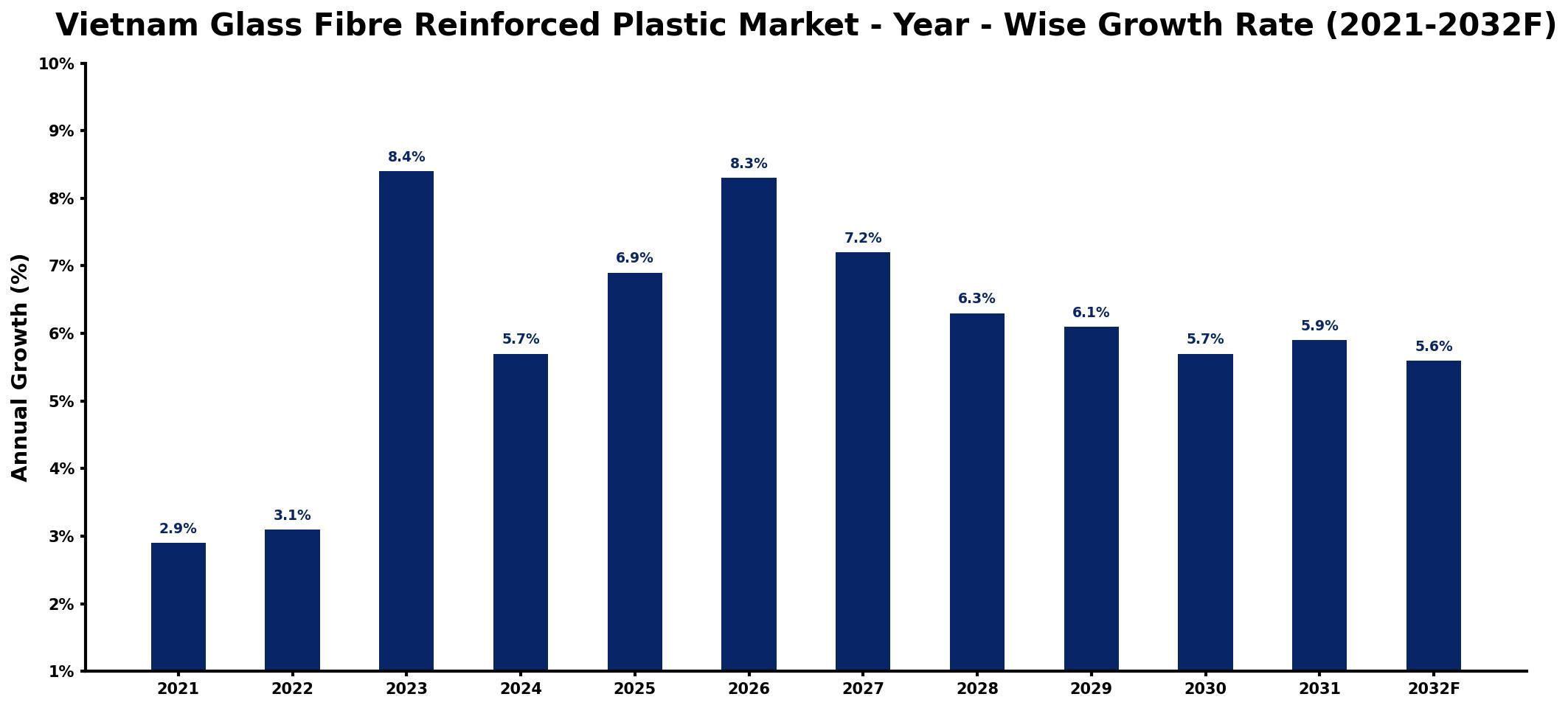
The table below presents the year‑wise growth rates along with the key drivers influencing the market
| Year | Growth Rate | Major Drivers |
| 2021 | 2.9% | Rising construction sector demand |
| 2022 | 3.1% | Increased automotive industry investments |
| 2023 | 8.4% | Growing renewable energy projects |
| 2024 | 5.7% | Expansion in infrastructure development |
| 2025 | 6.9% | Surge in marine applications |
| 2026 | 8.3% | Boost from aerospace sector growth |
| 2027 | 7.2% | Higher demand from consumer goods |
| 2028 | 6.3% | Increased focus on sustainability efforts |
| 2029 | 6.1% | Growth in telecommunications infrastructure |
| 2030 | 5.7% | Expansion of healthcare applications |
| 2031 | 5.9% | Rising demand for lightweight materials |
| 2032 | 5.6% | Increased adoption in electronics industry |
Note: Market size estimations and growth projections presented in this report are based on 6Wresearch's proprietary forecasting methodology, utilizing the latest available industry data, government publications, and primary research inputs.
Vietnam Glass Fibre Reinforced Plastic Market Synopsis
The Vietnam glass fibre reinforced plastic (GRP) market is currently gaining significant traction as industries turn towards advanced materials to meet rising performance expectations. With its unique combination of strength, durability, and resistance to harsh environmental conditions, GRP is increasingly being integrated into a wide array of applications from construction materials to automotive components.
Moreover, the growing realization of the benefits of lightweight materials has further pushed the adoption of GRP in various sectors, including marine and aerospace. Manufacturers are focusing on quality, customization, and adherence to strict industry standards to cater to the diverse requirements of their customers, ultimately driving market growth.
Vietnam Glass Fibre Reinforced Plastic Market Key Takeaways
- The market is projected to exhibit robust growth driven by infrastructure development and demand for lightweight materials.
- GRP's excellent corrosion resistance makes it a preferred choice in construction and automotive sectors.
- Government initiatives promoting sustainability are catalyzing the shift toward composite materials.
- Competition from alternative materials and consumer awareness are pivotal challenges for market expansion.
- COVID-19 highlighted GRP's versatility, opening new applications in healthcare and alternative energy sectors.
Evaluation of Restraints in Vietnam Glass Fibre Reinforced Plastic Market
Despite its many advantages, the Vietnam glass fibre reinforced plastic market faces significant restraints that could hinder its potential growth. Quality control remains a critical issue; the precision needed in GRP manufacturing processes is high, making it challenging for producers to consistently meet the required standards. Furthermore, the market is heavily reliant on the construction sector's health, making it vulnerable to economic downturns. As environmental regulations become increasingly stringent, manufacturers may need to invest heavily in sustainable practices and materials. Additionally, the low level of consumer awareness regarding the advantages of GRP over traditional materials poses a barrier to wider adoption.
Vietnam Glass Fibre Reinforced Plastic Market Trends
Current trends in the Vietnam GRP market indicate a marked shift towards sustainability and innovation. There is a growing preference for eco-friendly materials, prompting manufacturers to explore greener production methods. Technological advancements are also playing a critical role in enhancing product performance, leading to the development of customized solutions tailored for specific applications. Furthermore, the integration of GRP in the renewable energy sector, particularly in wind energy applications, illustrates its expanding relevance in emerging markets.
Vietnam Glass Fibre Reinforced Plastic Market Opportunities
The Vietnam glass fibre reinforced plastic market presents considerable growth and investment opportunities. The ongoing infrastructure boom necessitates innovative building materials, making GRP a viable option for modern construction. The automotive sector, transitioning towards lightweight and fuel-efficient vehicles, is also increasingly adopting GRP components. Additionally, the marine industry is poised to benefit from GRP's inherent corrosion resistance and lightweight properties. As demand for sustainable materials continues to rise, there is a unique opportunity for manufacturers to capitalize on this trend by developing eco-friendly GRP solutions.
Government Initiatives in the Vietnam Glass Fibre Reinforced Plastic Market
The Vietnamese government is actively promoting the use of composite materials, including glass fibre reinforced plastics, through various initiatives aimed at enhancing sustainability in construction and manufacturing. Public spending on infrastructure projects is increasing, supported by policies that encourage the adoption of innovative materials. Additionally, regulations that incentivize the use of environmentally friendly products are paving the way for GRP's growth in the market. These initiatives underscore the governments commitment to fostering a more sustainable industrial environment.
Future Insights of the Vietnam Glass Fibre Reinforced Plastic Market
Looking ahead to 2026-2032, the Vietnam glass fibre reinforced plastic market is expected to continue its upward trajectory fueled by ongoing infrastructure projects and technological advancements in materials science. The shift towards lightweight materials in automotive and construction sectors will likely drive innovation in GRP applications. Furthermore, as consumer awareness of GRP's benefits grows, coupled with increasing regulatory support for sustainable materials, the market is poised for significant expansion, solidifying its position as a key player in Vietnam's industrial landscape.
Vietnam Glass Fibre Reinforced Plastic Market Latest Developments (2025 - 2026)
In the recent months, the Vietnam glass fibre reinforced plastic market has seen a surge in research and development activities focusing on enhanced product performance and sustainability. Industry players are increasingly collaborating on innovative projects aimed at improving GRP formulations. There is also a growing emphasis on expanding production capabilities to meet rising demand across sectors, particularly in construction and automotive applications. As manufacturers adapt to evolving market conditions, the emphasis on quality assurance and compliance with international standards has become paramount.
Vietnam Glass Fibre Reinforced Plastic Market - Key Attractiveness of the Report
- 10 Years of Market Numbers
- Historical Data Starting from 2022 to 2025
- Base Year: 2025
- Forecast Data until 2032
- Key Performance Indicators Impacting the Market
- Major Upcoming Developments and Projects
Key Highlights of the Report:
- Vietnam Glass Fibre Reinforced Plastic Market Outlook
- Market Size of Vietnam Glass Fibre Reinforced Plastic Market, 2025
- Forecast of Vietnam Glass Fibre Reinforced Plastic Market, 2032
- Historical Data and Forecast of Vietnam Glass Fibre Reinforced Plastic Revenues & Volume for the Period 2022-2032F
- Vietnam Glass Fibre Reinforced Plastic Market Trend Evolution
- Vietnam Glass Fibre Reinforced Plastic Market Drivers and Challenges
- Vietnam Glass Fibre Reinforced Plastic Price Trends
- Vietnam Glass Fibre Reinforced Plastic Porter's Five Forces
- Vietnam Glass Fibre Reinforced Plastic Industry Life Cycle
- Historical Data and Forecast of Vietnam Glass Fibre Reinforced Plastic Market Revenues & Volume By Type for the Period 2022-2032F
- Historical Data and Forecast of Vietnam Glass Fibre Reinforced Plastic Market Revenues & Volume By Polyester for the Period 2022-2032F
- Historical Data and Forecast of Vietnam Glass Fibre Reinforced Plastic Market Revenues & Volume By Vinyl Ester for the Period 2022-2032F
- Historical Data and Forecast of Vietnam Glass Fibre Reinforced Plastic Market Revenues & Volume By Epoxy for the Period 2022-2032F
- Historical Data and Forecast of Vietnam Glass Fibre Reinforced Plastic Market Revenues & Volume By Polyurethane for the Period 2022-2032F
- Historical Data and Forecast of Vietnam Glass Fibre Reinforced Plastic Market Revenues & Volume By Peek Resin for the Period 2022-2032F
- Historical Data and Forecast of Vietnam Glass Fibre Reinforced Plastic Market Revenues & Volume By Others for the Period 2022-2032F
- Historical Data and Forecast of Vietnam Glass Fibre Reinforced Plastic Market Revenues & Volume By Application for the Period 2022-2032F
- Historical Data and Forecast of Vietnam Glass Fibre Reinforced Plastic Market Revenues & Volume By Wind Energy for the Period 2022-2032F
- Historical Data and Forecast of Vietnam Glass Fibre Reinforced Plastic Market Revenues & Volume By Transportation for the Period 2022-2032F
- Historical Data and Forecast of Vietnam Glass Fibre Reinforced Plastic Market Revenues & Volume By Marine for the Period 2022-2032F
- Historical Data and Forecast of Vietnam Glass Fibre Reinforced Plastic Market Revenues & Volume By Pipe & Tanks for the Period 2022-2032F
- Historical Data and Forecast of Vietnam Glass Fibre Reinforced Plastic Market Revenues & Volume By Others for the Period 2022-2032F
- Vietnam Glass Fibre Reinforced Plastic Import Export Trade Statistics
- Market Opportunity Assessment By Type
- Market Opportunity Assessment By Application
- Vietnam Glass Fibre Reinforced Plastic Top Companies Market Share
- Vietnam Glass Fibre Reinforced Plastic Competitive Benchmarking By Technical and Operational Parameters
- Vietnam Glass Fibre Reinforced Plastic Company Profiles
- Vietnam Glass Fibre Reinforced Plastic Key Strategic Recommendations






































