Vietnam Higher Education Market Size & Growth Rate (2026-2032)
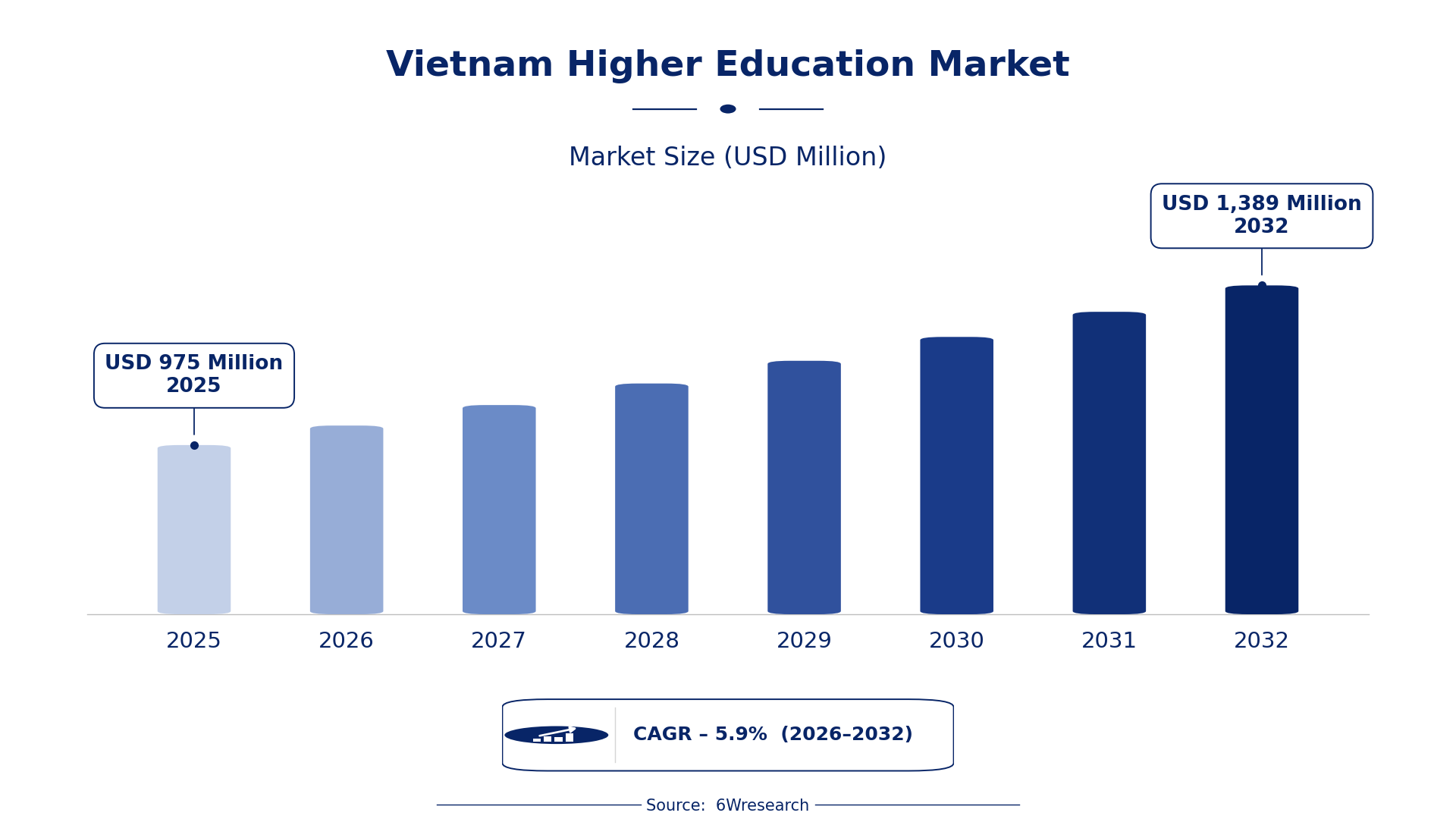
The Vietnam Higher Education Market was estimated at USD 975 Million in 2025 and is projected to reach USD 1389 Million by 2032, growing at a CAGR of 5.9% from 2026 to 2032.
Vietnam Higher Education Market Synopsis
The demand for higher education in Vietnam is surging, driven by a youthful population eager for quality learning experiences. This trend is prompting institutions to expand and modernize their offerings, resulting in a vibrant educational ecosystem.
Concurrently, the integration of digital technologies is transforming the educational experience. Online platforms and collaborative tools are becoming commonplace, making education more accessible and relevant to students' needs in a globalized world.
Vietnam Higher Education Market Year-wise Growth Rate and Key Drivers
This graph illustrates the annual growth rates of the Vietnam Higher Education Market from 2021 to 2032, highlighting a steady upward trajectory and projected expansion over the forecast period.
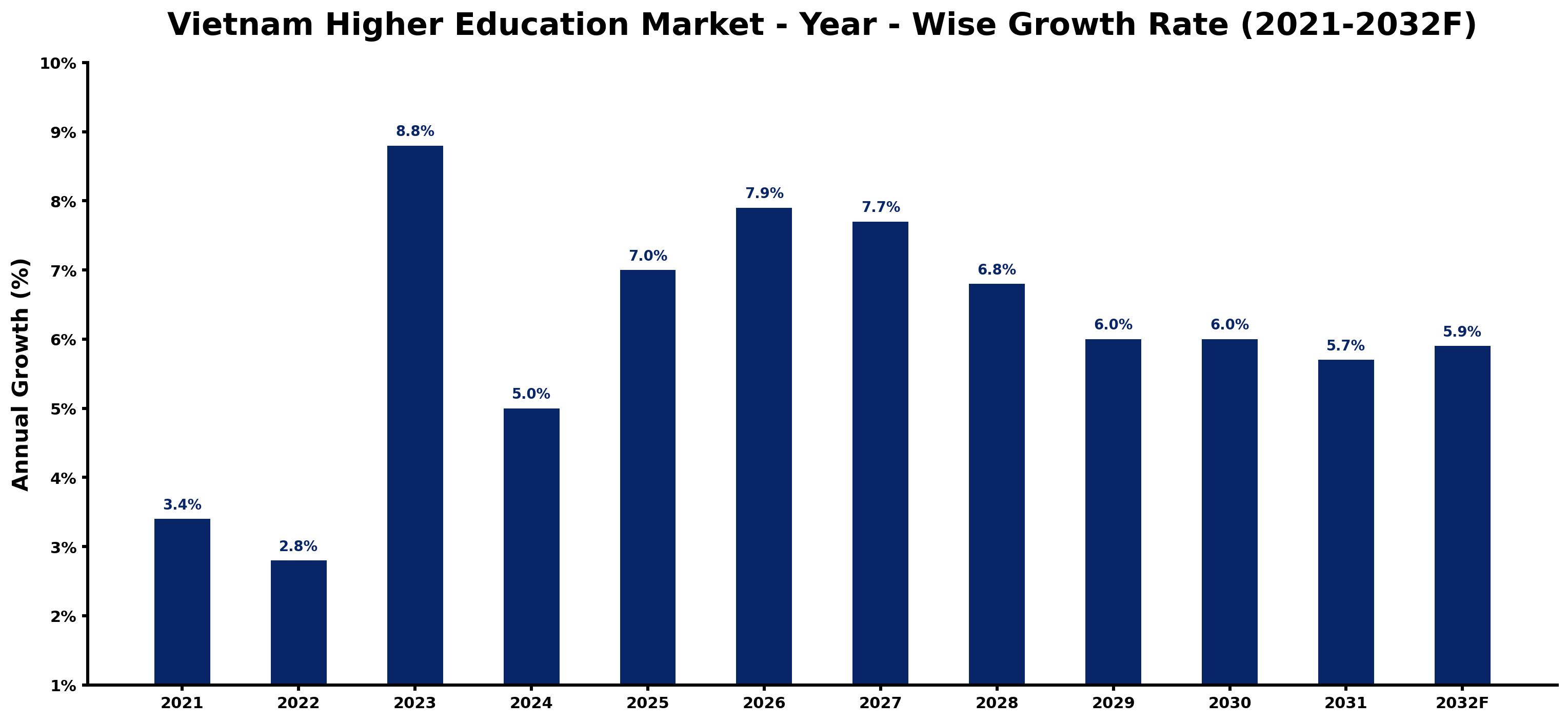
The table below presents the year‑wise growth rates along with the key drivers influencing the market
| Year | Growth Rate | Major Drivers |
| 2021 | 3.4% | Increased government funding for higher education initiatives. |
| 2022 | 2.8% | Rising local student enrollment in STEM programs. |
| 2023 | 8.8% | Launch of National Strategy for Digital Transformation 2025. |
| 2024 | 5.0% | Government incentives for private university establishment. |
| 2025 | 7.0% | Growing interest in international partnerships among universities. |
| 2026 | 7.9% | Increased scholarships for disadvantaged communities offered. |
| 2027 | 7.7% | Strengthened accreditation standards by Ministry of Education. |
| 2028 | 6.8% | Promotion of lifelong learning policies post-pandemic. |
| 2029 | 6.0% | Focus on entrepreneurship programs in higher education. |
| 2030 | 6.0% | Adoption of AI tools in educational administration. |
| 2031 | 5.7% | Development of research hubs supported by universities. |
| 2032 | 5.9% | Rise in online learning acceptance among students. |
Note: Market size estimations and growth projections presented in this report are based on 6Wresearch's proprietary forecasting methodology, utilizing the latest available industry data, government publications, and primary research inputs.
Vietnam Higher Education Market Key Takeaways
Below are some of the specific key takeaways from the market, including:
- The increasing youth population is driving enrollment growth across higher education institutions.
- Government initiatives are focused on enhancing educational quality and fostering research capabilities.
- Digital transformation has accelerated due to the COVID-19 pandemic, reshaping traditional learning models.
- Investment in educational infrastructure is critical to meeting the rising demand for tertiary education.
- Collaboration between local and international universities is on the rise, enriching the academic landscape.
Evaluation of Restraints in Vietnam Higher Education Market
Despite its growth, the Vietnam Higher Education Market faces substantial restraints. A critical issue is the disconnect between educational outcomes and labor market demands. Many graduates find their skills mismatched with industry needs, leading to high unemployment rates among young professionals. Capacity constraints are another pressing concern, as existing institutions struggle to accommodate the influx of students, resulting in overcrowded classrooms. on top of that, funding challenges hinder the ability of universities to invest in quality improvements and research initiatives, ultimately affecting the educational standards across the sector.
Vietnam Higher Education Market Trends
Several trends are shaping the Vietnam Higher Education Market. The growing popularity of online learning is changing how students engage with education, allowing for flexible learning environments. Universities are increasingly adopting blended learning models, combining traditional face-to-face instruction with online components. Another trend is the rise of interdisciplinary programs, which reflect the need for graduates to possess diverse skill sets. There is also a noticeable push towards internationalization, with institutions forming partnerships that enhance academic exchange and student mobility.
Vietnam Higher Education Market Opportunities
Investment opportunities abound in the Vietnam Higher Education Market. The demand for quality educational resources presents a ripe environment for private investors to establish new institutions or enhance existing ones. There's also a significant need for technology-driven solutions, such as learning management systems and digital content creation tools, which can improve educational delivery. The expansion of vocational training programs is another area where growth can be realized, catering to the skills gap in various industries.
Government Initiatives in the Vietnam Higher Education Market
The Vietnamese government is actively reshaping the higher education sector through targeted initiatives that prioritize quality and accessibility. Current public policies focus on improving educational standards, fostering research, and increasing international collaboration. As these initiatives unfold, they are expected to have a lasting impact on the market, driving both enrollment and educational excellence.
- A recent initiative launched in 2025 aims to enhance digital literacy across higher education institutions, providing resources and training for faculty and students.
- Currently underway is a nationwide accreditation process designed to ensure that institutions meet defined quality standards, which is expected to conclude by late 2026.
- Plans are in motion for a public-private partnership set to launch in 2027, aimed at developing new campuses in underserved regions.
- A regulatory framework introduced in 2025 mandates increased transparency in university funding and resource allocation.
- Ongoing efforts to integrate soft skills training into university curricula are expected to gain momentum in 2026.
Future Insights of the Vietnam Higher Education Market
Looking ahead to 2026-2032, the Vietnam Higher Education Market is set for continued growth driven by demographic shifts and educational reforms. The government's focus on elevating educational standards will likely yield a more competitive environment, enhancing both local and international student enrollment. As institutions adapt to technological advancements, we can expect a more dynamic educational landscape that better prepares graduates for the demands of a global economy.
Vietnam Higher Education Market Latest Developments
Over the past year, the Vietnam Higher Education Market has witnessed a flurry of activity aimed at enhancing educational quality and access. Institutions are increasingly focusing on digital transformation initiatives to meet the evolving expectations of students and employers alike.
- A major technology vendor announced a partnership with several universities to implement advanced learning management systems, enhancing the digital learning experience, with rollouts expected by mid-2026.
- In late 2025, a leading regional operator launched a new online degree program in partnership with international institutions, aimed at providing global exposure to local students.
- Ongoing discussions are taking place regarding the establishment of a national scholarship program aimed at increasing access for underprivileged students, which is expected to launch in 2027.
- Several institutions have begun upgrading their campus facilities to support hybrid learning environments, with projects that commenced in early 2025 and are slated for completion by late 2026.
Vietnam Higher Education Market - Key Attractiveness of the Report
- 10 Years of Market Numbers
- Historical Data Starting from 2022 to 2025
- Base Year: 2025
- Forecast Data until 2032
- Key Performance Indicators Impacting the Market
- Major Upcoming Developments and Projects
Key Highlights of the Report:
- Vietnam Higher Education Market Outlook
- Market Size of Vietnam Higher Education Market, 2025
- Forecast of Vietnam Higher Education Market, 2032
- Historical Data and Forecast of Vietnam Higher Education Revenues & Volume for the Period 2022-2032F
- Vietnam Higher Education Market Trend Evolution
- Vietnam Higher Education Market Drivers and Challenges
- Vietnam Higher Education Price Trends
- Vietnam Higher Education Porter's Five Forces
- Vietnam Higher Education Industry Life Cycle
- Historical Data and Forecast of Vietnam Higher Education Market Revenues & Volume By Component for the Period 2022-2032F
- Historical Data and Forecast of Vietnam Higher Education Market Revenues & Volume By Solutions for the Period 2022-2032F
- Historical Data and Forecast of Vietnam Higher Education Market Revenues & Volume By Services for the Period 2022-2032F
- Historical Data and Forecast of Vietnam Higher Education Market Revenues & Volume By Deployment Type for the Period 2022-2032F
- Historical Data and Forecast of Vietnam Higher Education Market Revenues & Volume By On-premises for the Period 2022-2032F
- Historical Data and Forecast of Vietnam Higher Education Market Revenues & Volume By Cloud for the Period 2022-2032F
- Historical Data and Forecast of Vietnam Higher Education Market Revenues & Volume By Vertical for the Period 2022-2032F
- Historical Data and Forecast of Vietnam Higher Education Market Revenues & Volume By State Universities for the Period 2022-2032F
- Historical Data and Forecast of Vietnam Higher Education Market Revenues & Volume By Community Colleges for the Period 2022-2032F
- Historical Data and Forecast of Vietnam Higher Education Market Revenues & Volume By Private Colleges for the Period 2022-2032F
- Vietnam Higher Education Import Export Trade Statistics
- Market Opportunity Assessment By Component
- Market Opportunity Assessment By Deployment Type
- Market Opportunity Assessment By Vertical
- Vietnam Higher Education Top Companies Market Share
- Vietnam Higher Education Competitive Benchmarking By Technical and Operational Parameters
- Vietnam Higher Education Company Profiles
- Vietnam Higher Education Key Strategic Recommendations






































