Vietnam Household furniture Market Summary
The vietnam household furniture market was estimated at USD 229 Million in 2025 and is projected to reach USD 322 Million by 2032, growing at a CAGR of 8.2% from 2026 to 2032.
Vietnam Household furniture Market Year-wise Growth Rate and Key Drivers
This graph highlights how the Vietnam Household furniture Market has steadily grown over the past five years, supported by major growth factors.
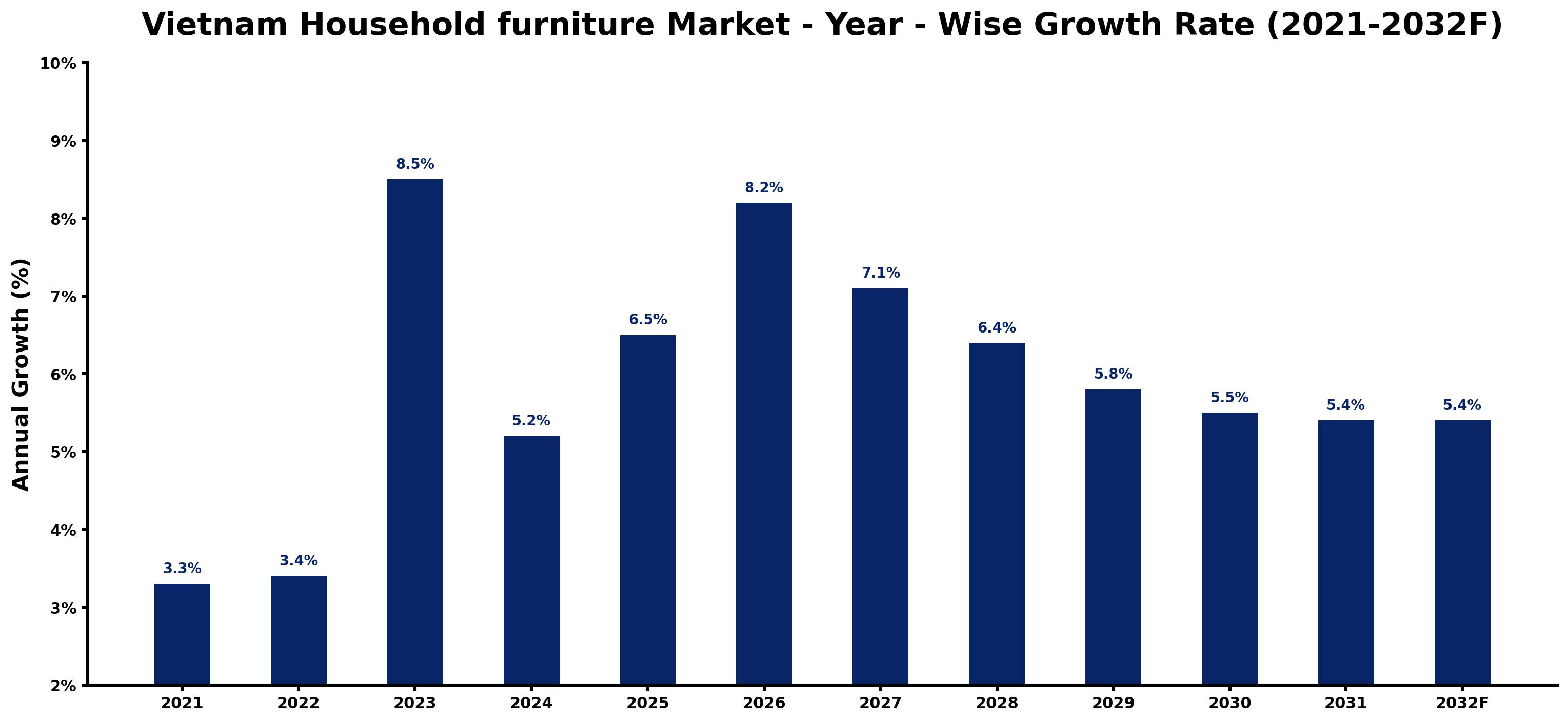
The table below presents the year wise growth rates along with the key drivers influencing the market
| Year | Growth Rate | Major Drivers |
| 2021 | 3.3% | Pandemic recovery stimulated an increased interest in home improvement projects across households. |
| 2022 | 3.4% | Urban migration trends led to higher demand for compact and multifunctional furniture solutions. |
| 2023 | 8.5% | Local production capabilities expanded, reducing costs and improving product availability in cities. |
| 2024 | 5.2% | Rising disposable incomes influenced consumer preferences towards premium and sustainable furniture options. |
| 2025 | 6.5% | E-commerce penetration increased, facilitating easier access to diverse furniture brands and styles. |
| 2026 | 8.2% | Cultural shifts towards personalized living spaces created a demand for custom furniture solutions. |
| 2027 | 7.1% | Young professionals entering the market emphasized trends in modern and minimalist design aesthetics. |
| 2028 | 6.4% | Smart home technology integration prompted innovation in furniture functionality and design frameworks. |
| 2029 | 5.8% | Sustainability practices among manufacturers aligned with consumer preferences for eco-friendly materials. |
| 2030 | 5.5% | Rural infrastructure development opened new avenues for furniture markets beyond urban centers. |
| 2031 | 5.4% | International brands established a foothold, enhancing competition and driving market diversification. |
| 2032 | 5.4% | Home office setups remained essential, sustaining long-term demand for ergonomic furniture solutions. |
Note - Market size estimations and growth projections presented in this report are based on 6Wresearch's advanced forecasting approach, validated with industry datasets as of June 2026.
Vietnam Household furniture Market Synopsis
The Vietnam Household furniture Market is projected to reach 8.2% and witness significant growth during the forecast period (2026-2032). This growth reflects the increasing urbanization, rising disposable incomes, and evolving consumer preferences that are reshaping the demand for household furniture in the country. With a burgeoning urban population and a strong inclination towards modern and functional designs, Vietnam's market for household furniture is positioned for dynamic expansion.
Vietnam Household furniture Market Growth Drivers
Several fundamental factors are driving the growth of the Vietnam Household furniture Market. Firstly, the rapid urbanization in major cities has triggered a surge in new residential developments, necessitating a higher demand for furniture to adequately furnish these homes. Secondly, the rising disposable incomes among Vietnamese consumers have created an environment where investments in quality furniture products are more prevalent. The aspirations of the younger demographic, which favors trendy and aesthetically appealing furniture, have further refined consumer preferences.
- The ongoing urbanization process has resulted in a greater number of individuals and families requiring modern furniture solutions to suit their lifestyle needs.
- A young and aspirational consumer base is pursuing furniture designs that not only meet functional requirements but also reflect personal style and design sensibilities.
- Increased accessibility to a wide range of affordable furniture options from both local artisans and international brands has played a pivotal role in the market's growth.
- Economic improvement across various sectors has allowed consumers to allocate more of their budgets towards home furnishing, thus driving demand.
- Changing lifestyle preferences, especially post-pandemic, have justifiably influenced the need for multi-functional furniture solutions, adapted for home office use and compact living spaces.
Vietnam Household furniture Market Challenges and Restraints
Despite the promising outlook, the Vietnam Household furniture Market is not without its challenges. Competing with low-cost imports has emerged as a notable concern, as these products often present a price advantage that can undermine domestic manufacturers. The labor market also poses difficulties, as there is a shortage of skilled labor capable of producing high-quality and intricately designed furniture, which hampers the competitiveness of home-grown companies. Additionally, fluctuations in raw material prices, influenced by both global supply chain dynamics and local market conditions, complicate cost management for furniture manufacturers.
- The influx of inexpensive furniture from international markets threatens local producers who may struggle to keep pricing competitive.
- A limited pool of skilled artisans and craftsmen affects the overall quality and uniqueness of domestically manufactured products.
- Economic pressures, arising from rising raw material costs, can lead to tighter margins and impact profitability in the industry.
- Currency exchange rate volatility can influence the pricing of imported materials and finished goods, posing additional hurdles for manufacturers.
- Changing consumer expectations regarding quality and sustainability can present challenges for manufacturers that need to adapt their business models rapidly.
Vietnam Household furniture Market Impact of COVID-19
The COVID-19 pandemic, which began to significantly impact Vietnam in 2025, introduced a series of challenges for the household furniture market. In the early stages, consumer spending on non-essential items, including furniture, saw a noticeable decline as households prioritized essential goods. The enforcement of movement restrictions and the temporary closure of retail outlets also adversely affected furniture sales. Nevertheless, as Vietnam navigated the pandemic and the economy gradually reopened, the household furniture market began to recover. With more individuals working and spending time at home, there was an increased demand for multifunctional and ergonomic furniture solutions tailored to the new normal of home living.
Vietnam Household furniture Market Government Investment and Initiatives
The Vietnamese government has recognized the importance of the household furniture market, initiating several policies aimed at fostering growth and sustainability. Public spending is being allocated towards urban infrastructure development, which indirectly benefits the furniture market through increased demand for residential furnishings. Additionally, industry bodies are being encouraged to enhance training programs that focus on improving the skills of craftsmen and furniture designers. The government also promotes the use of sustainable materials in furniture production, aligning with global standards of environmental responsibility. Investment incentives for local manufacturers are being introduced to strengthen the domestic supply chain and enhance competitiveness against imports.
Vietnam Household furniture Market Latest Developments (May 2025 - June 2026)
In the period spanning from May 2025 to June 2026, the Vietnam Household furniture Market saw a variety of developments that reflect the market's resilience and adaptability. Manufacturers have increasingly pivoted towards e-commerce platforms to reach consumers, enhancing their online presence as a response to changing shopping habits prompted by the pandemic. Additionally, there has been a noticeable trend toward customized furniture solutions, as consumers seek pieces that cater specifically to their individual aesthetic and functional needs. Collaborations between designers and manufacturers are becoming more frequent, focusing on unique designs that highlight local craftsmanship while also incorporating modern aesthetics.
Vietnam Household furniture Market - Key Attractiveness of the Report
- 10 Years of Market Numbers
- Historical Data Starting from 2022 to 2025
- Base Year: 2025
- Forecast Data until 2032
- Key Performance Indicators Impacting the Market
- Major Upcoming Developments and Projects
Key Highlights of the Report:
- Vietnam Household furniture Market Outlook
- Market Size of Vietnam Household furniture Market, 2025
- Forecast of Vietnam Household furniture Market, 2032
- Historical Data and Forecast of Vietnam Household furniture Revenues & Volume for the Period 2022-2032F
- Vietnam Household furniture Market Trend Evolution
- Vietnam Household furniture Market Drivers and Challenges
- Vietnam Household furniture Price Trends
- Vietnam Household furniture Porter's Five Forces
- Vietnam Household furniture Industry Life Cycle
- Historical Data and Forecast of Vietnam Household furniture Market Revenues & Volume By Types for the Period 2022-2032F
- Historical Data and Forecast of Vietnam Household furniture Market Revenues & Volume By Wood Furniture for the Period 2022-2032F
- Historical Data and Forecast of Vietnam Household furniture Market Revenues & Volume By Metal Furniture for the Period 2022-2032F
- Historical Data and Forecast of Vietnam Household furniture Market Revenues & Volume By Plastic Furniture for the Period 2022-2032F
- Historical Data and Forecast of Vietnam Household furniture Market Revenues & Volume By Others for the Period 2022-2032F
- Historical Data and Forecast of Vietnam Household furniture Market Revenues & Volume By Area of Use for the Period 2022-2032F
- Historical Data and Forecast of Vietnam Household furniture Market Revenues & Volume By ?Bedroom Furniture for the Period 2022-2032F
- Historical Data and Forecast of Vietnam Household furniture Market Revenues & Volume By Living Room Furniture for the Period 2022-2032F
- Historical Data and Forecast of Vietnam Household furniture Market Revenues & Volume By Dining Room Furniture for the Period 2022-2032F
- Historical Data and Forecast of Vietnam Household furniture Market Revenues & Volume By Household Furniture for the Period 2022-2032F
- Historical Data and Forecast of Vietnam Household furniture Market Revenues & Volume By Others for the Period 2022-2032F
- Vietnam Household furniture Import Export Trade Statistics
- Market Opportunity Assessment By Types
- Market Opportunity Assessment By Area of Use
- Vietnam Household furniture Top Companies Market Share
- Vietnam Household furniture Competitive Benchmarking By Technical and Operational Parameters
- Vietnam Household furniture Company Profiles
- Vietnam Household furniture Key Strategic Recommendations






































