Vietnam Inorganic Chemicals Market Size, Share & Growth Rate
The Vietnam Inorganic Chemicals Market was estimated at USD 1099 Million in 2025 and is projected to reach USD 1564 Million by 2032, growing at a CAGR of 5.2% from 2026 to 2032. This growth is primarily fueled by the vibrant manufacturing sector, which increasingly relies on inorganic chemicals as essential raw materials. Additionally, the ongoing urbanization and infrastructure development within Vietnam are driving demand for construction materials and fertilizers, both of which utilize a wide array of inorganic chemicals.
Vietnam Inorganic Chemicals Market Year-wise Growth Rate and Key Drivers
This graph highlights how the Vietnam Inorganic Chemicals Market has steadily grown over the years, supported by major growth factors.
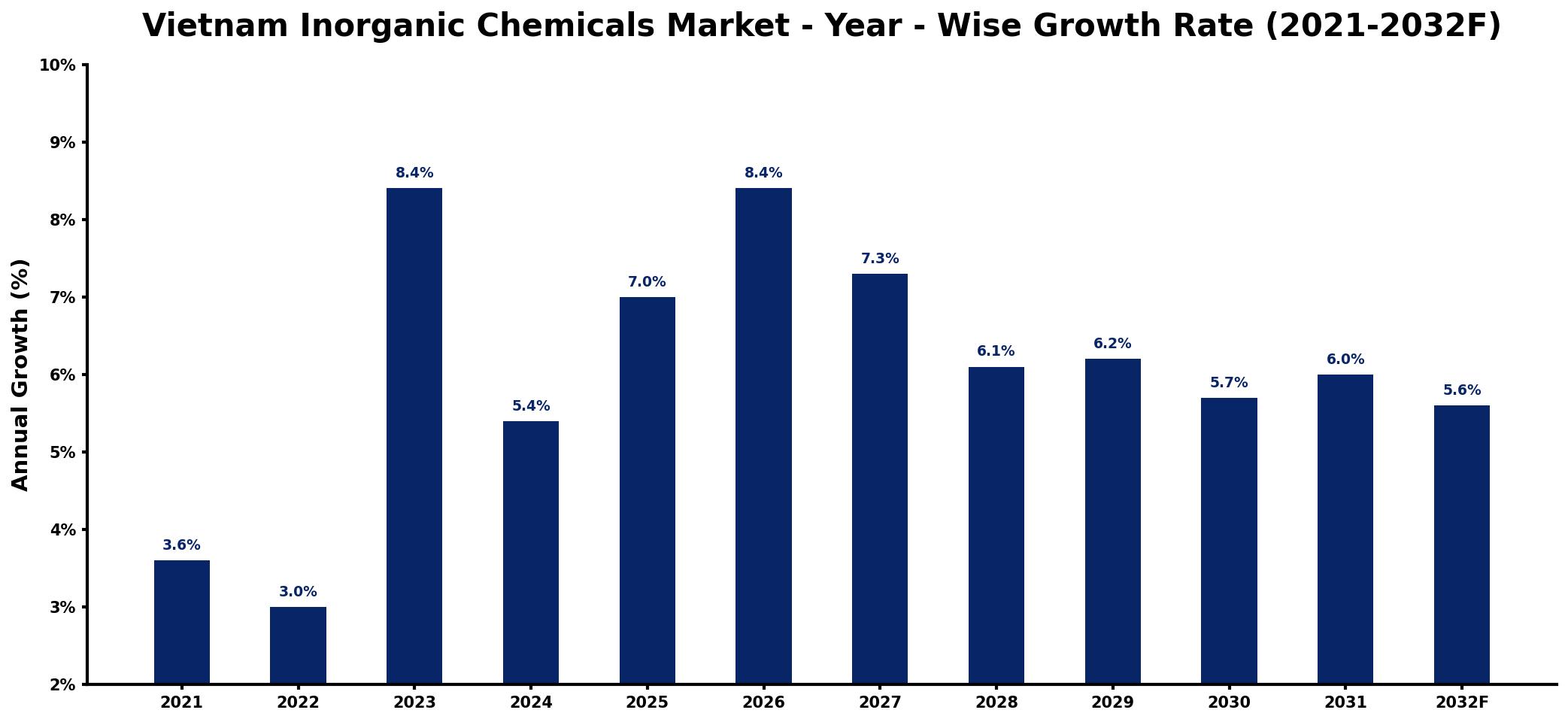
The table below presents the year‑wise growth rates along with the key drivers influencing the market
| Year | Growth Rate | Major Drivers |
| 2021 | 3.6% | Rising demand from construction sector |
| 2022 | 3.0% | Expansion of manufacturing facilities |
| 2023 | 8.4% | Increased investments in infrastructure |
| 2024 | 5.4% | Growth in agriculture sector needs |
| 2025 | 7.0% | Surge in energy production projects |
| 2026 | 8.4% | Technological advancements driving production |
| 2027 | 7.3% | Higher export opportunities emerging |
| 2028 | 6.1% | Growing urbanization and industrialization |
| 2029 | 6.2% | Demand from automotive industry rising |
| 2030 | 5.7% | Emerging renewable energy initiatives |
| 2031 | 6.0% | growing commercial sector adoption |
| 2032 | 5.6% | Increased focus on sustainability efforts |
Note: Market size estimations and growth projections presented in this report are based on 6Wresearch's proprietary forecasting methodology, utilizing the latest available industry data, government publications, and primary research inputs.
Vietnam Inorganic Chemicals Market Synopsis
The Vietnamese market for inorganic chemicals is witnessing a surge in demand, particularly from agriculture, where these chemicals play a crucial role in enhancing crop productivity. The robust construction sector further stimulates this demand, as materials such as cement and water treatment chemicals are integral to ongoing infrastructure projects.
As a result of Vietnam's strategic economic policies and commitment to industrial development, manufacturers are focusing on innovative practices and sustainable solutions. This evolution aligns with global trends, showcasing a market poised for growth and adaptation in response to environmental considerations and regulatory frameworks.
Vietnam Inorganic Chemicals Market Key Takeaways
- The market is expected to experience robust growth driven by increased demand across agriculture, construction, and manufacturing sectors.
- Sustainability initiatives are reshaping the landscape, prompting the development of eco-friendly inorganic chemical alternatives.
- The COVID-19 pandemic temporarily disrupted supply chains, but recovery is fostering new applications and market strategies.
- Government support for industrial expansion and environmental regulations is impacting market dynamics significantly.
- The growing trend towards urbanization in Vietnam is further amplifying the need for inorganic chemicals in various applications.
Evaluation of Restraints in Vietnam Inorganic Chemicals Market
Despite the promising growth trajectory, the Vietnam inorganic chemicals market is hindered by challenges surrounding environmental regulations and sustainability. Manufacturers are increasingly pressured to meet higher standards for eco-friendly production methods, which often require substantial investment in research and technology. This necessity for adaptation can strain resources, particularly for smaller players in the market. Additionally, navigating the complexities of compliance with evolving regulatory frameworks presents ongoing operational hurdles that can limit market agility.
Vietnam Inorganic Chemicals Market Trends
Current trends in the Vietnam inorganic chemicals market highlight a pronounced shift towards sustainability and green chemistry. As stakeholders prioritize eco-friendly solutions, there is a growing emphasis on the development of biodegradable and less toxic inorganic materials. Moreover, advancements in technology, such as automation and digitalization, are enhancing production efficiency and quality control. This progressive approach not only meets consumer expectations but also aligns with global sustainability goals, marking a significant evolution in the industry.
Vietnam Inorganic Chemicals Market Opportunities
As Vietnam continues to develop its industrial capacity, there are numerous opportunities for investment in the inorganic chemicals sector. The governments focus on enhancing agricultural productivity provides avenues for growth in fertilizers and crop protection chemicals. Furthermore, with urbanization on the rise, significant opportunities exist in the construction chemicals market, including materials required for infrastructure projects. Companies willing to innovate and invest in sustainable practices are likely to capture a growing share of this expanding market.
Government Initiatives in the Vietnam Inorganic Chemicals Market
The Vietnamese government is actively promoting policies aimed at boosting industrial development and environmental sustainability. Public investments in infrastructure projects are increasing, which directly benefits the inorganic chemicals sector, particularly in construction and agriculture. Additionally, initiatives focused on advancing technology and research in eco-friendly production methods signal strong support for the evolution of the market. Regulatory frameworks are also being established to guide sustainable practices, ensuring that the industry evolves in a responsible manner.
Future Insights of the Vietnam Inorganic Chemicals Market
Looking ahead to 2026-2032, the Vietnam inorganic chemicals market is expected to navigate a dynamic landscape marked by innovation and sustainability. The demand for inorganic chemicals will likely escalate as the economy continues to grow and urban infrastructure expands. Companies that proactively adapt to regulatory changes and consumer preferences for sustainable products will be best positioned for success. The convergence of industrial advancement with environmental responsibility will define the future of this market, potentially leading to new applications and diversified product lines.
Vietnam Inorganic Chemicals Market Latest Developments (2025 - 2026)
Recent developments in the Vietnam inorganic chemicals market include a notable increase in collaborations aimed at enhancing product sustainability. Companies are exploring partnerships with research institutions to innovate greener chemical processes. Additionally, there has been a marked increase in trade exhibitions focused on chemical manufacturing technology, showcasing advances in eco-friendly practices. The industry is also witnessing greater engagement from government bodies to facilitate the transition towards sustainable practices, which is fostering a cooperative environment for growth.
Vietnam Inorganic Chemicals Market - Key Attractiveness of the Report
- 10 Years of Market Numbers
- Historical Data Starting from 2022 to 2025
- Base Year: 2025
- Forecast Data until 2032
- Key Performance Indicators Impacting the Market
- Major Upcoming Developments and Projects
Key Highlights of the Report:
- Vietnam Inorganic Chemicals Market Outlook
- Market Size of Vietnam Inorganic Chemicals Market, 2025
- Forecast of Vietnam Inorganic Chemicals Market, 2032
- Historical Data and Forecast of Vietnam Inorganic Chemicals Revenues & Volume for the Period 2022-2032F
- Vietnam Inorganic Chemicals Market Trend Evolution
- Vietnam Inorganic Chemicals Market Drivers and Challenges
- Vietnam Inorganic Chemicals Price Trends
- Vietnam Inorganic Chemicals Porter's Five Forces
- Vietnam Inorganic Chemicals Industry Life Cycle
- Historical Data and Forecast of Vietnam Inorganic Chemicals Market Revenues & Volume By Type for the Period 2022-2032F
- Historical Data and Forecast of Vietnam Inorganic Chemicals Market Revenues & Volume By Ammonia for the Period 2022-2032F
- Historical Data and Forecast of Vietnam Inorganic Chemicals Market Revenues & Volume By Chlor alkali for the Period 2022-2032F
- Historical Data and Forecast of Vietnam Inorganic Chemicals Market Revenues & Volume By Ammonium nitrate for the Period 2022-2032F
- Historical Data and Forecast of Vietnam Inorganic Chemicals Market Revenues & Volume By Ammonium sulfate for the Period 2022-2032F
- Historical Data and Forecast of Vietnam Inorganic Chemicals Market Revenues & Volume By Inorganic acid for the Period 2022-2032F
- Historical Data and Forecast of Vietnam Inorganic Chemicals Market Revenues & Volume By Sodium hydroxide for the Period 2022-2032F
- Historical Data and Forecast of Vietnam Inorganic Chemicals Market Revenues & Volume By Hydrogen peroxide for the Period 2022-2032F
- Historical Data and Forecast of Vietnam Ammonia Inorganic Chemicals Market Revenues & Volume By Oxygen for the Period 2022-2032F
- Vietnam Inorganic Chemicals Import Export Trade Statistics
- Market Opportunity Assessment By Type
- Vietnam Inorganic Chemicals Top Companies Market Share
- Vietnam Inorganic Chemicals Competitive Benchmarking By Technical and Operational Parameters
- Vietnam Inorganic Chemicals Company Profiles
- Vietnam Inorganic Chemicals Key Strategic Recommendations






































